


Artificial Intelligence and Machine Learning Articles
Finance Manager to Data Analytics: Career Growth, Salary and Seniority
How to Evaluate LLM Outputs in Production Deployments
AI/ML Skills Gap 2026: Why Companies Can't Find Job-Ready Talent
20 AI/ML Interview Questions Recruiters Can Use Without a Tech Background - Best Guide


Get In Touch For Details! Request More Information

What is AI Ethics? Building Responsible AI Systems
Aug 19, 2026 5 Min Read 637 Views
(Last Updated)
Artificial Intelligence is transforming various industries faster than ever before. While these AI systems are now responsible for making human decisions that impact sectors like healthcare, finance, education, and cybersecurity, concerns arise over fairness, privacy, accountability, and transparency of these technologies that improve efficiency and drive innovation.
Herein lies the importance of AI ethics.
AI ethics enable businesses to build ethical AI systems that are aligned with human values and have minimal harmful impact. When ethical guidelines are not enforced, AI models may lack transparency or fairness or even become unsafe.
In this article, we will cover all aspects of what AI ethics is, its importance, core principles, major challenges, real-world applications, and best practices for building trustworthy AI.
Table of contents
- TL;DR
- Why AI Ethics Matters
- Mitigate Bias and Discrimination
- Ensure Trust
- Protect User Privacy
- Reduce Risks of Legal Non-Compliance
- Minimize Harm to Humans
- Core Principles of Ethical AI
- Fairness
- Transparency
- Accountability
- Privacy Protection
- Explainable AI
- Safety and Reliability
- Common Ethical Challenges in AI
- Bias
- Lack of Transparency
- Privacy Risks
- Deepfakes and Disinformation
- Job Displacement
- Real World Examples of AI Ethics Issues
- Facial Recognition Bias
- Biased Hiring Algorithms
- Social Media Recommendation Systems
- Responsible AI and AI Governance
- Explainable AI and Transparency
- AI Regulations Around the World
- European Union AI Act
- United States AI Policies
- India’s AI Initiatives
- Best Practices for Building Ethical AI Systems
- Use Diverse and High Quality Data
- Conduct Bias Audits
- Maintain Human Oversight
- Improve Transparency
- Prioritize Privacy
- Continuously Monitor AI Systems
- Future of AI Ethics
- Conclusion
- FAQs
- What is AI ethics?
- Why is fairness important in AI?
- What is explainable AI?
- What are the biggest ethical challenges in AI?
- What is responsible AI?
TL;DR
- AI ethics deals with principles and practices that guarantee AI systems are fair, transparent, responsible, and safe.
- Modern AI systems, if unregulated, can exhibit bias, security risks, and unjust decision-making patterns.
- Key areas for responsible AI are fairness, explainable AI, accountability, privacy, and trustworthy decision-making.
- Governments and companies are putting AI regulation and AI governance to control the risks of AI systems and enhance transparency.
- An understanding of AI ethics is vital for any developer, business, student, or AI professional beyond 2026.
What is AI Ethics?
AI ethics is the field that studies the moral principles, guidelines, and responsibilities involved in the design, development, deployment, and use of artificial intelligence systems. It focuses on ensuring that AI technologies operate fairly, transparently, safely, and responsibly while minimizing harm to individuals and society. AI ethics also emphasizes protecting user privacy, reducing bias, promoting accountability, and safeguarding human rights throughout the lifecycle of AI applications.
Why AI Ethics Matters
Most of today’s AI systems are expected to make decisions that impact human lives. These include, but are not limited to, hiring, loan approvals, health diagnosis, insurance premiums, criminal justice decisions, etc.
Biased data, when used for AI training, may create unfair outcomes, and it is difficult for human beings to even understand how the AI system reached its decision. AI ethics plays a major role in modern Artificial Intelligence systems used across industries
Mitigate Bias and Discrimination
AI models may unknowingly develop a biased pattern in accordance with training data. This may result in unfair hiring decisions, facial recognition, or loan application outcomes based on gender, race, or economic status.
Ensure Trust
Users are more likely to trust AI systems when the organizations clearly define the functioning and the logic behind decision-making.
Protect User Privacy
The majority of the AI applications use enormous amounts of personal data. Ethical AI helps in responsible data handling, minimizing the risk of misuse of customer data.
Reduce Risks of Legal Non-Compliance
Various governments across the world have already passed regulations or introduced new frameworks governing the use of AI. Adopting ethical AI practices helps organizations avoid penalties and sanctions.
Minimize Harm to Humans
Safety must be guaranteed for AI systems operating in various sectors, including healthcare, autonomous vehicles, and security, to eliminate harm.
Core Principles of Ethical AI
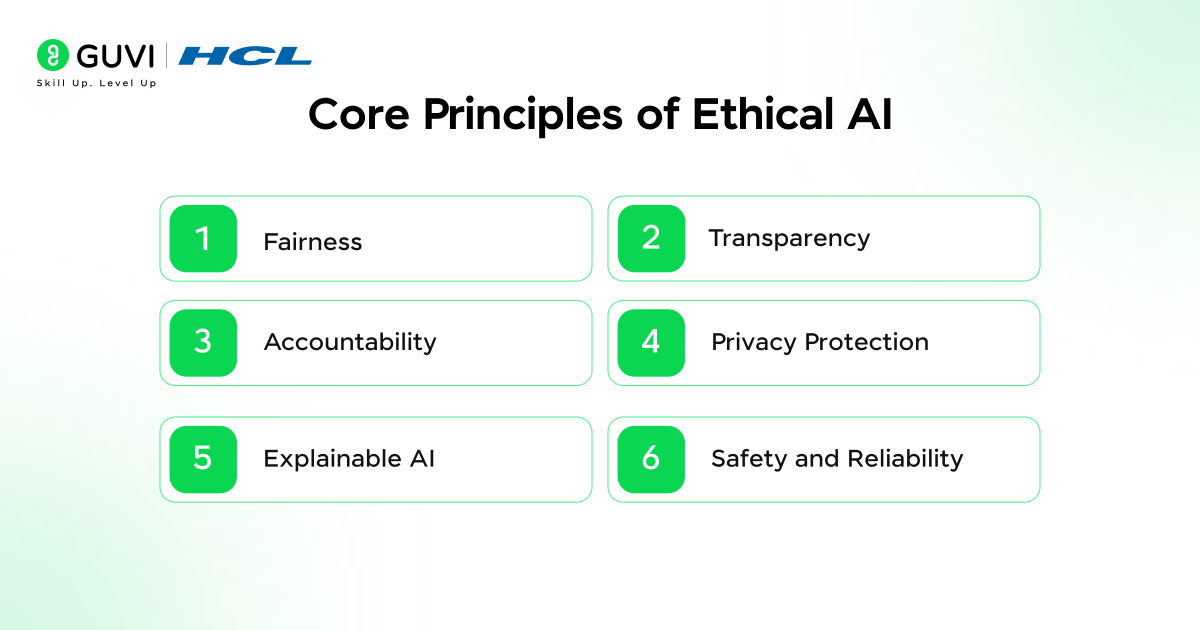
Responsible AI systems must uphold the following core principles:
Fairness
An AI system must treat all individuals equitably and must not produce biased outcomes. For example, an AI-based hiring tool must treat candidates solely based on their qualifications and skills and not based on gender, age, or other discriminating parameters. This helps reduce bias and ethical concerns in machine learning.
Transparency
Humans should be able to understand how AI systems work and how they make decisions. This enhances trust and removes confusion when automated decisions are made.
Accountability
The organization or developers using AI must be held responsible for its actions and consequences. If the AI system harms humans or creates biased outcomes, the stakeholders must be held liable for its rectification.
Privacy Protection
Sensitive user information collected during interaction with an AI system should be protected by adhering to robust data handling practices and laws. This also aims to protect against surveillance and leaks of personal data.
Explainable AI
Explainable AI models provide the human decision-making ability, in contrast to the “black box” nature of advanced AI. Instead of producing just a recommendation or a decision, it helps to trace the steps taken to arrive at the result. This improves transparency and supports responsible AI development.
Safety and Reliability
AI systems must reliably and securely operate even under diverse conditions. Rigorous testing and continuous monitoring are necessary for the models to avoid failure.
You can also check HCL GUVI’s free AI learning resources and ebooks to strengthen your understanding of responsible AI systems and emerging AI technologies.
Common Ethical Challenges in AI
While the use of AI is rapidly expanding, a few ethical challenges persist.
Bias
Perhaps one of the largest ethical issues in AI is bias in AI models. AI models are prone to reproducing the biases in the training data, resulting in discriminatory decisions and outcomes.
Lack of Transparency
The functioning of advanced AI models often seems opaque, and humans may not be able to discern how an AI model reaches a particular decision. This makes trust and accountability difficult.
Privacy Risks
The massive amount of data AI applications use poses a serious privacy risk. Organisations must implement strong data protection measures and laws to prevent the exploitation of sensitive information.
Deepfakes and Disinformation
With the ability of AI to generate synthetic media such as deepfakes, a major threat looms to information integrity and social safety.
Job Displacement
The automation capabilities of AI will make many repetitive jobs obsolete, creating the need for workforce re-skilling and societal adaptation.
mAs artificial intelligence becomes more deeply integrated into business operations, organizations worldwide are increasing their investments in AI ethics, governance, and responsible AI practices. Companies are focusing on improving transparency, reducing algorithmic bias, strengthening accountability, and ensuring compliance with emerging AI regulations and industry standards. This shift reflects a growing recognition that successful AI adoption depends not only on model performance but also on building systems that are trustworthy, explainable, and aligned with legal and ethical expectations.

Real World Examples of AI Ethics Issues
Several real-world incidents have highlighted the importance of ethical AI practices.
Facial Recognition Bias
Some facial recognition systems showed lower accuracy for women and people with darker skin tones because training datasets lacked diversity.
This raised concerns about fairness and discrimination in AI systems.
Biased Hiring Algorithms
Certain AI recruitment systems favored specific demographic groups due to biased historical hiring data.
Companies had to redesign these systems to reduce unfair outcomes.
Social Media Recommendation Systems
AI-powered recommendation engines sometimes promote harmful or misleading content because engagement metrics prioritize clicks and watch time.
This has increased discussions around AI accountability and platform responsibility.
Responsible AI and AI Governance
Responsible AI refers to building AI systems that align with ethical standards, human values, and regulatory requirements.
AI governance provides the policies, frameworks, and processes needed to manage AI responsibly within organizations.
Strong AI governance typically includes:
- Ethical AI guidelines
- Risk assessment processes
- Human oversight mechanisms
- Data governance policies
- AI auditing and monitoring
- Compliance with AI regulations
Large technology companies and governments are now investing heavily in AI governance frameworks to improve safety and accountability.
Explainable AI and Transparency
Many modern AI systems use deep learning models that can be difficult to interpret.
Explainable AI aims to solve this problem by making AI decisions easier to understand for users, developers, and regulators.
Explainable AI helps organizations:
- Improve user trust
- Detect bias and errors
- Support regulatory compliance
- Increase transparency in AI systems
- Enable better debugging and monitoring
For example, a healthcare AI model should explain why it recommended a particular diagnosis instead of simply providing an output.
AI Regulations Around the World
Governments are actively developing AI regulations to reduce risks and improve accountability.
Some important developments include:
European Union AI Act
The European Union introduced comprehensive AI regulations focused on risk classification, transparency, and safety requirements.
United States AI Policies
The United States is developing AI governance initiatives focused on responsible innovation, privacy, and national security.
India’s AI Initiatives
India is promoting ethical AI adoption through policy discussions, digital governance frameworks, and responsible AI development programs.
As AI adoption grows, regulatory frameworks will continue evolving globally.
Best Practices for Building Ethical AI Systems
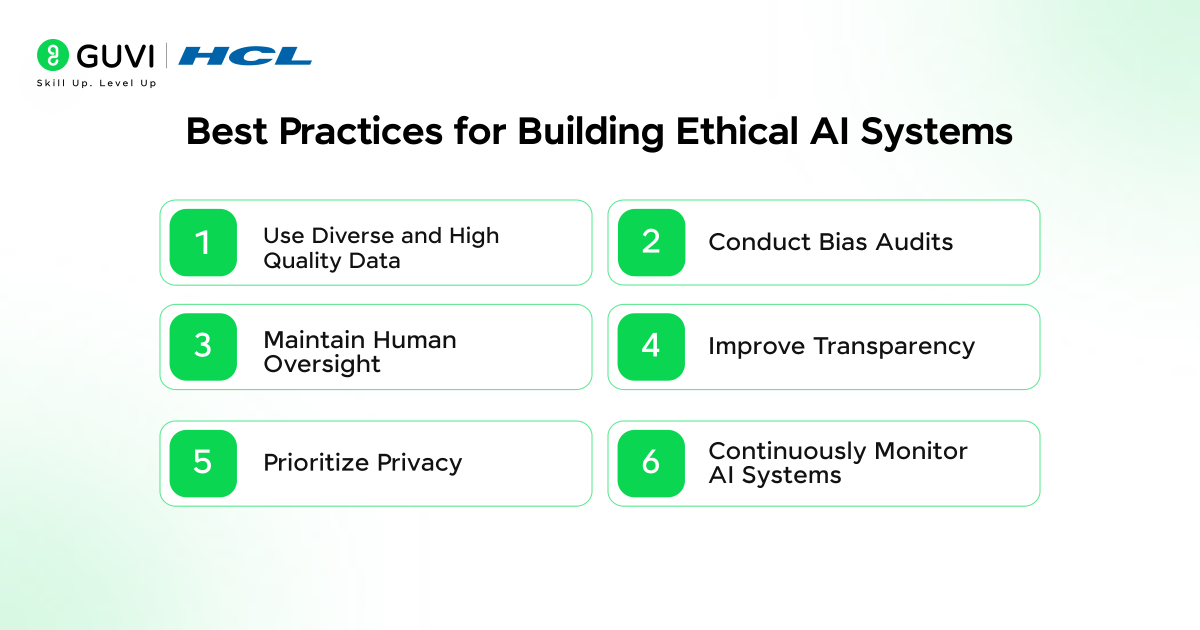
Organizations can follow several best practices to improve responsible AI development.
Use Diverse and High Quality Data
Balanced datasets help reduce bias and improve fairness in AI systems.
Conduct Bias Audits
Regular testing helps identify discriminatory patterns or unfair outcomes.
Maintain Human Oversight
Human involvement remains essential for reviewing sensitive or high-impact AI decisions.
Improve Transparency
Organizations should clearly explain how AI systems work and how data is used.
Prioritize Privacy
Strong security measures and ethical data collection practices help protect user information.
Continuously Monitor AI Systems
AI models should be monitored regularly to detect drift, errors, or unintended behavior over time.
Ethical practices are becoming important across real-world machine learning applications.
If you want to build real-world AI applications and understand concepts like ethical AI, machine learning, NLP, and deep learning, explore HCL GUVI’s industry-focused AI and Machine Learning programs designed for beginners and professionals.
Future of AI Ethics
AI ethics will become even more important as AI systems grow more powerful and autonomous.
Future trends in ethical AI may include:
• Stronger AI regulations worldwide
• Advanced explainable AI techniques
• Better bias detection systems
• Human-centered AI design approaches
• Improved AI governance standards
• Increased focus on trustworthy AI development
Organizations that prioritize ethical AI today will likely build stronger trust, better compliance, and more sustainable innovation in the future.
Conclusion
AI ethics plays a critical role in ensuring artificial intelligence systems remain fair, transparent, accountable, and trustworthy.
As AI continues influencing business operations and everyday life, organizations must focus on responsible AI practices to reduce risks and protect users. Ethical AI is no longer optional. It is becoming a core requirement for building sustainable and reliable AI systems.
Understanding AI ethics helps developers, businesses, and students create technologies that not only perform efficiently but also align with human values and societal expectations.
FAQs
1. What is AI ethics?
AI ethics refers to the principles and guidelines used to ensure AI systems operate fairly, transparently, responsibly, and safely.
2. Why is fairness important in AI?
Fairness helps prevent discrimination and ensures AI systems treat individuals equally without biased outcomes.
3. What is explainable AI?
Explainable AI refers to AI systems that provide understandable explanations for their decisions and predictions.
4. What are the biggest ethical challenges in AI?
Some major challenges include bias in AI, privacy risks, lack of transparency, misinformation, and accountability concerns.
5. What is responsible AI?
Responsible AI involves developing and using AI systems in ways that align with ethical principles, regulations, and human values.
Success Stories

About the Author
Vishalini Devarajan
An Aerospace Engineer turned content writer, I focus on making complex concepts easy to understand through well-structured, reader-friendly blogs. Whether it’s a technical topic or a non-technical one, I love creating content that is clear, engaging, and impactful.
View all posts by Vishalini Devarajan
Connect with me @














Did you enjoy this article?