


Salesforce Articles
Salesforce Admin Interview Questions and Answers for Success in 2026
Salesforce Trigger Interview Questions & Answers
Salesforce API: Integration and Automation Guide
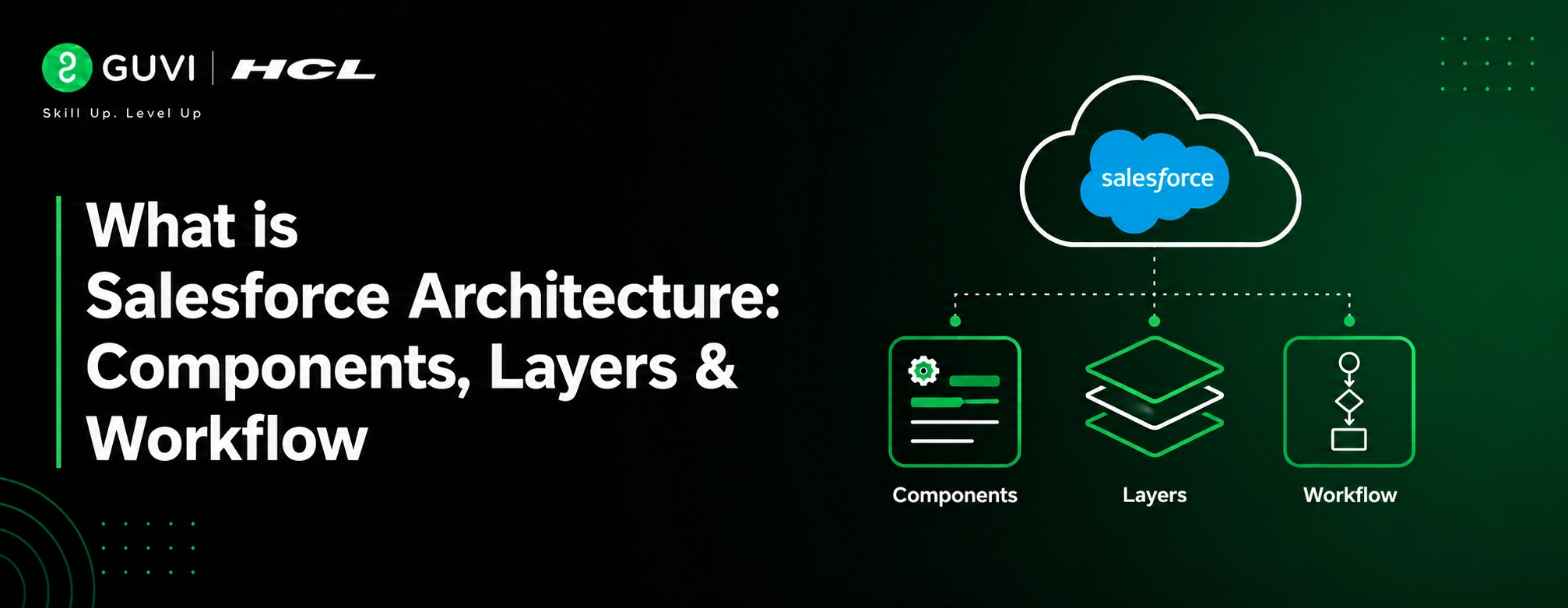
What is Salesforce Architecture: Components, Layers & Workflow


Get In Touch For Details! Request More Information
Best Salesforce Courses for Beginners & Professionals in 2026: Your Complete Learning Guide
Sep 10, 2026 7 Min Read 6357 Views
(Last Updated)
Salesforce continues to be a major player in the CRM space, helping businesses manage sales, customer service, marketing, and other operations. In 2026, Salesforce was ranked the #1 CRM provider worldwide for the 13th consecutive year, with a 20% share of the global CRM market in 2025.
If you’re planning to learn Salesforce, the number of courses and learning paths available can make it difficult to know where to begin. In this guide, we’ve shortlisted some of the top Salesforce courses for beginners and experienced professionals, along with what they cover, the skills you can build, and who each course is best suited for.
Table of contents
- TL;DR
- Salesforce Courses at a Glance
- Why is learning about Salesforce valuable?
- Best Salesforce Courses for Beginners
- Salesforce Trailhead (Free, Official)
- HCL GUVI: Salesforce Course
- Udemy: Salesforce Admin Certification Course (39.5 hrs Video + Practice Test)
- Coursera: Salesforce Fundamentals by Salesforce (~58 hrs Total)
- Salesforce Courses for Experienced Professionals
- Salesforce Trailhead Academy: Design and Build Integration Solutions (ARC101)
- Focus on Force: Platform Developer II Certification Prep
- Trailhead: Advanced Developer Trail
- DevOps Launchpad: CI/CD for Salesforce
- Trailhead: Build Lightning Web Components
- How to Choose the Right Salesforce Course?
- Tips for Success
- Final Note
- FAQs
- Can I learn Salesforce without a technical background?
- How long does it take to learn Salesforce?
- Do I need a Salesforce certification to get a job?
- Can Salesforce courses prepare me for certification exams?
- Do Salesforce certifications expire?
- Are online Salesforce courses enough to become job-ready?
- Should I learn Salesforce Admin or Salesforce Development first?
TL;DR
- Salesforce Courses can help beginners as well as experienced professionals build skills in administration, development, integration, automation, and other areas.
- Salesforce Trailhead is a good starting point if you want to learn the platform for free through hands-on modules.
- HCL GUVI offers structured Salesforce learning focused on development skills such as Apex, Lightning Web Components, APIs, and data management.
- Experienced professionals can explore advanced courses in Salesforce development, integrations, and DevOps based on their career goals.
Salesforce Courses at a Glance
Before exploring each course in detail, here’s a quick look at the Salesforce courses covered in this guide:
| Salesforce Course | Best For | Level | Learning Format |
| Salesforce Trailhead: Admin Beginner | Learning Salesforce fundamentals for free | Beginner | Self-paced |
| HCL GUVI Salesforce Course | Building core Salesforce and CRM skills | Beginner | Self-paced |
| Udemy: Complete Salesforce Certified Platform Administrator Course | Salesforce Administrator certification preparation | Beginner | Self-paced |
| Coursera: Salesforce Fundamentals Specialization | Structured Salesforce foundational learning | Beginner | Self-paced |
| Salesforce Trailhead Academy: ARC101 | Designing Salesforce integration solutions | Intermediate | Instructor-led |
| Focus on Force: Platform Developer II Certification Prep | Advanced developer certification preparation | Advanced | Self-paced |
| Trailhead: Developer Advanced | Building advanced Salesforce development skills | Advanced | Self-paced |
| DevOps Launchpad: CI/CD for Salesforce | Salesforce DevOps and CI/CD practices | Intermediate | Self-paced |
| Trailhead: Build Lightning Web Components | Specialising in Lightning Web Component development | Intermediate | Self-paced |
Why is learning about Salesforce valuable?
Salesforce is a cloud-based customer relationship management platform. It stores and organizes contact records for sales and marketing teams. The platform offers secure data storage and real‑time analytics. It also includes a declarative app builder for custom business solutions.
Earning a Salesforce certification course can fast‑track a career change into tech. Companies place a high premium on administrators and developers. Hands‑on skills translate directly to roles in sales, service, and IT teams. It further offers:
- Higher entry‑level salaries for certified professionals.
- Versatility across multiple industries and departments.
- Low‑code development options for non‑technical learners.
Read: Salesforce Careers in India: Everything You Need to Know
Best Salesforce Courses for Beginners
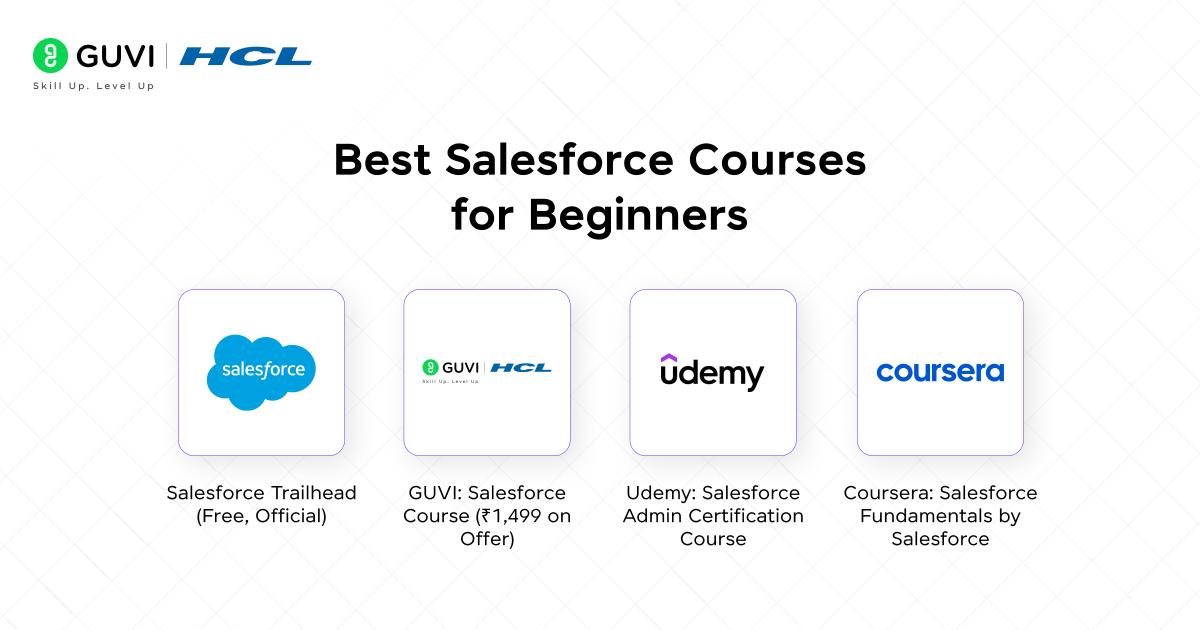
1. Salesforce Trailhead (Free, Official)
Trailhead’s Admin Beginner trail is a self‑paced learning path that combines short, interactive modules with hands-on challenges in a live Salesforce playground to solidify each concept.
Key Features:
- Around 7.5 hours of structured content covering UI navigation, data modeling, and basic customization
- Badges and a points system to track progress and motivate completion
- Real-world exercises that mirror workplace tasks
Skills you will develop:
- Configuration of user profiles, roles, and permission sets
- Creation of custom objects, fields, and relationships
- Building reports and dashboards for data analysis
- Building basic process automation using Salesforce Flow
Scope of Course:
- Prepares you for the Salesforce Certified Administrator exam
- Lays the groundwork for advanced developer and architect trails
- Grants access to a global Trailblazer community for ongoing support
2. HCL GUVI: Salesforce Course
HCL GUVI’s Salesforce course online with certification blends video lessons with expert-led mentor sessions. It offers project assignments designed to replicate real‑world scenarios in user management and data operations.
Paid or Free:
Paid (₹1,499)
Duration:
6 hours (self‑paced with mentor support, English medium)
Course Content:
- Foundational CRM concepts and understanding Salesforce architecture
- Apex fundamentals and advanced programming methods
- Visualforce framework for creating custom interfaces
- Lightning Component Framework and Lightning Web Components
- REST and SOAP API integration
- Data modeling and management essentials
- Salesforce security model, sharing rules, and permissions
- Writing test classes and ensuring code coverage
Key Features:
- Training delivered by experienced Salesforce professionals
- Personalized learning paths to match your current skill level
- Project-based assignments that simulate real business scenarios
- Lifetime access to continually updated course content
- One-on-one mentorship sessions for direct support
Skills:
- Building custom Salesforce applications with Apex triggers and classes
- Designing and managing complex data models
- Developing responsive UIs using Lightning Web Components and Visualforce
- Integrating Salesforce with external systems using APIs
- Applying robust security controls and meeting code coverage requirements
Scope of the Course:
- Prepares learners for developer and technical consultant roles in Salesforce
- Lays the groundwork for Platform Developer I and Architect certifications
- Enables you to build a strong, project-based portfolio for employers and interviews
3. Udemy: Salesforce Admin Certification Course (39.5 hrs Video + Practice Test)
This Udemy Salesforce course delivers in‑depth video lectures aligned with official exam objectives, plus timed practice tests and scenario‑based quizzes to ensure you master each topic before sitting for certification.
Key Features:
- Around 40 hours of on‑demand video content
- Practice test aligned with the updated Salesforce Administrator exam structure
- ChatGPT Prompt Library for generating study aids and code samples
- Updated lessons covering Agentforce and newer Salesforce features
Skills you will develop:
- Configuration of security settings, sharing rules and permission sets
- Automation via Flow Builder, workflow rules and approval processes
- Creation and customization of reports, dashboards and list views
- Best practices for data management and quality control
Scope of Course:
- Builds high confidence for the Salesforce Certified Administrator exam
- Establishes a strong foundation for roles in Sales Cloud and Service Cloud
- Provides case studies you can reference in interviews
4. Coursera: Salesforce Fundamentals by Salesforce (~58 hrs Total)
This specialization, led by Salesforce instructors, comprises three modules plus a capstone project. Peer‑reviewed assignments and graded quizzes reinforce both theory and application across core platform domains.
Key Features:
- 4-course beginner-level specialization
- Hands-on projects, quizzes, and practical Salesforce activities
- Covers Salesforce basics, reporting, data management, automation, and integration
- Capstone based on the Business Administration Specialist Superbadge project
Skills you will develop:
- Management of users, roles and enterprise data access
- Development of reports, dashboards and Analytics apps
- Building declarative automation with processes and flows
- Understanding of object relationships and data integration
Scope of Course:
- Prepares you for foundational certifications such as Administrator
- Acts as a springboard into specialist tracks (developer, consultant)
- Connects you with a global learner community for peer support
Salesforce Courses for Experienced Professionals
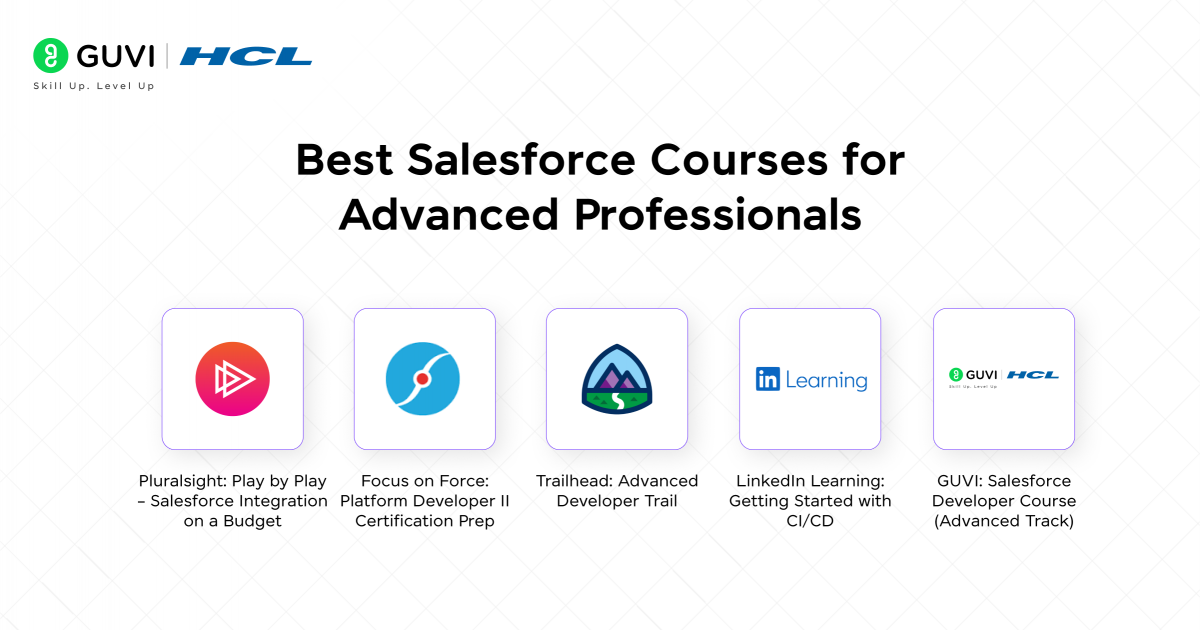
1. Salesforce Trailhead Academy: Design and Build Integration Solutions (ARC101)
Design and Build Integration Solutions (ARC101) is an instructor-led Salesforce course for experienced administrators, developers, and architects who want to build secure and scalable integration solutions. It combines demonstrations, discussions, and hands-on exercises to help you understand how different systems and data sources can work together on the Salesforce Platform.
Paid or Free:
Paid
Duration:
3 days (instructor-led)
Course Content:
- Salesforce integration architecture and key integration concepts
- Salesforce APIs, including REST, SOAP, Bulk, and Streaming APIs
- Platform Events and Change Data Capture
- Integration patterns for different business requirements
- Working with large volumes of data
- Salesforce Connect and external system integration
- Security and performance considerations for integration solutions
Key Features:
- Official instructor-led training from Salesforce
- Hands-on exercises alongside demonstrations and discussions
- Focus on secure, scalable, and high-performing integrations
- Covers multiple Salesforce integration patterns and technologies
- Built for professionals with prior Salesforce knowledge
Skills:
- Identifying business and technical integration requirements
- Selecting suitable integration patterns for different use cases
- Choosing the right Salesforce APIs and integration capabilities
- Designing scalable integration architectures
- Connecting Salesforce with external applications and data sources
Scope of the Course:
- Suitable for experienced Salesforce administrators and developers moving towards architecture roles
- Useful for solution, enterprise, and technical architects working with Salesforce integrations
- Supports preparation for the Salesforce Certified Platform Integration Architect credential
2. Focus on Force: Platform Developer II Certification Prep
This Salesforce course and practice‑exam bundle aligns exactly with the Platform Developer II exam objectives. Detailed explanations and domain‑weighted practice tests help you master advanced coding, integration, and architectural concepts.
Paid or Free:
Paid
Duration:
Self-paced (typically 2–4 weeks)
Course Content:
- Asynchronous Apex and platform events
- Design patterns for scalable code
- Multi-tenant architecture best practices
- Exam-specific quizzes and real-world scenarios
- Review and recap modules for exam revision
Key Features:
- Detailed coverage of every Platform Developer II objective
- Hundreds of practice questions and explanations
- Downloadable review cards for quick revision
- Realistic scenario simulations
Skills:
- Writing Apex for bulk data and governor-safe performance
- Advanced automation across multiple Salesforce clouds
- Adapting platform logic to evolving business needs
- Testing, deployment, and code coverage mastery
Scope of the Course:
- Direct prep for the advanced developer exam
- Raises skill level for technical team leads and architects
- Portfolio and CV boost for high-stakes technical interviews
3. Trailhead: Advanced Developer Trail
Trailhead’s advanced developer trail delivers free, self‑paced modules on high‑level Apex and integration techniques. Hands‑on challenges reinforce every concept in a live org environment.
Paid or Free:
Free
Duration:
~11 hours (flexible, module-based)
Course Content:
- Apex REST and SOAP integration services
- Asynchronous Apex processing
- Lightning Web Component testing and troubleshooting
- Platform caching and event-based development
- Lightning Web Components for mobile
- Salesforce Mobile SDK fundamentals
Key Features:
- Live, hands-on exercises in a real Salesforce org
- Use-case-based project templates
- Cross-linking with advanced Superbadges
- Access to use-case-based project templates
Skills:

- Implementing scalable, secure Apex code
- Advanced component development in LWC
- Cross-system orchestration
- Handling data and processes at enterprise scale
Scope of the Course:
- Targeted for developers and architects in large Salesforce implementations
- Supports practical readiness for the architect board reviews
- Enables direct Superbadge achievement
4. DevOps Launchpad: CI/CD for Salesforce
The CI/CD for Salesforce course from DevOps Launchpad is an intermediate-level course for Salesforce professionals who want to understand and apply continuous integration, continuous delivery, and deployment practices. It focuses specifically on improving and automating Salesforce development and release workflows.
Paid or Free:
Free
Duration:
Self-paced
Course Content:
- Core concepts of continuous integration and continuous delivery
- Continuous deployment and its role in Salesforce DevOps
- Automated testing and deployment processes
- Source control and version control strategies
- Infrastructure and workflow automation
- Implementing CI/CD processes in Salesforce environments
- Transitioning from manual releases to continuous delivery
Key Features:
- Salesforce-specific CI/CD learning
- Free and self-paced format
- Vendor-neutral DevOps concepts and best practices
- Modules followed by quizzes to test your understanding
- Final assessment and certificate on successful completion
Skills:
- Understanding CI/CD workflows for Salesforce
- Using source control as part of the development lifecycle
- Automating software testing and deployment processes
- Reducing manual effort and deployment errors
- Building more reliable and repeatable Salesforce release processes
Scope of the Course:
- Suitable for Salesforce admins, developers, DevOps professionals, and release managers
- Helps professionals move from manual deployment processes towards automated Salesforce delivery workflows
- Builds practical knowledge of CI/CD and Salesforce DevOps practices
- Useful for professionals working with Salesforce development, testing, and release cycles
5. Trailhead: Build Lightning Web Components
Salesforce’s Build Lightning Web Components trail is an intermediate learning path for developers who want to build reusable and interactive components using JavaScript and HTML. It combines foundational LWC concepts with hands-on development, testing, troubleshooting, and Salesforce data integration.
Paid or Free:
Free
Duration:
~11 hours 10 minutes
Course Content:
- Setting up the Lightning Web Components development environment
- Lightning Web Components fundamentals
- Working with Salesforce data in Lightning Web Components
- Testing components using Jest
- Troubleshooting with Chrome DevTools
- Building Lightning Web Components for mobile
- Communicating between Lightning Web Components
- Applying LWC skills through a hands-on application project
Key Features:
- Official Salesforce Trailhead learning path
- 11-step intermediate developer trail
- Hands-on exercises and practical development activities
- Covers development, testing, troubleshooting, and data integration
- Includes a project to build a working application using Lightning Web Components
Skills:
- Building reusable Lightning Web Components
- Working with JavaScript, HTML, and Salesforce data
- Testing and troubleshooting components
- Developing components for web and mobile experiences
- Managing communication between different Lightning Web Components
Scope of the Course:
- Suitable for Salesforce developers looking to specialise in Lightning Web Components
- Strengthens front-end development skills within the Salesforce ecosystem
- Helps developers build more interactive and reusable Salesforce applications
- Provides practical experience for advanced Salesforce development projects
How to Choose the Right Salesforce Course?
The right Salesforce course depends on your current experience, career goals, and the Salesforce skills you want to build. Before enrolling, consider these factors:
- Start with your experience level: If you are new to Salesforce, choose a beginner-friendly course covering CRM fundamentals, platform navigation, data management, and basic automation. Experienced learners can move towards development, integrations, DevOps, or architecture.
- Choose based on your target role: Aspiring administrators should focus on configuration, security, reports, dashboards, and automation, while developers need skills such as Apex, Lightning Web Components, APIs, and testing.
- Check the learning format: Self-paced courses offer greater flexibility, while instructor-led training can be useful if you prefer structured guidance and interaction.
- Look for hands-on learning: Choose courses that include projects, exercises, Salesforce Playgrounds, or practical challenges so you can apply what you learn.
- Consider your certification goals: If you plan to earn a Salesforce certification, make sure the course aligns with the relevant exam topics and recommended preparation.
- Check how current the course is: Salesforce regularly introduces new features and platform updates, so prioritise courses with updated curricula and learning resources.
Tips for Success
- Open a free Salesforce Developer Org to experiment with platform features and build hands‑on skills in a safe environment.
- Participate in Salesforce Community Groups to learn from peers, ask questions, and stay motivated by real success stories.
- Choose HCL GUVI or another structured learning provider for guided courses and regular mentor feedback, especially if you want support beyond self‑study.
- Tackle Trailhead Superbadges to build a visible portfolio of practical achievements.
- Stay updated on platform changes by following official Salesforce blogs and release notes.
- Set steady learning targets each week and try applying new ideas to a personal project for better retention.
- Take mock tests before scheduling any Salesforce certification exam so you know what to expect.
- Seek out volunteer opportunities on Salesforce implementations for non‑profits or small businesses, which provide genuine work experience.
- Find a mentor or study partner to share your progress and get help when you’re stuck with your Salesforce course.
Salesforce’s famous Trailhead mascot, Astro, actually began as an astronaut illustration for a Developer Week T-shirt in 2014. The community loved the design so much that Astro eventually became the face of Trailhead.
Final Note
A thoughtful approach to learning a Salesforce certification course transforms career possibilities, whether you are just starting your journey or already working as an experienced professional. Selecting a path that matches your current skills and ambitions allows you to progress with clarity and confidence, and you can rely on structured programs from platforms like HCL GUVI, Trailhead, Udemy, and Coursera to keep you on track.
Consistent practice and active engagement in the community toward the Salesforce certification course turn new skills into practical expertise valued by employers. With each course you complete and every challenge you overcome, you move closer to roles that offer growth and recognition within the Salesforce ecosystem. Keep building, keep connecting with others, and watch your career expand along with your knowledge.
FAQs
1. Can I learn Salesforce without a technical background?
Yes. You can start learning Salesforce without prior coding experience, particularly if you are interested in administration, CRM operations, reporting, data management, or platform configuration. Development-focused paths involving Apex and Lightning Web Components will require programming skills.
2. How long does it take to learn Salesforce?
There is no fixed timeline. You can learn basic Salesforce concepts within a few weeks, while becoming comfortable with administration, development, integrations, or other specialised areas can take several months of consistent learning and hands-on practice.
3. Do I need a Salesforce certification to get a job?
A certification is not the only factor employers consider. Practical platform knowledge, projects, hands-on experience, and role-specific skills also matter. However, a relevant Salesforce certification can help validate your knowledge in a particular area.
4. Can Salesforce courses prepare me for certification exams?
Yes, but it depends on the course. Some Salesforce certification courses are specifically aligned with certification objectives, while others focus more broadly on practical skills. If certification is your goal, check the latest official exam guide alongside your chosen course.
5. Do Salesforce certifications expire?
Most Salesforce certifications require ongoing maintenance through Trailhead badges. Maintenance requirements are tied to Salesforce’s platform release cycles, so certified professionals need to complete the applicable requirements by the specified deadlines to keep their credentials active.
6. Are online Salesforce courses enough to become job-ready?
Salesforce online courses can help you build the required knowledge, but completing videos or modules alone may not be enough. Combine your course with hands-on practice, projects, Salesforce Playgrounds, and practical challenges to strengthen your ability to apply what you learn.
7. Should I learn Salesforce Admin or Salesforce Development first?
Choose based on your career goal. Salesforce Admin is generally more suitable if you are interested in platform configuration, users, security, automation, reports, and business processes. Salesforce Development is better suited to learners who want to work with Apex, Lightning Web Components, APIs, and custom applications.
Success Stories

About the Author
Vaishali
I'm a seasoned writer with four years of experience across technical, non-technical, and just about every genre or niche you can imagine. Adaptable and curious, I enjoy exploring new topics and making information engaging and easy to understand. Fueled by a steady stream of tea, I approach each project with creativity, reliability, and genuine enthusiasm for storytelling.
View all posts by Vaishali
Connect with me @








Did you enjoy this article?