


Data Science Articles
Accountant to Data Analyst: Skills, Roadmap and Career Path (2026)
SQL for customer support executives: What to Learn and How to Practice
Accounting Team Lead to Data Analytics Skills and Roadmap
Can an Insurance Professional Become a Data Analyst Early in Their Career?


Get In Touch For Details! Request More Information
Mastering the Data Science Interview: A Comprehensive Preparation Guide
Oct 31, 2026 7 Min Read 5319 Views
(Last Updated)
Are you ready to turn your data science knowledge into a job offer? You’ve completed the courses, built a few projects, maybe even earned a certificate or two, but now comes the real test: the interview.
For fresh graduates entering the competitive world of data science, the interview stage can feel daunting, and your mind races with many questions. What should you expect? What topics matter most? How do you stand out when everyone’s as skilled as you?
In this article, we’ll walk you through a structured approach to ace your data science interviews. We’ll cover what to expect in the interview process, how to prepare for technical topics, how to sharpen your behavioral and communication skills, and the importance of portfolio building and mock interviews. Let’s get started!
Table of contents
- Quick Answer
- Understanding the Data Science Interview Process
- Strategies To Prepare For Technical Rounds
- Programming (Python/R) and SQL Skills
- Machine Learning and Algorithmic Concepts
- Statistics and Probability Fundamentals
- Data Cleaning and Data Visualization
- Non-Technical Preparation (Behavioral and Soft Skills)
- 30-Day Data Science Interview Preparation Plan
- Week 1: Build Your Coding and SQL Foundation
- Week 2: Become Interview-Ready in Machine Learning
- Week 3: Statistics, Data Handling, and Storytelling
- Week 4: Turn Knowledge Into Interview Performance
- Final 3 Days: Simulate the Real Interview
- 30-Day Success Rule
- 30-Day Data Science Interview Checklist
- Week 1: Python/R + SQL
- Week 2: Machine Learning
- Week 3: Statistics + Real-World Data
- Week 4: Portfolio + Behavioral Preparation
- Final Interview Sprint
- Final Readiness Checklist
- Building a Strong Portfolio and Resume
- Conclusion
- FAQs
- What are the key topics I should focus on for a data science interview?
- How can I effectively prepare for behavioral interview questions?
- Is it necessary to have a strong background in programming for data science roles?
- What types of projects should I include in my portfolio to impress interviewers?
- How can I stay updated with the latest trends and tools in data science?
Quick Answer
A strong 30-day Data Science interview plan should balance technical revision, hands-on practice, portfolio preparation, and mock interviews.
- Week 1: Python/R + SQL
- Week 2: Machine Learning
- Week 3: Statistics + Data Handling
- Week 4: Portfolio + Behavioral Prep
- Final Days: Technical, case-study, and full mock interviews
Understanding the Data Science Interview Process
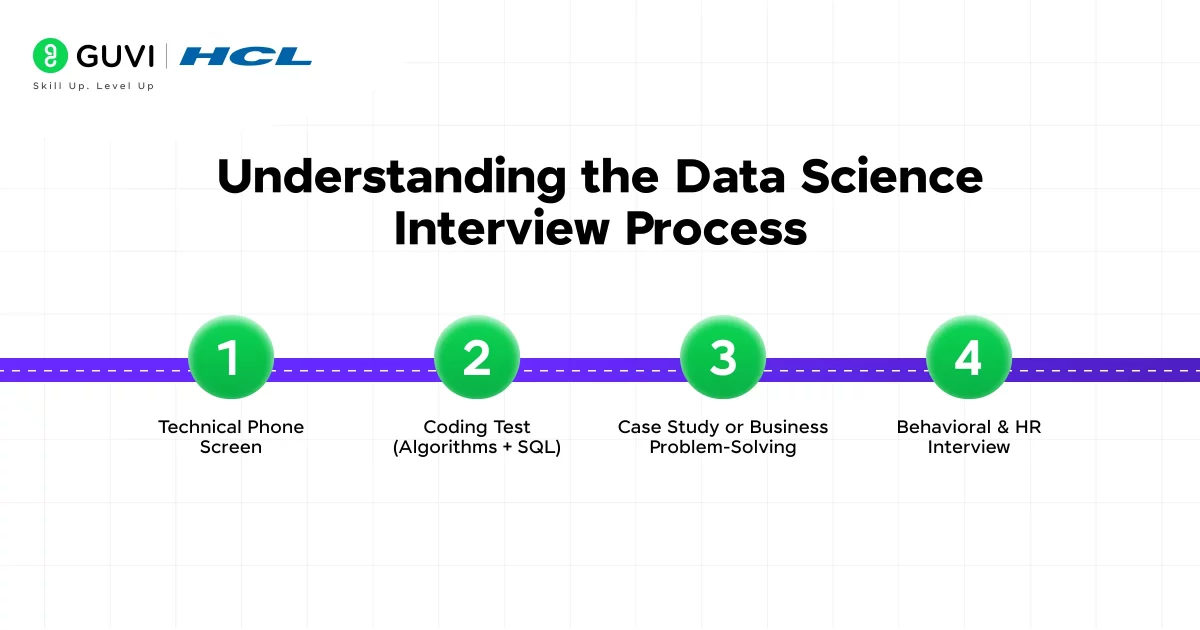
Data science roles often have multi-stage interview processes designed to evaluate different skill areas. While every company’s hiring steps differ, most data science interviews include a mix of technical assessments and behavioral evaluations.
Most hiring processes will have several of the following rounds (not necessarily in this order):
- Technical Phone Screen: A 30–45 minute call with a data scientist or engineer, focusing on basic technical knowledge in areas like Python, SQL, and machine learning.
- Coding Test (Algorithms + SQL): Many companies use an online coding assessment or take-home test to evaluate your programming skills. You may face short coding challenges and SQL queries involving joins, aggregations, etc.
- Case Study or Business Problem-Solving: This round evaluates your ability to apply data science to business scenarios. You might be given a case study or asked open-ended questions like how to detect fraud or reduce customer churn. The focus here is on your problem-solving approach, analytical thinking, and product sense.
- Behavioral & HR Interview: Finally, most processes include a behavioral or HR interview to assess your soft skills, teamwork, and culture fit. Expect questions about your past experiences, challenges, and working style.
Strategies To Prepare For Technical Rounds
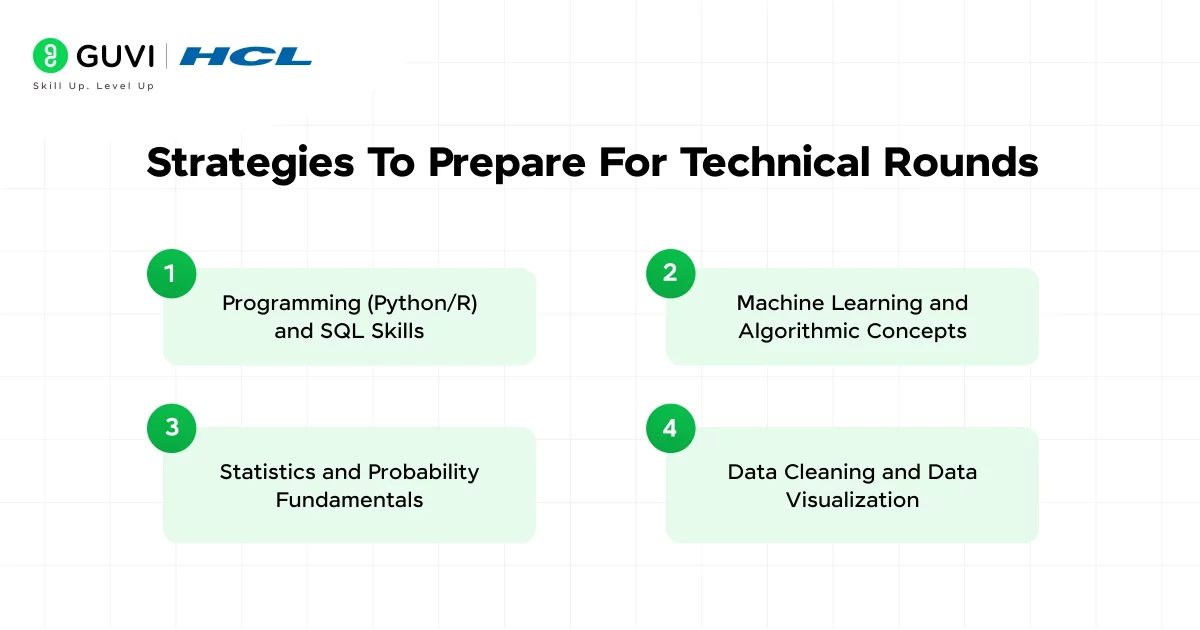
Technical skills form the core of most data science interviews. Fresh graduates should be ready to demonstrate programming, SQL, machine learning, statistics, data cleaning, and visualization skills.
1. Programming (Python/R) and SQL Skills
Most data science roles require Python or R for analysis and SQL for working with databases.
How to prepare:
- Strengthen programming basics: Review syntax, functions, data structures, DataFrames, and commonly used libraries.
- Practice coding problems: Use platforms such as LeetCode, HackerRank, InterviewBit, and StrataScratch to improve problem-solving speed.
- Master SQL queries: Practice SQL questions involving
SELECT,JOIN,WHERE,GROUP BY, aggregates, and window functions. - Explain your logic: Be ready to describe how your code or SQL query works step by step.
2. Machine Learning and Algorithmic Concepts
Interviewers often test whether you understand core machine learning algorithms and when to use them.
How to prepare:
- Review key algorithms: Understand machine learning models such as linear regression, logistic regression, decision trees, random forests, KNN, clustering, and neural networks.
- Know model evaluation: Review accuracy, precision, recall, F1-score, cross-validation, and other relevant metrics.
- Understand model selection: Be ready to explain why one algorithm may suit a problem better than another.
- Review role-specific topics: If the job mentions NLP, time series, or deep learning, revise those areas as well.
3. Statistics and Probability Fundamentals
Statistics helps data scientists interpret data, evaluate experiments, and make reliable conclusions.
How to prepare:
- Review core statistics: Revise mean, median, variance, standard deviation, probability, and common distributions.
- Understand distributions: Know normal, uniform, and binomial distributions along with concepts such as skewness.
- Learn experimentation basics: Understand hypothesis testing and A/B testing.
- Practice interpretation: Be able to explain statistical results, confusion matrices, or experiment outcomes in simple language.
4. Data Cleaning and Data Visualization
Interviewers may test how you handle messy datasets and communicate insights clearly.
How to prepare:
- Practice data cleaning: Review missing values, duplicates, outliers, categorical variables, and normalization.
- Know your tools: Be comfortable using pandas or R for filtering, aggregation, transformation, and date-time handling.
- Build visualization skills: Practice Matplotlib, Seaborn, ggplot2, Tableau, or similar tools.
- Explain insights clearly: Be ready to describe what a chart shows and why the insight matters.
- Use project examples: Prepare examples showing how you cleaned data, analyzed it, visualized results, and communicated findings.
Prepare confidently for data science interviews with HCL GUVI’s Data Science Course. Strengthen your Python, SQL, statistics, machine learning, and practical problem-solving skills through 6 months of live online classes, expert mentorship, 1:1 doubt sessions, and placement assistance with 1000+ hiring partners. Enroll in HCL GUVI’s Data Science Course to build job-ready skills and prepare for your next data science interview.
Non-Technical Preparation (Behavioral and Soft Skills)
Why it matters: Data scientists often collaborate with engineers, analysts, managers, and non-technical stakeholders. Interviewers want to know whether you can communicate clearly, handle challenges, and contribute effectively to a team.
How to prepare:
- Review your experiences: Prepare examples from projects, internships, hackathons, group assignments, volunteering, or part-time work.
- Use the STAR method: Structure answers around Situation, Task, Action, and Result to keep responses clear and focused.
- Quantify your impact: Use measurable outcomes such as improved model accuracy, faster processing, better rankings, or project results whenever possible.
- Show communication skills: Practice explaining technical concepts in simple language for non-technical stakeholders.
- Keep answers concise: Avoid long explanations. Focus on the problem, your action, and the result.
- Prepare teamwork examples: Be ready to discuss collaboration, leadership, conflict resolution, failures, and lessons learned.
- Ask thoughtful questions: Prepare questions about the team, projects, tools, workflow, expectations, and growth opportunities.
- Practice mock interviews: Rehearse behavioral questions with a friend, mentor, or by recording yourself to improve clarity and confidence.
If you want to read more about how Data Science works and its use cases, consider reading HCL GUVI’s Free Ebook: Master the Art of Data Science – A Complete Guide, which covers the key concepts of Data Science, including foundational concepts like statistics, probability, and linear algebra, along with essential tools.
30-Day Data Science Interview Preparation Plan
Week 1: Build Your Coding and SQL Foundation
Day 1: Assess Your Interview Readiness
Map the common interview rounds and rate yourself on Python/R, SQL, ML, statistics, visualization, communication, and projects.
Output: Personal gap analysis with your three weakest areas.
Day 2: Refresh Python or R Fundamentals
Review syntax, functions, lists, dictionaries, DataFrames, and basic data manipulation.
Output: Solve 5 short coding problems without notes.
Day 3: Strengthen Data Manipulation
Practice filtering, grouping, aggregating, and transforming datasets with pandas or your preferred R tools.
Output: One mini data-manipulation notebook.
Day 4: Master Core SQL
Practice SELECT, WHERE, ORDER BY, GROUP BY, and aggregate functions.
Output: 8 SQL queries written from scratch.
Day 5: Practice SQL Joins
Work through INNER JOIN, LEFT JOIN, multi-table queries, and aggregations.
Output: 6 solved SQL interview questions.
Day 6: Add Window Functions
Practice common window-function patterns and explain what each query returns.
Output: 4 window-function problems.
Day 7: Take Your First Checkpoint
Complete a timed coding and SQL practice session. Review every mistake instead of only checking the score.
Output: Scorecard + mistake log.
Week 2: Become Interview-Ready in Machine Learning
Day 8: Linear and Logistic Regression
Learn when each model is appropriate and how to explain it without memorized definitions.
Output: One real-world example for each model.
Day 9: Decision Trees and Random Forests
Compare their working logic, strengths, limitations, and use cases.
Output: One comparison sheet.
Day 10: KNN and K-Means
Use them to strengthen your understanding of supervised vs unsupervised learning.
Output: Two interview-ready explanations.
Day 11: Neural Network Fundamentals
Review basic neural-network concepts and the ML frameworks you can genuinely discuss.
Output: A two-minute neural-network explanation.
Day 12: Model Evaluation
Review cross-validation and the metrics you would use to assess different models.
Output: One model-evaluation cheat sheet.
Day 13: Solve a Business Case
Take a problem such as customer churn or fraud detection. Structure the answer around the problem, data, approach, evaluation, and business outcome.
Output: One complete case-study framework.
Day 14: ML Mock Interview
Answer 10 machine-learning questions verbally without looking at notes.
Output: Rewrite every weak answer until it becomes concise and defensible.
Week 3: Statistics, Data Handling, and Storytelling
Day 15: Refresh Descriptive Statistics
Review mean, median, variance, standard deviation, skewness, and related concepts.
Output: Explain each using a simple example.
Day 16: Review Probability Distributions
Focus on normal, uniform, binomial, and other distributions covered in your preparation.
Output: Match each distribution to a practical scenario.
Day 17: Practice Probability
Work through probability questions rather than only rereading theory.
Output: 8 solved questions + error log.
Day 18: Understand A/B Testing
Practice explaining how an experiment should be designed and interpreted.
Output: One interview-ready A/B testing answer.

Day 19: Practice Interpretation
Take a confusion matrix or experiment result and explain what it means to a non-technical stakeholder.
Output: Two plain-English interpretations.
Day 20: Handle Messy Data
Review missing values, outliers, categorical variables, normalization, and inconsistencies.
Output: Build a step-by-step cleaning plan for one dataset.
Day 21: Improve Data Storytelling
Create or review three visualizations and identify the business insight each communicates.
Output: Three charts with one clear takeaway each.
Week 4: Turn Knowledge Into Interview Performance
Day 22: Choose Your Best Portfolio Projects
Select 2–5 projects that best demonstrate your technical and analytical skills.
Output: Ranked project shortlist.
Day 23: Prepare for Project Deep-Dives
For your strongest project, prepare to explain the problem, approach, technical choices, results, challenges, and what you would improve.
Output: One complete project interview sheet.
Day 24: Polish Resume and GitHub
Align technical skills with actual evidence from your projects. Clean project documentation and README files.
Output: Interview-ready resume and portfolio.
Day 25: Build Five STAR Stories
Prepare stories around teamwork, leadership, failure, conflict, and problem-solving. Quantify outcomes where possible.
Output: Five STAR answers.
Day 26: Practice Communication
Record yourself explaining three technical concepts to a non-technical person. Remove jargon and unnecessary detail.
Output: Three concise explanations.
Day 27: Prepare Questions for the Interviewer
Draft questions about team workflow, projects, tools, expectations, and learning opportunities.
Output: Choose your best four questions.
Final 3 Days: Simulate the Real Interview
Day 28: Full Technical Mock
Combine Python/SQL, machine learning, statistics, data cleaning, and visualization into one timed session.
Output: Mock score + final technical weak-topic list.
Day 29: Case Study + Behavioral Mock
Complete one business case followed by six behavioral questions.
Output: Refined case framework + polished STAR responses.
Day 30: Final Interview Simulation
Run one complete mock interview. Review your resume, portfolio, projects, technical gaps, and communication.
Output: A one-page last-minute revision sheet.
30-Day Success Rule
Do not measure progress only by hours studied. By Day 30, you should be able to write SQL and code under time pressure, explain core ML and statistics clearly, solve a business case logically, defend every project on your resume, and communicate technical decisions confidently.
30-Day Data Science Interview Checklist
Week 1: Python/R + SQL
☐ Day 1: Assess strengths and gaps across Python/R, SQL, ML, statistics, visualization, portfolio, and behavioral skills.
☐ Day 2: Revise Python/R syntax, functions, lists, dictionaries, and basic data structures.
☐ Day 3: Practice DataFrames, filtering, grouping, aggregation, and data manipulation.
☐ Day 4: Practice SQL SELECT, WHERE, ORDER BY, GROUP BY, and aggregate functions.
☐ Day 5: Solve SQL JOIN and multi-table query problems.
☐ Day 6: Practice SQL window functions and explain each query step-by-step.
☐ Day 7: Complete a timed Python/R + SQL mock and create a mistake log.
Week 2: Machine Learning
☐ Day 8: Revise linear regression and logistic regression.
☐ Day 9: Review decision trees and random forests.
☐ Day 10: Review KNN, k-means, and supervised vs unsupervised learning.
☐ Day 11: Revise neural-network basics and relevant ML frameworks.
☐ Day 12: Review model evaluation and cross-validation.
☐ Day 13: Solve one business case such as churn or fraud detection.
☐ Day 14: Answer 10 machine-learning interview questions without notes.
Week 3: Statistics + Real-World Data
☐ Day 15: Revise mean, median, variance, standard deviation, and skewness.
☐ Day 16: Review normal, uniform, binomial, and other important distributions.
☐ Day 17: Solve at least 8 probability questions.
☐ Day 18: Review A/B testing fundamentals and interpretation.
☐ Day 19: Practice explaining statistical and model results in simple language.
☐ Day 20: Practice handling missing values, outliers, categorical data, and normalization.
☐ Day 21: Create or analyze 3 visualizations and explain the insight from each.
Week 4: Portfolio + Behavioral Preparation
☐ Day 22: Shortlist your best 2–5 data science projects.
☐ Day 23: Prepare one detailed project explanation covering problem, approach, challenges, results, and improvements.
☐ Day 24: Update your resume, GitHub, project descriptions, and README files.
☐ Day 25: Prepare 5 STAR stories for teamwork, leadership, conflict, failure, and problem-solving.
☐ Day 26: Practice explaining 3 technical concepts to a non-technical person.
☐ Day 27: Prepare 4 strong questions to ask your interviewer.
Final Interview Sprint
☐ Day 28: Complete a full technical mock covering Python/R, SQL, ML, statistics, and data handling.
☐ Day 29: Complete one case-study mock and 6 behavioral questions.
☐ Day 30: Run a complete interview simulation and prepare a one-page final revision sheet.
Final Readiness Checklist
Before applying or appearing for an interview, confirm that you can:
☐ Write common Python/R data-manipulation code without constant reference material.
☐ Write JOINs, aggregations, and window-function SQL queries.
☐ Explain major ML algorithms and when to use them.
☐ Discuss model evaluation and cross-validation clearly.
☐ Explain core statistics and probability concepts.
☐ Handle common data-cleaning scenarios.
☐ Turn analytical results into clear visual and business insights.
☐ Explain every project listed on your resume in depth.
☐ Answer behavioral questions using the STAR method.
☐ Solve an open-ended data science business case logically.
☐ Explain technical concepts clearly to non-technical stakeholders.
☐ Complete a timed mock interview without relying heavily on notes.
Building a Strong Portfolio and Resume
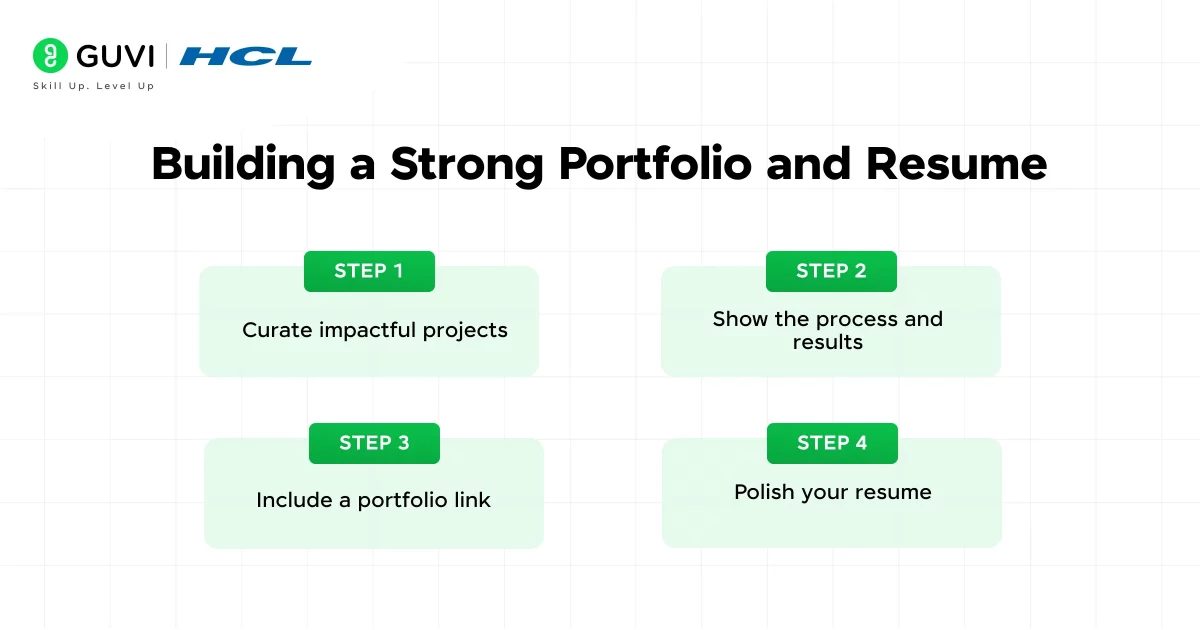
A strong compelling portfolio and resume can help you stand out and give interviewers clear proof of your data science skills.
- Choose strong projects: Include 2-5 projects that best demonstrate your skills, such as coursework, Kaggle projects, thesis work, or independent projects.
- Explain your process: Be ready to discuss the problem, approach, tools, challenges, model validation, results, and what you would improve.
- Add a portfolio link: Use GitHub or a personal portfolio website. Keep your code clean, documented, and supported by a clear README.
- Tailor your resume: Highlight relevant programming languages, tools, libraries, and data science skills that match the role.
- Focus on outcomes: Show measurable results, improvements, insights, or project impact instead of listing only tasks.
- Know every project well: Interviewers may ask detailed questions directly from your resume, so be prepared to justify every technical choice you mention.
Conclusion
In conclusion, preparing for a data science interview is a holistic process. With thorough preparation and the right mindset, you can walk into your data science interviews feeling prepared and excited to showcase your abilities. Every question is a chance to tell the interviewer something about how you think and what you know.
By following the strategies from this article, you’re well on your way to acing that data science interview and launching your career. Now, go out there and show them what you can do!
FAQs
1. What are the key topics I should focus on for a data science interview?
Data science interviews typically assess both technical and soft skills. Key technical areas include statistics, machine learning algorithms, data manipulation using tools like Python or R, and data visualization.
2. How can I effectively prepare for behavioral interview questions?
Behavioral questions aim to evaluate your past experiences and how you handle various situations. A common method to structure your responses is the STAR technique: Situation, Task, Action, and Result. This approach helps you provide clear and concise answers by outlining the context, your responsibilities, the actions you took, and the outcomes achieved.
3. Is it necessary to have a strong background in programming for data science roles?
While a solid understanding of programming is beneficial, especially in languages like Python or R, it’s not mandatory to be an expert coder. Employers often look for candidates who can write clean, efficient code for data analysis and model implementation.
4. What types of projects should I include in my portfolio to impress interviewers?
Your portfolio should showcase projects that demonstrate your ability to handle end-to-end data science tasks. This includes data cleaning, exploratory data analysis, feature engineering, model building, and result interpretation. Projects that solve real-world problems or contribute to open-source initiatives can be particularly impactful.
5. How can I stay updated with the latest trends and tools in data science?
Staying current in the rapidly evolving field of data science is crucial. Regularly reading industry blogs, participating in online forums, and attending webinars or workshops can help. Engaging with platforms like GitHub, Kaggle, and Stack Overflow allows you to learn from the community and contribute to ongoing projects.
Success Stories

About the Author
Vaishali
I'm a seasoned writer with four years of experience across technical, non-technical, and just about every genre or niche you can imagine. Adaptable and curious, I enjoy exploring new topics and making information engaging and easy to understand. Fueled by a steady stream of tea, I approach each project with creativity, reliability, and genuine enthusiasm for storytelling.
View all posts by Vaishali
Connect with me @










Did you enjoy this article?