


Career Articles
Accountant vs Data Analyst Salary in India After Switching Careers - Best Guide
Finance Managers: Could Data Science Be Your Next Career Move?
Insurance Claims Executive to Data Analyst: Is It a Good Switch?
Banking Executive (Loans, KYC) to Data Analyst: Skills and Career Path


Get In Touch For Details! Request More Information

Machine Learning Prerequisites: 6 Things to Learn Before You Start (2026)
Sep 22, 2026 8 Min Read 17951 Views
(Last Updated)
Machine learning prerequisites are the core skills, like statistics, probability, math, and programming, that you need before you start building models. Without them, you can still follow tutorials, but you won’t really understand what’s happening behind the code.
Most beginners jump straight into algorithms and get stuck because the basics were never clear. Getting these prerequisites right first makes everything after, from your first model to your first project, much easier to follow.
Table of contents
- TL;DR Summary
- 6 Essential Machine Learning Prerequisites
- Statistics
- Probability
- Linear Algebra
- Calculus
- Programming Languages
- Exploratory Data Analysis
- 6 Machine Learning Prerequisites: Overview
- What to Learn After Completing These Prerequisites?
- Conclusion
- FAQs
- What are the machine learning prerequisites?
- Do I need a degree to learn machine learning?
- Which programming language is best for machine learning?
- Is math a prerequisite for machine learning?
- How long does it take to learn machine learning prerequisites?
- Can I learn machine learning without knowing all the prerequisites first?
- What is the best order to learn machine learning prerequisites?
TL;DR Summary
- Machine learning prerequisites cover six core areas: statistics, probability, linear algebra, calculus, programming, and exploratory data analysis
- Statistics and probability help you understand data and handle uncertainty in predictions
- Linear algebra and calculus explain how models are built and how they learn from errors
- Python is the most beginner-friendly language to actually apply these prerequisites
- Once these basics are clear, you can move on to real algorithms and your first machine learning project
6 Essential Machine Learning Prerequisites
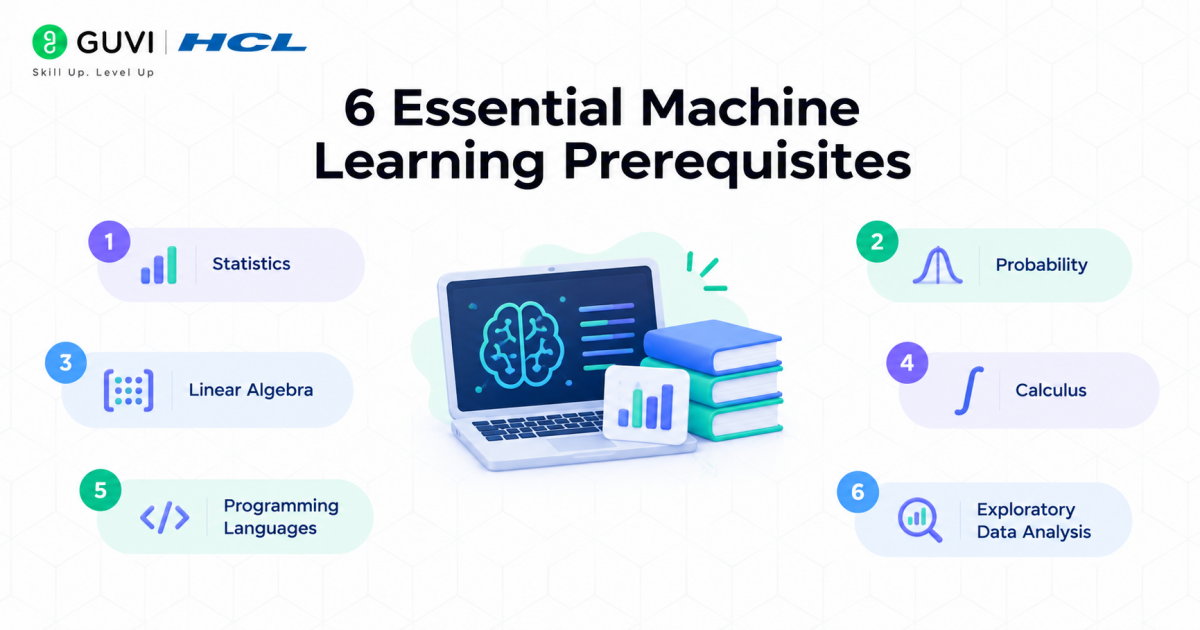
1. Statistics
Statistics is one of the most important machine learning prerequisites because it helps beginners understand data patterns before building models. It explains how data is collected, summarized, compared, distributed, and interpreted.
Key topics to learn:
- Mean, median, and mode: These help identify the central value of a dataset. They help you understand average customer age, product price, salary range, test scores, or sales numbers.
- Variance and standard deviation: These show how much values differ from the average. Machine learning models use this understanding to detect spread, consistency, and unusual behaviour in data.
- Correlation: Correlation explains how two variables move together. It helps identify relationships such as study hours and marks, marketing spend and sales, or temperature and electricity demand.
- Covariance: Covariance shows whether two variables increase or decrease together. It is useful for understanding feature relationships in machine learning datasets.
- Sampling: Sampling helps work with a smaller, meaningful part of a large dataset. Good sampling improves the quality of machine learning model training.
- Hypothesis testing: This helps determine whether a data pattern is meaningful or due to chance. It is useful in A/B testing, business analysis, and model validation.
- Confidence intervals: Confidence intervals show the possible range of a result. They help measure uncertainty in data analysis and machine learning predictions.
- Skewness and kurtosis: These explain the shape of data distribution. They help detect whether data is balanced, heavily tilted, or affected by extreme values.
- Outlier detection: Statistics helps identify unusually high or low values. Outliers can affect regression models, clustering models, and overall model accuracy.
Importance of Statistics in Machine Learning:
- Understands data behaviour: Statistics helps identify patterns, trends, spread, and variation within datasets before model training begins.
- Improves feature selection: Statistical methods help identify which variables are useful, weak, duplicated, or strongly related to the target variable.
- Supports model evaluation: Metrics like accuracy, precision, recall, variance, and confidence intervals help measure machine learning model performance.
- Reduces wrong assumptions: Statistical analysis helps determine whether a pattern is meaningful or driven by random variation.
- Detects bias and errors: Statistics helps identify skewed data, class imbalance, outliers, and unreliable samples that can reduce model quality.
- Strengthens decision-making: It helps data scientists interpret results clearly and make reliable business or research decisions from machine learning outputs.
Ready to turn theory into real skill? HCL GUVI’s Artificial Intelligence and Machine Learning Programme takes you from these prerequisites into classical ML, deep learning, and even LLMs and AI agents, with 120+ hours of live classes and mentor support. You’ll build 10+ real projects, get placement assistance, and learn from mentors who’ve worked on production AI systems. Enroll today and take the next step toward becoming a job-ready AI/ML engineer!
2. Probability
Probability is a core part of machine learning prerequisites because Machine learning models often make predictions when data is uncertain, incomplete, or noisy. It helps estimate how likely an event is to happen based on available information.
Key topics to learn:
- Basic probability: This measures the chance of an event happening. It is used in prediction tasks such as customer churn, loan approval, fraud detection, and disease risk analysis.
- Conditional probability: This explains the chance of one event happening based on another event. It is useful in classification problems and recommendation systems.
- Bayes’ theorem: Bayes’ theorem updates predictions when new information is available. It is commonly used in spam filtering, medical diagnosis, and document classification.
- Random variables: Random variables represent uncertain outcomes in numerical form. They are useful for modelling real-world uncertainty.
- Expected value: Expected value estimates the average result of a random event. It supports decision-making in risk analysis and predictive modelling.
- Probability distributions: Distributions show how values are arranged in data. Important examples include normal distribution, binomial distribution, Poisson distribution, and uniform distribution.
- Joint probability: Joint probability measures the chance of two events happening together. It helps you understand combined conditions in datasets.
- Marginal probability: Marginal probability focuses on the probability of a single event, regardless of other variables.
- Maximum likelihood estimation: This helps machine learning models estimate the best parameters from data.
- Naive Bayes: A beginner-friendly machine learning algorithm based on probability. It is often used for text classification and spam detection.
Importance of Probability in Machine Learning:
- Handles uncertainty: Probability helps machine learning models make predictions even when data is incomplete, noisy, or unpredictable.
- Supports classification models: Algorithms use probability to classify emails, images, customers, transactions, and medical records into different categories.
- Improves prediction confidence: Probability helps estimate how confident a model is about a prediction instead of giving only a fixed answer.
- Powers Bayesian learning: Bayes’ theorem helps models update predictions when new evidence or fresh data becomes available.
- Helps in risk analysis: Probability is useful in fraud detection, insurance modelling, credit scoring, disease prediction, and financial forecasting.
- Supports recommendation systems: Probability helps estimate user preferences and suggest products, videos, courses, or content based on past behaviour.
3. Linear Algebra
Linear algebra is the mathematical language of machine learning. It helps represent large datasets, images, text, audio, and model parameters in numerical form. Most machine learning algorithms use vectors, matrices, and tensors internally.
Key topics to learn:
- Scalars: A scalar is a single number, such as age, price, height, weight, or temperature.
- Vectors: A vector is a list of numbers. In machine learning, one data point is often represented as a vector of features.
- Matrices: A matrix is a table of numbers arranged in rows and columns. Most datasets are stored and processed as matrices.
- Tensors: Tensors are multi-dimensional arrays. They are used in deep learning, image recognition, natural language processing, and neural networks.
- Matrix addition and multiplication: These operations help process large datasets efficiently.
- Transpose and inverse: These operations are used in regression, optimization, and numerical computation.
- Dot product: Dot product measures the relationship or similarity between two vectors. It is used in recommendation systems, search engines, and neural networks.
- Norms: Norms measure the length or magnitude of a vector. They are useful in distance-based algorithms and regularization.
- Eigenvalues and eigenvectors: These help understand important directions in data. They are used in dimensionality reduction methods like PCA.
- Dimensionality reduction: This reduces the number of features while keeping important information. It improves speed, reduces noise, and supports better model performance.
Importance of Linear Algebra in Machine Learning:
- Represents data numerically: Linear algebra converts real-world data into vectors, matrices, and tensors that machine learning models can process.
- Supports large-scale computation: Matrix operations help process thousands or millions of data points faster and more efficiently.
- Builds the base for algorithms: Linear regression, logistic regression, support vector machines, PCA, and neural networks depend on linear algebra.
- Improves similarity measurement: Vector operations help compare users, documents, images, products, and search results.
- Supports dimensionality reduction: Linear algebra helps reduce large feature sets while keeping the most important information.
- Powers deep learning models: Neural networks use tensors, matrix multiplication, and vector operations during training and prediction.
4. Calculus
Calculus is an essential machine learning prerequisite because it explains how models learn from errors. It helps algorithms adjust internal values, reduce loss, and improve prediction accuracy during training.
Key topics to learn:
- Functions: A function shows the relationship between input and output. Machine learning models also behave like functions that map data inputs to predictions.
- Limits: Limits explain how a function behaves as values move closer to a point. They create the foundation for understanding derivatives.
- Derivatives: Derivatives measure how one value changes with another. They help machine learning models understand how prediction errors change.
- Partial derivatives: Partial derivatives are used when a model has many input variables. Most ML datasets have multiple features, so this concept is important.
- Gradients: A gradient shows the direction and speed of change. It tells the model how to update parameters to reduce error.
- Gradient descent: Gradient descent is an optimization technique that reduces model error step by step. It is widely used in machine learning and deep learning.
- Chain rule: The chain rule helps calculate gradients across multiple layers. It is essential for backpropagation in neural networks.
- Loss functions: A loss function measures how far a model’s prediction is from the correct answer.
- Optimization: Optimization helps machine learning models find the best values for weights and parameters.
- Backpropagation: Backpropagation uses calculus to train neural networks by updating weights based on error.
Importance of Calculus in Machine Learning:
- Reduces prediction errors: Calculus helps models understand how errors change and how to reduce them during training.
- Supports gradient descent: Derivatives and gradients guide models toward better weights, lower loss, and improved accuracy.
- Trains neural networks: Calculus powers backpropagation, which helps deep learning models learn from mistakes.
- Improves optimization: Calculus helps algorithms find the best values for parameters, weights, and coefficients.
- Explains model learning: It shows how machine learning models improve step by step with every training cycle.
- Supports advanced ML concepts: Deep learning, reinforcement learning, computer vision, and natural language processing rely heavily on calculus-based optimization.
5. Programming Languages
Programming is one of the most practical prerequisites for machine learning. Machine learning isn’t just theory. You need code to collect data, clean it, train models, evaluate results, and deploy solutions.
Python is the most popular programming language for machine learning because it is easy to read and has powerful libraries. However, other languages like R, SQL, Java, Julia, and C++ are also useful in specific areas.

Important programming languages for machine learning:
- Python: Python is the best language for beginners in machine learning. It supports libraries like NumPy, Pandas, Scikit-learn, TensorFlow, PyTorch, Matplotlib, and Seaborn.
- R: R is useful for statistics, data analysis, and visualization. It is often used in research, finance, healthcare, and academic data science.
- SQL: SQL is essential for working with databases. Machine learning projects often require extracting data from tables, filtering records, joining datasets, and preparing data for analysis.
- Java: Java is used in large-scale enterprise applications. It is useful when machine learning needs to be integrated with production-level software systems.
- C++: C++ is used where high performance is required. It is useful in robotics, gaming, computer vision, and real-time machine learning systems.
- Julia: Julia is useful for numerical computing and scientific machine learning. It is faster than many high-level languages, but less common for beginners.
Python concepts beginners should learn:
- Variables and Data Types: These help store numbers, text, lists, and other values.
- Conditional Statements: These help your program make decisions using if, else, and elif.
- Loops: Loops help repeat tasks, such as reading rows from a dataset.
- Functions: Functions help write reusable code and organize machine learning workflows.
- Lists, Tuples, Sets, and Dictionaries: These store and manage data in different formats.
- File Handling: This helps read and write files like CSV, Excel, JSON, and text files.
- Object-Oriented Programming: Classes and objects help structure larger ML projects.
- Error Handling: This helps manage mistakes in code without crashing the entire program.
- Libraries and Packages: ML depends heavily on external libraries for data processing, visualization, and model training.
Important machine learning libraries:
- NumPy: Used for numerical calculations and array operations.
- Pandas: Used for data cleaning, data manipulation, and data analysis.
- Matplotlib: Used for creating charts and graphs.
- Seaborn: Used for statistical data visualization.
- Scikit-learn: Used for beginner-friendly machine learning models.
- TensorFlow: Used for deep learning and neural networks.
- PyTorch: Used for deep learning research and production models.
- OpenCV: Used for computer vision and image processing.
Why programming matters in machine learning:
Programming connects theory with real-world implementation. You may understand an algorithm on paper, but programming helps you apply it to real datasets.
For example, Python helps you clean customer data, train a prediction model, check accuracy, and visualize results. SQL helps you extract business data. Libraries like Scikit-learn help you build models without writing every formula from scratch.
6. Exploratory Data Analysis
Exploratory Data Analysis, or EDA, is the process of studying a dataset before applying machine learning algorithms. It helps you understand the data, find patterns, detect errors, identify missing values, and decide how to prepare the dataset for model training.
EDA is one of the most practical skills required for machine learning because machine learning models are only as good as the data used to train them.
Key steps in exploratory data analysis:
- Understanding the Dataset: Check the number of rows, columns, data types, and feature names. This gives a basic overview of the dataset.
- Checking Missing Values: Missing values can affect model performance. Identify them and decide whether to remove, replace, or impute them.
- Finding Duplicate Records: Duplicate data can mislead the model and create biased results. EDA helps detect and remove repeated entries.
- Checking Data Types: Numeric, text, date, and categorical columns require different preprocessing methods.
- Detecting Outliers: Outliers are extreme values that differ significantly from the rest of the data. They can affect models like linear regression and clustering.
- Understanding Data Distribution: Distribution shows how values are spread. It helps identify skewed data, normal data, and unusual patterns.
- Univariate Analysis: This studies one variable at a time. It helps understand individual columns like age, salary, price, or score.
- Bivariate Analysis: This studies the relationship between two variables. For example, it can show how experience affects salary.
- Multivariate Analysis: This studies relationships among multiple variables. It helps detect complex patterns in the dataset.
- Correlation Analysis: Correlation shows how strongly two variables are related. It helps select useful features for machine learning models.
- Feature Importance: EDA helps identify which columns may strongly affect the target variable.
- Data Visualization: Charts make patterns easier to understand. Bar charts, histograms, box plots, scatter plots, and heatmaps are commonly used.
Common EDA techniques:
- Head and Tail Check: View the first and last few rows of the dataset.
- Shape Check: Find the number of rows and columns.
- Summary Statistics: Check mean, median, minimum, maximum, and standard deviation.
- Missing Value Count: Find columns with blank or null values.
- Unique Value Count: Check how many unique values exist in each column.
- Value Counts: Understand frequency in categorical columns.
- Histogram: Understand the distribution of numerical values.
- Box Plot: Detect outliers and data spread.
- Scatter Plot: Study relationships between two numerical variables.
- Heatmap: Visualize correlation between multiple variables.
Why EDA (Exploratory Data Analysis) Matters in Machine Learning
EDA helps you understand whether your data is ready for machine learning. It also helps avoid wrong assumptions.
For example, a dataset may look clean at first but may contain missing values, duplicate rows, wrong data types, or extreme outliers. Training a model without EDA can lead to poor accuracy and misleading predictions.
EDA also helps in feature selection, feature engineering, and model choice. A classification problem may need different preprocessing than a regression problem. A skewed dataset may need balancing. A dataset with strong outliers may need special treatment.
In simple words, EDA helps you know your data before asking a machine learning model to learn from it.
6 Machine Learning Prerequisites: Overview
Here’s a quick look at all the Machine Learning prerequisites side by side, so you know what to expect from each one:
| Prerequisite | Why It Matters | Where It’s Used | Difficulty Level | Time to Learn |
|---|---|---|---|---|
| Statistics | Helps you understand data patterns, distributions, and make sense of results | Model evaluation, hypothesis testing, A/B testing | Moderate | 3-4 weeks |
| Probability | Powers how ML models handle uncertainty and predict outcomes | Naive Bayes, decision trees, probabilistic models | Moderate | 2-3 weeks |
| Linear Algebra | Forms the math behind how data is stored and transformed in models | Neural networks, PCA, image processing | Hard | 4-5 weeks |
| Calculus | Explains how models learn by minimizing errors over time | Gradient descent, backpropagation, optimization | Hard | 4-5 weeks |
| Programming Languages | Lets you actually build, train, and test ML models | Writing algorithms, using libraries like Scikit-learn, TensorFlow | Easy to Moderate | 4-6 weeks |
| Exploratory Data Analysis | Helps you clean, visualize, and understand data before modeling | Data preprocessing, feature selection, spotting outliers | Easy | 2-3 weeks |
What to Learn After Completing These Prerequisites?
Once you’re done with the machine learning prerequisites, the next step is to actually start applying them. This is where most beginners either build momentum or lose interest, so keep it simple and hands-on.
Start with the basics of machine learning itself, not advanced topics:
- Types of machine learning — supervised, unsupervised, and reinforcement learning
- Basic algorithms like linear regression, logistic regression, and decision trees
- Model evaluation — accuracy, precision, recall, and how to read a confusion matrix
- Scikit-learn library — the most beginner-friendly tool to build your first models
Once these feel familiar, move into your first real project. A simple prediction task, like predicting house prices or classifying emails as spam, works well because it forces you to apply everything from the machine learning prerequisites in one place.
After that, you can explore:
- Feature engineering in more depth
- Cross-validation and hyperparameter tuning
- Neural networks, once your math and programming base feels solid
The key is to not rush. Machine learning prerequisites give you the foundation, but skills stick only when you use them on real data, not just theory.
Conclusion
Getting started with machine learning isn’t about rushing into models and algorithms — it’s about building a base you can actually rely on. Once you’ve covered these machine learning prerequisites, you’re not just ready to learn ML; you’re ready to actually understand what’s happening under the hood, and that makes all the difference going forward.
FAQs
1. What are the machine learning prerequisites?
The core prerequisites for machine learning are statistics, probability, linear algebra, calculus, and programming, along with basic data analysis skills.
2. Do I need a degree to learn machine learning?
No, a degree isn’t required — you just need to cover the core prerequisites for machine learning and practice through real projects.
3. Which programming language is best for machine learning?
Python is the top choice among machine learning prerequisites because of its simple syntax and strong library support.
4. Is math a prerequisite for machine learning?
Yes, basic math is a key machine learning prerequisite—mainly linear algebra, calculus, probability, and statistics.
5. How long does it take to learn machine learning prerequisites?
Most beginners cover the core prerequisites for machine learning in 2 to 3 months with consistent daily practice.
6. Can I learn machine learning without knowing all the prerequisites first?
You can start, but having the machine learning prerequisites in place makes it much easier to understand why models work the way they do.
7. What is the best order to learn machine learning prerequisites?
Start with programming and statistics, then move to probability, linear algebra, and calculus, followed by exploratory data analysis.
Success Stories

Did you enjoy this article?
Comments
















Your point of view caught my eye and was very interesting. Thanks. I have a question for you.