


Roadmap Articles
Angular Roadmap: Best Guide for Beginners in 2026
Embedded Systems Roadmap: Best Guide for Beginners in 2026
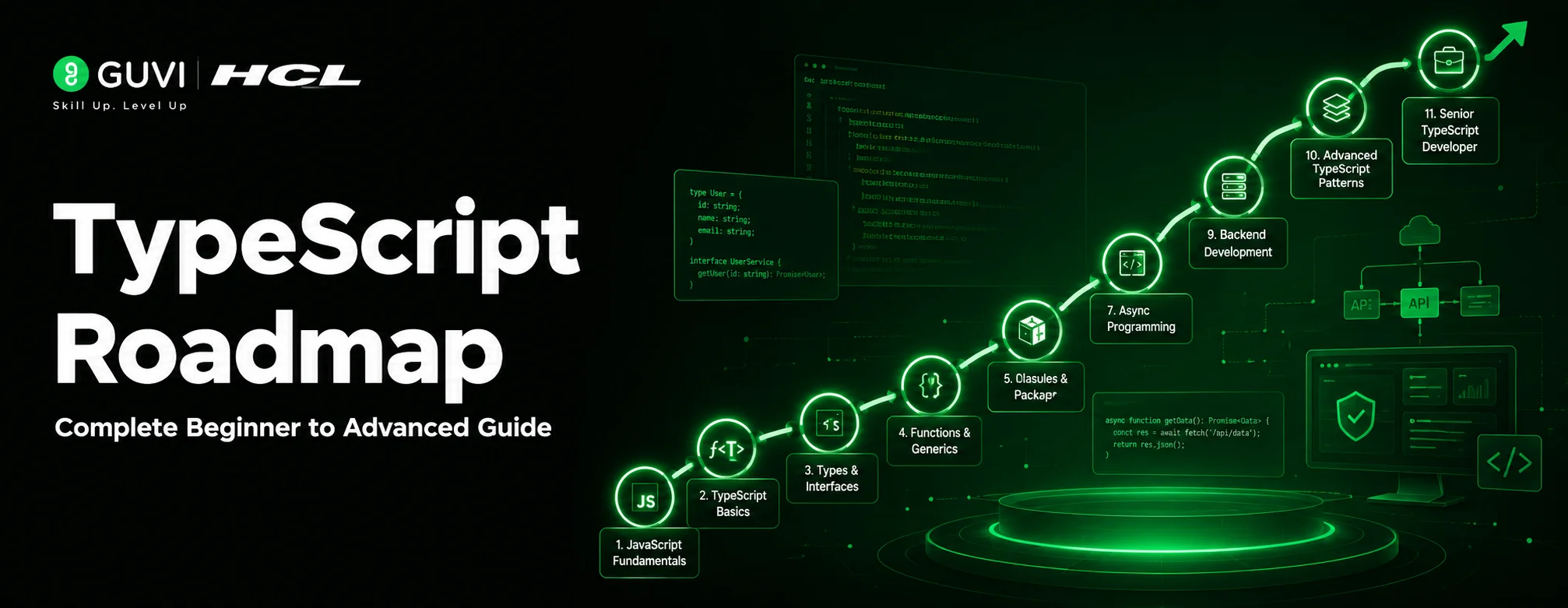
TypeScript Roadmap 2026: Complete Beginner to Advanced Guide


Get In Touch For Details! Request More Information
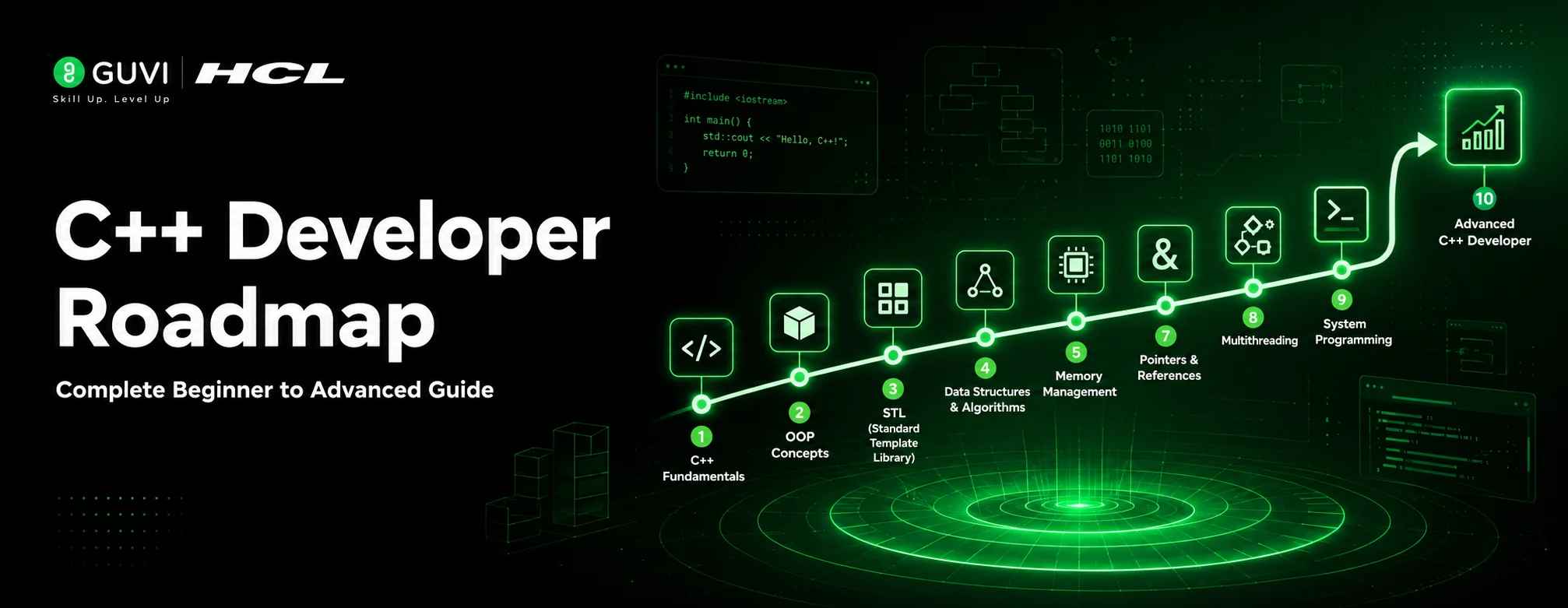
C++ Developer Roadmap 2026: Complete Beginner to Advanced Guide
Aug 04, 2026 4 Min Read 1750 Views
(Last Updated)
“C++ is outdated now.”
You’ve probably heard this from many people in tech.
The Reality is Different!
Even in 2026, C++ continues to power some of the most performance-critical technologies in the world including:
- Game engines
- Embedded systems
- Operating systems
- Finance platforms
- Real-time applications
In fact, C++ still remains one of the most widely used programming languages for high-performance software development and problem solving.
This C++ Developer Roadmap focuses on practical projects, modern industry skills, real-world tools, and career-focused learning instead of outdated textbook theory.
Table of contents
- TL;DR Summary
- C++ DEVELOPER ROADMAP
- Phase 1: Understanding C++ Development
- Phase 2: Building Core C++ Fundamentals
- Phase 3: Learn Modern C++ Concepts
- Phase 4: Choosing Your C++ Specialization
- Phase 5: Core Skills & Tools Every C++ Developer Must Know
- Phase 6: Build Projects Based on Your Specialization
- Phase 7: Becoming Industry Ready
- What is C++ Developer Salary in 2026?
- Conclusion
- FAQs
- Is C++ still worth learning in 2026?
- Is C++ difficult for beginners?
- What is the best roadmap to learn C++ in 2026?
- What are the best projects for C++ beginners?
- Is C++ good for game development?
- How long does it take to learn C++?
- Which companies still use C++?
- Is C++ better than Python?
- What is STL in C++?
- Can I get a job after learning C++?
TL;DR Summary
- This C++ Developer Roadmap helps you understand what to learn in 2026.
- It covers core programming fundamentals and modern C++ concepts.
- It explains important areas like real-world projects, tools, game development, and system programming.
- It also highlights career paths such as software development, game development, embedded engineering, and competitive programming.
- Overall, this roadmap helps you focus on the right C++ skills and technologies step by step.
C++ DEVELOPER ROADMAP
Phase 1: Understanding C++ Development
What is C++?
C++ is a powerful programming language used for building fast and high-performance software. It is widely used in game development, operating systems, embedded systems, and real-time applications. A C++ developer commonly builds applications that require strong memory management, fast execution, and system-level programming.
Why is C++ Still in Demand in 2026?
Performance Dominance
C++ is still heavily used in industries where speed and efficiency matter the most.
Massive Infrastructure
Many operating systems, browser engines, and large-scale platforms still rely on C++.
Active Evolution
Modern C++ continues to evolve with updates like C++20, C++23, and upcoming C++26 features.
Industry Popularity
C++ still consistently ranks among the world’s most popular programming language
Understanding Basic C++ Syntax
| #include using namespace std; int main() { cout << “Hello, C++ Developer!”; return 0; } |
This simple example shows the basic structure of a C++ program and how output is displayed on the screen.
The name “C++” itself was inspired by the ++ operator in C, which means “increment.” So the name literally means “C but improved.”
Interestingly, many developers once believed C++ would disappear with newer languages, but decades later it is still heavily used in game engines, finance systems, browsers, and operating systems.
Phase 2: Building Core C++ Fundamentals
Before building advanced projects or jumping into modern C++ concepts, every C++ developer first needs to get comfortable with the core fundamentals. This is the phase where you slowly start understanding how C++ actually works behind the scenes.
Don’t worry if some concepts feel confusing at first. Every strong C++ developer once struggled with pointers, memory, and OOP concepts too.
Take it step by step and focus on understanding the basics properly instead of rushing ahead.
Phase 3: Learn Modern C++ Concepts
Once your basics become strong, the next step in this C++ Developer Roadmap is learning modern C++ concepts that real developers use in today’s industry. This is where C++ starts feeling more powerful, efficient, and much cleaner to work with.
Don’t try to master every modern C++ feature at once. Start using these concepts slowly while building projects, and over time your coding style will naturally become more efficient and industry-ready.
Explore: C++ Programming Interview Questions and Answers
Quick Skill Check Before Choosing Your Specialization
Before moving into a specific C++ career path, make sure you’re comfortable with these core concepts:
| Skill | Comfortable With It? |
| Variables & Data Types | ☐ |
| Loops & Functions | ☐ |
| Pointers & References | ☐ |
| OOP Concepts | ☐ |
| STL Basics | ☐ |
| Memory Management | ☐ |
| Modern C++ Basics | ☐ |
If most of these concepts feel comfortable, you’re now ready to explore the C++ specialization paths based on your interests and career goals.
Phase 4: Choosing Your C++ Specialization
One of the biggest advantages of learning C++ Developer Roadmap is that it opens doors to multiple career paths.
What are the Popular C++ Career Paths?
Game Development
Build high-performance games and game engine systems.
System Programming
Work on operating systems, compilers, and low-level software.
If you are interested in operating systems and low-level development, understanding concepts like time-sharing and real-time operating systems can be very helpful.
Embedded Systems
Develop software for hardware devices, IoT, and robotics.
Competitive Programming
Focus on DSA, algorithms, and advanced problem solving.
Performance Engineering
Optimize large-scale applications for speed and efficiency.
Phase 5: Core Skills & Tools Every C++ Developer Must Know
As you start building real-world C++ projects, this C++ Developer Roadmap also introduces the essential tools developers use daily for coding, debugging, project management, and collaboration.
| Tool | Why do these tools matter? |
| CMake | Managing and building C++ projects |
| Git & GitHub | Version control and collaboration |
| VS Code / CLion | Writing and managing code |
| GDB | Debugging C++ applications |
| STL | Faster problem solving |
| Linux | Important for system-level development |
| Valgrind | Memory debugging and optimization |
| Unreal Engine | C++ game development |
Pro Tip
Start with Git, STL, Linux, and debugging tools first, then slowly explore advanced tools based on your specialization.

Phase 6: Build Projects Based on Your Specialization
The best way to improve your C++ skills is by building projects. Follow all the steps of this C++ Developer Roadmap. Projects help you understand how logic, debugging, memory management, and real-world development actually work together.
- 2D Racing Game
- Mini Game Engine
System Programming
- File Compression Tool
- Mini Shell Terminal
Embedded Systems
- Smart Home Simulator
- IoT Sensor Dashboard
Competitive Programming
- DSA Visualizer
- STL Practice Toolkit
Performance Engineering
- Multithreaded Chat Server
- Memory Optimization Tool
EXPLORE: Top 9 C++ Project Ideas with Source Code
Start with smaller projects first instead of directly building advanced systems. The more projects you build, the more comfortable you become with real-world C++ development.
Phase 7: Becoming Industry Ready
As you move closer to real-world development, focus on improving your practical skills and developer profile alongside coding.
- Build a strong GitHub portfolio
- Practice DSA and problem solving regularly
- Participate in coding contests
- Learn debugging and optimization
- Prepare for technical interviews
If you are planning to enter the gaming industry, practicing game developer interview questions and answers can help you better understand industry expectations.
- Explore open-source contributions
Master C++ from basics to advanced concepts with this free beginner-friendly C++ tutorial designed for practical learning and coding practice.
You do not need to master everything at once. Stay consistent, keep building projects, and your skills will improve naturally over time.
Pointers, memory management, OOP, DSA — this roadmap lays out exactly what to learn, but mastery comes from solving problems repeatedly. HCL GUVI’s Code Kata gives you structured C++ coding challenges from beginner to advanced, matching every phase of this roadmap.
What is C++ Developer Salary in 2026?
- Freshers: ₹4 LPA – ₹8 LPA
- Mid-Level Developers: ₹10 LPA – ₹20 LPA
- Performance / System Engineers: ₹25 LPA+
- Game & Embedded Developers: Salary varies based on specialization and experience
Developers with strong C++ fundamentals, problem-solving skills, and real-world project experience are still highly valued in performance-focused industries.
Not Sure Where to Start Learning C++ From?
The best way to gain real development experience is by learning step by step, building projects, and working with modern development tools used in the industry.
EXPLORE FULL-STACK DEVELOPMENT COURSE BY HCL GUVI
Conclusion
This C++ Developer Roadmap is not about learning everything quickly. It is about building strong fundamentals, improving problem-solving skills, and growing step by step through real projects and practical learning.
C++ may feel challenging in the beginning, but the skills you build while learning it can help you throughout your entire development career. Stay consistent, keep building, and your progress will naturally improve over time.
FAQs
Is C++ still worth learning in 2026?
Yes, C++ is still widely used in game development, embedded systems, system programming, finance, robotics, and high-performance software development.
Is C++ difficult for beginners?
C++ has a slightly steeper learning curve, but it helps developers build very strong programming and problem-solving fundamentals.
What is the best roadmap to learn C++ in 2026?
The best C++ roadmap includes fundamentals, OOP, STL, modern C++ concepts, projects, debugging tools, and specialization-based learning.
What are the best projects for C++ beginners?
Beginners can start with projects like banking systems, mini games, file management systems, DSA visualizers, and shell terminals.
Is C++ good for game development?
Yes, C++ is one of the most important languages in game development and is heavily used in modern game engines.
How long does it take to learn C++?
With regular practice and project building, beginners can learn core C++ concepts within a few months.
Which companies still use C++?
Companies working in gaming, operating systems, finance, browsers, robotics, and embedded systems still heavily use C++.
Is C++ better than Python?
C++ offers better performance and low-level control, while Python is generally easier and faster for beginners to learn.
What is STL in C++?
STL (Standard Template Library) provides ready-to-use data structures and algorithms that help developers solve problems more efficiently.
Can I get a job after learning C++?
Yes, strong C++ skills combined with projects, DSA, and problem-solving can help you prepare for software development and system programming roles.
Success Stories

About the Author
Reemsha Khan
Always been a storyteller at heart. Now, I turn complex topics into simple, easy-to-understand stories through content. Hope you find it helpful.
View all posts by Reemsha Khan
Connect with me @










Did you enjoy this article?