


Robotics Process Automation Articles
Selenium vs RPA: Battle Of The Best Automation Technologies
Robotics and Artificial Intelligence – A Comprehensive Look
How to Become a Robotics Engineer: A Beginner's Guide [2026]


Get In Touch For Details! Request More Information
Roles and Responsibilities of RPA Developer
Jun 17, 2026 6 Min Read 8822 Views
(Last Updated)
Automation is no longer limited to large tech teams. Today, banks, IT companies, finance teams, HR departments, and customer support teams use bots to complete repetitive work faster and with fewer errors.
That is where an RPA Developer comes in. An RPA Developer builds software bots that can handle rule-based tasks such as invoice processing, email updates, data entry, report generation, and employee onboarding.
This career is becoming important because companies want to save time, improve accuracy, and let employees focus on work that needs human thinking. In this blog, we will understand what RPA is, what an RPA Developer does, the roles and responsibilities, skills required, salary range, hiring companies, and real-world examples.
Read the full blog to learn how you can start a career in RPA development.
TL;DR:
- RPA developers build software bots that automate repetitive business tasks and reduce manual effort.
- Their work includes problem identification, requirement gathering, bot development, testing, deployment, and maintenance.
- Key RPA roles include RPA Developer, RPA Engineer, Technical Lead, Consultant, Administrator, and Business Analyst.
- Important skills include programming, RPA tools, SDLC knowledge, problem-solving, planning, and communication.
- Companies like IBM, UiPath, Infosys, Deloitte, EY, KPMG, Capgemini, and Cognizant hire RPA professionals.
Table of contents
- What is RPA?
- Roles and Responsibilities of RPA Developer
- Responsibilities of RPA Developer
- Various Roles of RPA Developer
- Skills Required for an RPA Developer
- How to Start Your Career as an RPA Developer
- Understand how business processes work
- Learn one programming language
- Choose one RPA tool first
- Create a small project portfolio
- Learn debugging and documentation early
- Companies Hiring RPA Developer
- Real-World Examples of RPA Development
- Example 1: Invoice Processing in a Finance Team
- Example 2: Employee Onboarding in an HR Department
- Common Mistakes Beginners Make in RPA
- Conclusion
- FAQs
- Q1. Does an RPA developer need coding?
- Q2. What is the salary of an RPA developer?
- Q3. Can a person from a non-technical background become an RPA developer?
- Q4. How long will it take to learn RPA?
What is RPA?
Robotics Process Automation(RPA) is a technology that uses robotic software known as bots to automate repetitive tasks. It is a process of building the software bots according to the requirements of the tasks.
For example, after creating an account on a website we get a confirmation email saying that we successfully created our account on that website. This email is sent by automatic email bot after confirming our registration. Nowadays, every website has this feature, it is one of the examples of the vast usage of RPA. Now that we know what RPA is, let’s dive into the responsibilities of a RPA developer.
Roles and Responsibilities of RPA Developer
- UiPath’s 2022 State of the RPA Developer Report found that three in five developers moved into RPA from another role.
- About 53% of developers said their transition into RPA was easy.
- This highlights how RPA development can be a practical career switch for software developers and other IT professionals.
Responsibilities of RPA Developer
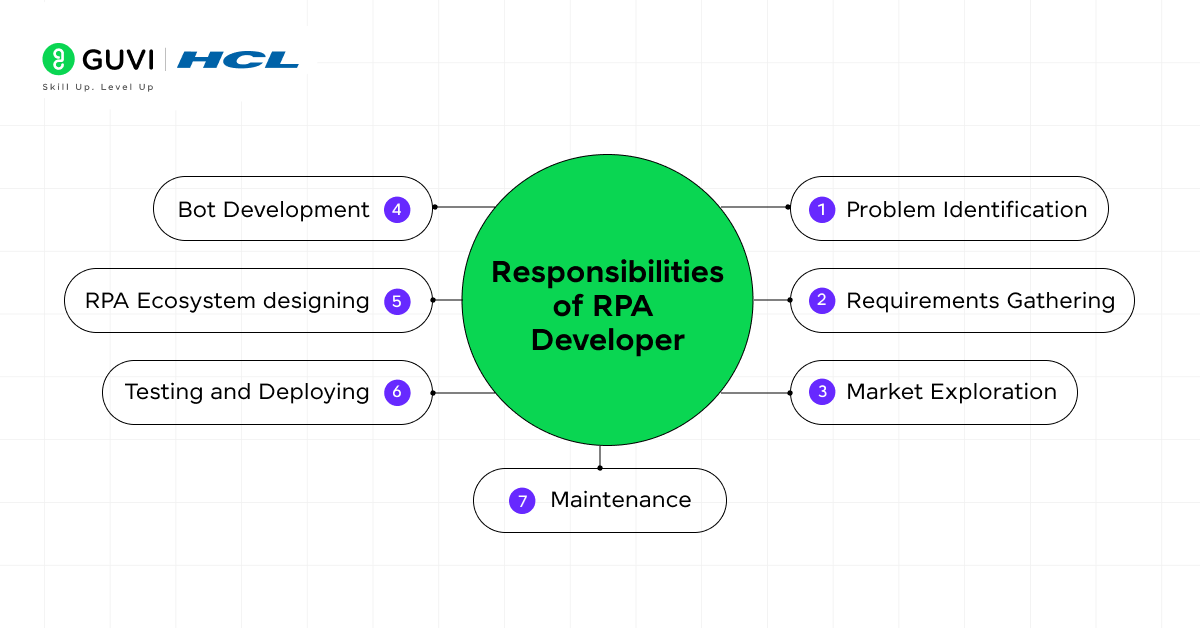
The responsibilities of a RPA developer are from identifying the problem to building and deploying the automation solution. Let’s briefly look into it.
- Problem Identification
The first responsibility of an RPA developer is to identify a problem to automate it. There are so many problems in the world that need to be addressed, but every problem is not able to be automated. The developer needs to find a problem that a human is repetitively doing. The problem needs to be worthy and at the same time, it should save time by automating it.
- Requirements Gathering
Once the developer identifies a problem, their second responsibility is to gather requirements for the approached solution. Requirements gathering is an important responsibility, where they decide whether it is a small or a big project and in the future when they work they need to meet the requirements gathered in this step. If it is a small project, they will gather a small team, relevant technical resources will be small and vice versa for a big project.
- Market Exploration
The third important responsibility is market exploration. Exploring the market is a crucial responsibility where they find the needs and potential customers for the project. A detailed market exploration is essential for any project before building it. According to this, they will decide the number of potential customers/clients and the budget they can allocate.
- Bot Development
The first and most important responsibility of an RPA developer is to develop an automatic robotic system. This responsibility requires you to be quite technical, but trust me it’s worth it. As a developer, you will work on building an automatic bot from scratch that meets the requirements gathered before. Developers must know their customers i.e., whether there will be a tech whiz(company client) or a normal user and build bots according to their level of technology.
- RPA Ecosystem designing
The first responsibility is to design a RPA ecosystem. This responsibility will require you to be a technical expert. An RPA ecosystem is a whole workflow of how the customer accesses the bot. Starting from the user interface that a user interacts with, backend where the automatic bot works, to the service it interacts with. This entire ecosystem will be developed by a set of RPA developers who will be specialized in each area.
- Testing and Deploying
The next comes testing and deploying. Before publishing the project to the market, every project must go through the testing phase. During this testing phase, the project will be tested under various unexpected conditions to check its durability and reliability. It is also one of the responsibilities of an RPA developer. Once the testing is successfully done, it will then be deployed and ready for use.
- Maintenance
The last responsibility of an RPA developer is to maintain the software bot in order to stay consistent. There is no guarantee that a project will always be in the same condition, so they need to monitor it frequently to avoid unexpected errors and downtime.
If you are interested in starting your career as a RPA developer, don’t waste any more of your time. Enroll in HCL GUVI’s Advanced RPA course to get globally recognized certifications and hands-on experience in building automated systems.

Various Roles of RPA Developer
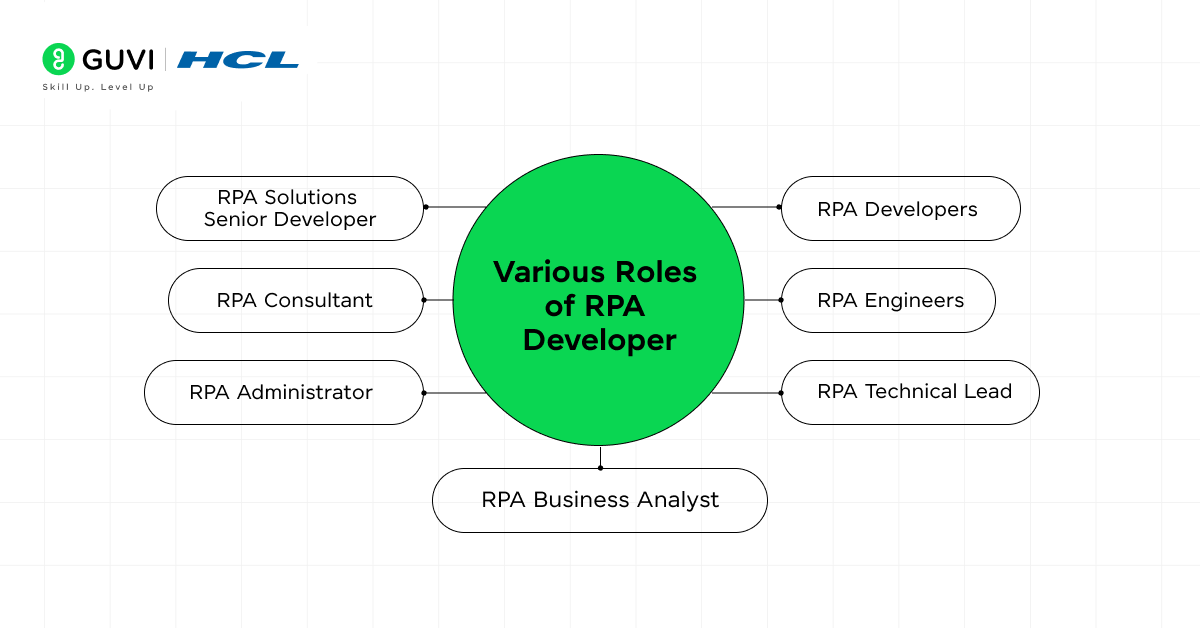
According to the task assigned to a developer, an RPA developer will perform different roles. Let’s see an overview of the roles that an RPA developer typically performs.
- RPA Developers are the person who builds and develops the software bot. They are the technical people who take care of building the user interface and backend apis.
- Average Salary in India: 4-7 LPA
- RPA Engineers design, develop and implement the RPA ecosystem. RPA engineers are similar to RPA developers but they work purely on developing the automation system from planning, designing, implementing, testing and deploying.
- Average Salary in India: 5-7 LPA
- RPA Technical Lead guides a team and oversees the technical aspects of the project. They work closely with both RPA developers and engineers. They provide detailed instructions on what the project is about and keep track of project progress along with its requirements.
- Average Salary in India: 9.6-29 LPA
- RPA Solutions Senior Developer takes responsibility for more complex automation systems. Senior developers are responsible for handling larger projects. They use RPA tools like UiPath, Automation Anywhere or Blue Prism.
- Average Salary in India: 11-33.6 LPA
- RPA Consultant advises organizations on RPA strategies and helps in identifying potential opportunities for automation. They assess the current workflow in an organization and evaluate potential use cases for automation.
- Average Salary in India: 4-21 LPA
- RPA Administrator manages and maintains the RPA infrastructure and software bot’s performance. They monitor the security, scalability and availability of the bot. They also help in troubleshooting and resolving technical issues.
- Average Salary in India: 5-7 LPA
- RPA Business Analyst works closely with stakeholders and determines where RPA brings more value. They identify the boring, repetitive, time-consuming tasks and make them ideal for automation.
- Average Salary in India: 4.4-18 LPA
Once you enter into a company as a RPA developer, these are the possible positions you will be assigned to. Now that we have seen the roles and responsibilities, as a next step we will explore the skills required to become a RPA developer.
Skills Required for an RPA Developer
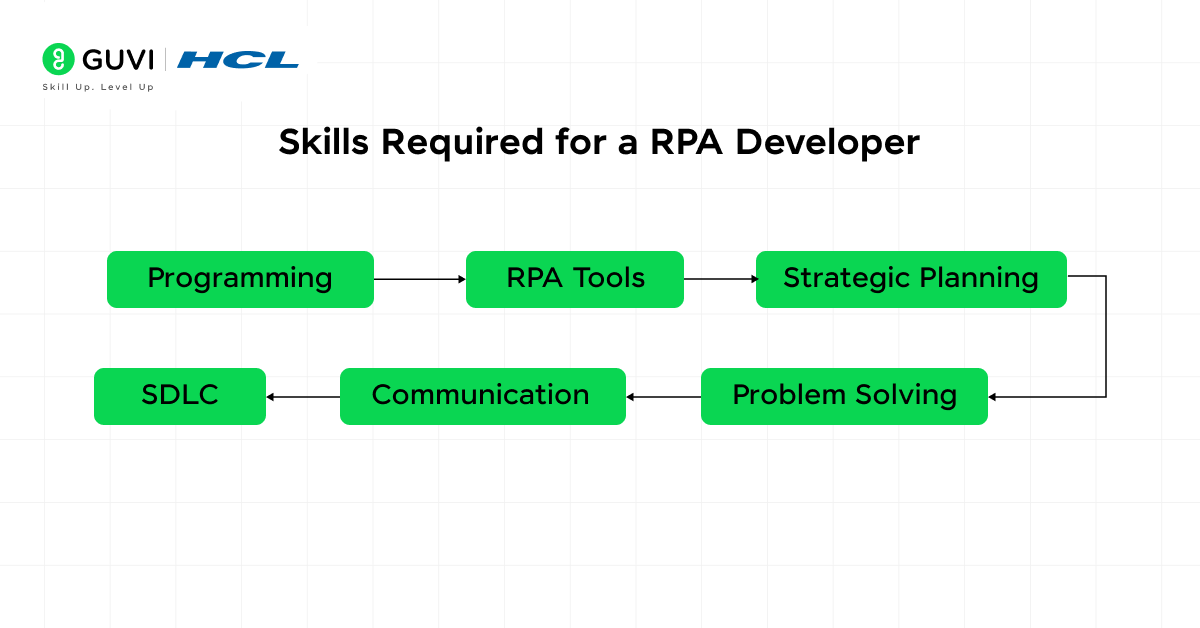
To become a RPA developer you need both technical and non-technical skills. In this section, we will see an overview of both the skills.
- Programming: RPA development is all about technical skills, it is mandatory to learn programming in any of the languages such as C, C++, Python and Java.
- RPA Tools: This helps in developing automation systems easier.
- Strategic Planning: It is the ability to plan the execution timeline and strategy for the automation system solution.
- Problem Solving: It is the ability to solve problems using automation systems.
- Communication: It requires communicating with teammates, customers and stakeholders.
- SDLC: Building an automated system is similar to building a software system, so the knowledge of the software development life cycle(SDLC) helps in following the development process.
How to Start Your Career as an RPA Developer
Starting a career as an RPA Developer becomes easier when you follow a practical learning path instead of jumping directly into tools.
1. Understand how business processes work
Before building bots, learn how repetitive tasks move inside a company.
- Study simple workflows like invoice approval, employee onboarding, form filling, and report generation.
- Observe where people repeat the same task every day.
- Learn how data moves between emails, spreadsheets, CRMs, ERPs, and internal systems.
- Focus on tasks that are rule-based, time-consuming, and easy to document.
2. Learn one programming language
RPA tools make automation easier, but programming gives you better control.
- Start with Python, Java, C#, or Java.
- Learn variables, loops, conditions, functions, and error handling.
- Practice file handling, Excel automation, web scraping basics, and API concepts.
- Build small scripts before moving to full RPA workflows.
3. Choose one RPA tool first
Beginners often try too many tools at once. That slows learning.
- Start with UiPath, Automation Anywhere, or Blue Prism.
- Learn workflow creation, selectors, variables, activities, triggers, and bot scheduling.
- Practice automating simple tasks like reading Excel data, sending emails, and extracting PDF content.
- Build one complete project instead of only watching tutorials.
4. Create a small project portfolio
A portfolio helps you show practical ability to recruiters.
- Build an invoice data extraction bot.
- Create an email automation bot.
- Make a report generation bot using Excel.
- Build a form-filling bot for repetitive web tasks.
- Add short project notes explaining the problem, tools used, workflow, and result.
5. Learn debugging and documentation early
Real RPA work is not only about building bots. It is also about fixing and maintaining them.
- Track bot errors clearly.
- Document workflow steps.
- Mention credentials, input files, exception rules, and output formats.
- Keep screenshots or process maps for future reference.
- Write simple notes so another developer can understand your bot quickly.
Companies Hiring RPA Developer
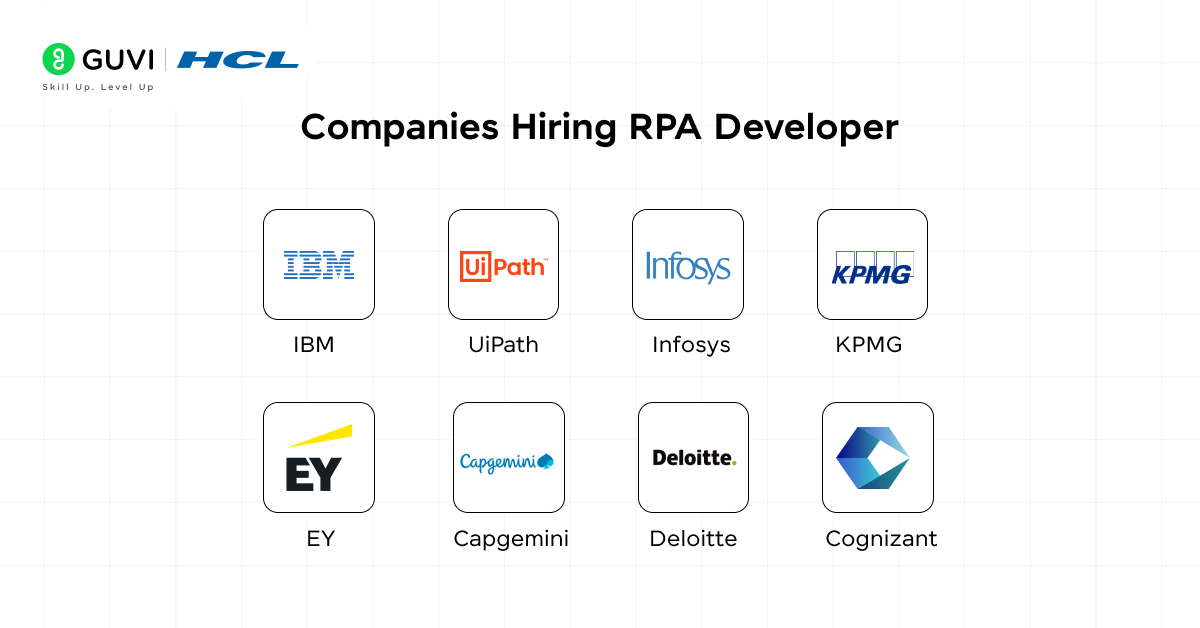
Due to the recent advancement in the AI field, there is a lot of potential to automate tasks using AI agents. Many companies are incorporating AI agents for repetitive tasks. Because of this, there are more opportunities. Let’s look into some major companies that hire RPA developers.
- IBM: Focus on combining AI and Machine learning with RPA solutions.
- UiPath: They provide user-friendly automation platforms
- Infosys: They provide end-to-end RPA services to organizations.
- KPMG: They are specialized in RPA consulting and helping clients to automate their workflow.
- EY: They use RPA to improve business operations and integrate with data analytics to deliver advanced insights.
- Capgemini: They focus mainly on sustainable automation for smart decision-making.
- Deloitte: They deliver end-to-end RPA solutions combined with AI and machine learning.
- Cognizant: They focus on implementing RPA on industry-specific solutions.
Real-World Examples of RPA Development
“`html id=”i6t2a9″- India’s technology sector is expanding with AI and automation-led demand, as Nasscom projected it to reach $315 billion in FY2026, with AI becoming part of nearly every tech proposal globally.
Example 1: Invoice Processing in a Finance Team
A finance team can use RPA to read invoice details from emails, extract data from PDF files, validate vendor information, and update the accounting system.
This reduces manual data entry and speeds up payment processing. The RPA developer builds the bot, handles exceptions, and monitors failed invoice cases.
Example 2: Employee Onboarding in an HR Department
An HR team can use RPA to create employee records, send welcome emails, assign onboarding documents, and update payroll systems.
This improves consistency and saves time for HR executives. The RPA developer connects multiple systems and ensures every step follows company rules.
Common Mistakes Beginners Make in RPA
- Automating an unclear process: Beginners often automate a process before understanding every step. Document the workflow first, then decide whether it is suitable for automation.
- Ignoring exception handling: Bots can fail when data is missing, formats change, or applications respond slowly. Add clear exception handling so the bot does not stop unexpectedly.
- Skipping testing: A bot may work once but fail with different inputs. Test the bot with normal, incorrect, missing, and edge-case data before deployment.
- Depending only on drag-and-drop tools: RPA tools are helpful, but complex projects need logic and scripting skills. Learn programming basics along with tool usage.
- Poor documentation: Many beginners build bots without proper notes. Document requirements, design decisions, credentials, schedules, and error-handling steps for future maintenance.
Conclusion
RPA development is a strong career option for anyone who wants to work at the intersection of automation, software, and business operations. An RPA Developer helps companies automate repetitive tasks, reduce manual errors, and improve workflow speed.
The role requires technical skills such as programming, RPA tools, SDLC knowledge, testing, and deployment. It also needs problem-solving, communication, and process understanding because every bot must solve a real business problem.
As more companies adopt automation and AI-led workflows, the demand for skilled RPA professionals is expected to grow. Start with the basics, learn popular RPA tools, build small automation projects, and keep improving with practical experience.
FAQs
Q1. Does an RPA developer need coding?
Even though coding is programming skills and languages are mandatory to become an RPA developer. Due to the rapid advancement in no coding platforms, you can learn tools and techniques to build automation solutions.
Q2. What is the salary of an RPA developer?
The national average salary of an RPA developer ranges from 5L to 16L depending on your role, skillset and experience.
Q3. Can a person from a non-technical background become an RPA developer?
Yes! With an understanding of basic programming and the RPA tools for building automation solutions, anyone with a non-technical background can become an RPA developer.
Q4. How long will it take to learn RPA?
If you are a complete beginner, it will take approximately from 4 to 6 months of consistent learning starting with basics. If you are a technical person and want to switch careers, it will take only a few weeks depending on your technical level in programming.
Success Stories

About the Author
Vaishali
I'm a seasoned writer with four years of experience across technical, non-technical, and just about every genre or niche you can imagine. Adaptable and curious, I enjoy exploring new topics and making information engaging and easy to understand. Fueled by a steady stream of tea, I approach each project with creativity, reliability, and genuine enthusiasm for storytelling.
View all posts by Vaishali
Connect with me @

Did you enjoy this article?
Comments












Thank you for sharing your expertise and insights through this blog. Whether it's offering practical advice, sparking inspiration, or fostering meaningful discussions, your articles never fail to leave a lasting impression. Your dedication to providing quality content is evident, and it's greatly appreciated by your readers.