


Robotics Process Automation Articles
Selenium vs RPA: Battle Of The Best Automation Technologies
Robotics and Artificial Intelligence – A Comprehensive Look
How to Become a Robotics Engineer: A Beginner's Guide [2026]


Get In Touch For Details! Request More Information
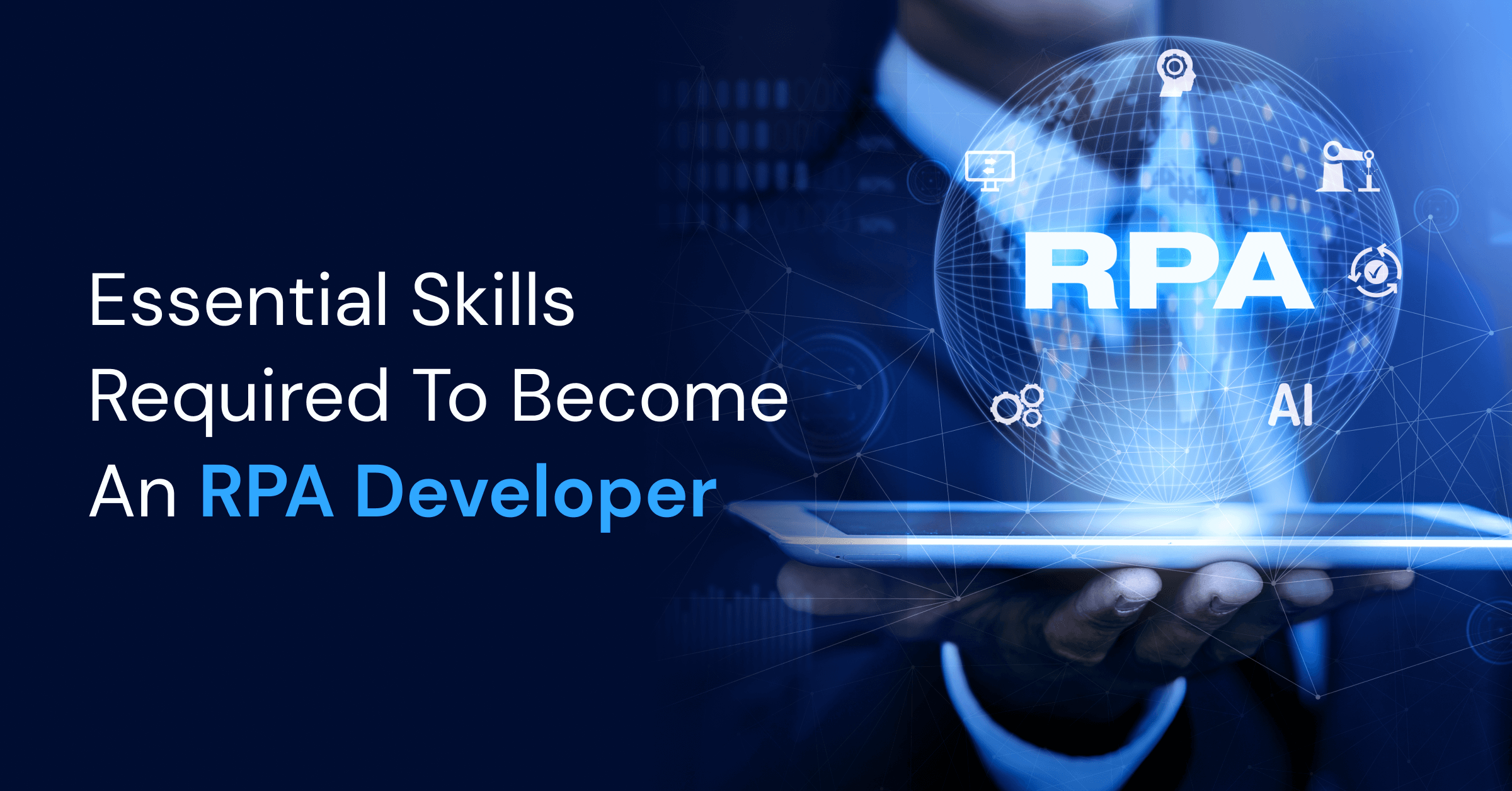
15 Essential RPA Developer Skills You Need in 2026
Jun 10, 2026 7 Min Read 23689 Views
(Last Updated)
Robotic Process Automation is transforming how businesses operate across banking, healthcare, retail, and IT services. RPA bots now handle everything from invoice processing and employee onboarding to compliance reporting and customer service. This explosive growth means RPA developer skills are in higher demand in 2026 than ever before — and the role itself has evolved significantly beyond basic bot building. This guide covers all 15 essential RPA developer skills you need, the tools to master, the career path ahead, and a roadmap to get there.
Table of contents
- TL;DR Summary
- What Does an RPA Developer Do?
- Why RPA Developer Skills Matter in 2026
- All 15 RPA Developer Skills at a Glance
- Technical RPA Developer Skills
- Strategic Planning Skills
- Workflow Design Skills
- Understanding of Document Object Model (DOM)
- Programming Language Skills
- RPA Platform Expertise
- Data Analytics and SQL Skills
- Debugging and Testing of Bots
- Analytical and Planning RPA Developer Skills
- Strong Analytical Skills
- Business Process Management (BPM)
- Problem-Solving Abilities
- Soft Skills for RPA Developers
- User Experience Design Basics
- Communication Skills
- New RPA Developer Skills for 2026: AI, Cloud, and Hyperautomation
- AI and Machine Learning Integration
- Cloud RPA and SaaS Platform Skills
- Hyperautomation Awareness
- Top RPA Tools and Platforms to Learn
- RPA Developer Career Path and Progression
- How to Build RPA Developer Skills: Step-by-Step Roadmap
- Real-World Use Cases
- Common Mistakes to Avoid
- 💡 Did You Know?
- Conclusion
- FAQs
- Is RPA simple to learn?
- Is RPA based on Python?
- Is RPA a viable career option?
- Is there a demand for RPA developers?
- Do we need coding knowledge for RPA?
TL;DR Summary
- What this covers: 15 essential RPA developer skills, tools, career path, salary data, and a step-by-step learning roadmap.
- Technical skills: Programming languages (Python, Java, C#), RPA platforms (UiPath, Automation Anywhere, Blue Prism), workflow design, DOM understanding, SQL and data analytics.
- Analytical and planning skills: Strategic planning, process analysis, business process management, debugging, and testing.
- New in 2026: AI and ML integration with RPA bots, cloud RPA skills, and hyperautomation awareness are now employer expectations, not optional extras.
- Salary: Entry-level RPA developers in India earn ₹4–5.5 LPA. Senior professionals earn ₹10–17 LPA.
- Career path: Junior RPA Developer → RPA Developer → Senior RPA Developer → RPA Architect → Centre of Excellence (CoE) Lead.
What Does an RPA Developer Do?
An RPA developer designs, builds, tests, and deploys software bots that automate repetitive, rule-based tasks. They work closely with business analysts to identify automation opportunities, translate business requirements into bot workflows, and maintain those bots as systems and processes change.
Key day-to-day responsibilities of an RPA developer includes:
| Responsibility | What It Involves |
|---|---|
| Process Analysis | Identify which business processes are suitable for automation |
| Bot Development | Build and configure automation workflows using RPA tools |
| Integration | Connect bots with enterprise systems like SAP, Salesforce, or ERP tools |
| Testing and Debugging | Test bots thoroughly and fix errors before deployment |
| Documentation | Create Process Design Documents (PDD) and Solution Design Documents (SDD) |
| Maintenance | Monitor deployed bots and update them when business processes change |
| Stakeholder Communication | Explain automation outcomes to non-technical business teams |
Why RPA Developer Skills Matter in 2026
The global RPA market was valued at $3.7 billion in 2023 and is projected to reach $23.9 billion by 2030. India is a primary market for RPA talent, with companies like TCS, Infosys, Wipro, Accenture, and Capgemini actively hiring certified RPA developers. Building strong RPA developer skills today positions you for one of the fastest-growing technology careers in the country.
All 15 RPA Developer Skills at a Glance
| # | RPA Developer Skill | Category | Priority |
|---|---|---|---|
| 1 | Strategic Planning | Analytical | Must-have |
| 2 | Strong Analytical Skills | Analytical | Must-have |
| 3 | Problem-Solving and Debugging | Technical | Must-have |
| 4 | Programming Languages | Technical | Must-have |
| 5 | Workflow Design | Technical | Must-have |
| 6 | Document Object Model (DOM) | Technical | Must-have |
| 7 | Data Analytics and SQL | Technical | Must-have |
| 8 | RPA Platform Expertise | Technical | Must-have |
| 9 | Business Process Management | Analytical | Must-have |
| 10 | Testing and Quality Assurance | Technical | Important |
| 11 | User Experience Design Basics | Soft | Important |
| 12 | Communication Skills | Soft | Must-have |
| 13 | AI and ML Integration | Emerging (2026) | Important |
| 14 | Cloud RPA and SaaS Platforms | Emerging (2026) | Important |
| 15 | Hyperautomation Awareness | Emerging (2026) | Good to have |
Technical RPA Developer Skills
These are the hard skills every RPA developer needs to build, deploy, and maintain automation bots professionally.

1. Strategic Planning Skills
Strategic planning is the foundation of every successful RPA project. Without a clear roadmap, automation efforts waste time and budget on the wrong processes. RPA developers need to:
- Define goals and KPIs for each automation initiative
- Map out end-to-end workflows before writing a single line of bot logic
- Identify dependencies between automated processes and existing systems
- Build an RPA roadmap that prioritises processes by ROI and complexity
A clear strategic plan prevents the most common RPA failure — automating the wrong processes first and running out of budget before the high-value ones get touched.
2. Workflow Design Skills
Workflow design is the technical translation of a business process into a structured, executable bot logic. It is one of the most fundamental RPA developer skills because even the most powerful platform cannot compensate for a poorly designed workflow.
Core workflow design concepts every RPA developer must know:
| Concept | What It Covers |
|---|---|
| Decision Diamonds | Binary decision points in a flow |
| Decision Trees | Branching logic with multiple outcomes |
| Decision Tables | Matrix-based rule management for complex conditions |
| State Machines | Managing bots with multiple persistent states |
| UML Diagrams | Standardised notation for system design |
| BPMN Notation | Business Process Model and Notation for process mapping |
Workflows must be designed with 100% accuracy — every possible path covered, every infinite loop identified and resolved, and all edge cases tested before deployment.
3. Understanding of Document Object Model (DOM)
RPA bots frequently interact with web pages and web applications. When the RPA recorder cannot identify a page element reliably — especially on dynamic JavaScript-heavy pages — understanding the DOM becomes essential. An RPA developer who knows how to inspect the page source, identify stable element selectors, and handle dynamic content will build bots that are far more robust than one who relies entirely on the recorder.
4. Programming Language Skills
Even though RPA platforms are low-code, RPA developer skills must include at least one programming language. As automations grow in complexity, custom scripting becomes necessary for:
- Processing complex data transformations
- Calling APIs and web services
- Handling advanced exception logic
- Writing custom libraries for reusable functionality
| Language | Why RPA Developers Need It |
|---|---|
| Python | AI/ML integration, custom scripts, data processing libraries |
| Java | Enterprise integrations, backend system interactions |
| C# | Used natively in UiPath; required for advanced custom activities |
| VB.NET | Used in UiPath Studio for expressions |
| SQL | Database queries, data extraction, transformation logic |
Python is the most versatile choice for RPA developers in 2026 because it bridges RPA with AI, machine learning, and data analytics workflows.
5. RPA Platform Expertise
Hands-on experience with at least one major RPA platform is the most direct signal hiring managers look for. The three dominant platforms are:
- UiPath — market leader, most widely used in India, has a free community edition and its own certification track
- Automation Anywhere — strong in enterprise and cloud deployments, uses a web-based development environment
- Blue Prism — enterprise-focused, strong process governance features, commonly used in banking and finance
6. Data Analytics and SQL Skills
Most RPA bots retrieve and process data from relational databases. SQL is the standard way to query that data efficiently. Beyond basic queries, RPA developers should be comfortable with:
- Writing SELECT, JOIN, UPDATE, and INSERT statements
- Using regular expressions to extract structured data from unstructured text (dates, account numbers, addresses)
- Basic string operations for text-based input/output processing
- Using Python data libraries like Pandas for transforming complex datasets before passing them to a bot
7. Debugging and Testing of Bots
Bots do not always work correctly the first time. Debugging is not just a reactive skill — it is a proactive one. Strong RPA developers write test cases before deployment and design their bots to handle exceptions gracefully.
Key debugging and testing skills for RPA developers:
- Exception handling — distinguishing between business exceptions (expected errors) and application exceptions (unexpected failures)
- Logging — writing meaningful log messages at every step so failures are traceable
- Test case design — creating test data that covers happy paths, edge cases, and failure scenarios
- Re-queuing and retry logic — handling transient failures without crashing the entire automation
Before we proceed further, it’s essential to have a solid foundation in automation testing principles and selenium basics. If you’re eager to dive deep into software testing, consider joining HCL GUVI’s Selenium Automation Testing Course. In this program, you’ll learn the fundamentals of Selenium, Python, Java, Jenkins, JMeter, API Testing, and more. Gain hands-on experience with industry-standard tools and techniques to get into a professional career focusing on the quality of Product & Process development.
Also, if you want to explore Automation Testing with Python through a Self-paced course, try HCL GUVI’s Selenium Automation with Python certification course.
Analytical and Planning RPA Developer Skills
8. Strong Analytical Skills
Before automating any process, RPA developers must analyse it thoroughly. This means:
- Reviewing processes end-to-end with the people who actually perform them
- Identifying variations between how different team members execute the same task
- Standardising inconsistent processes before automation begins
- Determining which sub-processes should be automated now vs later
Analytical skills are what separate RPA developers who deliver real business value from those who just build bots.
9. Business Process Management (BPM)
Understanding how business operations work is essential for identifying which processes will benefit from automation and which will not. RPA developers with BPM knowledge can:
- Recognise processes that are stable, high-volume, and rule-based — the ideal automation candidates
- Identify exceptions and special cases that require human escalation
- Apply methodologies like Six Sigma and Lean to eliminate waste before automating a process
- Engage directly with business stakeholders to capture accurate process requirements
10. Problem-Solving Abilities
Automation does not always go as planned. Bugs appear. Systems change. Business rules evolve. RPA developers are regularly called upon to diagnose failures under production pressure and fix them quickly without breaking related automations. Problem-solving also extends to designing resilient error-handling strategies before problems occur.
Soft Skills for RPA Developers
11. User Experience Design Basics
RPA bots are ultimately used by business teams, not developers. The interfaces and exception dashboards that developers build should be intuitive enough for a non-technical user to manage. Understanding basic UX principles — clear labels, logical flow, minimal steps — makes a practical difference in how well an automation is actually adopted by the business.
12. Communication Skills
RPA developers sit at the intersection of business and technology. They regularly communicate with:
- Business stakeholders to gather process requirements and validate automation outcomes
- IT and infrastructure teams to deploy bots and manage platform access
- Developers and architects to integrate bots with enterprise systems
- Management to report automation ROI and pipeline progress
Strong written and verbal communication skills are non-negotiable RPA developer skills for anyone aiming beyond a junior role.
New RPA Developer Skills for 2026: AI, Cloud, and Hyperautomation
These are the three emerging areas that are redefining what RPA developer skills mean in 2026. Competitors who only cover the classic 12 skills miss these entirely — and they are what employers at forward-looking companies are increasingly testing for.
13. AI and Machine Learning Integration
Modern RPA platforms now integrate with AI services to handle unstructured data — emails, PDFs, invoices, images — that classic rule-based bots cannot process. In 2026, RPA developers who can build intelligent bots using:
- OCR (Optical Character Recognition) for document processing
- NLP (Natural Language Processing) for email classification and response routing
- ML models for predictive decision-making within automation workflows
…are commanding significantly higher salaries and landing roles at product-based companies. UiPath’s AI Center and Automation Anywhere’s AARI are both platforms where AI and RPA converge.
14. Cloud RPA and SaaS Platform Skills
RPA deployments are increasingly cloud-native in 2026. UiPath Automation Cloud, Automation Anywhere Cloud, and Microsoft Power Automate are all cloud-first platforms. RPA developers who understand:
- Cloud bot deployment and orchestration
- API integration with SaaS platforms like Salesforce, SAP, ServiceNow, and Workday
- Security and compliance considerations in cloud RPA environments
…have access to a wider range of projects and enterprise clients than those who only know on-premise deployments.
15. Hyperautomation Awareness
Hyperautomation is Gartner’s term for the combination of RPA, AI, process mining, low-code platforms, and analytics into an end-to-end intelligent automation capability. In 2026, large enterprises are not just looking for RPA developers — they are looking for developers who understand how RPA fits within a broader hyperautomation strategy. You do not need to master every component, but understanding how tools like process mining (Celonis, UiPath Process Mining) and intelligent document processing plug into an RPA pipeline makes you a significantly more valuable hire.
Top RPA Tools and Platforms to Learn
| Tool | Category | Best For | Certification Available |
|---|---|---|---|
| UiPath | RPA Platform | Most widely used in India | Yes — UiPath RPA Associate |
| Automation Anywhere | RPA Platform | Cloud and enterprise deployments | Yes — Automation Anywhere Certified |
| Blue Prism | RPA Platform | Banking, finance, regulated industries | Yes — Blue Prism Developer |
| Microsoft Power Automate | Low-code RPA | Microsoft ecosystem integration | Yes — PL-500 certification |
| Python (with PyAutoGUI) | Programming | Custom scripts and AI integration | No |
| UiPath AI Center | AI + RPA | Intelligent document processing | Yes |
RPA Developer Career Path and Progression
One of the strongest aspects of building RPA developer skills is the clear career ladder available in this field.
| Level | Title | Experience | Avg. Salary |
|---|---|---|---|
| Entry | Junior RPA Developer | 0–1 year | ₹4–5.5 LPA |
| Mid | RPA Developer | 1–3 years | ₹5.5–8 LPA |
| Senior | Senior RPA Developer | 3–6 years | ₹8–17 LPA |
| Lead | RPA Architect / CoE Lead | 6+ years | ₹17–30 LPA |
Beyond the technical track, experienced RPA developers often move into RPA Business Analyst, RPA Program Manager, or Centre of Excellence (CoE) Lead roles, all of which combine domain expertise with automation strategy.
How to Build RPA Developer Skills: Step-by-Step Roadmap
This roadmap is what competitors do not provide. Most skills blogs list what to learn but not how to build those skills systematically.
| Week | Focus | What to Do |
|---|---|---|
| Week 1–2 | Foundations | Learn what RPA is, how bots work, and study a real process automation use case end-to-end |
| Week 3–4 | UiPath Basics | Install UiPath Community Edition, complete UiPath Academy’s RPA Developer Foundation path |
| Week 5–6 | Workflow Design | Practice designing BPMN flowcharts for 3 real-world processes before building any bot |
| Week 7–8 | First Bot | Build a data scraping bot, a form-filling bot, and an email automation bot |
| Week 9–10 | Programming | Learn Python basics + VB.NET expressions for UiPath; write custom activities |
| Week 11–12 | SQL and Data | Write 20 SQL queries including JOINs, WHERE filters, and GROUP BY; connect a bot to a database |
| Week 13–14 | Exception Handling | Rebuild your earlier bots with full try-catch-finally exception handling and logging |
| Week 15–16 | Certification Prep | Complete UiPath RPA Associate practice exams; take the certification exam |
| Week 17+ | AI Integration | Explore UiPath AI Center; build one bot that uses OCR or NLP for document processing |
Real-World Use Cases
HDFC Bank uses RPA bots to automate loan application processing, reducing turnaround time from 3 days to under 4 hours. The bots validate documents, cross-check credit scores, and update multiple internal systems — a direct application of workflow design, DOM interaction, and SQL querying RPA developer skills.
Infosys deploys over 1,000 bots across client engagements in HR, finance, and supply chain. Their RPA developers are specifically required to have Python scripting, UiPath certification, and BPM methodology knowledge — the exact skills covered in this guide.
Common Mistakes to Avoid
- Automating broken processes. The most expensive RPA mistake is building a bot around a process that is already inefficient or poorly defined. Before any bot is built, the process must be standardised and validated. A bot that faithfully replicates a flawed manual process just makes the flaw happen faster and at scale.
- Skipping exception handling. Many beginners build bots that work perfectly in testing but crash in production the first time they encounter an unexpected input, a slow network, or a page that loads differently. Always design exception handling before you consider a bot production-ready.
- Only learning one RPA platform. UiPath dominates the Indian market, but Blue Prism and Automation Anywhere are required at many large banking and insurance clients. Having fundamentals across two platforms makes you significantly more hireable than being limited to one.
💡 Did You Know?
- The global RPA market is projected to grow from USD 3.6 billion (approximately INR 29,800 crore) in 2023 to over USD 23 billion (approximately INR 1.9 lakh crore) by 2030, at a CAGR of 30.9%, making it one of the fastest-growing segments in enterprise software.
- According to Glassdoor India (May 2026), the top 10% of RPA developers in India earn ₹17.08 LPA or more, more than three times the average entry-level salary.
- UiPath is the most widely adopted RPA platform globally in 2026, used by over 10,000 enterprises across 90 countries, making UiPath certification the most in-demand RPA credential for Indian IT professionals.
Conclusion
There you have it! We have outlined the top 15 essential skills required to become RPA developer, which are crucial for success in this field.
Robotic Process Automation isn’t going away. RPA is being used in many industries such as healthcare, manufacturing, and retail to automate claims processing, inventory management, and invoice production. RPA is still progressing and improving the processes of those who use it correctly, and this trend isn’t going to stop anytime soon. As RPA improves, more businesses and organizations will gladly adopt it, necessitating hiring more RPA workers.
Which among the listed skills do you believe is most critical for RPA developer? Please tell us in the comments section below. We’d be delighted to hear from you!
FAQs
1. Is RPA simple to learn?
RPA is simple to learn because it does not require prior programming experience. Standard RPA tools such as UiPath, Blue Prism, and Automation Anywhere can be used to record tasks without requiring any programming knowledge, with only advanced tasks requiring programming knowledge. Most beginners can build their first working bot within a few days of starting.
2. Is RPA based on Python?
Python is the AI and machine learning programming language of choice. RPA employs software with Artificial Intelligence and Machine Learning capabilities to perform high-volume, repetitive operations. Python is widely used alongside RPA platforms for custom scripting, data processing, and building AI-powered automation components.
3. Is RPA a viable career option?
RPA is regarded as a highly effective career path in 2026. Emerging graduates can anticipate a large share of global job opportunities. Pay packages for professionals with RPA skills are comparatively higher than many other IT roles, especially when combined with certifications from UiPath, Automation Anywhere, or Blue Prism. The addition of AI skills further accelerates career growth.
4. Is there a demand for RPA developers?
Yes, significantly. RPA has grown rapidly over the last few years because it promises to replace repetitive, rule-based, manual digital operations with software robots. In India specifically, BFSI, healthcare, IT services, and manufacturing sectors are all actively hiring RPA developers. The global RPA market is projected to grow at a CAGR of 30.9% through 2030.
5. Do we need coding knowledge for RPA?
RPA does not require programming skills to get started because most platforms include drag-and-drop capabilities for recording and replaying tasks. However, coding knowledge becomes essential for advanced RPA solutions, custom activity development, API integrations, and exception handling. Python and C# are the most useful languages to learn alongside RPA tools.
Success Stories

About the Author
Jebasta
I translate the language of data into stories that anyone can understand. As a writer with a data science background, I simplify analytics, AI, and decision-making so beginners and enthusiasts can confidently explore the world of data.
View all posts by Jebasta
Connect with me @











Did you enjoy this article?