


Artificial Intelligence and Machine Learning Articles
Finance Manager to Data Analytics: Career Growth, Salary and Seniority
How to Evaluate LLM Outputs in Production Deployments
AI/ML Skills Gap 2026: Why Companies Can't Find Job-Ready Talent
20 AI/ML Interview Questions Recruiters Can Use Without a Tech Background - Best Guide


Get In Touch For Details! Request More Information
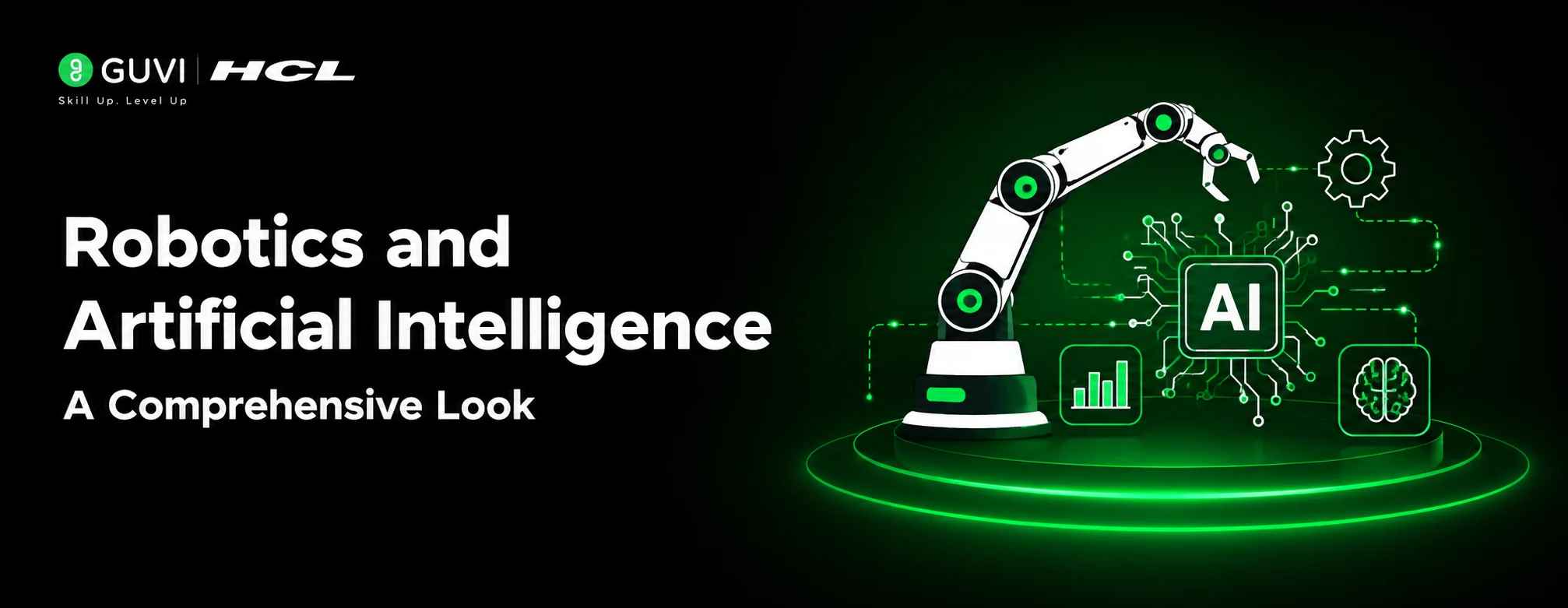
Robotics and Artificial Intelligence in 2026: A Beginner’s Guide to Careers, Salaries & Key Differences
Sep 22, 2026 6 Min Read 4398 Views
(Last Updated)
Have you ever wondered how robotics and artificial intelligence are transforming the world around you? These two technologies are often mentioned together, and for good reason.
In today’s tech-driven era, robotics and artificial intelligence (AI) are changing industries and daily life in profound ways. This article will help you understand the basics of robotics and artificial intelligence, how they differ and complement each other, and why they matter.
We’ll explore what each term means, look at real-world applications, discuss benefits and challenges, and even include some fun facts and a quick quiz to test your knowledge. Let’s dive in!
Table of contents
- Direct Answer
- TL;DR Summary
- What is Robotics?
- What is Artificial Intelligence?
- Are Robotics and AI the Same Thing?
- How Do AI and Robotics Work Together?
- Can Robots Work Without AI?
- Best Robotics and AI Careers in India (2026)
- Challenges and Ethical Considerations
- Test Your Knowledge: Quick Quiz
- Answers:
- Conclusion
- FAQs
- What is the difference between robotics and artificial intelligence?
- How are robotics and AI used in everyday life?
- What are the main benefits of using robotics and AI?
- What are the challenges and risks of robotics and AI?
- What is the future of robotics and artificial intelligence?
Direct Answer
Robotics is the engineering field that builds physical machines capable of performing real-world tasks; artificial intelligence is the software field that lets machines learn, reason, and make decisions. Together, they power self-driving cars, surgical robots, warehouse automation, and the new wave of humanoid robots entering commercial use in 2026.
TL;DR Summary
- Robotics is the engineering discipline that designs and builds physical machines capable of performing real-world tasks
- Artificial intelligence is the software science that enables machines to learn, reason, and make decisions
- Robotics builds the “body”, AI provides the “brain”
- Together, they power self-driving cars, surgical robots, warehouse automation, and more
- AI robotics is one of the fastest-growing career fields in India, with salaries ranging from ₹8–30 LPA
- You don’t need a background in both fields to start, Python and basic ML knowledge are enough to get going
What is Robotics?
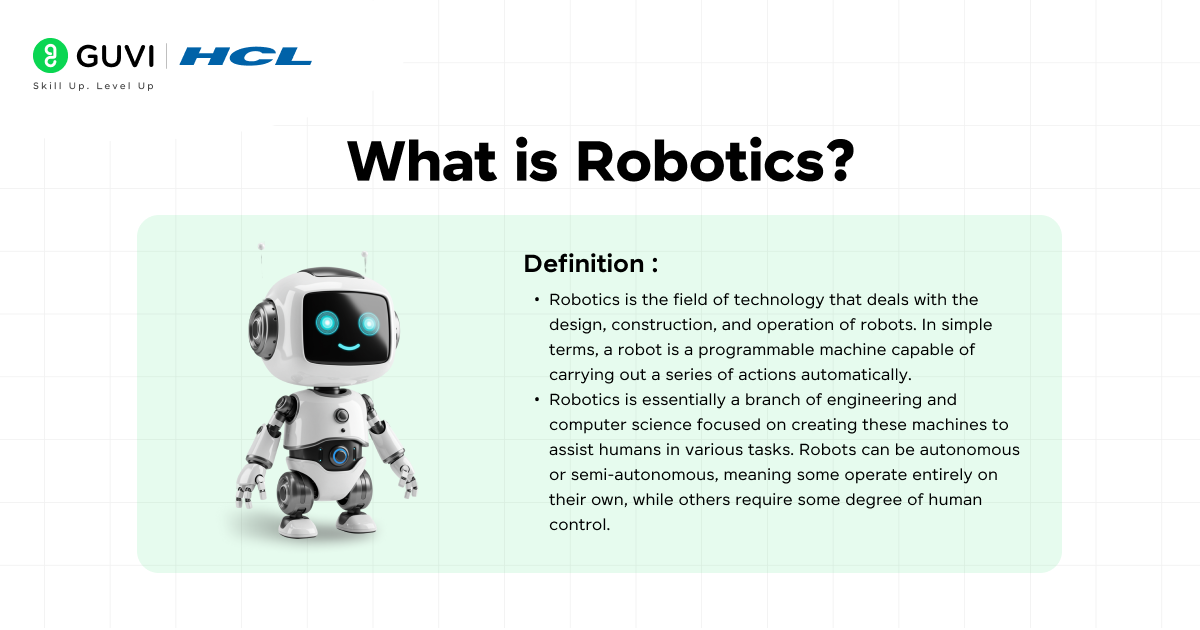
Robotics is the field of technology that deals with the design, construction, and operation of robots. In simple terms, a robot is a programmable machine capable of carrying out a series of actions automatically.
A robot doesn’t have to look like a humanoid from a sci-fi movie. It can be a robotic arm assembling cars in a factory, a drone delivering packages, or a surgical system performing precise incisions. What they all share is the ability to perform tasks, automatically or semi-automatically, in the real world.
Every robotic system is built around three core components:
- Sensors gather information from the environment (cameras, LiDAR, touch sensors)
- Actuators, the motors and mechanisms that allow physical movement
- Control systems, the software and programming that tells the robot what to do
Robotics as a field draws from mechanical engineering, electrical engineering, and computer science — all working together.
What is Artificial Intelligence?
Artificial intelligence (AI) is the branch of computer science that enables machines to simulate human cognitive functions, learning, reasoning, problem-solving, and perception.
Unlike robotics, AI is primarily software. It doesn’t need a physical body to exist. The AI powering your Netflix recommendations, Google Search results, or a customer service chatbot — none of that has wheels or arms.
AI works by training on large amounts of data, identifying patterns, and using those patterns to make predictions or decisions. The three most common techniques used in AI today are:
- Machine learning (ML), systems approach that improves through experience and data
- Deep learning is a subset of ML using neural networks modelled on the human brain
- Natural language processing (NLP) is enabling machines to understand and generate human language
The term “Artificial Intelligence” was coined in 1956 by John McCarthy at the Dartmouth Conference. Nearly 70 years later, AI is projected to contribute over $15.7 trillion to the global economy by 2030, according to PwC.
Are Robotics and AI the Same Thing?
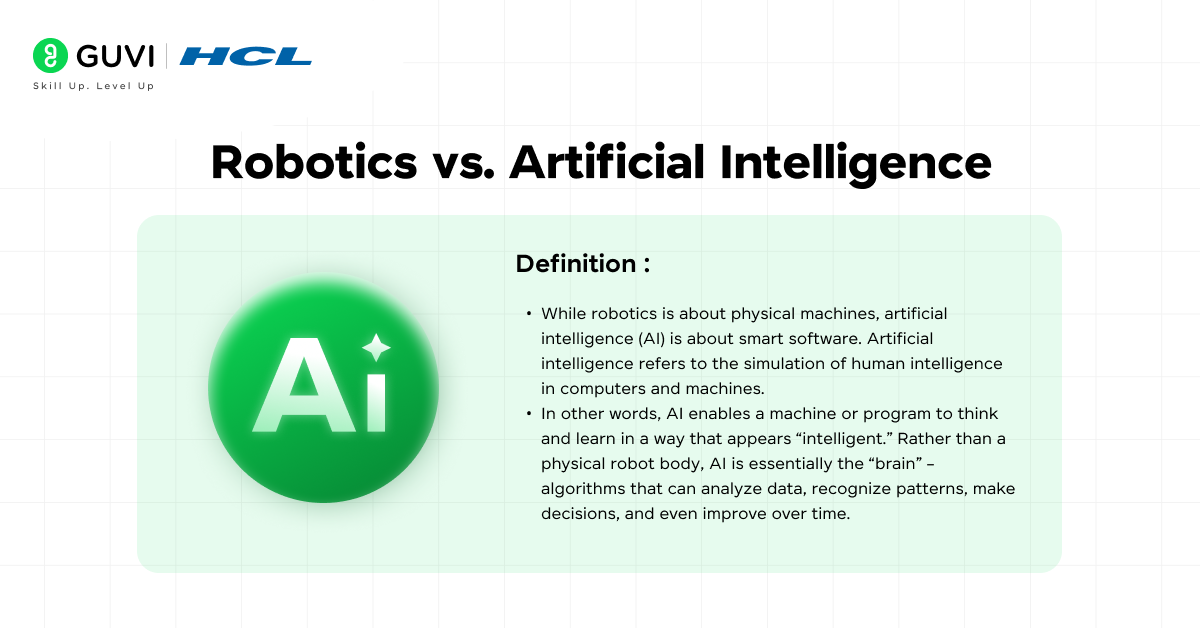
No, and this is one of the most common misconceptions.
Think of it this way: most robots don’t use AI, and most AI doesn’t control robots. A factory robot that repeats the same welding motion all day is running a pre-programmed script — no intelligence involved. Meanwhile, the AI model that detects fraud in your bank transactions has no physical form at all.
Here’s a simple comparison to make this clear:
| Dimension | Robotics | Artificial Intelligence |
| Definition | The computer science field for intelligent software | Industrial arms, drones, and surgical robots |
| Needs a physical body? | Yes | No |
| Examples | Industrial arms, drones, surgical robots | ChatGPT, Google Search, recommendation engines |
| Can exist without the other? | Yes | Yes |
| Overlap | AI-powered robots, autonomous vehicles, cobots | Embodied AI / physical AI systems |
| Career salary in India | ₹8–18 LPA | ₹8–30 LPA |
The overlap where both fields meet is where the most exciting technology lives. That’s where you get autonomous robots that can actually think, adapt, and learn.
How Do AI and Robotics Work Together?
When AI is added to a robotic system, the robot stops following a fixed script and starts making decisions based on what it perceives around it.
Here’s a practical way to think about it:
- Robotics gives the machine a body, sensors, motors, and the ability to act
- AI gives the machine a brain, the ability to interpret data, learn from experience, and decide what to do next
A robot with AI can look at its environment through a camera, recognise an object using computer vision, decide how to pick it up, and adjust its grip in real time. None of that is possible with pre-programmed automation alone.
The key AI techniques used inside robotic systems include:
- Computer vision allows robots to “see” and interpret their surroundings
- Reinforcement learning helps robots learn tasks by trial and error, improving over time
- Natural language processing enables voice commands and human-robot interaction
- SLAM (Simultaneous Localisation and Mapping) helps robots navigate unknown environments
Can Robots Work Without AI?
Yes, and most industrial robots today still do.
A robot on an automotive assembly line that welds the same point on a car frame thousands of times a day is running a deterministic program. It has no ability to adapt, learn, or respond to unexpected changes. If something shifts by even a few millimetres, it fails.
These are called non-intelligent robots, and they make up the vast majority of the world’s deployed robotics systems.
AI becomes necessary when you need the robot to:
- Operate in unpredictable environments
- Make real-time decisions based on sensor data
- Learn and improve from experience
- Interact naturally with humans
So the question isn’t whether AI is required, it’s whether the task demands adaptability. The more dynamic the environment, the more AI becomes essential.
Best Robotics and AI Careers in India (2026)
If you’re weighing a career in this space, 2026 data shows robotics and AI hiring has moved well beyond pure R&D into production roles across manufacturing, logistics, healthcare, and automotive. Here’s a snapshot of the top roles, what they focus on, and what they pay in India today:
| Role | Focus Area | Avg. Salary in India (2026) | Typical Employers |
|---|---|---|---|
| Robotics Engineer | Designing, building, and maintaining physical robotic systems | ₹6–24 LPA (up to ₹40+ LPA senior/specialized) | Manufacturing firms, automotive OEMs, robotics startups |
| AI/ML Engineer | Building and deploying machine learning models and systems | ₹6–20 LPA (up to ₹95 LPA at architect level) | TCS, Infosys, Wipro, Amazon, Flipkart, HCL, AI startups |
| Computer Vision Engineer | Enabling robots and systems to interpret visual data | ₹10–35 LPA | Autonomous vehicle firms, industrial automation companies |
| Human-Robot Interaction Specialist | Designing how robots communicate and collaborate with people | ₹12–35 LPA | Healthcare robotics, service robot companies |
| MLOps Engineer | Deploying and maintaining ML/AI systems at production scale | ₹6–50+ LPA (senior) | Product companies, cloud-native AI teams |
Which specialization pays the most? Human-robot interaction, computer vision, and swarm robotics are consistently cited as the highest-paying robotics specializations for 2026, with autonomous vehicle development and medical robotics also commanding premium packages.
For a deeper breakdown of pay by experience and city, see our dedicated guides on Machine Learning Engineer Salary in India and
Artificial Intelligence Engineer Salary in India. If you’re just getting started, our guide to
AI Career Opportunities in 2026 walks through entry points like AI intern, ML trainee, and junior AI developer roles.
Challenges and Ethical Considerations
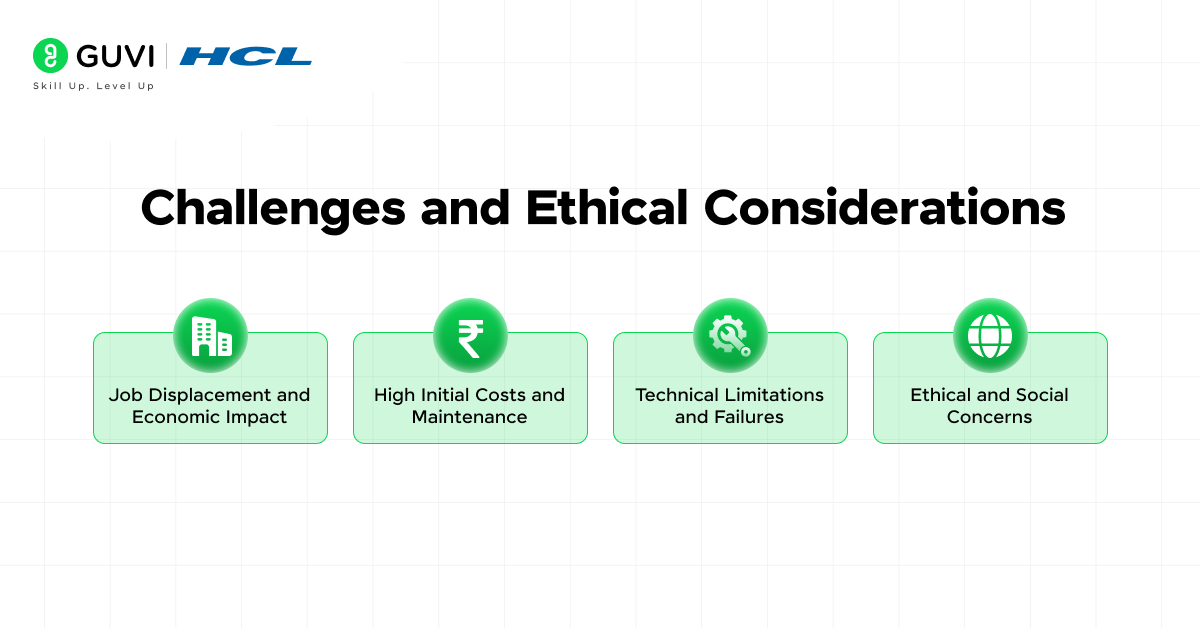
Despite the exciting benefits, it’s important to acknowledge that robotics and artificial intelligence also bring challenges and raise important ethical questions:

- Job Displacement and Economic Impact: Perhaps the most discussed concern is how automation will affect jobs. As robots and AI take over tasks, some jobs may become obsolete. For instance, self-checkout machines (a form of simple robotics/AI) reduce the need for cashiers. AI that automates data analysis might reduce certain administrative roles.
- High Initial Costs and Maintenance: Implementing robotics and AI systems can be expensive. Robots often require a significant up-front investment, not just to purchase the hardware but also to set up the infrastructure and training needed to use them.
- Technical Limitations and Failures: Robots can malfunction; AI systems can make mistakes or yield unexpected results. A glitch in a factory robot could halt a production line, or worse, cause an accident. AI systems are only as good as the data and algorithms behind them – if there’s a flaw, the AI might behave in undesired ways.
- Ethical and Social Concerns: AI in particular raises many ethical issues. Bias in AI is a big one: if an AI system is trained on biased data (say, for loan approvals or hiring), it could end up discriminating against certain groups. This has serious consequences for fairness and justice.
In short, while robotics and artificial intelligence offer great promise, they must be developed and deployed thoughtfully. Governments, industries, and researchers are increasingly aware of these issues. There are efforts to create ethical AI principles and safety standards for robots. For example, the OECD and United Nations have been working on AI ethics guidelines.
To lighten things up, here are some interesting tidbits about robotics and artificial intelligence that you might find surprising:
Origin of the Word “Robot”: The term “robot” comes from the Czech word “robota,” which means “forced labor” or “hard work.” It was first used in a 1920 Czech play by Karel Čapek, where mechanical beings called robots were workers.
AI as a Term Was Coined in 1956: The field of artificial intelligence got its name in the mid-1950s. In 1956, a group of scientists led by John McCarthy held a workshop at Dartmouth College, and in their proposal, they coined the term “artificial intelligence” to describe this new field of study.
These facts highlight the rich history and rapid progress in robotics and AI. From coining terms decades ago to achieving feats that once belonged only to science fiction, the journey of robotics and artificial intelligence is full of fascinating stories!
Test Your Knowledge: Quick Quiz
Ready for a quick challenge? Try answering these questions to check your understanding of robotics and artificial intelligence. This mini-quiz is just for fun – to recap some key points from the article.
- Which of the following best describes the difference between robotics and artificial intelligence?
A. Robotics is about programming software algorithms, while artificial intelligence is about building physical machines.
B. Robotics involves designing and building physical machines (robots), whereas artificial intelligence involves creating smart algorithms that can simulate thinking.
C. Robotics and artificial intelligence are actually the same field and the terms can be used interchangeably. - What is an example of an AI application that does not involve a robot?
A. An autonomous drone used for surveying crops.
B. A factory arm that assembles smartphones.
C. A voice assistant on your phone that uses speech recognition to answer questions. - Which is not an advantage of using robotics and AI?
A. They can work continuously without fatigue, improving efficiency.
B. They always make perfect decisions with no possibility of error or bias.
C. They can perform tasks dangerous to humans, improving safety in certain jobs.
(Check your answers in the answers section below to see how you did!)
Answers:
- B. Robotics focuses on physical machines (robots), and AI focuses on intelligence and algorithms. (Answer A is reversed; Answer C is incorrect – the fields are related but not identical.)
- C. A voice assistant like Siri is pure AI software without a robot body. (A and B both involve physical robots – a drone and a factory arm are robotics examples combined with AI.)
- B. It’s not true that these technologies are infallible; AI can have errors or bias, and robots can malfunction. (Options A and C are true benefits of robotics/AI.)
If you’re serious about mastering artificial intelligence and want to apply it in real-world scenarios, don’t miss the chance to enroll in HCL GUVI’s Intel & IITM Pravartak Certified Artificial Intelligence & Machine Learning course. Endorsed with Intel certification, this course adds a globally recognized credential to your resume, a powerful edge that sets you apart in the competitive AI job market.
Conclusion
In conclusion, we’ve explored the basics of robotics and artificial intelligence, from what they are to how they’re used, their benefits, and their challenges. It’s clear that these technologies are already deeply embedded in our lives – and their influence is only growing.
Looking ahead, the line between robotics and AI will continue to blur as we build more intelligent machines that can learn and adapt.
Feel free to explore further, ask questions, and even get hands-on. The world of robotics and artificial intelligence is as exciting as it has ever been – and you are now better equipped to understand and be a part of it!
FAQs
1. What is the difference between robotics and artificial intelligence?
Robotics focuses on designing and building physical machines (robots) that can perform tasks, while artificial intelligence is about creating smart algorithms that enable machines to think, learn, and make decisions. AI can exist without robotics, and robotics can function without AI, but when combined, they create intelligent robots.
2. How are robotics and AI used in everyday life?
They power technologies like robotic vacuum cleaners, AI voice assistants, autonomous cars, smart appliances, and AI-powered healthcare diagnostics. From home cleaning to online recommendations, you’re likely using both in some form daily.
3. What are the main benefits of using robotics and AI?
Key advantages include higher efficiency, precision, safety, and the ability to handle repetitive or dangerous tasks. They also help in discovering new solutions through data analysis and enable innovations like personalized learning or robotic surgeries.
4. What are the challenges and risks of robotics and AI?
Challenges include job displacement, high setup costs, technical failures, and ethical issues like AI bias, data privacy concerns, and misuse (e.g., autonomous weapons). Responsible development and regulation are crucial to mitigate these risks.
5. What is the future of robotics and artificial intelligence?
Expect to see more collaborative robots (cobots) working alongside humans, smarter AI systems integrated into daily tools, humanoid robots for human-like environments, and AI-powered decision-making in industries. The future will likely involve greater synergy between AI’s “brain” and robotics’ “body.”
Success Stories

About the Author
Lukesh S
A professional content writer who has experience in freelancing and now working as a Technical Content Writer at HCL GUVI having sound knowledge in Blog Writing and Creative Writing!
View all posts by Lukesh S
Connect with me @












Did you enjoy this article?