


Artificial Intelligence and Machine Learning Articles
Finance Manager to Data Analytics: Career Growth, Salary and Seniority
How to Evaluate LLM Outputs in Production Deployments
AI/ML Skills Gap 2026: Why Companies Can't Find Job-Ready Talent
20 AI/ML Interview Questions Recruiters Can Use Without a Tech Background - Best Guide


Get In Touch For Details! Request More Information
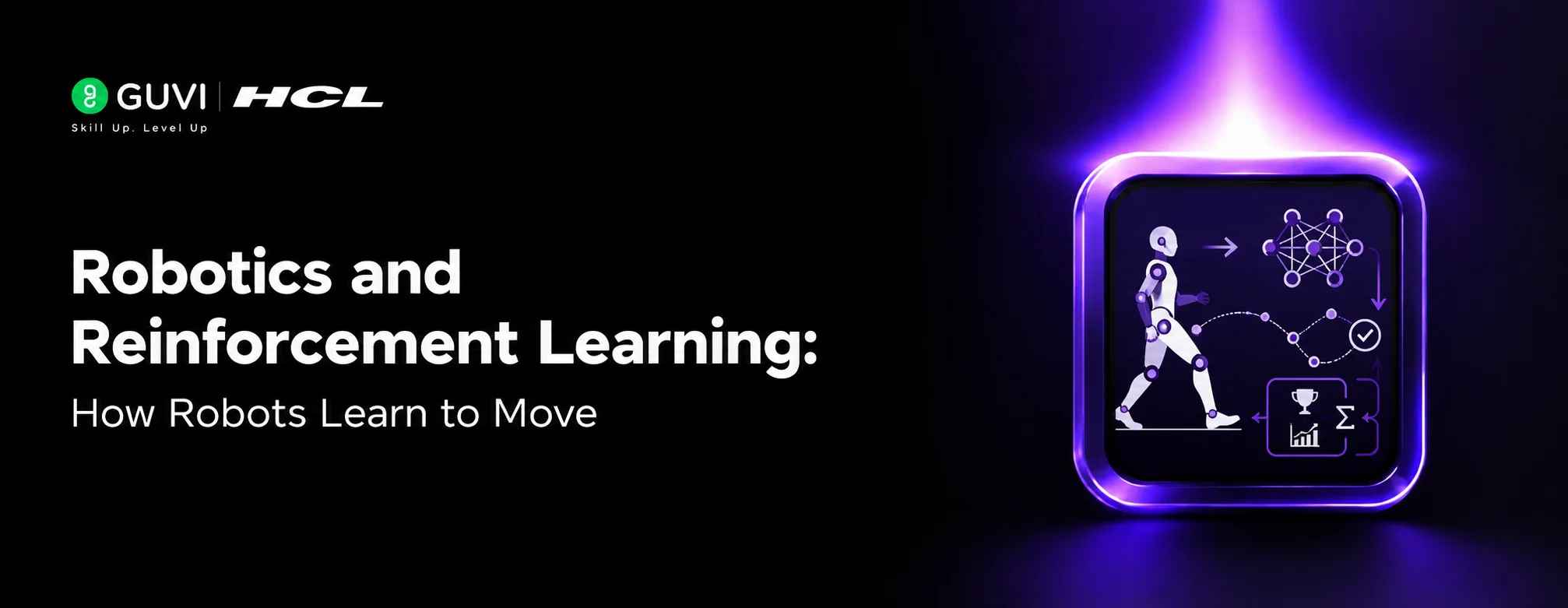
Robotics and Reinforcement Learning: How Robots Learn to Move
Aug 27, 2026 4 Min Read 363 Views
(Last Updated)
Reinforcement learning enables robots to learn complex movements through trial and error rather than explicit programming.
From walking robots to robotic arms manipulating objects, RL is transforming how machines acquire physical skills.
This guide explains how robotics and reinforcement learning work together to teach robots to move.
Table of contents
- Direct Answer
- TL;DR Summary Box
- The Challenge of Robot Movement
- Why RL for Robotics?
- How Robots Learn with RL
- The Learning Loop
- State Representation
- Action Spaces
- Reward Design
- Key Algorithms for Robot Learning
- PPO (Proximal Policy Optimization)
- SAC (Soft Actor-Critic)
- DDPG (Deep Deterministic Policy Gradient)
- TD3 (Twin Delayed DDPG)
- Training Robots: Simulation to Reality
- Simulation Training
- The Sim-to-Real Gap
- Bridging the Gap
- Real-World Applications
- Legged Locomotion
- Robotic Manipulation
- Mobile Robots
- Common Mistakes to Avoid
- Conclusion
- FAQs
- Why use RL instead of traditional control for robots?
- How long does it take to train a robot with RL?
- What is the sim-to-real gap?
- Which RL algorithm is best for robotics?
- Do I need expensive hardware to start?
Direct Answer
Robotics and Reinforcement Learning combine to enable robots to learn motor skills through interaction with their environment. Instead of programming every movement, robots use RL algorithms to explore actions, receive rewards for successful behaviors, and gradually improve their policies. Key challenges include sample efficiency, safety during learning, and transferring skills from simulation to real robots. Modern approaches use simulation training, reward shaping, and advanced algorithms like PPO and SAC to teach robots walking, grasping, and complex manipulation tasks.
TL;DR Summary Box
- RL enables robots to learn movements through trial and error
- Simulation training reduces real-world sample requirements
- Key algorithms include PPO, SAC, and DDPG for continuous control
- Major challenges: sample efficiency, safety, and sim-to-real transfer
- Applications span walking robots, manipulation, and autonomous systems
The Challenge of Robot Movement
Traditional robot control relies on carefully engineered controllers that specify every movement. This approach works well for structured environments but struggles with:
- Unstructured environments: Real-world settings are unpredictable
- Complex tasks: Walking, grasping, and manipulation require coordination
- Adaptability: Pre-programmed robots can’t adapt to new situations
- Development time: Engineering controllers takes months or years
Reinforcement learning offers a different paradigm: let the robot learn through experience.
Why RL for Robotics?
RL provides several advantages for robot learning:
Automatic Skill Acquisition:
- Robots discover effective strategies through exploration
- No need to manually engineer every movement
- Can find solutions humans might not consider
Adaptability:
- Learn to handle novel situations
- Adapt to changes in environment or robot itself
- Recover from unexpected disturbances
Generalization:
- Learn policies that work across variations
- Transfer skills to similar tasks
- Handle uncertainty and noise
End-to-End Learning:
- Learn directly from sensors to actuators
- No need for intermediate representations
- Discover optimal control strategies
Robots learn to move by training RL policies in simulation (often with domain randomization) and then transferring them to real hardware, using reward shaping, imitation learning, and safety constraints to master walking, grasping, and manipulation. Master AI & ML at HCL GUVI: Artificial Intelligence and Machine Learning.
How Robots Learn with RL
The basic RL framework for robotics follows a standard pattern:
The Learning Loop
- Observation: Robot perceives state (joint angles, velocities, camera images, etc.)
- Action: Policy selects action (motor torques, joint positions)
- Environment: Robot executes action, environment changes
- Reward: Robot receives feedback (success/failure, task completion)
- Update: Policy updates to maximize future rewards
- Repeat: Continue until policy converges
State Representation
What the robot observes critically affects learning:
Proprioceptive States:
- Joint angles and velocities
- End-effector position and orientation
- IMU readings (acceleration, orientation)
- Force/torque sensor readings
Exteroceptive States:
- Camera images (RGB, depth)
- LiDAR point clouds
- Tactile sensor data
- Audio signals
Combined Representations:
- Fuse proprioceptive and exteroceptive information
- Use attention mechanisms to focus on relevant features
- Learn representations automatically with deep learning
Action Spaces
Robot actions can be represented in different ways:
Joint Position Control:
- Directly command joint angles
- Simple but may not account for dynamics
- Common for manipulation tasks
Joint Torque Control:
- Command motor torques
- Accounts for robot dynamics
- More natural for locomotion
End-Effector Control:
- Command Cartesian position/orientation
- Abstracts away joint-level details
- Requires inverse kinematics
Velocity Control:
- Command joint or end-effector velocities
- Smooth movements
- Common in mobile robots
Reward Design
Reward functions shape what the robot learns:
Task Completion Rewards:
- +1 for reaching goal
- -1 for falling over
- Sparse but clear signal
Shaping Rewards:
- +0.1 for moving toward goal
- -0.1 for each step taken
- Dense signal guides learning
Regularization Terms:
- -0.01 for high energy consumption
- -0.01 for jerky movements
- Encourages smooth, efficient motion
Constraint Penalties:
- -10 for exceeding joint limits
- -5 for collisions
- Enforces safety constraints
Key Algorithms for Robot Learning
PPO (Proximal Policy Optimization)
PPO is one of the most popular algorithms for robot learning:
Key Features:
- Stable, reliable training
- Good sample efficiency
- Handles continuous action spaces
- Widely used in robotics research
How it Works:
- Collect trajectories using current policy
- Estimate advantages using value function
- Update policy with clipped objective
- Prevents destructive large updates
Applications:
- Quadruped locomotion (walking, running)
- Robotic manipulation (grasping, pushing)
- Bipedal walking
- Drone control
SAC (Soft Actor-Critic)
SAC excels at continuous control tasks:
Key Features:
- Off-policy (reuses old data)
- Maximum entropy (encourages exploration)
- Sample efficient
- Stable learning
How it Works:
- Learn policy and value functions
- Maximize reward plus entropy
- Reuse experience replay buffer
- Automatic temperature tuning
Applications:
- Precise manipulation tasks
- Dexterous hand control
- Fine motor skills
- Continuous control with exploration
DDPG (Deep Deterministic Policy Gradient)
DDPG pioneered deep RL for continuous control:
Key Features:
- Deterministic policy (single best action)
- Off-policy learning
- Actor-critic architecture
- Experience replay
Limitations:
- Can be unstable
- Sensitive to hyperparameters
- Less sample efficient than SAC
Applications:
- Robotic arm control
- Continuous control tasks
- Foundation for improved algorithms
TD3 (Twin Delayed DDPG)
TD3 improves upon DDPG with better stability:
Key Features:
- Twin critics (reduces overestimation)
- Delayed policy updates
- Target policy smoothing
- More stable than DDPG
Applications:
- Continuous control
- Robotics tasks requiring precision
- Environments with noisy rewards
Training Robots: Simulation to Reality
Training robots entirely in the real world is impractical due to:
- Sample inefficiency: RL requires millions of trials
- Hardware wear: Physical robots break with extensive use
- Safety: Random exploration can damage robot or environment
- Time: Real-world trials are slow
Simulation Training
Most robot RL happens in simulation first:
Advantages:
- Millions of trials in hours
- No hardware wear or damage
- Perfect safety during exploration
- Parallel training across many simulations
- Automated data collection
Popular Simulators:
- MuJoCo: High-fidelity physics, widely used in research
- PyBullet: Open-source, good for robotics
- Isaac Gym: GPU-accelerated, massive parallelization
- Gazebo: ROS integration, realistic sensors
- Brax: JAX-based, very fast

The Sim-to-Real Gap
Policies trained in simulation often fail on real robots due to:
Reality Gap:
- Physics simulation is imperfect
- Sensor noise differs from simulation
- Actuator dynamics not perfectly modeled
- Unmodeled environmental factors
Domain Shift:
- Lighting conditions differ
- Textures and appearances vary
- Friction coefficients inaccurate
- Latency and delays differ
Bridging the Gap
Several techniques help transfer policies from sim to real:
Domain Randomization:
- Randomize physical parameters in simulation
- Train on wide distribution of conditions
- Policy learns to be robust to variations
- Examples: friction, mass, damping, delays
System Identification:
- Measure real robot’s physical parameters
- Match simulation to reality
- Calibrate sensors and actuators
- Reduce reality gap
Progressive Networks:
- Start training in simulation
- Gradually introduce real data
- Fine-tune on real robot
- Combine sim and real experience
Adaptation Methods:
- Learn to adapt to new conditions
- Meta-learning for quick adaptation
- Online adaptation during deployment
- Handle unmodeled dynamics
Real-World Applications
Legged Locomotion
Quadruped and bipedal robots learn to walk, run, and navigate:
Examples:
- Laikago: Quadruped learning to walk and recover from pushes
- Cassie: Bipedal robot learning to walk over rough terrain
- ANYmal: Industrial quadruped for inspection tasks
- Boston Dynamics: Using RL for improved locomotion (combined with traditional control)
Capabilities:
- Walking on flat ground
- Navigating rough terrain
- Recovering from pushes and falls
- Climbing stairs and obstacles
- Running at various speeds
Robotic Manipulation
Robotic arms learn to grasp, push, and manipulate objects:
Examples:
- Dexterous grasping: Learning to grasp novel objects
- In-hand manipulation: Rotating objects in hand
- Assembly tasks: Inserting pegs, screwing caps
- Tool use: Learning to use tools for tasks
Capabilities:
- Grasping diverse objects
- Precise positioning and insertion
- Force-controlled manipulation
- Bimanual coordination
- Learning from human demonstrations
Mobile Robots
Wheeled and tracked robots learn navigation:
Examples:
- Autonomous driving: Learning driving policies
- Warehouse robots: Navigation in dynamic environments
- Delivery robots: Sidewalk navigation
- Exploration robots: Mapping unknown environments
Capabilities:
- Obstacle avoidance
- Path planning and following
- Multi-robot coordination
- Human-aware navigation
- Long-horizon navigation
Robots learn to move by training RL policies in simulation (often with domain randomization) and then transferring them to real hardware, using reward shaping, imitation learning, and safety constraints to master walking, grasping, and manipulation. Master AI & ML at HCL GUVI: Artificial Intelligence and Machine Learning.
Common Mistakes to Avoid
- Poor reward design: Rewards that don’t capture true objective
- Ignoring safety: Allowing dangerous exploration
- No simulation: Training only on real hardware (too slow/expensive)
- Sim-to-real gap: Not addressing reality gap
- Wrong algorithm: Using discrete action algorithms for continuous control
- Insufficient exploration: Policy gets stuck in local optima
- No curriculum: Starting with hardest tasks immediately
- Ignoring hardware limits: Commands that exceed robot capabilities
- Poor state representation: Missing critical information
- No baseline: Not comparing to traditional control methods
OpenAI’s Dactyl project trained a robotic hand to solve a Rubik’s cube entirely in simulation, then transferred the policy to a real robot with no additional training—demonstrating the power of domain randomization. Boston Dynamics’ robots, while primarily using traditional control, increasingly incorporate RL for specific behaviors like recovery from falls and adaptive locomotion on challenging terrain.
Conclusion
Robotics and reinforcement learning enable robots to acquire complex motor skills through experience rather than explicit programming. By combining simulation training, advanced RL algorithms, and sim-to-real transfer techniques, robots can learn walking, manipulation, and navigation tasks that would be extremely difficult to engineer by hand.
The field continues to advance rapidly, with improvements in sample efficiency, safety, and transfer making RL increasingly practical for real-world robotic applications. Success requires careful attention to reward design, simulation fidelity, and systematic approaches to bridging the reality gap.
FAQs
Why use RL instead of traditional control for robots?
RL enables automatic skill discovery, adaptability to new situations, and end-to-end learning without manual controller engineering, though it requires more samples and careful safety considerations.
How long does it take to train a robot with RL?
In simulation: hours to days for millions of trials. On real robots: weeks to months due to sample inefficiency, which is why most training happens in simulation first.
What is the sim-to-real gap?
The difference between simulation and reality that causes policies trained in simulation to fail on real robots due to imperfect physics, sensor noise, and unmodeled dynamics.
Which RL algorithm is best for robotics?
PPO for stability and ease of use, SAC for sample efficiency in continuous control, and TD3 for precision tasks. Choice depends on specific requirements and constraints.
Do I need expensive hardware to start?
No. Start with simulation (free simulators available) and low-cost platforms like Raspberry Pi robots or educational manipulators before moving to expensive industrial hardware.
Success Stories

About the Author
HCL GUVI
This article was selected and published as part of the HCL GUVI AI Blogathon 2026, an initiative designed to encourage students, AI enthusiasts, and aspiring tech writers to simplify complex AI concepts through impactful technical content. The contest recognized high-quality, original, and insightful AI-focused blogs, with selected authors receiving publication opportunities on the HCL GUVI blog platform along with official author credits and recognition.
View all posts by HCL GUVI
Connect with me @









Did you enjoy this article?