


Artificial Intelligence and Machine Learning Articles
Finance Manager to Data Analytics: Career Growth, Salary and Seniority
How to Evaluate LLM Outputs in Production Deployments
AI/ML Skills Gap 2026: Why Companies Can't Find Job-Ready Talent
20 AI/ML Interview Questions Recruiters Can Use Without a Tech Background - Best Guide

Get In Touch For Details! Request More Information
Inside Replit’s Snapshot Engine: The Tech Making AI Agents Safe
Jun 24, 2026 5 Min Read 1148 Views
(Last Updated)
In July 2025, a high-profile incident brought AI agent safety into sharp focus. An investor publicly documented their Replit AI agent deleting a production database while building an app. The story went viral and for good reason. It exposed a real, structural problem: AI agents that can read and write your codebase and database need fundamentally different safety infrastructure than traditional dev tools.
Replit had already been building that infrastructure. In December 2025, they published a technical deep-dive into their Snapshot Engine, the compute and storage fabric that makes Replit’s AI agent reversible, isolated, and safe to use on real projects. The post was authored by Connor Brewster and Luis Héctor Chávez, two engineers on Replit’s infrastructure team.
This guide breaks down the Replit snapshot engine AI safety system in plain English, what it does, how each layer works technically, why it matters for developers using AI agents today, and what it means for the future of agentic software development.
Quick TL;DR Summary
● What it is: Replit’s snapshot engine AI safety infrastructure makes every AI agent action fully reversible using three-layered technologies.
● Layer 1: Storage Copy-on-Write block storage enables constant-time filesystem snapshots regardless of project size, and forks happen in milliseconds.
● Layer 2: Code Git commits are created automatically at every agent checkpoint, with an immutable backup remote so even full filesystem deletion is recoverable.
● Layer 3: Database Forkable PostgreSQL databases keep the agent locked to a development environment, completely separated from production data at the architecture level.
● Coming next, parallel agent simulations will run multiple isolated sandbox forks simultaneously, selecting the best solution and applying it atomically, improving task success by ~8 percentage points
Table of contents
- What Is the Replit Snapshot Engine?
- The Problem: Why AI Agents Need Reversibility
- Layer 1: Bottomless Storage and Copy-on-Write
- How Copy-on-Write Works
- Versioning the Filesystem
- Layer 2: Git-Based Code Versioning
- Why Git Is the Right Tool Here
- Protection Against Git State Corruption
- Layer 3: Forkable Databases
- The Dev/Prod Split
- Checkpoint and Restore for Databases
- The Future: Parallel Agent Simulations
- How Parallel Simulations Work
- The Performance Impact
- Conclusion
- FAQs
- What is Replit's Snapshot Engine?
- How does Copy-on-Write storage work in Replit?
- Why does Replit use Git for code versioning in the agent?
- How does Replit prevent AI agents from corrupting the production database?
- What is Parallel Sampling, and how does it improve AI agent performance?
What Is the Replit Snapshot Engine?
The Replit Snapshot Engine is a compute and storage infrastructure that gives every Replit app and every AI agent action the equivalent of a time machine. It lets you clone, checkpoint, revert, and fork your entire development environment, including the filesystem, codebase, and database, in milliseconds.
The system was originally built to make Replit faster for professional developers, enabling instant project remixing and team collaboration. When Replit built its AI Agent in 2024, it realized these same primitives could make agentic coding fundamentally safer.
The core idea: if every agent action is reversible, the cost of a mistake goes to zero. That changes what an agent can safely attempt and dramatically expands what it can autonomously do.
Replit grew from $10M ARR to $100M ARR in just 9 months after launching its AI Agent, marking one of the fastest revenue ramps for any developer tool in that period, according to SaaStr.
Its Snapshot Engine infrastructure played a key role in enabling the Agent’s safe, autonomous behavior, helping ensure changes could be executed and recovered reliably.
The Problem: Why AI Agents Need Reversibility
Traditional developer environments are static. To test a risky change, you have to manually copy files, spin up a new server, or create a Git branch. These steps are slow, error-prone, and add friction that discourages experimentation.
For human developers, this is manageable. For AI agents, it’s a fundamental blocker. An agent that can’t freely experiment will be overly cautious or dangerously overconfident in a single path.
The risk has real-world consequences. When an AI agent has direct access to your code and database, it might:
• Make code changes that break things in non-obvious ways
• Run database migrations that destroy data
• Delete files or alter configurations that it wasn’t supposed to touch
• Corrupt the Git state itself, making recovery difficult
Without reversibility, none of these are safe to allow. With the Snapshot Engine, all of them become acceptable risks because any mistake can be unwound instantly.
Layer 1: Bottomless Storage and Copy-on-Write
The foundation of the Snapshot Engine is Replit’s Bottomless Storage Infrastructure, originally released in 2023. It provides virtual block devices backed by Google Cloud Storage, co-located with the VMs and Linux containers that run Replit apps to minimize latency.
How Copy-on-Write Works
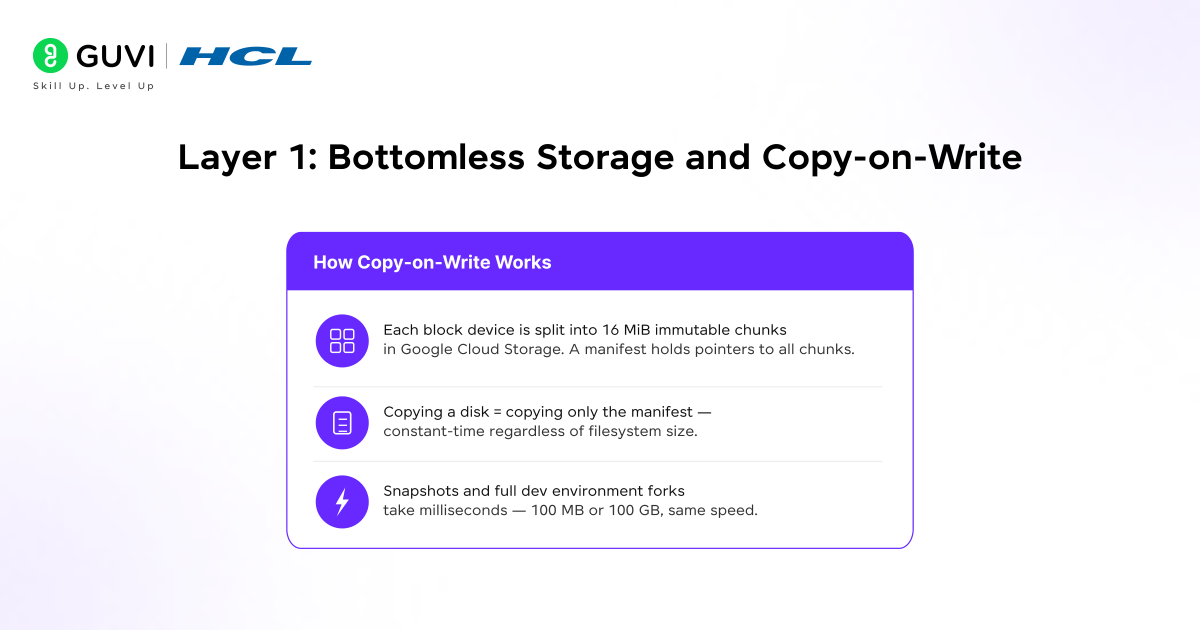
Each block device is split into 16 MiB chunks stored immutably in Google Cloud Storage. A manifest file holds pointers to all the chunks that make up a single version of the block device.
Since chunks are immutable, copying a disk is just copying the manifest making it constant-time regardless of filesystem size. This is the Copy-on-Write technique applied at the block device level.
The result: taking a filesystem snapshot, or forking an entire development environment, takes milliseconds whether the project is 100 MB or 100 GB.
This design also provides strong recovery guarantees: two forked environments are completely independent after the copy. Each can evolve separately. Changes in one cannot corrupt the other.
Versioning the Filesystem
Copy-on-Write at the block device level doesn’t just enable fast copies it unlocks full filesystem versioning. Every checkpoint is essentially remixing the same disk over and over. Replit can restore to any previous checkpoint, enabling near-point-in-time recovery for disaster scenarios.
Layer 2: Git-Based Code Versioning
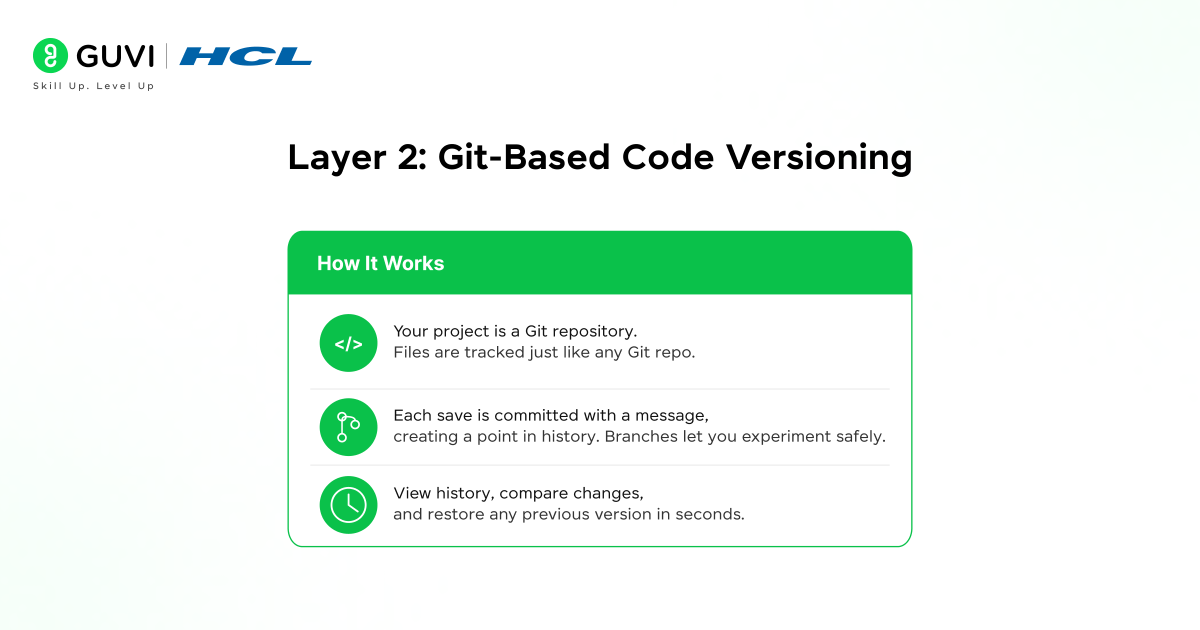
For tracking code changes specifically, Replit uses the industry-standard Git version control system. Whenever the Agent reaches a meaningful state, completing a task, passing a test, or reaching a checkpoint, it creates a Git commit and records it in the checkpoint metadata.
Why Git Is the Right Tool Here
Git is a standard tool deeply embedded in LLMs’ training data. This makes it easier for the model to reason about code history and changes without additional prompting. Replit actually observed their agent looking at Git history to recover code that had been refactored away in an earlier session.
If a user wants to revert code changes made by the Agent, the rollback uses Git to restore the codebase to its earlier state. Clean, familiar, reviewable.
Protection Against Git State Corruption
But what if the Agent accidentally corrupts the Git state itself? Replit has two layers of protection:
- Filesystem recovery: The Git object graph can be recovered from a prior version of the filesystem via the Bottomless Storage Infrastructure.
- Immutable Git remote: Every Replit app has a separate, immutable, append-only Git remote. The entire Git history can be recovered even if the entire filesystem is deleted.
These two layers together make Git state corruption a recoverable event, not a catastrophic one.
Layer 3: Forkable Databases
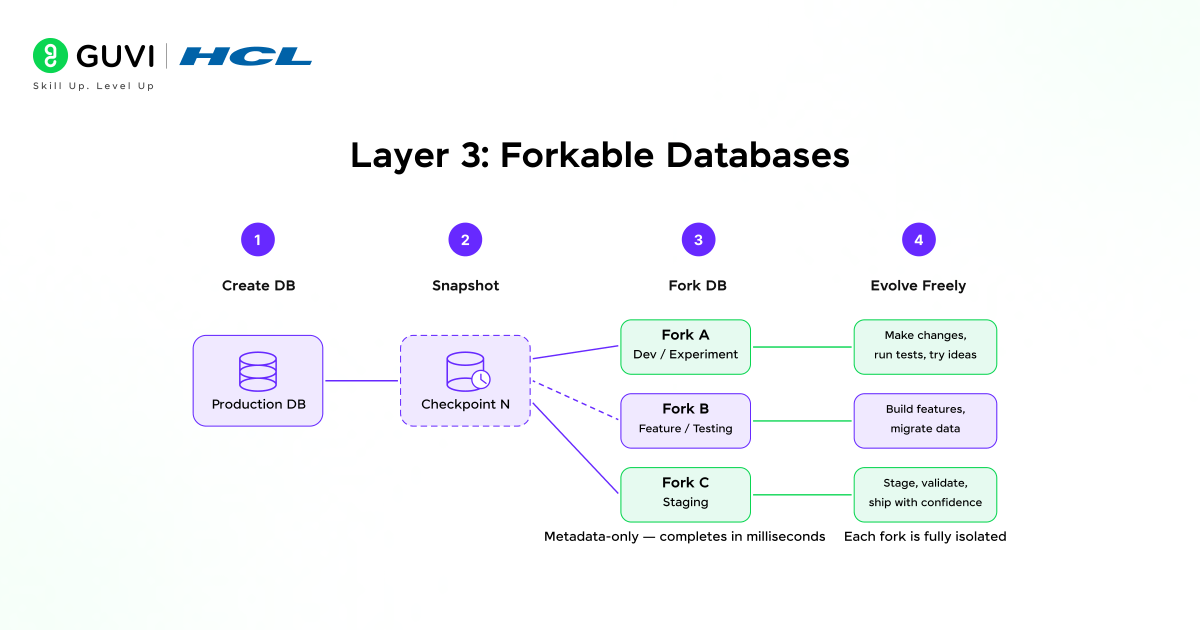
Code versioning is not enough for production safety. Most real applications use a database, and the schema and data must stay in sync with the code as the Agent makes changes.
Giving an AI agent direct access to your production database is a known risk. A database migration gone wrong, a schema change that breaks existing queries, or a bulk delete, any of these can cause data loss that is difficult or impossible to reverse with traditional tools.

The Dev/Prod Split
Replit’s solution is architectural: separate production and development databases, with the Agent permitted to access only the development database. This is an automatic guardrail, not one that relies on the agent following instructions.
The development database is built using the same Bottomless Storage Infrastructure as the filesystem. Replit runs an unmodified local instance of PostgreSQL, but stores its data on a filesystem backed by their CoW storage engine.
Checkpoint and Restore for Databases
Every checkpoint operation includes both a Git commit (for code) and a database state snapshot (for data). The two most common operations are:
- Checkpoint: Copies the current storage manifest under a new name in constant time, regardless of database size.
- Restore: Replaces the current manifest with a previous version, also constant-time.
This means the user can roll back the database to any prior state just as easily as reverting code. They can also fork the database to create a new app with a copy of the development data, useful for testing migrations against real data without touching the live database.
The Future: Parallel Agent Simulations
Replit’s published roadmap for the Snapshot Engine points to a significant capability expansion: using fast, isolated forks to let AI agents run multiple parallel experiments simultaneously.
How Parallel Simulations Work
Instead of running one agent on one approach, Replit can spin up multiple isolated copies of the same environment and run different agents against the same problem in parallel. Each agent operates in its own sandbox, with separate code, a separate database, and a separate filesystem.
This uses a technique called Parallel Sampling, a form of Inference-Time Scaling. The LLM’s natural non-determinism means each agent will take a slightly different path to solving the same problem. The diverging trajectories are compared, and the best result is selected and applied atomically to the main application.
The Performance Impact
Replit’s post cites prior research using this technique on SWE-bench, a benchmark for evaluating AI coding agents on real GitHub issues. Parallel Sampling produced an approximately 8 percentage point improvement from 72% to 80% task completion.
For developers, this means more complex tasks can be attempted autonomously, with higher confidence that the best solution will be selected, not just the first one the agent finds.
Parallel Sampling works because AI models are non-deterministic; even with the same prompt and codebase, different runs can generate meaningfully different outputs. By using isolated sandboxes, Replit can take advantage of this variation, running multiple solution paths in parallel and retaining only the results that actually work.
If you want to learn more about building skills for Claude Code and automating your procedural knowledge, do not miss the chance to enroll in HCL GUVI’s Intel & IITM Pravartak Certified Artificial Intelligence & Machine Learning courses. Endorsed with Intel certification, this course adds a globally recognized credential to your resume, a powerful edge that sets you apart in the competitive AI job market.
Conclusion
Replit’s snapshot engine AI safety infrastructure represents one of the most thoughtful approaches to making autonomous coding agents safe for real-world use. By combining Copy-on-Write block storage, Git-based code versioning, and forkable PostgreSQL databases, Replit has made every agent action reversible, every environment forkable, and every mistake recoverable.
The system was not built specifically for AI it grew out of infrastructure designed for developer collaboration and fast project remixing. But it turns out the same primitives that make human collaboration safe also make AI agents safe.
As AI agents become more capable and more autonomous, this kind of infrastructure will move from a competitive advantage to a baseline requirement. Replit has published a clear technical blueprint for what safe agentic development looks like, and the industry is paying attention.
FAQs
1. What is Replit’s Snapshot Engine?
Replit’s Snapshot Engine is a compute and storage infrastructure that makes every AI agent action reversible. It combines Copy-on-Write block storage, Git versioning, and forkable databases to allow instant checkpointing and rollback of the entire development environment code, filesystem, and database.
2. How does Copy-on-Write storage work in Replit?
Replit’s block storage splits each virtual disk into 16 MiB chunks stored immutably in Google Cloud Storage. A manifest file tracks which chunks make up each version. Copying a disk means copying the manifest, making snapshots constant-time regardless of project size. Two forked environments share the same underlying chunks until either makes a change.
3. Why does Replit use Git for code versioning in the agent?
Git is a standard tool embedded in the LLM’s training data, making it easier for the agent to reason about code history without additional prompting. Replit also adds an immutable append-only Git remote for each app, ensuring code history is recoverable even if the entire filesystem is deleted.
4. How does Replit prevent AI agents from corrupting the production database?
Replit automatically separates production and development databases, restricting the agent’s access to the development database only. The development database runs PostgreSQL on Replit’s Bottomless Storage, making it fully snapshotable and restorable identical to how the filesystem is handled.
5. What is Parallel Sampling, and how does it improve AI agent performance?
Parallel Sampling runs multiple isolated copies of the same environment simultaneously, each with a different agent attempting the same task. The LLM’s non-determinism means different agents take different paths. The best result is selected and applied atomically. Prior research using this technique improved SWE-bench task completion by approximately 8 percentage points.
Success Stories

About the Author
Vishalini Devarajan
An Aerospace Engineer turned content writer, I focus on making complex concepts easy to understand through well-structured, reader-friendly blogs. Whether it’s a technical topic or a non-technical one, I love creating content that is clear, engaging, and impactful.
View all posts by Vishalini Devarajan
Connect with me @







Did you enjoy this article?