


Artificial Intelligence and Machine Learning Articles
Finance Manager to Data Analytics: Career Growth, Salary and Seniority
How to Evaluate LLM Outputs in Production Deployments
AI/ML Skills Gap 2026: Why Companies Can't Find Job-Ready Talent
20 AI/ML Interview Questions Recruiters Can Use Without a Tech Background - Best Guide
Get In Touch For Details! Request More Information
Replit AI Code Security: Complete Guide for Developers
Jun 24, 2026 6 Min Read 1278 Views
(Last Updated)
Artificial intelligence is changing how we write code. Tools like GitHub Copilot, ChatGPT, and Replit’s own AI assistant can generate entire functions, fix bugs, and even build complete applications in seconds. But with this convenience comes a serious question: how secure is AI-generated code?
Replit, one of the world’s most popular browser-based coding platforms, has made security a core part of how it handles AI-generated code.
In this guide, we will break down exactly what Replit AI Code Security is, what measures they have put in place, and what you need to know as a developer using AI tools.
Quick TL;DR Summary
- This guide explains the security risks that come with AI-generated code and why they matter to every developer.
- You will learn about Replit’s multi-layered approach to securing code created by its AI assistant.
- The guide covers how Replit protects user data, prevents code leaks, and ensures compliance with licensing requirements.
- Real-world examples show you what secure AI coding looks like in practice and where risks can appear.
- Practical tips help you use AI coding tools safely while maintaining control over your projects.
- You will also understand the limitations of current security measures and what developers still need to watch out for.
Table of contents
- What Is Replit?
- Why AI-Generated Code Security Matters
- The Main Security Concerns
- How Replit Approaches AI Code Security
- Real-World Examples of Secure AI Coding
- Example 1: Building a Login System
- Example 2: Database Query Generation
- Example 3: API Integration
- Example 4: Handling User Input
- What Replit Does Behind the Scenes
- Pros and Cons of Replit's Security Approach
- Pros
- Cons
- Tips for Using AI Code Securely on Replit
- Limitations to Keep in Mind
- Conclusion
- FAQs
- Can I trust AI-generated code from Replit without reviewing it?
- Does Replit use my code to train its AI models?
- What happens if the AI suggests vulnerable code?
- Is AI-generated code safe to use in production applications?
- How does Replit handle licensing for AI-generated code?
What Is Replit?
Replit is an online coding platform that lets you build and run software directly in your browser. You do not need to install anything, configure environments, or worry about your operating system. You just open a browser, pick your programming language, and start writing code.
It supports over 50 programming languages including Python, JavaScript, HTML, CSS, and more. It is widely used by students, hobbyists, educators, and increasingly, professional developers who want a fast and flexible workspace.
Think of it like Google Docs, but for code. Everything is in the cloud, accessible from any device, and easy to share with others.
Why AI-Generated Code Security Matters
When you write code yourself, you know exactly where it came from. You understand every line, every function, every decision. But when an AI generates code, the situation changes.
AI models are trained on billions of lines of code from across the internet. They learn patterns, syntax, and solutions from open-source projects, documentation, Stack Overflow answers, and more. This training makes them incredibly powerful, but it also creates risks.
Read More: AI in Software Development: How it Transforms Coding?
The Main Security Concerns
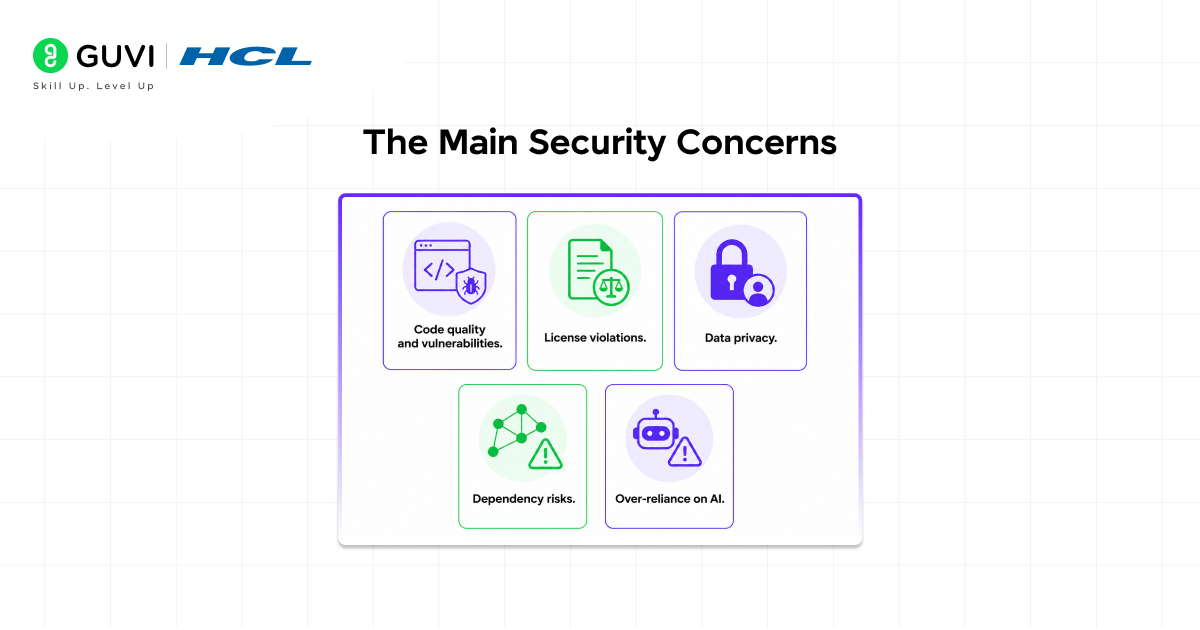
- Code quality and vulnerabilities.
AI can generate code that looks correct but contains security flaws. It might use outdated libraries, skip input validation, or create functions vulnerable to common attacks like SQL injection or cross-site scripting.
- License violations.
If an AI was trained on copyrighted or restrictively licensed code, it might reproduce that code when you ask for help. This could put you or your company in legal trouble without you even realizing it.
- Data privacy.
When you use an AI assistant, you might share sensitive information in your prompts or code context. If that data is not handled properly, it could leak to other users or be stored in ways you did not intend.
- Dependency risks.
AI-generated code often pulls in external libraries and packages. If the AI suggests an outdated or compromised package, your project inherits that risk.
- Over-reliance on AI.
Developers who trust AI output without reviewing it can ship vulnerable code to production. The AI does not understand the security context of your specific application.
These risks are not hypothetical. Security researchers have already documented cases where AI tools suggested vulnerable code patterns, reproduced licensed code without attribution, and introduced dependencies with known security issues.
How Replit Approaches AI Code Security
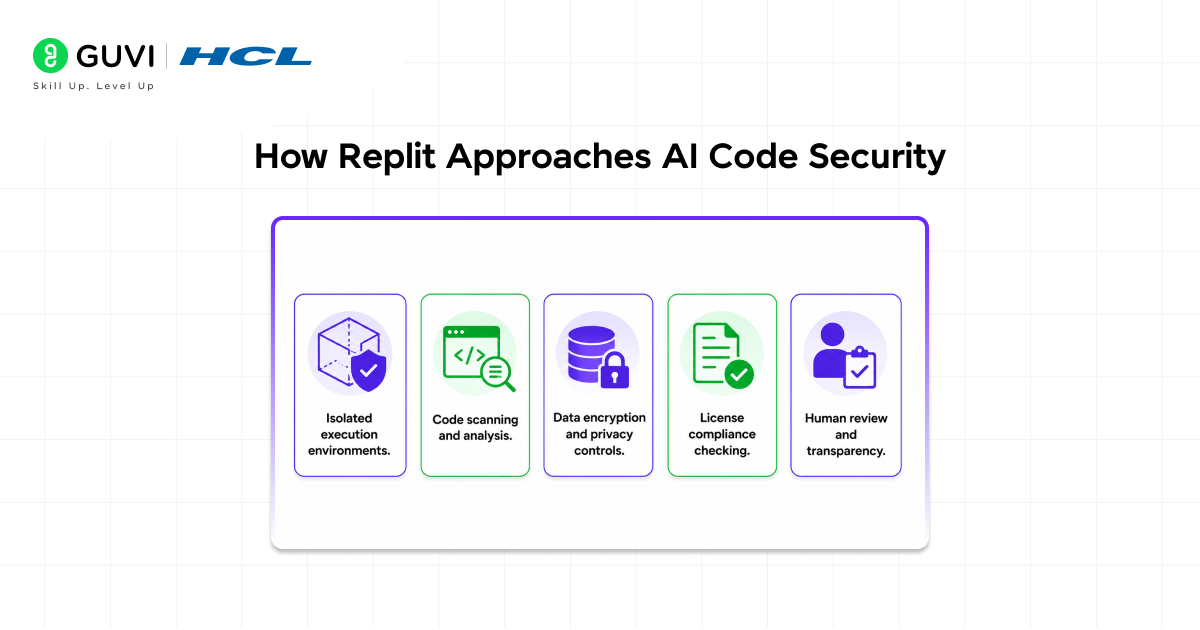
Replit has built its AI security strategy around five core principles.
- Isolated execution environments.
Every Replit project runs in its own containerized environment. This means that even if AI-generated code contains a vulnerability or malicious logic, it cannot access other users’ projects or Replit’s underlying infrastructure. The isolation layer acts as a sandbox that limits what any piece of code can do.
- Code scanning and analysis.
Before AI-generated code reaches your editor, Replit runs it through automated security checks. These scans look for known vulnerability patterns, dangerous function calls, and suspicious behaviors. While no scanner catches everything, this layer helps filter out obvious risks before you even see the code.
- Data encryption and privacy controls.
When you interact with Replit’s AI, your prompts and code context are encrypted in transit and at rest. Replit has stated that user code is not used to train their AI models without explicit consent. This helps prevent accidental data leaks and ensures your proprietary code stays private.
- License compliance checking.
Replit’s AI assistant is designed to avoid reproducing code that would violate licensing terms. The model is trained to generate original solutions rather than copying existing implementations verbatim. When the AI does reference external code or libraries, Replit aims to flag licensing requirements so you can make informed decisions.
- Human review and transparency.
Replit encourages developers to review all AI-generated code before running or deploying it. The platform shows you exactly what the AI suggested and highlights areas where you should pay extra attention. This keeps the human developer in control rather than blindly trusting the AI.
Real-World Examples of Secure AI Coding
Example 1: Building a Login System
A developer asks Replit’s AI to create a user authentication system. The AI generates code that includes password hashing, session management, and input validation.
Behind the scenes, Replit’s security layer checks this code for common authentication vulnerabilities. It verifies that the AI used a secure hashing algorithm, did not hard-code secrets, and included proper input sanitization. The developer reviews the code, sees these security measures in place, and can confidently use it.
Example 2: Database Query Generation
A student learning SQL asks the AI to help write a database query to fetch user records. The AI generates a parameterized query instead of concatenating strings, which prevents SQL injection attacks.
Replit’s scanning system recognizes this as a secure pattern and flags it as safe. If the AI had generated a vulnerable query using string concatenation, the scanner would have flagged it and suggested a safer approach.
Example 3: API Integration
A freelancer needs to connect their app to a third-party API. They ask the AI for help. The AI suggests using an official SDK and storing API keys in environment variables rather than hard-coding them in the source code.
Replit’s environment supports secure secret management, and the AI is trained to recommend these best practices. The developer follows the suggestion, and their API credentials stay protected.
Example 4: Handling User Input
A team building a web app asks the AI to process form submissions. The AI generates code that validates and sanitizes user input before processing it, protecting against cross-site scripting and other injection attacks.
Replit’s security checks confirm that the AI included proper input validation. The team reviews the logic, runs tests, and ships the feature knowing it follows secure coding standards.
Studies show that over 40% of AI-generated code can contain at least one security vulnerability when used without proper review.
That’s why platforms like Replit emphasize human oversight and automated security scanning as critical layers of defense.
What Replit Does Behind the Scenes
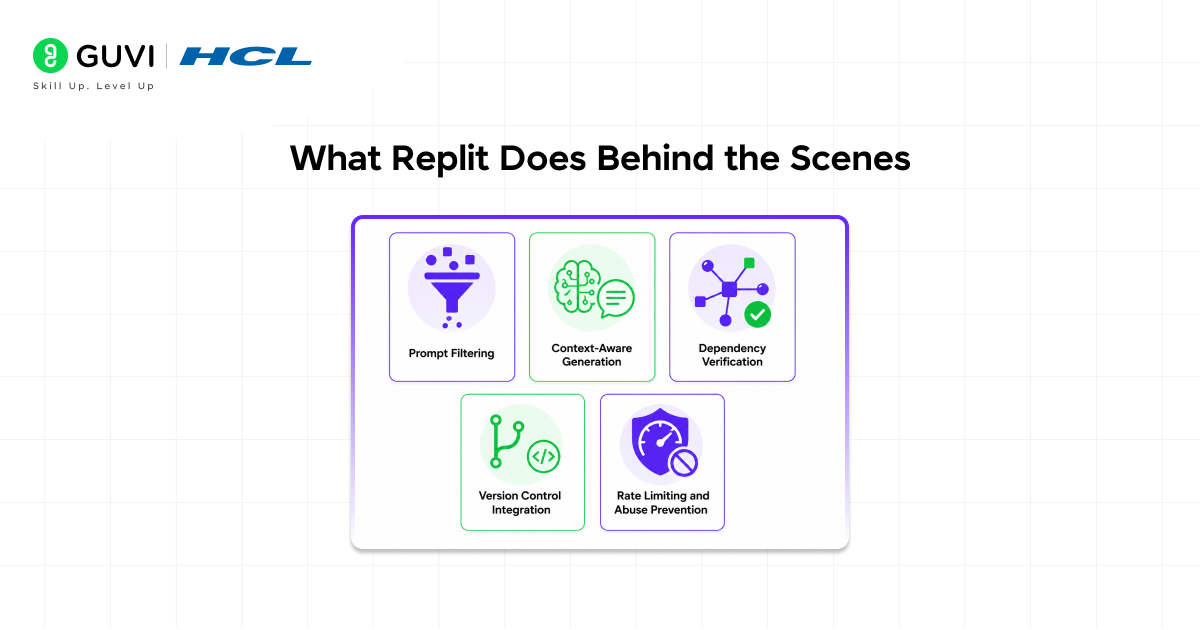
Most developers never see the security infrastructure working in the background. Here is what happens every time you use Replit’s AI assistant.
- Prompt filtering.
When you type a request, Replit’s system analyzes your prompt for patterns that might lead to insecure code generation. If you ask for something inherently risky, the AI can refuse or suggest a safer alternative.

- Context-aware generation.
The AI considers your project’s existing code and dependencies when generating new code. This helps it produce solutions that fit your security posture rather than generic snippets that might introduce conflicts.
- Dependency verification.
If the AI suggests installing a package or library, Replit checks that package against known vulnerability databases. If a suggested dependency has a known security flaw, you get a warning before you proceed.
- Version control integration.
Replit’s version control features let you track exactly what the AI changed and when. This makes it easy to audit AI contributions and roll back changes if something goes wrong.
- Rate limiting and abuse prevention.
Replit limits how much AI-generated code a single user can request in a given timeframe. This prevents bad actors from using the platform to mass-generate malicious code or exploit the AI for unintended purposes.
Pros and Cons of Replit’s Security Approach
Pros
- Replit provides multiple layers of protection rather than relying on a single security measure.
- The platform is transparent about what data it collects and how it uses your code, which builds trust.
- Automated scanning catches many common vulnerabilities before they reach production.
- Isolation ensures that even if something goes wrong, the damage is contained.
- Regular updates mean Replit’s security measures evolve as new threats emerge.
Cons
- No automated system catches every vulnerability, so human review is still essential.
- Developers who skip reviewing AI-generated code can still introduce security flaws.
- License compliance checking is not foolproof, and edge cases can slip through.
- The security model depends on users understanding basic security principles, which not all beginners have.
- Performance overhead from scanning and isolation can slightly slow down the development process.
Tips for Using AI Code Securely on Replit
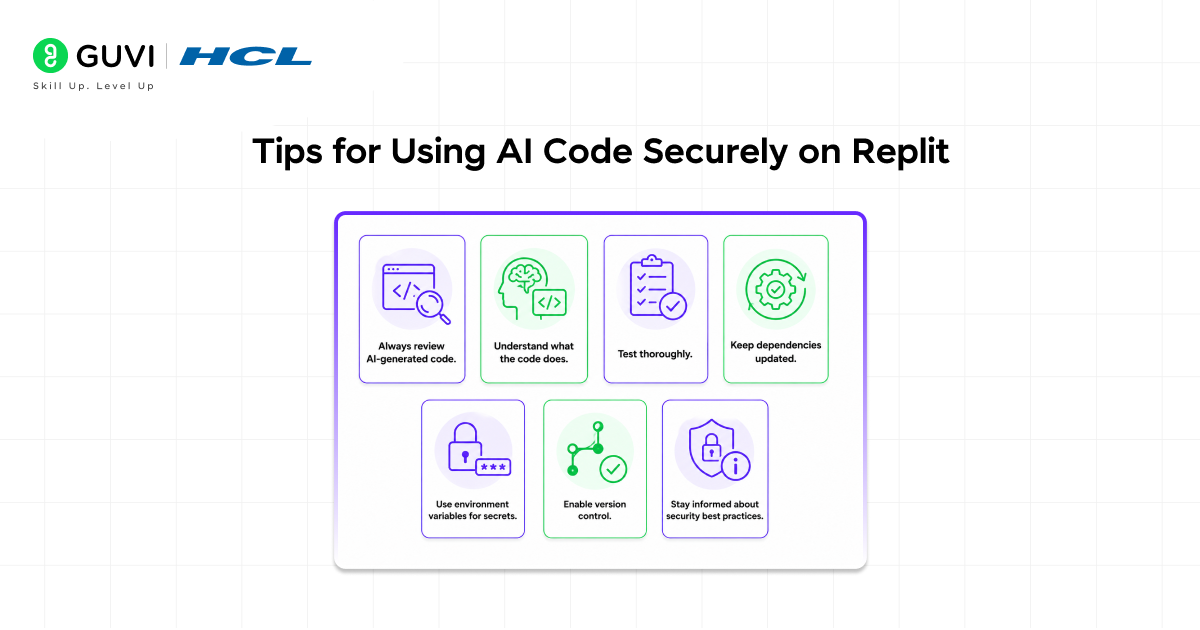
- Always review AI-generated code.
Never copy and paste AI output without reading it first. Look for logic errors, security gaps, and places where the code might not fit your specific use case.
- Understand what the code does.
If the AI generates something you do not understand, research it before using it. Blindly running code you do not comprehend is a security risk.
- Test thoroughly.
Run tests on AI-generated code just like you would for code you wrote yourself. Include security-focused tests that check for common vulnerabilities.
- Keep dependencies updated.
If the AI suggests libraries or packages, make sure they are current versions without known security issues. Use Replit’s dependency management tools to stay on top of updates.
- Use environment variables for secrets.
Never hard-code API keys, passwords, or other sensitive data. Store them in environment variables and reference them securely in your code.
- Enable version control.
Track all changes to your project, especially those made by AI. This makes it easier to audit, review, and roll back if needed.
- Stay informed about security best practices.
The more you know about secure coding, the better you can evaluate AI suggestions. Invest time in learning about common vulnerabilities and how to prevent them.
Limitations to Keep in Mind
Replit’s security measures are strong, but they are not perfect. Here are the limitations you should be aware of.
- AI models can still make mistakes.
Even with scanning and filtering, AI can generate code with subtle vulnerabilities that automated tools miss. Human expertise remains essential.
- New attack vectors emerge constantly.
Security is an ongoing battle. Replit’s defenses are updated regularly, but there is always a window between a new threat being discovered and defenses being updated.
- User behavior matters.
If a developer disables security features, ignores warnings, or blindly trusts AI output, no platform-level security can fully protect them.
- Legal gray areas remain.
License compliance for AI-generated code is still evolving. Courts have not fully settled how copyright applies to AI outputs, which means uncertainty remains.
- Performance trade-offs.
Some security measures add latency or resource overhead. Developers working on performance-critical projects may find these trade-offs frustrating.
Replit processes millions of lines of AI-generated code every month, with built-in systems that analyze code in real time.
These security layers automatically detect and block thousands of unsafe code snippets before they ever reach a developer, adding a critical layer of protection to AI-assisted development.
If you want to learn more on how Replit secures AI-Generated Code, do not miss the chance to enroll in HCL GUVI’s Intel & IITM Pravartak Certified Artificial Intelligence & Machine Learning course. Endorsed with Intel certification, this course adds a globally recognized credential to your resume, a powerful edge that sets you apart in the competitive AI job market.
Conclusion
AI-generated code makes development faster and more accessible, but speed cannot come at the cost of security. Replit has built a comprehensive system to address the unique security challenges of AI code, from isolated execution environments to automated scanning and data privacy controls.
However, no system is perfect. Developers still need to review, test, and understand the code they use. When you combine Replit’s security infrastructure with your own diligence, you get the best of both worlds: the speed of AI with the reliability of human oversight.
FAQs
1. Can I trust AI-generated code from Replit without reviewing it?
No. While Replit has strong security measures in place, you should always review AI-generated code before using it. Automated systems cannot catch every vulnerability, and only you understand the specific security requirements of your project.
2. Does Replit use my code to train its AI models?
Replit has stated that user code is not used to train AI models without explicit consent. Your projects and proprietary code remain private and are protected by encryption.
3. What happens if the AI suggests vulnerable code?
Replit’s automated scanning systems catch many common vulnerabilities and flag them before you see the code. However, some issues might slip through, which is why human review is essential.
4. Is AI-generated code safe to use in production applications?
It can be, but only if you review, test, and validate it thoroughly. Treat AI-generated code the same way you would treat code from any other developer: with careful scrutiny and proper testing.
5. How does Replit handle licensing for AI-generated code?
Replit’s AI is designed to generate original code rather than copying existing implementations. However, licensing for AI-generated code is still an evolving area of law, so you should stay informed and exercise caution when using AI output in commercial projects.
Success Stories

About the Author
Vishalini Devarajan
An Aerospace Engineer turned content writer, I focus on making complex concepts easy to understand through well-structured, reader-friendly blogs. Whether it’s a technical topic or a non-technical one, I love creating content that is clear, engaging, and impactful.
View all posts by Vishalini Devarajan
Connect with me @





Did you enjoy this article?