


Product Management Articles
Enterprise Product Management: Unique Challenges, Skills & Strategy
B2B vs B2C Product Management: Key Differences, Skills, Strategy & Career Scope
Working with Engineers as a Product Manager: A Practical Guide


Get In Touch For Details! Request More Information
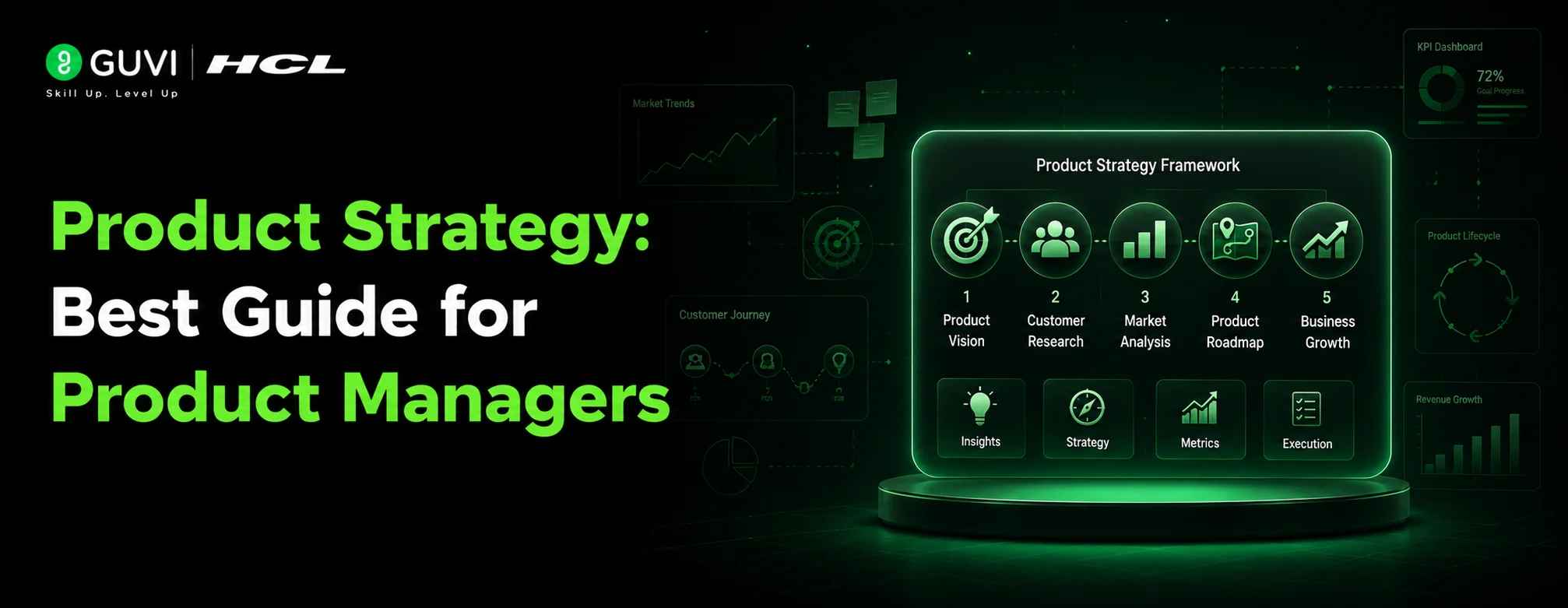
Product Strategy: Best Guide for Product Managers in 2026
Jul 14, 2026 7 Min Read 428 Views
(Last Updated)
Table of contents
- TL;DR Summary
- What is Product Strategy?
- Product Strategy in Simple Words
- Why is Product Strategy Important?
- Product Strategy vs Product Vision vs Product Roadmap
- Quick Difference
- Key Elements of a Good Product Strategy
- Target Customer
- Customer Problem
- Value Proposition
- Business Goal
- Success Metrics
- How to Create a Product Strategy Step by Step
- Step 1: Understand the User
- Step 2: Define the Problem Clearly
- Step 3: Decide the Product Positioning
- Step 4: Set Product Goals
- Step 5: Choose Strategic Initiatives
- Step 6: Build the Roadmap
- Product Strategy Framework for Beginners
- Product Strategy Template
- Real-World Example of Product Strategy
- Example Strategy
- Product Strategy Examples for Different Products
- Best Practices for Building Product Strategy in 2026
- Common Mistakes to Avoid While Creating Product Strategy
- Confusing Strategy With a Feature List
- Choosing Too Many Target Users
- Ignoring Business Goals
- Not Measuring Success
- Treating Strategy as Permanent
- Build Product Management Skills With HCL GUVI
- Conclusion
- FAQS
- What is product strategy in simple words?
- What are the key elements of product strategy?
- Why is product strategy important?
- What is the difference between product strategy and product roadmap?
- Who owns product strategy?
- How do you create a product strategy?
- What is an example of product strategy?
- Is product strategy useful for beginners and students?
TL;DR Summary
Product Strategy is the high-level plan that explains who a product is for, what problem it solves, why it matters, and how it will achieve business goals. A good product strategy connects customer needs, market opportunity, product vision, success metrics, and roadmap priorities. It helps product managers, designers, developers, marketers, and leadership teams make better decisions. For beginners, the easiest way to understand product strategy is this: it tells a team what to build, who to build for, why it matters, and how success will be measured.
Product Strategy helps teams decide what to build, why to build it, who to build it for, and how success will be measured.
Without a clear strategy, product teams may keep adding features without solving the right customer problem.
This guide explains product strategy in simple terms, with examples, framework, roadmap connection, common mistakes, and practical steps for beginners.
To understand the broader field behind product strategy, you can also read this guide on product management.
What is Product Strategy?
Product Strategy is a high-level plan that connects customer needs, product vision, business goals, and execution priorities.
In simple words, it answers four questions:
- Who are we building for?
- What problem are we solving?
- Why will users choose this product?
- How will the product create business value?
A product strategy defines the direction of a product by connecting the target user, problem, value proposition, business goal, and execution priorities.
So, product strategy is not just a document. It is the thinking system that guides product decisions.
Product Strategy in Simple Words
A product strategy is like a direction map for a product.
For example, if a startup wants to build a learning app for college students in India, its strategy should define the target users, their learning problems, the app’s unique value, pricing model, growth channel, and success metrics.
Without this, the team may build random features like quizzes, videos, chatbots, leaderboards, and certificates without knowing what truly helps users.
Why is Product Strategy Important?
Product strategy is important because it keeps product teams focused on outcomes, not just features.
A product team may have many ideas. But not every idea deserves engineering time, design effort, marketing spend, or leadership attention.
A good strategy helps teams:
- Choose the right customer segment
- Prioritize important problems
- Avoid random feature building
- Align design, engineering, marketing, and sales
- Connect product decisions to business goals
- Measure success with clear metrics
- Say no to low-impact ideas
Many product teams struggle with product strategy because it requires balancing user needs, business goals, roadmap priorities, stakeholder inputs, and measurable outcomes.
Product strategy also helps teams understand how different roles in a product-based company work together, including product managers, designers, developers, marketers, and sales teams.
A product roadmap is useful only when it is connected to a clear product strategy. Without strategy, a roadmap becomes a list of features instead of a plan for solving user and business problems.
Product Strategy vs Product Vision vs Product Roadmap
Beginners often confuse product vision, product strategy, product roadmap, and execution.
They are connected, but they are not the same.
| Concept | Meaning | Simple Example |
| Product Vision | The long-term future direction of the product | “Help Indian students learn job-ready tech skills in their own language.” |
| Product Strategy | The plan to achieve the vision | “Target tier 2 and tier 3 learners with affordable, project-based courses.” |
| Product Roadmap | The timeline of major product priorities | “Launch mobile learning, doubt-solving, and placement dashboard in phases.” |
| Product Goals | Measurable targets | “Improve course completion by 25% in six months.” |
| Product Execution | The actual work done by teams | Designing screens, writing code, launching features, tracking usage. |
A product roadmap shows the major priorities, timelines, and planned work that help a team execute the product strategy.
Quick Difference
Product vision says where the product wants to go.
Product strategy explains how the product will get there.
Product roadmap shows what will be built over time.
Execution is the actual work done to deliver the roadmap.
If you want a deeper comparison, read GUVI’s detailed guide on product strategy vs product roadmap.
Key Elements of a Good Product Strategy
A good product strategy should be clear enough for the team to follow and practical enough to guide real decisions.
It does not need to be a 50-page document.
It should clearly define the user, problem, value, goals, and priorities.
1. Target Customer
A product strategy should clearly define who the product serves.
Do not write “everyone” as your target user.
For example, “college students preparing for placement interviews in India” is much clearer than “students.”
2. Customer Problem
The strategy should explain the exact problem the user faces.
A weak problem statement is:
“Students need better learning.”
A better problem statement is:
“Final-year students struggle to practise interview questions in a structured way before campus placements.”
3. Value Proposition
The value proposition explains why users should choose your product.
It should answer:
- What benefit does the product give?
- What makes it different?
- Why should users care?
For example, a placement preparation platform may offer company-specific mock tests, progress tracking, coding practice, and interview questions in one place.
4. Business Goal
A product must create value for the business too.
Business goals can include:
- Increasing paid users
- Improving retention
- Reducing churn
- Expanding to a new market
- Increasing course completion
- Improving customer satisfaction
A strong product strategy usually includes the target audience, user needs, key product value, differentiator, business goal, and success metrics.
5. Success Metrics
A product strategy must include measurable success metrics.
Examples include:
- Monthly active users
- Conversion rate
- Retention rate
- Churn rate
- Completion rate
- Customer satisfaction score
- Revenue per user
- Feature adoption rate
Metrics help the team know whether the strategy is working.
Understanding the product life cycle can also help you set better goals because product priorities change from launch to growth, maturity, and decline.
How to Create a Product Strategy Step by Step
Creating product strategy becomes easier when you follow a simple process.
You do not need to start with complex frameworks.
Start with the user problem and connect it to business value.
Step 1: Understand the User
Talk to users before deciding the strategy.
You can use:
- User interviews
- Surveys
- Support tickets
- App reviews
- Sales calls
- Analytics data
- Competitor research
For example, if you are building a budgeting app for Indian college students, you should understand their spending patterns, UPI habits, income sources, and common money problems.
Step 2: Define the Problem Clearly
Write the problem in one sentence.
Use this format:
“[User type] struggles with [problem] because [reason].”
Example:
“Final-year engineering students struggle with placement preparation because resources are scattered across aptitude, coding, resume, and interview practice.”
This makes the strategy sharper.
Step 3: Decide the Product Positioning
Positioning explains how your product is different from other options.
Ask:
- Why will users choose us?
- What do we do better?
- What do we not want to focus on?
- Which market segment matters most?
For example, one product may focus on affordable learning, while another may focus on premium mentorship.
Both can work, but the strategy will be different.
Step 4: Set Product Goals
Set 2–3 clear product goals.
Good goals are measurable.
Examples:
- Increase trial-to-paid conversion by 15%.
- Improve day 30 retention by 20%.
- Reduce onboarding drop-off by 25%.
- Increase course completion from 35% to 50%.
Avoid vague goals like “make the app better.”
Step 5: Choose Strategic Initiatives
Initiatives are big action areas that support the goals.
For example:
Goal: Improve course completion.
Possible initiatives:
- Add weekly progress reminders
- Improve doubt-solving experience
- Add milestone certificates
- Create shorter lesson paths
- Add mentor check-ins
These initiatives can later become roadmap items.
Step 6: Build the Roadmap
The roadmap converts strategy into planned work.
A good roadmap should not be just a feature list.
It should show the outcomes the team wants to achieve.
| Quarter | Strategic Focus | Example Initiative |
| Q1 | Improve onboarding | Skill assessment and personalized course path |
| Q2 | Improve retention | Weekly learning streaks and mentor nudges |
| Q3 | Improve placement outcomes | Mock interview dashboard and company-wise practice |
| Q4 | Improve revenue | Premium mentor-led placement plan |
For a deeper step-by-step approach, explore this guide on how to build a product development strategy.
Product Strategy Framework for Beginners
Here is a simple product strategy framework you can use for a college project, startup idea, SaaS product, app, or internal product.
| Product Strategy Element | Question to Answer | Example |
| Target User | Who is the product for? | Final-year engineering students |
| Problem | What problem do they face? | Placement preparation is scattered |
| Insight | What did we learn from users? | Students want company-specific practice |
| Value Proposition | Why will users choose us? | One platform for aptitude, coding, resume, and interviews |
| Business Goal | What does the business want? | Increase paid subscriptions |
| Success Metric | How will we measure success? | Trial-to-paid conversion, course completion |
| Differentiator | What makes it stand out? | Company-wise mock tests and progress tracking |
| Roadmap Focus | What should we build first? | Placement dashboard and smart practice plan |

Product Strategy Template
You can use this simple template:
Product vision:
What future do we want to create?
Target users:
Who are we serving first?
User problem:
What painful problem are we solving?
Market insight:
What do we know about the market or competition?
Value proposition:
Why will users choose this product?
Business goal:
How will this product help the company?
Success metrics:
How will we know the strategy is working?
Strategic initiatives:
What big themes will we focus on?
Roadmap priorities:
What should we build first, next, and later?
Real-World Example of Product Strategy
Imagine an Indian edtech company wants to build a placement preparation product for engineering students.
The team may first think of adding many features like coding tests, aptitude quizzes, resume builders, HR questions, AI mock interviews, company pages, and leaderboards.
But product strategy helps the team choose what matters first.
Example Strategy
Target user:
Final-year engineering students preparing for campus placements.
Problem:
Students do not know what to practise first because placement preparation is spread across aptitude, coding, resume, and interview skills.
Value proposition:
A structured placement preparation platform with company-wise practice, progress tracking, and interview preparation.
Business goal:
Increase course enrollments and improve student placement readiness.
Success metrics:
- Mock test completion rate
- Resume builder usage
- Interview practice completion
- Paid conversion rate
- Student placement outcome feedback
Roadmap focus:
- First: Company-wise mock tests
- Next: Resume improvement and coding practice
- Later: AI interview feedback and personalized learning path
This example shows how product strategy helps a team avoid random feature building and focus on real user outcomes.
A strong strategy also supports successful product launches because the team already knows the target user, value proposition, roadmap, and success metrics.
Product Strategy Examples for Different Products
Different products need different strategies.
A fintech app, food delivery app, edtech platform, and B2B SaaS product cannot use the same strategy.
| Product Type | Example Strategy Focus | Key Metric |
| Edtech app | Improve course completion and placement readiness | Course completion rate |
| Fintech app | Make UPI payments and budgeting simpler | Monthly active users |
| Food delivery app | Improve repeat orders in metro cities | Repeat purchase rate |
| B2B SaaS product | Reduce manual reporting for teams | Activation and retention |
| Healthcare app | Improve appointment booking and follow-up care | Completed bookings |
| Creator tool | Help users create content faster | Weekly active creators |
The strategy should match the user problem, product category, and business goal.
Best Practices for Building Product Strategy in 2026
Product strategy in 2026 should be customer-focused, data-informed, and flexible.
AI tools can help with research, summarization, idea generation, and competitor analysis, but human judgment is still important.
Follow these best practices:
- Start with a real user problem.
- Keep the strategy short and clear.
- Connect product goals to business goals.
- Use data, but do not ignore user interviews.
- Prioritize outcomes over features.
- Review the strategy every quarter.
- Share the strategy with design, engineering, marketing, and sales.
- Use a roadmap to convert strategy into action.
- Track metrics and adjust based on learning.
In 2026, product managers are expected to combine customer research, data analysis, AI awareness, prioritization, business thinking, and communication to build better products.
Product managers can also use the right product manager tools to manage research, prioritization, roadmaps, collaboration, and product decisions more efficiently.
ou can also explore how AI is changing the product manager role to understand how modern PMs use AI for research, analysis, prioritization, and decision-making.
For strategy decisions backed by data, this guide on business analytics for business growth can help you understand how data supports better product and business decisions
ProductLed Alliance’s 2026 State of Product Management Report is based on insights from nearly 250 product professionals and covers strategy alignment, prioritization challenges, customer insights, and AI adoption. This shows that product strategy is still one of the core focus areas for product teams in 2026.
Common Mistakes to Avoid While Creating Product Strategy
1. Confusing Strategy With a Feature List
Many beginners write a list of features and call it product strategy.
Fix it by first defining the user, problem, business goal, and success metrics.
2. Choosing Too Many Target Users
A product made for everyone usually becomes unclear.
Fix it by choosing one primary user segment first, then expanding later.
3. Ignoring Business Goals
A product can be useful to users but still fail as a business.
Fix it by connecting product decisions to revenue, retention, cost reduction, growth, or market expansion.
4. Not Measuring Success
Without metrics, teams cannot know if the strategy is working.
Fix it by choosing 2–3 success metrics before building the roadmap.
5. Treating Strategy as Permanent
Markets, competitors, user behavior, and technology can change.
Fix it by reviewing the strategy regularly and updating it when new evidence appears.
Before moving into this career, it is useful to understand product manager roles and responsibilities so you know how strategy connects with research, roadmaps, execution, and stakeholder management.
If you want to build this career step by step, follow the product manager roadmap to understand the skills, tools, and learning path required.
Build Product Management Skills With HCL GUVI
Learning product strategy becomes easier when you practise it with real product cases, user problems, roadmaps, and business goals.
HCL GUVI’s Product Management course is beginner-friendly and helps learners understand the product lifecycle, customer problems, product strategy, business goals, roadmaps, and decision-making frameworks.
Explore HCL GUVI’s Product Management Course
Conclusion
Product Strategy is the foundation that helps a product team make clear decisions. It defines the target user, problem, value proposition, business goal, success metrics, and roadmap direction. For beginners, the best way to learn product strategy is to start with a simple product idea and answer four questions: who is it for, what problem does it solve, why will users choose it, and how will success be measured? In 2026, product managers need strategy, data, customer research, AI awareness, and strong communication to build products that create real value.
FAQS
1. What is product strategy in simple words?
Product strategy is a clear plan that explains who a product is for, what problem it solves, why users will choose it, and how it will meet business goals.
2. What are the key elements of product strategy?
The key elements of product strategy are target users, customer problem, value proposition, business goal, success metrics, differentiation, and roadmap priorities.
3. Why is product strategy important?
Product strategy is important because it helps teams focus on the right users, choose the right problems, prioritize features, and connect product decisions to business results.
4. What is the difference between product strategy and product roadmap?
Product strategy explains why and how the product will win. A product roadmap shows what the team will build over time to support that strategy.
5. Who owns product strategy?
Product strategy is usually owned by the product manager or product leader, but it should be created with inputs from customers, business teams, engineering, design, sales, and leadership.
6. How do you create a product strategy?
To create a product strategy, define the target user, identify the problem, study the market, set product goals, choose success metrics, define initiatives, and convert them into a roadmap.
7. What is an example of product strategy?
An edtech product strategy could be to help final-year engineering students prepare for placements through company-wise mock tests, coding practice, resume tools, and interview preparation.
8. Is product strategy useful for beginners and students?
Yes, product strategy is useful for beginners because it teaches structured product thinking. It helps students understand how real product managers connect users, business goals, and product decisions.
Success Stories

About the Author
Reemsha Khan
Always been a storyteller at heart. Now, I turn complex topics into simple, easy-to-understand stories through content. Hope you find it helpful.
View all posts by Reemsha Khan
Connect with me @










Did you enjoy this article?