


Product Management Articles
Enterprise Product Management: Unique Challenges, Skills & Strategy
B2B vs B2C Product Management: Key Differences, Skills, Strategy & Career Scope
Working with Engineers as a Product Manager: A Practical Guide


Get In Touch For Details! Request More Information
What is SWOT Analysis in Product Management?
Sep 13, 2026 4 Min Read 519 Views
(Last Updated)
Table of contents
- TL;DR
- What is SWOT Analysis in Product Management?
- Internal Factors
- External Factors
- Why Do Product Managers Use SWOT Analysis?
- Understanding the Four Components of SWOT Analysis
- Strengths
- Weaknesses
- Opportunities
- Threats
- How to Conduct a SWOT Analysis for a Product
- Step 1: Define the Objective
- Step 2: Gather Product Data
- Step 3: Identify Strengths and Weaknesses
- Step 4: Identify Opportunities and Threats
- Step 5: Prioritize Findings
- Step 6: Create an Action Plan
- SWOT Analysis Product Management Example
- Strengths
- Weaknesses
- Opportunities
- Threats
- Benefits of SWOT Analysis for Product Managers
- Better Strategic Planning
- Improved Prioritization
- Stronger Competitive Positioning
- Risk Reduction
- Better Collaboration
- Common Mistakes to Avoid
- Being Too Vague
- Ignoring Data
- Treating SWOT as a One-Time Exercise
- Listing Too Many Items
- Failing to Create Action Plans
- SWOT Analysis vs Competitor Analysis
- Best Practices for Product Managers
- Conclusion
- FAQs
- What is SWOT analysis in product management?
- Why is SWOT analysis important for product managers?
- What are the four components of SWOT analysis?
- How often should product managers perform SWOT analysis?
- What is the difference between SWOT analysis and competitor analysis?
Building a successful product involves more than just a great idea. Product managers need to understand their product’s strengths, find weaknesses, identify market opportunities, and prepare for potential risks before making decisions.
This is where SWOT analysis in product management is helpful. It offers a clear framework for evaluating both internal and external factors that affect a product’s success. Whether launching new features or entering new markets, SWOT analysis guides product managers to make informed decisions based on facts instead of assumptions.
In this article, you’ll learn what SWOT analysis is, why product managers use it, how to conduct one effectively, and how to apply it to real product decisions.
TL;DR
- SWOT analysis in product management is a strategic framework used to assess Strengths, Weaknesses, Opportunities, and Threats affecting a product.
- Strengths and weaknesses are internal factors, while opportunities and threats are external market factors.
- Product managers use SWOT analysis to shape product strategy, prioritize features, position competitively, and plan roadmaps.
- A well-executed SWOT analysis helps teams find growth opportunities, minimize risks, and allocate resources more efficiently.
- SWOT works best when paired with action plans instead of being treated as a standalone exercise.
Turn insights into action with HCL GUVI’s Product Management Programme. Gain the skills to apply SWOT analysis, evaluate products, and make strategic decisions that drive growth.
What is SWOT Analysis in Product Management?
SWOT analysis is a strategic planning tool that evaluates a product’s Strengths, Weaknesses, Opportunities, and Threats. The aim is to understand the product’s current position and decide the best way forward.
The framework divides factors into two categories:
Internal Factors
- Strengths
- Weaknesses
External Factors
- Opportunities
- Threats
By examining both internal capabilities and external market conditions, product managers gain a clearer view of what helps or hinders product success.
Why Do Product Managers Use SWOT Analysis?
Product managers frequently face decisions involving limited resources, shifting customer needs, and competitive pressure.
SWOT analysis reduces uncertainty by offering a structured approach to evaluate a product before making strategic choices. It is often used for:
- Product roadmap planning
- Feature prioritization
- Market expansion decisions
- Product launches
- Competitive analysis
- Product repositioning
- Risk assessment
- Long-term product strategy
Since SWOT combines an internal product review with an external market evaluation, it helps teams make decisions that align with business goals and customer needs.
A strong understanding of product strategy helps product managers use SWOT analysis more effectively when making product decisions and setting long-term goals.
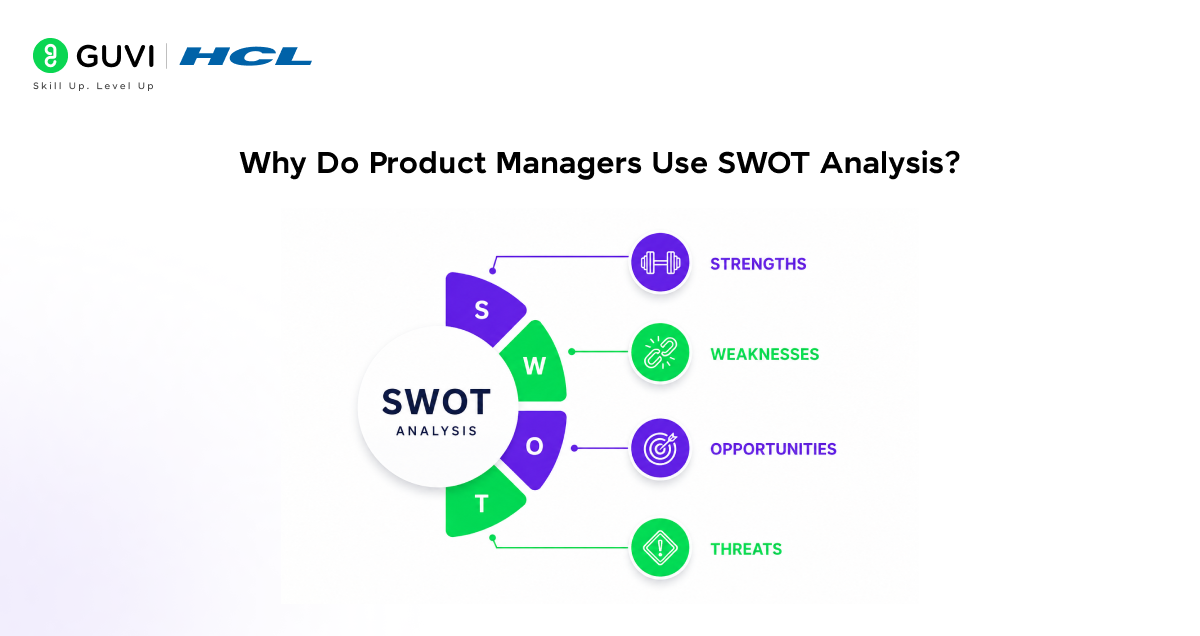
Understanding the Four Components of SWOT Analysis
1. Strengths
Strengths are internal advantages that help a product succeed in the market.
Examples include:
- Strong brand recognition
- Loyal customer base
- Unique features
- Superior user experience
- Strong engineering team
- Large data advantage
For instance, a productivity app with excellent customer retention and high app store ratings might point to these factors as strengths.
2. Weaknesses
Weaknesses are internal limitations that reduce a product’s competitiveness.
Examples include:
- Slow development cycles
- High customer acquisition costs
- Poor onboarding experience
- Technical debt
- Limited integrations
- Small development team
Recognizing weaknesses allows product managers to prioritize improvements before they become big issues.
3. Opportunities
Opportunities are external factors that could help the product grow.
Examples include:
- Emerging technologies
- New customer segments
- Untapped markets
- Industry trends
- Strategic partnerships
- Growing demand for AI solutions
Modern product teams increasingly look at opportunities created by AI, automation, and data-driven personalization when planning future roadmaps.
4. Threats
Threats are external risks that could harm product success.
Examples include:
- New competitors
- Regulatory changes
- Economic downturns
- Rapid technological shifts
- Market saturation
- Changing customer preferences
While threats cannot always be controlled, identifying them early helps teams get ready with mitigation strategies.
While SWOT analysis is widely used to evaluate Strengths, Weaknesses, Opportunities, and Threats, many organizations make the mistake of stopping at the identification stage. In modern strategic practice, the true value of SWOT lies not in the framework itself, but in how effectively it is translated into actionable decisions. High-performing teams use SWOT findings to shape concrete strategies, such as prioritizing investments, addressing internal gaps, leveraging competitive advantages, and responding to market risks. When applied correctly, SWOT becomes a bridge between analysis and execution, helping organizations move from insight to meaningful business action.
How to Conduct a SWOT Analysis for a Product
Step 1: Define the Objective
Start by pinpointing the specific goal.
Examples include:
- Launching a new feature
- Improving retention
- Entering a new market
- Increasing revenue
A focused objective generates more useful insights.
Step 2: Gather Product Data
Collect information from:
- User feedback
- Analytics platforms
- Customer interviews
- Market research
- Support tickets
- Sales teams
- Competitor analysis
Reliable data cuts down on bias during the SWOT process. Also, Modern product manager tools can help teams collect customer insights, analyze trends, and make more informed product decisions.
Step 3: Identify Strengths and Weaknesses
Evaluate internal factors such as:
- Product performance
- Team capabilities
- Technology stack
- Product quality
- Customer satisfaction
Step 4: Identify Opportunities and Threats
Examine external factors, including:
- Industry trends
- Competitor activity
- Changes in customer behavior
- Regulatory developments
- Shifts in technology

Step 5: Prioritize Findings
Not every item carries the same weight.
Rank each factor based on:
- Impact
- Urgency
- Strategic relevance
Step 6: Create an Action Plan
Turn findings into specific actions.
For instance:
- Use strengths to seize opportunities.
- Fix weaknesses before competitors take advantage of them.
- Develop backup plans for threats.
This is where SWOT delivers real business value.
SWOT Analysis Product Management Example
Imagine a product manager working on an AI-powered study assistant app.
Strengths
- Personalized learning recommendations
- Strong user engagement
- Positive reviews
Weaknesses
- Limited integrations
- Small development team
- Lack of offline support
Opportunities
- Rising demand for AI educational tools
- Expansion into universities
- Partnerships with edtech companies
Threats
- Large competitors entering the market
- Rapid AI advancements
- Data privacy regulations
Based on this SWOT analysis, the product manager might prioritize integrations, expand partnerships, and invest in AI differentiation.
Benefits of SWOT Analysis for Product Managers
Better Strategic Planning
SWOT offers a clear view of the product landscape and helps align choices with long-term goals.
Improved Prioritization
It becomes easier to see which problems need immediate attention.
Stronger Competitive Positioning
Teams gain a better understanding of their advantages and vulnerabilities.
Risk Reduction
Identifying threats early allows for proactive planning.
Better Collaboration
SWOT encourages teamwork among product, engineering, marketing, sales, and leadership teams.
SWOT analysis remains one of the foundational frameworks used in product management for evaluating opportunities, risks, and strategic direction.
Looking to strengthen your product thinking? Download HCL GUVI’s free UI/UX Design ebook and discover how UX principles can help you identify opportunities, solve user problems, and build successful products.
Common Mistakes to Avoid
1. Being Too Vague
Stay away from statements like:
- Good product
- Strong team
Be specific and measurable.
2. Ignoring Data
Opinions should not replace customer feedback and analytics.
3. Treating SWOT as a One-Time Exercise
Markets change fast. SWOT should be revisited regularly.
4. Listing Too Many Items
Concentrate on factors that significantly impact product success.
5. Failing to Create Action Plans
A SWOT document without follow-through has limited value.
Want to turn product insights into winning strategies? HCL GUVI’s Product Management Programme teaches you how to apply SWOT analysis, evaluate product performance, uncover market opportunities, and make strategic product decisions with confidence.
SWOT Analysis vs Competitor Analysis
While both frameworks support strategic decision-making, they serve different purposes.
- SWOT analysis looks at both internal and external factors affecting a product.
- Competitor analysis focuses mainly on rival products, pricing, and market strategies.
Product managers often combine both approaches for a complete market view.
Best Practices for Product Managers
- Conduct SWOT reviews quarterly or before key product decisions.
- Use actual customer and market data.
- Involve teams from different functions.
- Prioritize findings that will have the greatest impact.
- Connect SWOT insights directly to roadmap choices.
- Regularly reassess assumptions as market conditions change.
- Turn every major finding into an actionable strategy.
Conclusion
SWOT analysis is one of the most effective strategic tools available to product managers. By assessing strengths, weaknesses, opportunities, and threats, teams can make smarter decisions, lessen uncertainty, and develop more competitive products.
When used properly, SWOT analysis becomes more than just a planning exercise. It turns into a decision-making tool that helps product managers find growth opportunities, tackle weaknesses, anticipate risks, and create stronger product strategies.
As products, technologies, and customer expectations continue to evolve, mastering SWOT analysis in product management can support smarter strategic decisions throughout your career.
FAQs
1. What is SWOT analysis in product management?
SWOT analysis in product management is a strategic framework used to assess a product’s strengths, weaknesses, opportunities, and threats to aid in better decision-making and product planning.
2. Why is SWOT analysis important for product managers?
It helps product managers understand their internal capabilities, identify market opportunities, assess risks, and create more effective product strategies.
3. What are the four components of SWOT analysis?
The four components are Strengths, Weaknesses, Opportunities, and Threats.
4. How often should product managers perform SWOT analysis?
Most organizations review SWOT quarterly, annually, or before major product initiatives like launches, market expansions, or significant roadmap changes.
5. What is the difference between SWOT analysis and competitor analysis?
SWOT analysis evaluates both internal and external factors affecting a product, while competitor analysis focuses specifically on understanding competing products and market rivals.
Success Stories

About the Author
Vishalini Devarajan
An Aerospace Engineer turned content writer, I focus on making complex concepts easy to understand through well-structured, reader-friendly blogs. Whether it’s a technical topic or a non-technical one, I love creating content that is clear, engaging, and impactful.
View all posts by Vishalini Devarajan
Connect with me @











Did you enjoy this article?