


Product Management Articles
User Research Methods for Product Managers -Best Guide 2026
Product Strategy: Best Guide for Product Managers in 2026
How to Use Airtable: Best Guide for Project Management
How to Use ClickUp: Best Guide for Software Development Projects


Get In Touch For Details! Request More Information
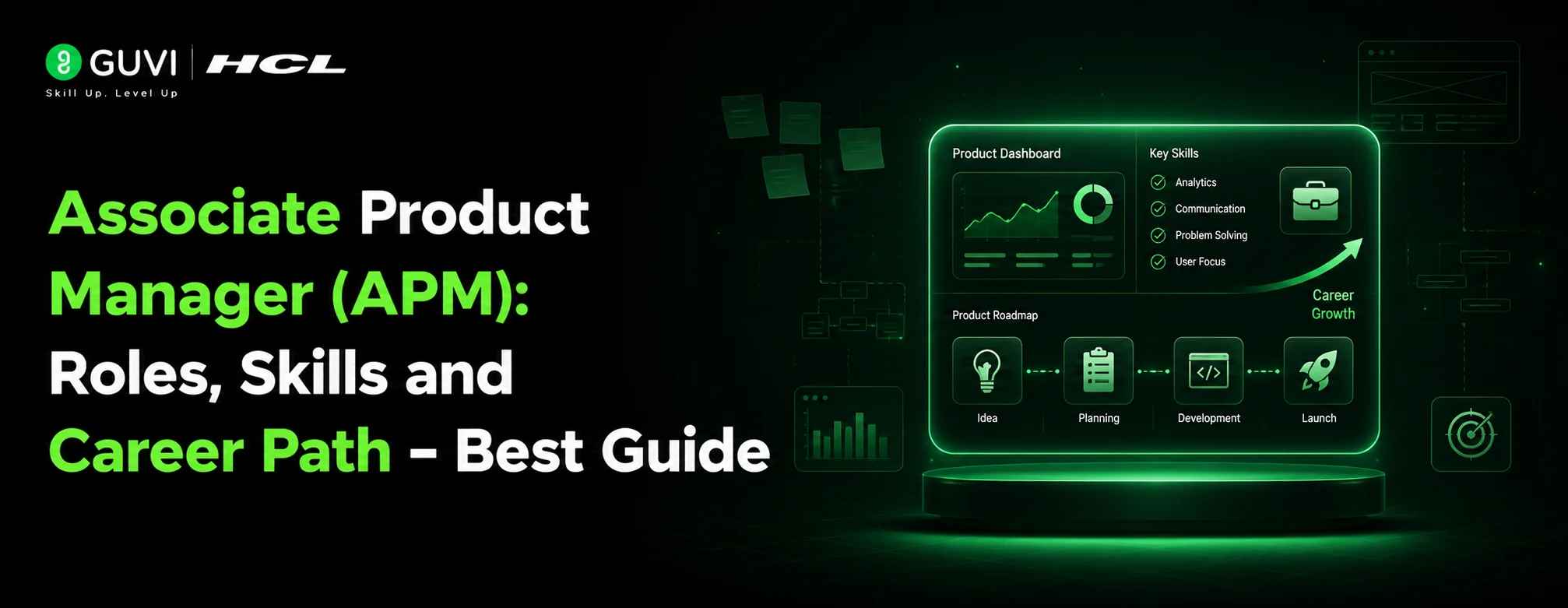
Associate Product Manager (APM): Roles, Skills and Career Path- Best Guide
Jul 14, 2026 9 Min Read 28 Views
(Last Updated)
Table of contents
- TL;DR
- What Is an Associate Product Manager?
- Why Is the Associate Product Manager Role Important?
- APM Job vs APM Programme
- What Does an Associate Product Manager Do?
- What Does an APM Do During a Typical Week?
- What Is the Difference Between an APM and a Product Manager?
- What Skills Does an Associate Product Manager Need?
- Do APMs Need Coding Skills?
- Why Is Analytical Thinking Important for APMs?
- What Tools Do Associate Product Managers Use?
- How Do You Become an Associate Product Manager?
- A 12-Week APM Preparation Roadmap
- What Does APM Work Look Like in a Real Product Team?
- What Is the Associate Product Manager Career Path?
- Stage 1: Associate Product Manager
- Stage 2: Product Manager
- Stage 3: Senior Product Manager
- Stage 4: Principal PM or Product Lead
- Stage 5: Director, VP of Product, or Chief Product Officer
- What Is the Associate Product Manager Salary in India?
- How Is the APM Role Changing in 2026?
- Common Mistakes Aspiring APMs Make
- Build Practical Product Management Skills With HCL GUVI
- Conclusion
- FAQs
- What does an Associate Product Manager do?
- Is an Associate Product Manager an entry-level role?
- Can a fresher become an Associate Product Manager?
- Do I need an MBA to become an Associate Product Manager?
- Does an Associate Product Manager need coding skills?
- What is the difference between an APM and a Product Manager?
- How can I become an Associate Product Manager without experience?
- What should an APM portfolio contain?
- What is an APM programme?
- What comes after an Associate Product Manager role?
TL;DR
An Associate Product Manager is an early-career product professional who helps a product team understand users, define requirements, coordinate delivery, and measure results. APMs usually manage a feature, workflow, or small product area under the guidance of an experienced Product Manager. The role requires user research, data analysis, clear writing, prioritisation, communication, and basic technical understanding. You can prepare for an APM role by learning product fundamentals, completing product case studies, writing a sample PRD, analysing product metrics, and building a focused portfolio. The usual career path moves from APM to Product Manager and then towards senior individual contributor or product leadership roles.
An Associate Product Manager role is one of the common entry points into product management, but getting selected requires more than knowing product terms.
Recruiters want evidence that you can understand users, break down problems, communicate with different teams, and use data to support decisions.
This guide explains the role, daily responsibilities, required skills, salary in India, preparation roadmap, and career path for students, freshers, and career switchers.
What Is an Associate Product Manager?
An Associate Product Manager, or APM, is an early-career product professional who supports the discovery, planning, development, launch, and improvement of a product.
An APM usually works with a Product Manager or Senior Product Manager. The APM may own a smaller feature, customer problem, workflow, experiment, or product metric rather than an entire product.
For example, a Product Manager at an online learning company may own the complete learner experience. An APM may focus specifically on improving course completion, simplifying the assignment flow, or increasing the number of learners who return after their first lesson.
Why Is the Associate Product Manager Role Important?
The APM role gives new product professionals controlled ownership. You learn through real product decisions while receiving guidance from an experienced manager.
Companies also benefit because APMs can take responsibility for research, documentation, analysis, feature coordination, and follow-up work. This gives senior PMs more time to focus on product direction and wider business decisions.
APM Job vs APM Programme
An APM job is an entry-level product position within a product team. You may work with one team, own a defined feature or workflow, and report to an experienced Product Manager.
An APM programme is a structured early-career pathway that may include formal training, mentorship, peer learning, product assignments, and periodic reviews.
Some programmes allow participants to work across different product areas. Others place each APM with one team for the entire programme. The structure, duration, eligibility criteria, and available locations vary by employer.
You do not need to come from only one academic background to prepare for an APM role. Candidates from engineering, business, design, analytics, marketing, and other fields can build relevant product skills through projects, internships, research, and practical case studies.
What Does an Associate Product Manager Do?
Associate Product Manager roles and responsibilities vary according to the company, product, and maturity of the team.
However, most APMs work across user understanding, product planning, execution, communication, and measurement.
| Responsibility | What the APM Does | Common Output |
| User research | Talks to users, reviews feedback, and identifies recurring problems | Interview notes or research summary |
| Market research | Studies competing products, customer groups, and market changes | Competitor analysis |
| Problem definition | Converts a broad complaint into a specific problem that the team can address | Problem statement |
| Requirements writing | Explains what should be built, why it matters, and how it should behave | PRD, user stories, or acceptance criteria |
| Prioritisation | Compares possible features using impact, effort, risk, and business goals | Prioritised backlog |
| Team coordination | Works with engineering, design, analytics, marketing, support, and sales | Meeting notes and decision log |
| Product analytics | Tracks user behaviour and checks whether a release improved the target metric | Metrics report or experiment analysis |
| Launch support | Helps prepare product communication, internal training, testing, and release plans | Launch checklist |
| Post-launch improvement | Reviews adoption, feedback, bugs, and drop-off points | Improvement recommendations |
As you gain experience, your scope will expand beyond individual features. You can review the broader Product Manager roles and responsibilities to understand what changes at the next career level.
Launch work also requires coordination across engineering, marketing, sales, support, and analytics. Understanding how Product Managers plan successful product launches can help you prepare for this responsibility.

What Does an APM Do During a Typical Week?
An APM may spend one part of the week reviewing user feedback and another part preparing requirements for an upcoming feature.
The APM may also attend design discussions, clarify requirements for engineers, check analytics dashboards, test a new release, and prepare a progress update.
The role is not limited to meetings. Strong APMs create useful outputs that help the team move forward, such as a clear PRD, a prioritised problem list, or a reliable product performance report.
What Is the Difference Between an APM and a Product Manager?
An APM and a Product Manager work on similar product activities. The main differences are the size of their scope, decision authority, experience, and level of support.
| Area | Associate Product Manager | Product Manager |
| Typical scope | One feature, workflow, experiment, or small product area | A larger product area, customer segment, or complete product |
| Ownership | Works with regular guidance | Owns outcomes with greater independence |
| Product strategy | Supports research and planning | Defines direction and major priorities |
| Decisions | Recommends options and handles defined decisions | Makes wider trade-offs across users, technology, and business |
| Stakeholder exposure | Coordinates mainly within the immediate team | Works with team leads, business heads, and senior stakeholders |
| Risk level | Usually handles lower-risk or well-defined work | Handles uncertain and higher-impact decisions |
| Success measure | Quality of execution, learning, analysis, and communication | Product outcomes, strategy, prioritisation, and business impact |
| Support | Receives mentorship from experienced PMs | May mentor APMs and junior team members |
An APM is not simply an assistant who completes administrative tasks. A good APM owns a defined problem and is accountable for understanding it, coordinating the work, and measuring the result.
What Skills Does an Associate Product Manager Need?
The most important APM skills combine product thinking, communication, data awareness, execution, and customer understanding.
You do not need expert-level knowledge in every area before applying. However, you should be able to demonstrate the following skills through projects, internships, work examples, or product case studies.
| Skill | Expected Beginner Level | How to Demonstrate It |
| User research | Ask neutral questions and identify patterns | Conduct five user interviews and summarise findings |
| Problem-solving | Break a vague issue into smaller causes | Create a root-cause analysis for an app problem |
| Product sense | Explain why a feature helps users and the business | Write a product teardown |
| Data analysis | Read funnels, percentages, retention, and conversion | Analyse a sample product dataset |
| PRD writing | Define the problem, users, requirements, limits, and metrics | Create a sample PRD |
| Prioritisation | Compare ideas using impact, effort, urgency, and risk | Prioritise a feature backlog |
| Communication | Explain decisions in simple written and spoken language | Present a product case in five minutes |
| Technical fluency | Understand APIs, databases, frontend, backend, bugs, and releases at a basic level | Explain how a familiar application may work |
| Collaboration | Work with people who have different goals and constraints | Complete a team project with design or development learners |
| Business thinking | Connect product changes to revenue, cost, adoption, or retention | Add business impact to a product proposal |
For a detailed breakdown of product thinking, communication, analytics, leadership, and technical awareness, explore the essential Product Manager skills required across different career levels.
Do APMs Need Coding Skills?
Most Associate Product Managers do not write production code as part of their main role.
However, basic technical understanding helps you communicate with engineers and recognise dependencies, limitations, data requirements, and development effort.
A beginner should understand concepts such as APIs, databases, frontend and backend systems, testing, analytics events, and software releases. Coding can strengthen your profile, but it is not a universal eligibility condition.
If you already work in development, this guide to switching from software engineering to product management explains how to present your technical experience as relevant product experience.
Why Is Analytical Thinking Important for APMs?
APMs regularly compare user feedback, product metrics, business needs, and technical constraints. Analytical thinking helps you separate assumptions from evidence and select the right problem to solve.
The World Economic Forum’s Future of Jobs Report 2025 found that seven out of ten surveyed employers considered analytical thinking an essential core skill.
Boston Consulting Group’s 2026 AI at Work survey found that 72% of employees said AI had changed the skills expected in their roles, but only 36% felt they had received adequate upskilling. For aspiring Associate Product Managers, this highlights the need to build AI literacy, data skills, and human judgment alongside core product management skills.
What Tools Do Associate Product Managers Use?
Tools support product work, but knowing a tool is not the same as knowing product management.
An APM should first understand the purpose of the work. The tool can then make documentation, analysis, design, or coordination easier.
Common APM tools include:
- Jira, Linear, or Azure DevOps: Backlog management, user stories, bugs, and sprint tracking
- Notion, Confluence, or Google Docs: PRDs, meeting notes, research, and decision records
- Figma: Wireframes, user flows, prototypes, and design feedback
- Miro or FigJam: Brainstorming, journey maps, and workshop activities
- Excel or Google Sheets: Basic analysis, prioritisation, and planning
- SQL: Querying product and user data
- Mixpanel, Amplitude, or GA4: Funnels, retention, events, and user behaviour
- PowerPoint or Google Slides: Product reviews, proposals, and stakeholder presentations
- ChatGPT, Gemini, or Claude: Drafting, research synthesis, ideation, and document review with human verification
Do not list ten tools on your resume unless you can explain how you used them to solve a product problem.
How Do You Become an Associate Product Manager?
To become an Associate Product Manager, you need to learn product fundamentals and produce evidence that you can apply them.
A degree in engineering, management, design, economics, psychology, marketing, or another discipline can provide useful skills. However, no single degree guarantees entry into product management.
A 12-Week APM Preparation Roadmap
Weeks 1–2: Understand Product Management Fundamentals
Learn how product teams identify problems, select users, define value, prioritise work, build features, launch products, and measure results.
Study the difference between outputs and outcomes. Shipping a feature is an output. Improving activation, retention, revenue, or customer satisfaction is an outcome.
Weeks 3–4: Practise User Research
Choose a small problem that affects students, employees, shoppers, creators, or local businesses.
Interview five to eight potential users. Ask about their current behaviour, difficulties, workarounds, and priorities. Avoid asking whether they “like” your idea.
Summarise the patterns you find. A good research summary should explain who has the problem, when it occurs, why it matters, and how users handle it now.
Weeks 5–6: Learn Product Metrics and Basic Analytics
Learn common metrics such as activation, conversion, engagement, retention, churn, and customer acquisition cost.
Create a simple funnel for an application you use. For example:
- The user installs the application.
- The user creates an account.
- The user completes onboarding.
- The user performs the core action.
- The user returns within seven days.
Identify where users may drop out and suggest what data you would need before proposing a solution.
Weeks 7–8: Write a Product Requirements Document
Select one problem from your research and write a short PRD.
Include:
- Problem statement
- Target user
- Supporting evidence
- User goal
- Proposed solution
- User stories
- Acceptance criteria
- Success metric
- Risks
- Dependencies
- Out-of-scope items
Keep the document focused. A short PRD with clear reasoning is more useful than a lengthy document filled with general statements.
Weeks 9–10: Build a Product Case Study
Turn your research, analysis, feature proposal, wireframe, and measurement plan into one structured case study.
Explain the decisions you made and the alternatives you rejected. Recruiters want to understand how you think, not only see a polished final screen.
Weeks 11–12: Prepare for Applications and Interviews
Create an APM resume that highlights product evidence.
Include relevant examples from internships, college clubs, hackathons, analytics projects, development work, design projects, marketing campaigns, or operations roles.
Prepare for common APM interview areas:
- Product improvement
- Product design
- Prioritisation
- Metrics
- Root-cause analysis
- Estimation
- Behavioural questions
- Technical understanding
- Product strategy basics
- Practise these areas using common Product Manager interview questions and explain your reasoning instead of memorising fixed answers.
What Does APM Work Look Like in a Real Product Team?
Consider an APM working on the onboarding process of a UPI payments application.
The analytics dashboard shows that many users begin identity verification but do not complete it. The APM should not immediately suggest adding a progress bar or reducing the number of screens.
The APM first defines the problem and gathers evidence. They may:
- Check which verification step has the largest drop-off.
- Compare completion rates by device, language, network type, and user group.
- Read support complaints related to verification.
- Interview users who abandoned the process.
- Review regulatory and compliance requirements with the legal team.
- Work with design and engineering to compare possible fixes.
- Define a success metric, such as verified-account completion.
- Add guardrail metrics for errors, fraud risk, and support requests.
- Test the change with a limited user group.
- Review the result before a wider release.
This example shows why product work is not simply feature creation. The APM connects user needs, data, business goals, design, engineering, and risk requirements.
What Is the Associate Product Manager Career Path?
The APM career path usually progresses through greater product scope, decision authority, strategic responsibility, and organisational influence.
Companies use different titles, so progression should be evaluated by responsibilities rather than title alone.
Stage 1: Associate Product Manager
At this stage, you learn product execution and own a defined feature, workflow, experiment, or problem.
Your development areas include research, requirement clarity, analytics, prioritisation, communication, and reliable follow-through.
Stage 2: Product Manager
A Product Manager owns a larger product area and has greater responsibility for outcomes.
The PM makes prioritisation decisions, manages trade-offs, works with a wider group of stakeholders, and connects product work to company goals.
Stage 3: Senior Product Manager
A Senior Product Manager handles more complex or uncertain product areas.
The role requires stronger strategy, independent judgment, stakeholder influence, and the ability to guide decisions across multiple teams.
Stage 4: Principal PM or Product Lead
Professionals can continue as senior individual contributors or take responsibility for a product group.
A Principal PM usually handles high-impact strategic problems without directly managing a large PM team. A Product Lead or Group PM may guide several PMs and related product areas.
Stage 5: Director, VP of Product, or Chief Product Officer
Product leaders set direction across product lines, build product teams, allocate resources, and align product decisions with wider company strategy.
Not every APM needs to pursue executive management. Some professionals prefer specialist paths in growth, platforms, data products, AI products, developer tools, fintech, health technology, or product operations.
For a stage-by-stage view of the knowledge, projects, and experience required beyond the APM position, follow this Product Manager roadmap.
What Is the Associate Product Manager Salary in India?
Associate Product Manager salary in India varies according to the company, city, industry, previous experience, education, product complexity, and the mix of fixed pay, bonus, and equity.
Current salary platforms also use different datasets and definitions. Their figures should therefore be treated as market indicators rather than guaranteed offers.
| Source | 2026 India Snapshot | Data Context |
| Glassdoor | Average reported salary of approximately ₹16 lakh per year; typical reported range of ₹11 lakh to ₹20.8 lakh | Based on 3,269 salary submissions as of July 2026 |
| Indeed | Average reported base salary of approximately ₹15.39 lakh per year | Based on 34 reported salaries, updated May 25, 2026 |
A fresher may receive an offer below these averages, especially at an early-stage company or in a role with limited ownership. Product companies, funded startups, fintech businesses, software firms, and roles with equity may offer different compensation structures.
Always evaluate the learning opportunity, manager quality, ownership, company stability, fixed pay, variable pay, equity terms, and role expectations together.
You can also compare these entry-level figures with the wider Product Manager salary in India across experience levels, cities, and product roles.
How Is the APM Role Changing in 2026?
AI tools are changing how product teams collect information, write documents, analyse feedback, create prototypes, and prepare experiments.
An APM may use AI to:
- Group hundreds of user comments into themes
- Draft the first version of a PRD
- Generate alternative interview questions
- Summarise competitor information
- Create an early prototype
- Produce SQL drafts for review
- Compare prioritisation options
- Prepare release notes or stakeholder updates
However, an APM remains responsible for the final judgment.
AI-generated findings may contain incorrect assumptions, missed context, biased summaries, weak data interpretation, or invented details. You must verify research, metrics, customer claims, technical information, and business recommendations before using them.
The strongest APMs will combine AI fluency with human skills such as customer empathy, structured reasoning, communication, collaboration, and ethical judgment.
Understanding how AI is changing the Product Manager role can help aspiring APMs identify which activities are being automated and which human skills are becoming more valuable.
Common Mistakes Aspiring APMs Make
1. Learning frameworks without solving a real problem: Memorising RICE, MoSCoW, or JTBD does not prove product ability. Apply a framework to a real case and explain why it was suitable.
2. Suggesting features before validating the problem: A new feature may not address the actual cause of user difficulty. Start with user evidence, behaviour data, and a clear problem statement.
3. Building a portfolio filled with redesigns: Visual redesigns mainly demonstrate interface thinking. Add research, metrics, prioritisation, trade-offs, requirements, and a measurement plan.
4. Applying only to famous APM programmes: Structured programmes are highly competitive and may be available only in selected regions. Apply to startups, SaaS companies, product analyst roles, product operations roles, and internal product openings as well.
5. Treating technical knowledge as optional: You may not need to code, but you should understand how software teams discuss APIs, databases, releases, testing, bugs, and dependencies.
Before choosing a learning programme, compare the curriculum, teaching format, practical projects, duration, and mentor support offered by different product management courses in India
Build Practical Product Management Skills With HCL GUVI
Breaking into an APM role becomes easier when you practise the complete product process instead of studying isolated frameworks.
The Certificate Programme in Product Management by IIM Indore and HCL GUVI covers product strategy, growth, AI-supported product work, and product leadership through live online learning and campus immersion. The current programme page describes an eight-month format and includes Generative and Agentic AI applications in product management.
A structured programme can help you connect user research, product strategy, prioritisation, analytics, growth, and execution while creating stronger examples for your product portfolio.
Conclusion
An Associate Product Manager helps a product team understand customer problems, define requirements, coordinate execution, and measure whether a solution worked.
The role is suitable for freshers and career switchers who can demonstrate structured thinking, user empathy, data awareness, communication, and basic technical fluency. Start with one user problem, conduct research, analyse the product flow, write a focused PRD, and present your decisions as a case study. These practical outputs give recruiters clearer evidence than certificates alone. As product teams adopt more AI-supported workflows, APMs who combine product judgment with responsible AI use will be better prepared for long-term product management careers.
FAQs
1. What does an Associate Product Manager do?
An Associate Product Manager supports user research, product planning, requirements writing, team coordination, analytics, launches, and post-launch improvement for a defined product area.
2. Is an Associate Product Manager an entry-level role?
Yes. An APM is generally an early-career role, although some companies prefer candidates with internships or experience in engineering, analytics, design, marketing, consulting, or operations.
3. Can a fresher become an Associate Product Manager?
Yes. Freshers can apply for APM jobs and graduate programmes. A product case study, internship, sample PRD, analytics project, or team project can help demonstrate relevant ability.
4. Do I need an MBA to become an Associate Product Manager?
No. An MBA is not a universal requirement. Companies may hire candidates from engineering, business, design, economics, psychology, marketing, analytics, and other backgrounds.
5. Does an Associate Product Manager need coding skills?
Coding is useful but not compulsory for most APM roles. You should still understand basic software concepts so that you can discuss requirements, effort, dependencies, data, testing, and releases with engineers.
6. What is the difference between an APM and a Product Manager?
An APM usually handles a smaller product area with guidance, while a Product Manager owns wider outcomes, priorities, trade-offs, and stakeholder decisions with greater independence.
7. How can I become an Associate Product Manager without experience?
Build evidence through user interviews, product teardowns, sample PRDs, analytics exercises, hackathons, internships, freelance projects, or improvements to a product used by a college club or small business.
8. What should an APM portfolio contain?
An APM portfolio should contain one to three detailed case studies showing research, problem definition, data, prioritisation, proposed requirements, wireframes, trade-offs, success metrics, and lessons learned.
9. What is an APM programme?
An APM program is a structured early-career product management route that may include formal training, rotations, mentorship, peer learning, and product ownership. Its format and eligibility vary by company.
10. What comes after an Associate Product Manager role?
The common next role is Product Manager. Later options include Senior Product Manager, Principal PM, Product Lead, Group Product Manager, Director of Product, VP of Product, or specialist product roles.
Success Stories

About the Author
Reemsha Khan
Always been a storyteller at heart. Now, I turn complex topics into simple, easy-to-understand stories through content. Hope you find it helpful.
View all posts by Reemsha Khan
Connect with me @








Did you enjoy this article?