


Product Management Articles
Enterprise Product Management: Unique Challenges, Skills & Strategy
B2B vs B2C Product Management: Key Differences, Skills, Strategy & Career Scope
Working with Engineers as a Product Manager: A Practical Guide


Get In Touch For Details! Request More Information
Product-Led Growth: What It Means and How to Implement It
Aug 19, 2026 7 Min Read 719 Views
(Last Updated)
Think about the last time you signed up for Notion, Slack, or Zoom: you likely onboarded yourself, discovered value quickly, and decided to keep using (or pay for) the product without a salesperson’s help. That self‑service experience is the essence of product‑led growth (PLG): the product itself drives acquisition, activation, and retention.
PLG replaces heavy sales-led motion with user-focused product design that lets customers try, succeed, and expand on their own. It’s a cost‑efficient strategy aligned with modern buyers who prefer to evaluate products hands‑on before committing.
In this article, you will learn what product-led growth actually means, why it works so well in today’s market, how it differs from the traditional sales-led approach, and the step-by-step process to implement a product-led growth strategy for your own product or business.
Table of contents
- TL;DR
- How Product-Led Growth Actually Works
- PLG vs. Sales-Led Growth: The Real Difference
- Philosophy difference: people vs. experience
- Complementary models and the PQL concept
- The Three Pillars of a Successful PLG Strategy
- Step-by-Step: How to Implement a Product-Led Growth Strategy
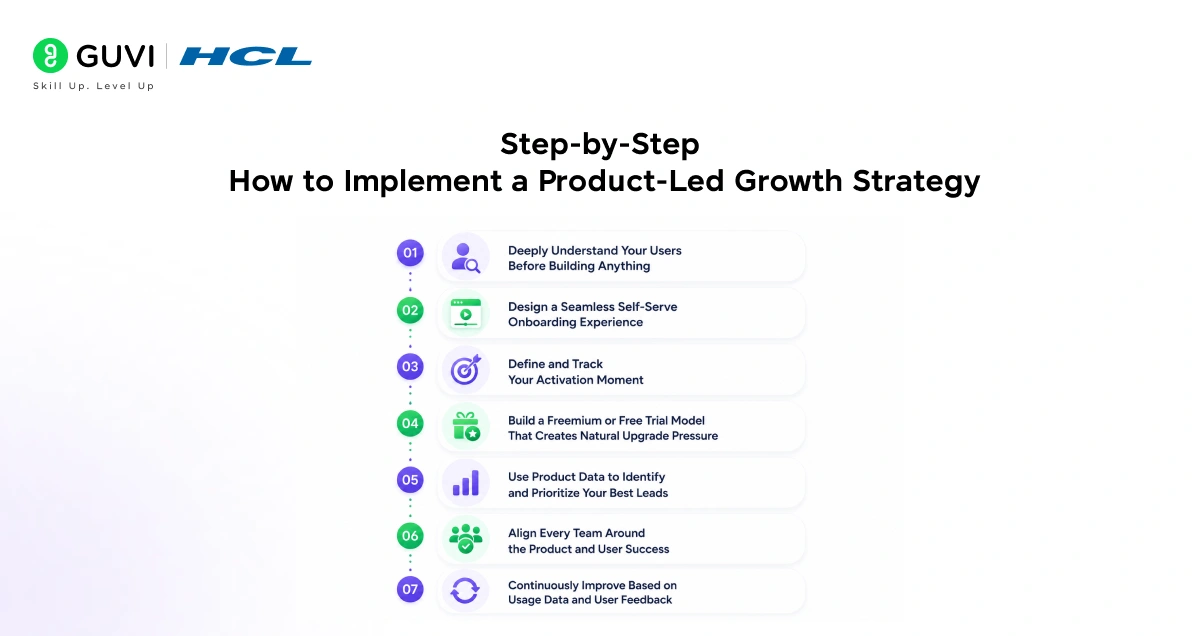
- Step 1: Deeply Understand Your Users Before Building Anything
- Step 2: Design a Seamless Self-Serve Onboarding Experience
- Step 3: Define and Track Your Activation Moment
- Step 4: Build a Freemium or Free Trial Model That Creates Natural Upgrade Pressure
- Step 5: Use Product Data to Identify and Prioritize Your Best Leads
- Step 6 : Align Every Team Around the Product and User Success
- Step 7: Continuously Improve Based on Usage Data and User Feedback
- The Key Metrics You Should Track in PLG
- Real Companies That PLG Built
- CONCLUSION
- FAQs
- Q: What’s the difference between freemium and a free trial and which should I pick?
- Q: How do I identify my product’s “aha” or activation moment?
- Q: What is a PQL and how do I use one in a hybrid sales model?
- Q: What metrics show PLG is working (or failing)?
- Q: How do I balance product self‑serve growth with enterprise sales needs?
TL;DR
- Product‑Led Growth (PLG) uses the product itself to drive acquisition, activation, retention, and expansion users try, see value, and convert without heavy sales.
- Core tactics: friction‑free onboarding, instrumented activation (the “aha”), freemium or trial models that create natural upgrade pressure, and PQLs (product‑qualified leads) for scaled sales outreach.
- Measure Time‑to‑Value, Activation Rate, Free→Paid conversion, PQL volume, and Expansion Revenue to track PLG health.
- PLG scales efficiently by automating growth inside the product; combine it with targeted sales for large or complex deals (hybrid model).
- Success requires cross‑company alignment: product, engineering, marketing, sales, and CS must optimize for user success inside the product.
What Is a Product-Led Growth (PLG) Strategy?
Product-Led Growth (PLG) is a business strategy where the product itself drives customer acquisition, engagement, retention, and revenue growth. Instead of relying heavily on sales or marketing teams, PLG companies let users experience the product directly through free versions, freemium models, or free trials. As users discover value and solve their problems through the product, they naturally progress toward upgrading to paid plans. This approach focuses on delivering immediate user value, reducing friction in onboarding, and using product experience as the primary driver of business growth.
How Product-Led Growth Actually Works
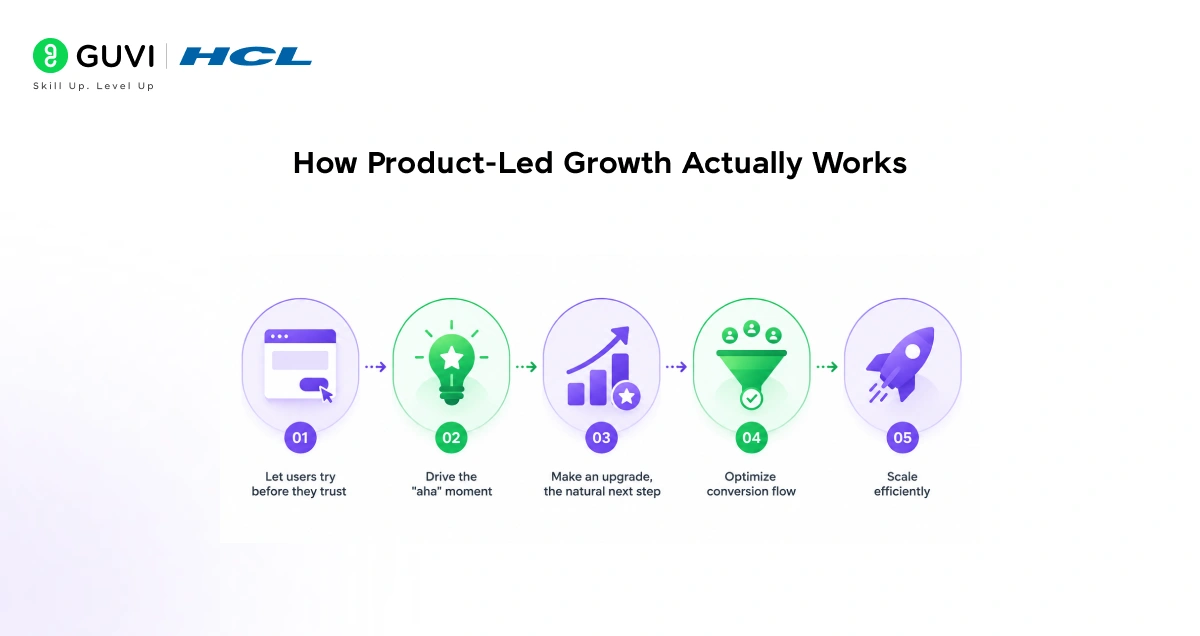
- Let users try before they trust
- Offer free access: freemium (limited features forever) or free trial (full access for a limited time).
- Remove signup friction so users start experiencing the product quickly.
- Drive the “aha” moment
- Define the aha: the specific in-product milestone where users see real value (example: Slack 2,000 messages; Dropbox first shared file opened on another device).
- Instrument events and guide users toward actions that produce that aha.
- Make an upgrade, the natural next step
- Design the post-aha path so upgrading feels logical, not like a sales pitch.
- Highlight incremental value in paid plans tied to the user’s behavior and needs.
- Optimize conversion flow
- Reduce friction in billing, plan selection, and feature comparison.
- Use contextual prompts, time-based nudges, and personalized messaging based on product usage.
- Scale efficiently
- Let the product drive growth so acquisition and expansion don’t require proportional increases in headcount.
- Automate PQL detection and in-product conversion triggers; reserve sales for high-touch, complex deals.
Turn Product-Led Growth into practice. Join HCL GUVI’s Product Management Programme by IIM Indore and gain the skills to build and scale products using modern PLG strategies.
PLG vs. Sales-Led Growth: The Real Difference
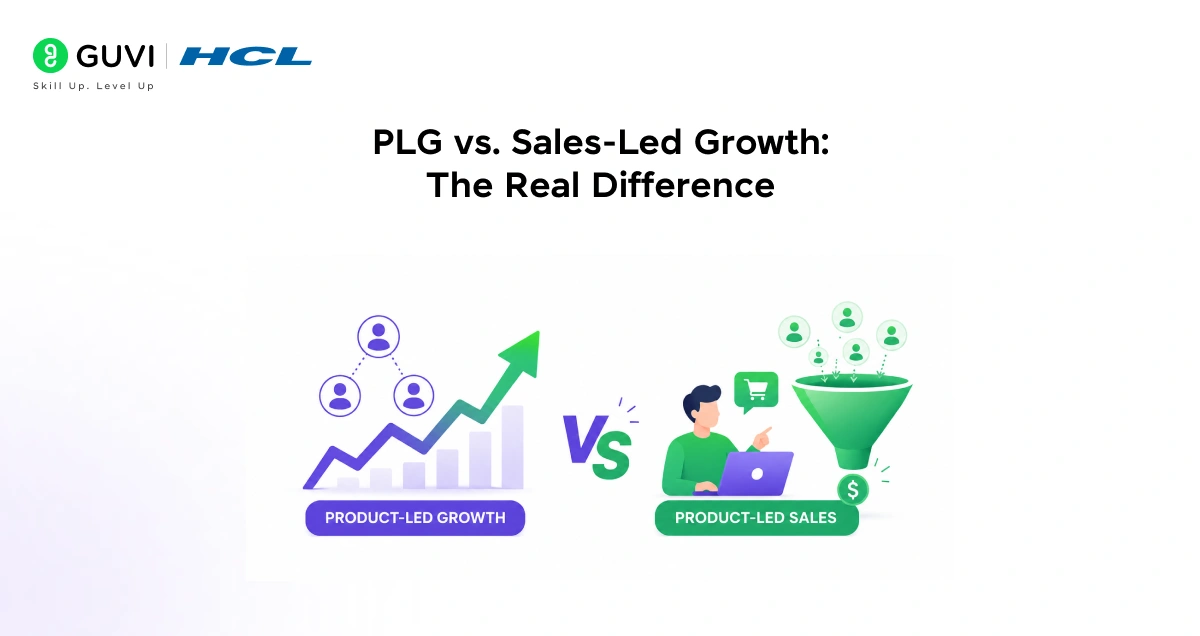
1. Philosophy difference: people vs. experience
- Sales-led: value is communicated by people sales reps build trust, explain features, and drive decisions through outreach and relationships.
- Product-led: value is communicated by the product; users discover benefits through direct experience and self-serve flows.
- Choose based on deal complexity: sales-led suits large, customized enterprise deals; product-led fits individual users, small teams, and mid-market SaaS.
2. Complementary models and the PQL concept
- Hybrid approach: PLG can own top-of-funnel acquisition while sales focuses on high-value accounts that need human coordination.
- Product Qualified Lead (PQL): a user who has achieved a meaningful in-product milestone (not just consumed marketing content).
- Why PQLs matter: sales outreach to PQLs converts at much higher rates because the prospect has already experienced core value (example: Slack’s 2,000-message threshold).
- Practical pointers: define clear PQL milestones, instrument product events, set automated alerts for sales, and create tailored outreach playbooks for different PQL segments.
Many successful Product-Led Growth (PLG) companies, including Slack, Dropbox, Zoom, and Figma, achieved scale by focusing on a clear activation moment—the point where users first experience meaningful value. Once users reach this milestone, they are more likely to engage deeply, invite others, and convert organically without heavy reliance on traditional sales-led strategies. PLG shifts the growth model from persuasion to product experience: instead of convincing users upfront, companies design products that demonstrate value quickly and naturally. In this model, well-defined product analytics events and Product Qualified Leads (PQLs) play a crucial role in identifying engaged users and turning them into high-quality growth opportunities.
The Three Pillars of a Successful PLG Strategy
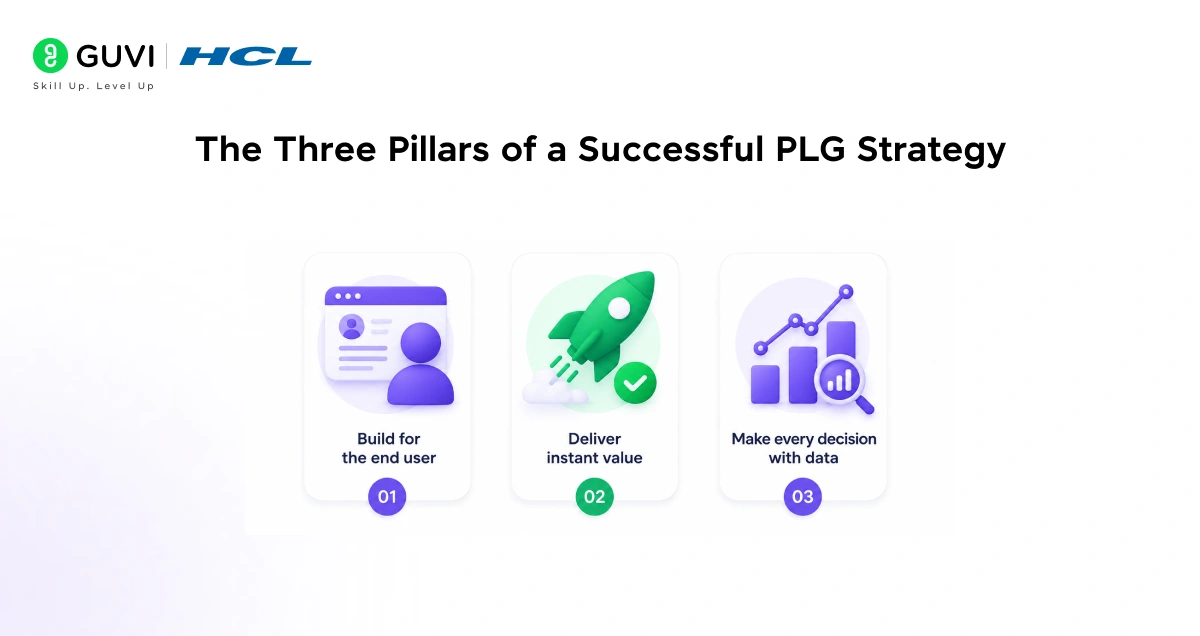
- Build for the end user
Design every decision around the person who uses the product day to day. Prioritize direct user research and feedback over large customer requests or sales promises. Map and remove points of friction, empathize with real user workflows, and continuously redesign experiences that don’t serve the end user’s immediate needs.
- Deliver instant value
Focus on enabling a meaningful win within minutes of first use. Optimize onboarding, eliminate unnecessary steps, and surface core values quickly so new users understand why the product matters. If users can’t see clear value fast, they’ll drop off so reduce time-to-value relentlessly.
- Make every decision with data
Treat hypotheses as experiments: instrument behavior, share metrics across product, marketing, and sales, and iterate based on measured outcomes. Use data to validate features, onboarding changes, and pricing let instincts guide tests, not final decisions.
Step-by-Step: How to Implement a Product-Led Growth Strategy
Step 1: Deeply Understand Your Users Before Building Anything
- The foundation of PLG is a product that genuinely solves a real problem. Before you can lead with your product, you need to know exactly what your ideal users are struggling with, what they have tried before, and what success looks like for them.
- This means going beyond surveys and conducting real conversations. Talk to potential users, watch them work, and identify the exact friction points your product can eliminate.
- Products like Slack, Figma, and Notion did not succeed because of clever marketing; they succeeded because they were built around a clear, deeply understood user pain point.
Step 2: Design a Seamless Self-Serve Onboarding Experience
- Once you have a product worth experiencing, you need to make sure users can experience it without any help from your team. This is where most PLG efforts either succeed or fail. Your onboarding flow should walk users toward their first success in the shortest possible time.
- Every screen, tooltip, and prompt should exist for one reason only: to help the user do the thing they came to do.
- Remove any step that asks for information you do not absolutely need right now. Eliminate any screen that explains features rather than showing users how to use them. Think of onboarding not as a tour of your product, but as a guided path to a first win.
Step 3: Define and Track Your Activation Moment
- The activation moment is the specific point in a user’s journey where they have experienced enough value to become genuinely invested in the product. Every product has a different activation moment, and finding yours is one of the most important things you can do.
- To identify it, look at the behavior patterns of users who eventually convert to paid plans versus those who churn.
- What actions did the paying users take that churners did not? How quickly did paying users reach those actions? That behavioral pattern is your activation signal, and your entire product experience should be designed to get new users there as fast as possible.
Step 4: Build a Freemium or Free Trial Model That Creates Natural Upgrade Pressure
- Your free offering needs to be genuinely useful useful enough that users become dependent on it. But it also needs to have natural limits that make users want more.
- This is the balance that every PLG company must strike carefully. If the free plan is too limited, users will not see enough value to justify staying. If it is too generous, users will never have a reason to upgrade.
- The best freemium products give users everything they need to see real value, and then place limits at the exact points where power users need more things like storage limits in Dropbox, message history in Slack, or seat limits in Notion. These limits feel organic rather than arbitrary, because they show up right when the user is getting the most value.

Step 5: Use Product Data to Identify and Prioritize Your Best Leads
- In a PLG model, the data your product generates is one of your most valuable sales assets. Track how users are engaging with the product which features they use, how frequently they log in, whether they are inviting teammates, and whether they have hit any usage limits.
- Users who are deeply engaged with the product are your best sales opportunities, not the people who attended a webinar or clicked on an ad. Build a scoring system that flags high-engagement users for your sales team so they can reach out with context, starting the conversation from a place of value rather than a cold pitch.
Step 6 : Align Every Team Around the Product and User Success
- PLG is not just a product team initiative it requires the entire organization to shift how it thinks about customers and growth. Marketing needs to ask how the product itself can generate demand. Sales needs to ask how product usage data can help them have better conversations.
- Customer success needs to ask how the product can help customers succeed without requiring constant human intervention. Engineering needs to optimize for time-to-value, not just feature delivery. When every team measures its success through the lens of user success inside the product, PLG gains real momentum.
Step 7: Continuously Improve Based on Usage Data and User Feedback
- The best PLG companies treat their product as something that is always in progress. They run constant experiments on their onboarding flows, pricing pages, upgrade prompts, and feature designs.
- They listen to users who churned and understand why. They study the behavior of users who upgraded and figure out how to replicate that journey for others. PLG is not a one-time setup it is an ongoing operating model that requires discipline, curiosity, and a genuine obsession with making the product better for users at every stage of their journey.
Read More: Product Manager Roadmap 2026: From Beginner to Industry-Ready PM
The Key Metrics You Should Track in PLG
Understanding how your PLG strategy is performing requires tracking the right numbers. The most important metric to start with is Time-to-Value: how long it takes a new user to reach their first meaningful outcome in the product. The shorter this time, the better your onboarding is doing its job.Time-to-Value: how
- Activation Rate tracks the percentage of new sign-ups who reach your defined activation moment.
- The free-to-paid conversion rate shows the percentage of free users who eventually upgrade to a paid plan. Product Qualified Leads tells you how many of your users are engaging deeply enough with the product to be worth a sales conversation.
- Expansion revenue measures the additional revenue generated from existing customers through upgrades, add-ons, or higher-tier plans.
- In a healthy PLG business, expansion revenue grows consistently, which is one of the most powerful indicators that your product is delivering lasting value.
You just learned what Product-Led Growth is and how to implement it to drive acquisition, conversion, and expansion. Take it further with HCL GUVI’s Product Management Program by IIM Indore. Learn to build, launch, and scale products using PLG strategies with expert guidance from IIM Indore.
Real Companies That PLG Built
It is worth looking at a few real examples to make all of this concrete. Slack grew from zero to a multi-billion dollar acquisition by Salesforce largely without traditional enterprise sales at the beginning.
- Teams started using it for free, loved it, spread it internally, and eventually paid for it when they needed more users or features. Dropbox became one of the fastest growing companies in history by offering free storage that created genuine dependence, then converting users to paid plans once they hit space limits.
- Zoom built an enormous user base during the pandemic because anyone could start a 40-minute free call without signing up for anything and when users needed longer calls or more participants, upgrading was obvious. These are not accidents or lucky breaks. They are the outcome of a deliberate and well-executed product-led growth strategy.
CONCLUSION
Start by auditing onboarding: measure how long it takes a new user to reach a meaningful outcome. If it takes more than five to ten minutes, prioritize shortening that path.
Next, evaluate your free offering does it clearly demonstrate core product value before asking for payment? If not, redesign the trial or freemium flow to let users experience the value first.
Finally, talk to users who churned without converting; their feedback reveals the highest-impact fixes. Product-led growth isn’t a shortcut, it’s the discipline of making the product itself the primary engine of sustainable, hard-to-replicate growth.
FAQs
Q: What’s the difference between freemium and a free trial and which should I pick?
A: Freemium offers a limited, useful version forever and works when network effects or habitual use drive upgrades (e.g., Slack, Dropbox limits). Free trials give full access for a short time and work when users need to experience the full product to see value. Choose freemium if the product hooks users with repeated, growing value; choose trials if the full feature set is needed to reach the activation moment quickly.
Q: How do I identify my product’s “aha” or activation moment?
A: Compare behavioral paths of users who convert versus those who churn. Find the earliest in‑product action(s) that correlate strongly with later retention or payment (e.g., inviting teammates, uploading a file, completing a project). Instrument those events and optimize flows to guide new users to that milestone as fast as possible.
Q: What is a PQL and how do I use one in a hybrid sales model?
A: A Product‑Qualified Lead is a user who has demonstrated meaningful product engagement (hit activation signals, used power features, or reached usage limits). Use PQLs to prioritize high‑intent outreach sales interacts with PQLs armed with context (what they used, frequency, team size) for higher conversion rates than cold leads.
Q: What metrics show PLG is working (or failing)?
A: Key signs of health: short Time‑to‑Value, increasing Activation Rate, healthy Free→Paid conversion, rising Expansion Revenue, and steady PQL growth. Warning signs: long time to activation, low conversion despite usage, high churn after initial use, or growth driven only by paid marketing rather than organic product usage.
Q: How do I balance product self‑serve growth with enterprise sales needs?
A: Run a hybrid model let PLG own top‑of‑funnel acquisition and low‑touch conversions, while a focused sales team handles large, complex, or high‑ARR accounts. Use product data to route high‑value PQLs to sales and build playbooks for different PQL segments (SMB, mid‑market, enterprise) so human effort is targeted where it moves the needle.
Success Stories

About the Author
Vishalini Devarajan
An Aerospace Engineer turned content writer, I focus on making complex concepts easy to understand through well-structured, reader-friendly blogs. Whether it’s a technical topic or a non-technical one, I love creating content that is clear, engaging, and impactful.
View all posts by Vishalini Devarajan
Connect with me @










Did you enjoy this article?