


Product Management Articles
Enterprise Product Management: Unique Challenges, Skills & Strategy
B2B vs B2C Product Management: Key Differences, Skills, Strategy & Career Scope
Working with Engineers as a Product Manager: A Practical Guide


Get In Touch For Details! Request More Information
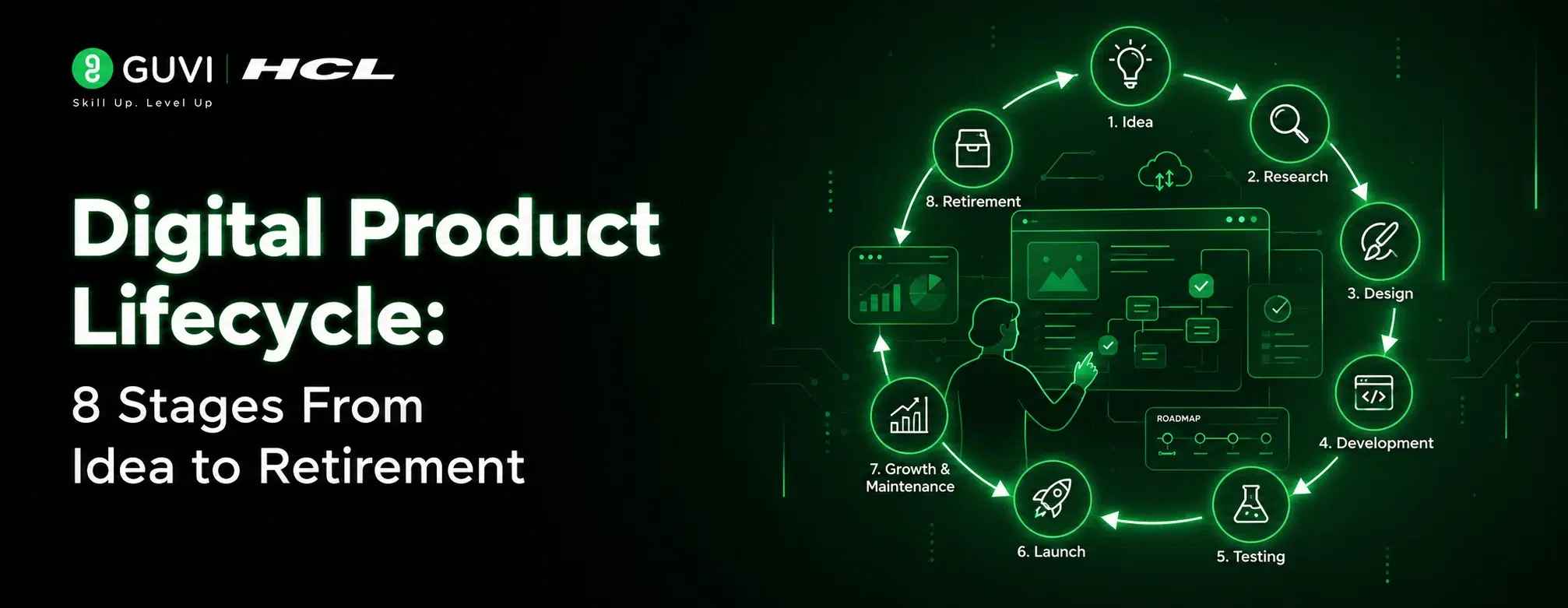
Digital Product Lifecycle: 8 Stages From Idea to Retirement – Best Guide
Jul 23, 2026 12 Min Read 307 Views
(Last Updated)
Table of contents
- TL;DR
- What Is the Digital Product Lifecycle?
- What Is a Digital Product?
- Why Is the Digital Product Lifecycle Important?
- How Is It Different From Other Product Lifecycles?
- Digital Product Lifecycle vs Product Development Lifecycle
- Digital Product Lifecycle vs Traditional Product Life Cycle
- What Are the Eight Digital Product Lifecycle Stages?
- Stage 1: Discovery and Problem Definition
- What Happens During Product Discovery?
- What Does the Digital Product Lifecycle Require During Discovery?
- Stage 2: Validation and Product Strategy
- What Should Be Validated?
- What Is the Product Strategy?
- What Is Prioritised?
- How Is the MVP Defined?
- Why Do Product Plans Lose Focus?
- Stage 4: Product Design and Prototyping
- What Does Product Design Include?
- What Should Be Decided Before Development?
- Stage 5: Development, Testing, and Release Readiness
- What Happens During Development?
- What Does Release Readiness Mean?
- Stage 6: Launch and Product Adoption
- What Does a Product Launch Strategy Include?
- How Is Product Adoption Measured?
- Stage 7: Growth and Continuous Optimisation
- What Happens During the Growth Stage?
- How Does Continuous Product Improvement Work?
- Stage 8: Maturity, Evolution, or Retirement
- When Should a Mature Product Evolve?
- When Should a Digital Product Be Retired?
- Which Metrics Matter at Each Stage?
- What Does a Product Manager Do Across the Digital Product Lifecycle?
- How Does the Lifecycle Work in Real Products?
- Example 1: Indian Fintech Expense Application
- Example 2: B2B Employee-Onboarding Platform
- How Is the Digital Product Lifecycle Changing in 2026?
- AI Is Accelerating Execution
- Product Management Is Becoming More Cross-Functional
- Adoption Is Becoming Part of Delivery
- Product Evidence Must Remain Connected
- Best Practices for Managing the Digital Product Lifecycle
- Define Success Before Building
- Use Evidence Appropriate to the Stage
- Keep the Lifecycle Connected
- Build in Small, Reversible Steps
- Include Quality From the Beginning
- Review the Product’s Stage Regularly
- Common Digital Product Lifecycle Mistakes
- Starting With a Solution
- Treating the MVP as a Smaller Final Product
- Treating Launch as the Finish Line
- Using the Same Metrics at Every Stage
- Avoiding Product Retirement
- Learn Product Management With HCL GUVI
- Conclusion
- FAQs
- What is the digital product lifecycle?
- What are the main stages of the digital product lifecycle?
- Is the digital product lifecycle a linear process?
- What is the difference between a product lifecycle and a product development lifecycle?
- Why is product discovery important?
- What is the role of an MVP in the product lifecycle?
- What happens after a digital product is launched?
- Which metrics should product teams track?
- When should a digital product be retired?
- Why should product managers understand the complete lifecycle?
TL;DR
The digital product lifecycle is the complete journey of an app, platform, website, or software service from the first problem discovery to eventual retirement. Its eight main stages are discovery, validation, strategy, planning, design, development, launch, growth, and maturity or retirement. Unlike a strictly linear project, a digital product continuously returns to research, measurement, and improvement. At every stage, teams must answer a different question, produce specific evidence, and track suitable metrics. Successful lifecycle management helps teams avoid unnecessary features, improve adoption, connect product work with business goals, and decide when to improve, reposition, rebuild, or retire a product.
The digital product lifecycle explains how a product moves from an identified user problem to a live solution that is measured, improved, scaled, and eventually replaced or retired.
It applies to products such as mobile apps, SaaS platforms, online marketplaces, digital banking services, learning platforms, and internal enterprise tools.
Understanding the lifecycle helps you make decisions based on the product’s current needs instead of treating every stage as a feature-development exercise.
It is especially useful for aspiring product managers because the priorities, risks, metrics, and stakeholders change as the product moves forward.
What Is the Digital Product Lifecycle?
The digital product lifecycle is a framework for managing a software-based product from initial discovery to decommissioning.
It includes everything required to:
- Identify a meaningful user problem
- Validate that the problem deserves investment
- Define a product strategy
- Design and build the solution
- Prepare it for release
- Drive adoption
- Measure outcomes
- Improve and scale it
- Modernise, reposition, or retire it
This end-to-end coordination is closely related to product life cycle management, which connects people, processes, product information, and technology from the initial idea to retirement.
The lifecycle does not move in a perfect straight line.
A team may return from development to design after usability problems appear. It may return from launch to discovery when customer behaviour challenges the original assumptions.
This repeated movement is normal. A digital product improves through evidence, not by following a rigid sequence without review.
What Is a Digital Product?
A digital product is a software-based solution that provides continuing value to users.
Examples include:
- A mobile banking application
- A streaming platform
- A project-management tool
- An online learning platform
- A food-delivery marketplace
- A business analytics dashboard
- A cloud-based accounting system
- An internal employee portal
A digital product is not simply a one-time development project. It continues to require updates, monitoring, support, security, research, and strategic decisions after its first release.
Why Is the Digital Product Lifecycle Important?
The lifecycle gives teams a shared way to understand what the product needs at a particular moment.
A product in discovery needs evidence about the problem. A newly launched product needs adoption and retention. A mature product may need efficiency, differentiation, modernisation, or retirement.
Using the same priorities at every stage creates waste.
For example, increasing paid acquisition does not solve poor onboarding. Adding more features does not solve an unclear value proposition. Modernising the technology does not help when the product no longer serves a valuable customer need.
Effective lifecycle management helps teams:
- Connect user needs with business goals
- Reduce investment in weak ideas
- Define clear stage-specific outcomes
- Improve cross-functional coordination
- Select relevant metrics
- Identify product and technical risks earlier
- Plan resources more effectively
- Respond to customer feedback
- Decide when to scale or stop investing
The Product-Led Alliance’s State of Product Management 2026 found that only 52.1% of surveyed product professionals gave a high score to the connection between product outcomes and company goals. This shows why product strategy and execution must remain connected throughout the lifecycle.
How Is It Different From Other Product Lifecycles?
Several lifecycle terms are used interchangeably, even though they answer different questions.
| Framework | Main Focus | Typical Starting Point | Typical End Point | Key Question |
| Digital product lifecycle | Full journey of a software product | User problem or opportunity | Evolution, replacement, or retirement | How should the product create value throughout its life? |
| Digital product development lifecycle | Activities required to build and release the product | Approved product idea | Release and post-release improvement | How should the team build the product? |
| Product management lifecycle | Decisions and coordination led by product management | Discovery and strategy | Continuous measurement and prioritisation | What should be built, why, and what should happen next? |
| Traditional product life cycle | Market performance of a product | Market introduction | Decline or withdrawal | How is demand changing in the market? |
| Software development life cycle | Technical software-delivery process | Software requirements | Deployment and maintenance | How should the software be designed, coded, tested, and maintained? |
Digital Product Lifecycle vs Product Development Lifecycle
The digital product development lifecycle mainly focuses on designing, building, testing, and releasing a product.
The broader lifecycle includes work before development, such as discovery and commercial validation, along with work after launch, such as adoption, retention, growth, modernisation, and product retirement.
Digital Product Lifecycle vs Traditional Product Life Cycle
The traditional product life cycle commonly describes development, introduction, growth, maturity, and decline.
That model helps companies understand market demand. However, digital products also undergo continuous releases, experiments, infrastructure changes, security updates, and user-experience improvements.
A mature software product can therefore begin a new growth cycle after a major redesign, new market entry, pricing change, or platform expansion.
What Are the Eight Digital Product Lifecycle Stages?
The following framework gives beginners a practical overview of the complete journey.
| Stage | Main Question | Key Output | Example Metrics | Decision Gate |
| 1. Discovery | Is there a meaningful problem? | Problem statement and user evidence | Interview patterns, problem frequency | Is the problem worth investigating? |
| 2. Validation and strategy | Should we solve it? | Value proposition and product strategy | Demand signals, willingness to adopt | Is the opportunity valuable and viable? |
| 3. Planning and prioritisation | What should we build first? | Roadmap, MVP scope, success metrics | Expected impact, effort, risk | Is the plan focused and feasible? |
| 4. Design and prototyping | Can users understand and use it? | User flows and tested prototype | Task success, usability issues | Is the proposed experience usable? |
| 5. Development and testing | Can we deliver it reliably? | Working product or feature | Defects, test coverage, performance | Is the product ready for controlled release? |
| 6. Launch and adoption | Will target users begin using it? | Live release and adoption plan | Activation, onboarding completion, usage | Are users reaching the intended value? |
| 7. Growth and optimisation | Can value and usage grow sustainably? | Experiments and product improvements | Retention, conversion, revenue, engagement | Is the product producing repeatable growth? |
| 8. Maturity or retirement | Should we improve, replace, or retire it? | Modernisation or retirement plan | Cost-to-serve, profitability, migration | Does continued investment create value? |
The boundaries between these stages are flexible.
One product may move quickly from validation to an MVP. Another may require months of compliance, research, technical feasibility work, or stakeholder approval.
The goal is not to follow identical timelines. The goal is to make the right decision with the right evidence.
Stage 1: Discovery and Problem Definition
Discovery begins before the team decides what to build.
The objective is to understand a user group, its context, and the problem affecting its ability to achieve an important outcome.
What Happens During Product Discovery?
Teams commonly:
- Interview users
- Observe workflows
- Review support tickets
- Analyse behavioural data
- Study competitor alternatives
- Map user journeys
- Examine market changes
- Identify unmet needs
- Define assumptions
A useful problem statement explains:
- Who experiences the problem
- What they are trying to achieve
- What prevents them from succeeding
- How often the problem occurs
- Why existing alternatives are inadequate
- What effect the problem creates
What Does the Digital Product Lifecycle Require During Discovery?
The digital product lifecycle requires evidence that the problem exists before the team invests heavily in a solution.
A discovery output should not say:
Users need an AI-powered dashboard.
That statement assumes a solution.
A stronger version would be:
Small retail managers cannot identify daily stock shortages without combining information from several spreadsheets, causing delayed restocking and lost sales.
The second version leaves room for different solutions.
The 2026 Product-Led Alliance research found that 27% of surveyed product professionals identified a lack of discovery or customer insight as a cause of strategy–roadmap misalignment. The same research found that customer needs and user insights influenced product strategy for 54.9% of respondents, making them the second-most reported influence after leadership direction and internal priorities.
Stage 2: Validation and Product Strategy
Discovery shows that a problem exists. Validation determines whether solving it could create enough value to justify investment.
A painful problem does not automatically create a successful product.
The target users must be reachable, the solution must be feasible, and the organisation must have a realistic way to create business or strategic value.
What Should Be Validated?
Teams should test:
- Problem importance
- Target-user fit
- Existing alternatives
- Expected value
- Demand
- Technical feasibility
- Business viability
- Operational constraints
- Legal and compliance risks
- Willingness to adopt or pay
Validation methods may include:
- Concept tests
- Landing-page experiments
- Prototype tests
- Waitlists
- Pre-orders
- Concierge services
- Pilot programmes
- Stakeholder interviews
- Technical proof of concept
What Is the Product Strategy?
The product strategy connects the validated opportunity with the organisation’s direction.
It should clarify:
- Target user
- Core problem
- Value proposition
- Business objective
- Product positioning
- Strategic choices
- Success measures
- Important constraints
- What the team will not pursue
Before defining these strategic choices, teams should create a clear product vision statement that describes the future they want the product to create for users and the business.
A strategy is not a list of features.
It explains how the product intends to create a valuable outcome and why that approach is more suitable than the alternatives.
Once the opportunity, vision, and value proposition are clear, teams can build a product development strategy that connects customer needs with goals, priorities, resources, and execution decisions.
Stage 3: Planning and Prioritisation
Once the opportunity and strategy are clear, the team decides what to build first.
Planning converts the strategy into an executable sequence of product outcomes, experiments, releases, and technical work.
What Is Prioritised?
Teams may prioritise:
- User problems
- Product outcomes
- Features
- Experiments
- Technical improvements
- Security work
- Compliance requirements
- Defect fixes
- Infrastructure changes
- Research questions
A product roadmap should communicate direction and expected outcomes. It should not become a permanent promise that prevents the team from responding to new evidence.
Understanding the difference between product strategy and a product roadmap prevents teams from confusing long-term product choices with the sequence of initiatives used to execute them.
How Is the MVP Defined?
A minimum viable product is the smallest usable version that can test an important product assumption or deliver an initial outcome.
A good MVP should:
- Serve a clearly defined user
- Solve one meaningful problem
- Include enough quality to be trusted
- Produce measurable feedback
- Exclude secondary features
- Support a clear learning objective
“Minimum” should not mean insecure, inaccessible, confusing, or unreliable.
Why Do Product Plans Lose Focus?
Product priorities are affected by capacity, urgent customer requests, leadership changes, technical constraints, and sales commitments.
A useful planning process therefore makes trade-offs visible.
Every major addition should answer:
- Which outcome does this support?
- What evidence justifies it?
- What will be delayed or removed?
- How will success be measured?
- What risk does it reduce or introduce?
Stage 4: Product Design and Prototyping
The design stage converts the proposed solution into a testable experience.
Teams decide how users will navigate the product, complete tasks, understand information, recover from mistakes, and receive value.
What Does Product Design Include?
The work may include:
- User flows
- Information architecture
- Wireframes
- Interactive prototypes
- Interface design
- Content design
- Accessibility planning
- Design-system components
- Error states
- Usability testing
A prototype allows the team to test a product experience before investing in complete development.
Modern teams can also use AI prototyping for product managers to create and test early product concepts faster before committing full engineering resources.
It can reveal:
- Confusing navigation
- Missing information
- Incorrect assumptions
- Unnecessary steps
- Accessibility barriers
- Weak value communication
- Unexpected user behaviour
What Should Be Decided Before Development?
The team should understand:
- The primary user journey
- Important edge cases
- Acceptance criteria
- Content requirements
- Technical dependencies
- Data requirements
- Privacy and security needs
- Accessibility expectations
- Expected product behaviour
The digital product lifecycle remains iterative during design. A failed usability test should lead to revision, not to defending the original concept because development has already been scheduled.
Stage 5: Development, Testing, and Release Readiness
Development turns the prioritised and validated solution into working software.
Product managers, designers, engineers, quality specialists, security teams, analysts, and business stakeholders collaborate throughout this stage.
What Happens During Development?
Teams typically:
- Break work into manageable increments
- Refine requirements and acceptance criteria
- Build frontend and backend components
- Integrate APIs and data services
- Review code
- Test individual components
- Conduct integration and system testing
- Monitor performance
- Resolve defects
- Prepare documentation
- Plan deployment and rollback
Requirements may change as engineers discover technical constraints or simpler alternatives.
The product manager should protect the intended outcome while remaining flexible about the exact implementation.
What Does Release Readiness Mean?
A product is release-ready when the team has reasonable confidence that it:
- Solves the intended problem
- Works across important journeys
- Meets quality expectations
- Protects user information
- Meets relevant accessibility requirements
- Can be monitored
- Can be supported
- Has a rollback or recovery plan
- Has clear ownership after release
Passing functional tests alone does not guarantee readiness.
A technically correct product may still fail because users cannot understand it, the support team is unprepared, or the organisation cannot operate it effectively.
Stage 6: Launch and Product Adoption
Launch makes the product available. Adoption occurs when target users begin using it successfully and repeatedly.
These are not the same outcome.
A team can launch on schedule and still fail to create meaningful usage.
What Does a Product Launch Strategy Include?
A launch plan may cover:
- Target audience
- Positioning and messaging
- Release scope
- Rollout method
- Pricing
- Sales enablement
- Customer communication
- Support readiness
- Onboarding
- Product analytics
- Incident response
- Success criteria
A complete guide to how product managers plan successful product launches can help teams coordinate launch readiness, go-to-market activities, controlled rollouts, cross-functional responsibilities, and post-launch monitoring.
Launches can be:
- Internal
- Pilot-based
- Invite-only
- Limited to one market
- Released to a percentage of users
- Publicly available
A gradual rollout reduces risk and gives the team an opportunity to correct unexpected problems before full exposure.
How Is Product Adoption Measured?
Adoption measures whether users are reaching meaningful value.
Common signals include:
- Account activation
- Onboarding completion
- First successful outcome
- Feature discovery
- Repeat usage
- Time to value
- Support requests
- Early retention
- Customer feedback
The digital product lifecycle does not consider “shipped” to be the final outcome. The release must change user behaviour or create the intended business value.
A digital product does not need every planned feature before its first launch. Product teams can release a focused initial version, study how users interact with it, and improve the product through continuous testing, feedback, and iteration throughout its lifecycle.
Stage 7: Growth and Continuous Optimisation
Growth begins when the team has evidence that the product creates value and can expand that value sustainably.
The focus moves from proving the basic solution to improving acquisition, activation, engagement, retention, monetisation, and operational efficiency.
What Happens During the Growth Stage?
Teams may work on:
- Improving onboarding
- Reducing user drop-off
- Expanding important use cases
- Increasing retention
- Improving conversion
- Testing pricing
- Entering new segments
- Scaling infrastructure
- Automating operations
- Improving reliability
- Building integrations
- Strengthening customer support
Growth should not be confused with adding features quickly.
More features can increase maintenance, create a confusing experience, and distract from the product’s main value.
How Does Continuous Product Improvement Work?
Continuous improvement follows a repeated loop:
- Observe behaviour
- Identify an opportunity
- Form a hypothesis
- Prioritise the opportunity
- Design a change
- Build or configure it
- Release it safely
- Measure the outcome
- Keep, modify, or remove it
The team should use both:

- Quantitative evidence: Usage, conversion, retention, performance, and revenue data
- Qualitative evidence: Interviews, usability sessions, reviews, and support conversations
Analytics can show where a problem occurs. Direct research can help explain why it occurs.
Stage 8: Maturity, Evolution, or Retirement
A product reaches maturity when growth stabilises and its value, customer base, operating model, and market position are well established.
Maturity does not mean the team stops working.
The priorities may shift towards:
- Retention
- Reliability
- Efficiency
- Profitability
- Platform stability
- Security
- Cost reduction
- Customer migration
- Market defence
- Product simplification
When Should a Mature Product Evolve?
A mature product may need evolution when:
- User expectations change
- Technology becomes outdated
- Competitors create a better experience
- Operating costs rise
- The business enters a new market
- Regulations change
- Product architecture restricts further growth
- A new platform creates a better opportunity
Evolution may involve redesigning, repositioning, re-platforming, integrating AI, changing pricing, or creating a replacement product.
When Should a Digital Product Be Retired?
Product retirement may be appropriate when:
- Usage has declined consistently
- Maintenance costs exceed the value created
- Security risks cannot be managed reasonably
- The technology is no longer supported
- Another product serves the same need better
- The product no longer fits company strategy
- Compliance requirements cannot be met
- Continued investment has a high opportunity cost
A responsible product-retirement plan should include:
- User communication
- Data export
- Alternative solutions
- Migration support
- Contract considerations
- Data retention and deletion
- Support timelines
- System shutdown
- Documentation and archiving
Retirement is part of product management, not an admission of failure.
It allows the organisation to move users safely and redirect resources towards more valuable work.
Which Metrics Matter at Each Stage?
No single metric measures the health of a product across its complete lifecycle.
| Lifecycle Stage | Useful Metrics |
| Discovery | Problem frequency, interview patterns, existing workaround usage |
| Validation | Concept interest, pilot participation, waitlist conversion, willingness to adopt |
| Planning | Expected impact, effort, risk, dependency count, roadmap alignment |
| Design | Task success, time on task, error rate, usability issues |
| Development | Defect rate, cycle time, deployment readiness, performance |
| Launch | Activation, onboarding completion, time to value, early usage |
| Growth | Retention, engagement, conversion, revenue, churn, expansion |
| Maturity | Profitability, cost-to-serve, reliability, customer satisfaction |
| Retirement | Migration completion, active users remaining, support volume, shutdown risk |
Metrics should connect with the intended outcome.
For example, the number of downloads is not enough for a learning application. The product team may need to measure whether learners begin a course, complete lessons, practise regularly, and achieve the intended learning outcome.
What Does a Product Manager Do Across the Digital Product Lifecycle?
A product manager helps the team decide what outcome deserves attention and coordinates the evidence required to make the next decision.
Understanding what product management involves can help you see how customer needs, business goals, technology, design, and delivery remain connected throughout the product lifecycle.
| Stage | Product Manager’s Main Responsibility |
| Discovery | Understand users and define the problem |
| Validation | Test demand, value, feasibility, and viability |
| Strategy | Define direction, positioning, goals, and choices |
| Planning | Prioritise outcomes and create a focused roadmap |
| Design | Align user experience with product and business goals |
| Development | Clarify decisions, manage trade-offs, and remove uncertainty |
| Launch | Coordinate rollout, communication, support, and adoption |
| Growth | Use evidence to prioritise experiments and improvements |
| Maturity | Balance retention, efficiency, modernisation, and differentiation |
| Retirement | Plan migration, communication, and responsible shutdown |
These activities form part of the wider product manager roles and responsibilities, which involve aligning customer needs, business objectives, design decisions, technical teams, and measurable outcomes.
The product manager does not independently complete every activity.
It is also useful to understand the difference between a product manager and project manager: the product manager focuses mainly on what should be built and why, while the project manager coordinates timelines, resources, budgets, and delivery.
The role connects research, design, engineering, analytics, marketing, sales, customer success, finance, legal, security, and leadership around shared outcomes.
The digital product lifecycle therefore requires strong communication and decision-making in addition to product knowledge.
Developing essential product manager skills in strategy, research, data analysis, prioritisation, technical collaboration, communication, and stakeholder management helps professionals handle these changing lifecycle responsibilities.
How Does the Lifecycle Work in Real Products?
Example 1: Indian Fintech Expense Application
Suppose an Indian fintech startup notices that self-employed professionals struggle to separate personal and business expenses.
During discovery, the team interviews freelancers, consultants, and small-business owners. It learns that users lose time classifying UPI and card transactions before filing taxes.
The team validates the problem through a clickable prototype and a manual pilot that categorises uploaded transaction statements.
It then develops an MVP that:
- Imports selected transaction data
- Suggests expense categories
- Lets users confirm or change categories
- Produces a monthly business-expense summary
The product launches to a small user group.
The team measures account connection, first completed expense report, correction rates, repeat monthly usage, and support requests.
If retention grows, the product may add invoicing, tax integrations, accountant access, and cash-flow insights.
If regulations or platform requirements later change, the product may be modernised or migrated rather than simply abandoned.
Example 2: B2B Employee-Onboarding Platform
A SaaS company discovers that growing organisations coordinate new-employee onboarding through emails, spreadsheets, and separate HR tools.
The team validates demand with HR managers and builds a pilot workflow for task ownership, document collection, equipment requests, and progress tracking.
After launch, activation is defined as successfully completing one employee-onboarding workflow.
The team initially measures:
- Time to configure the first workflow
- Invitations sent
- Tasks completed
- Drop-off points
- Weekly administrator usage
As the product grows, it introduces reusable templates, integrations, analytics, role-based access, and automation.
Years later, the company may need to rebuild its original workflow engine because it limits performance and enterprise customisation.
The lifecycle therefore continues after growth through maturity, modernisation, and possibly replacement.
How Is the Digital Product Lifecycle Changing in 2026?
The main stages remain useful, but the way teams execute them is changing in the digital product lifecycle.
AI Is Accelerating Execution
AI tools can support:
- Research synthesis
- Market analysis
- Idea exploration
- Prototype generation
- Product documentation
- Test creation
- Code assistance
- Support analysis
- Experiment evaluation
Understanding how AI is changing the product manager role can help teams separate tasks that AI can accelerate, such as research synthesis and documentation, from decisions that still require human judgement, empathy, accountability, and strategic context.
Faster execution does not remove the need for judgement.
Teams must still decide:
- Whether the evidence is reliable
- Which user problem matters
- What should not be built
- Which risk is acceptable
- What the product should optimise
- Whether an AI-enabled experience is safe and valuable
ADP Research’s People at Work 2026 found that 80% of employees in India used AI multiple times a week, while 41% used it almost every day. This growing adoption suggests that Indian product teams must now consider AI across product research, prototyping, development, testing, support, and continuous improvement—not only as a customer-facing feature.
Product Management Is Becoming More Cross-Functional
ProductPlan reported in 2026 that 73.4% of surveyed product professionals believed their role was becoming more hybrid.
Product managers are increasingly expected to contribute to discovery, user experience, data interpretation, technical trade-offs, delivery, adoption, and business communication.
This does not mean one person should perform every specialist role.
It means product decisions must connect customer evidence, design, engineering, operations, and commercial outcomes more closely.
Adoption Is Becoming Part of Delivery
A release date shows that software became available.
It does not show that users understood it, adopted it, or received value.
Modern product teams increasingly define:
- Adoption milestones
- Activation events
- Time-to-value targets
- Retention expectations
- Behaviour changes
This pushes lifecycle responsibility beyond launch.
Product Evidence Must Remain Connected
Research, roadmap decisions, design work, development information, launch plans, and product analytics often exist in different systems.
Teams need clear traceability between:
- User evidence
- Product assumptions
- Prioritisation decisions
- Releases
- Experiments
- Outcomes
Using the right essential product manager tools can help teams connect research, roadmaps, requirements, design work, delivery updates, collaboration, and product analytics.
Without this connection, teams may repeat research, lose decision context, and struggle to explain why a feature exists.
Best Practices for Managing the Digital Product Lifecycle
1. Define Success Before Building
Decide what outcome should change and how you will recognise progress.
This prevents teams from treating completion as success.
2. Use Evidence Appropriate to the Stage
A user interview is valuable for understanding a problem. It does not prove that thousands of people will adopt the product.
Use different evidence for problem discovery, demand validation, usability, adoption, retention, and commercial viability.
3. Keep the Lifecycle Connected
Maintain links between research findings, product decisions, roadmap items, design work, releases, and results.
A team should be able to explain why something was built and what happened after it launched.
4. Build in Small, Reversible Steps
Use prototypes, pilots, phased releases, feature flags, and controlled experiments where appropriate.
Smaller steps reduce risk and make learning faster.
5. Include Quality From the Beginning
Accessibility, security, privacy, performance, observability, and support should not be left until the final release review.
Early consideration makes later changes less disruptive.
6. Review the Product’s Stage Regularly
A team may believe it is in growth while retention remains weak.
Review the evidence and adjust priorities instead of assigning a lifecycle stage based on ambition alone.
Common Digital Product Lifecycle Mistakes
1. Starting With a Solution
Teams sometimes begin with a feature or technology before confirming the user problem.
Fix: Write an evidence-based problem statement before selecting the solution.
2. Treating the MVP as a Smaller Final Product
An MVP filled with incomplete features does not produce focused learning.
Fix: Build the smallest trustworthy experience that tests one important assumption or outcome.
3. Treating Launch as the Finish Line
A successful deployment does not guarantee activation, adoption, retention, or business value.
Fix: Define post-launch milestones before the release.
4. Using the Same Metrics at Every Stage
Revenue cannot guide an early prototype, while interview enthusiasm cannot prove sustainable growth.
Fix: Select metrics that match the current lifecycle decision.
5. Avoiding Product Retirement
Teams may continue supporting a weak or outdated product because users still depend on it.
Fix: Compare user value, strategic fit, operating cost, technical risk, and migration options objectively.
Aspiring professionals can first review a structured product manager roadmap to understand the skills, responsibilities, tools, projects, and experience needed to progress into product roles.
Learn Product Management With HCL GUVI
Understanding the digital product lifecycle is essential for anyone who wants to manage products from customer discovery to strategy, execution, launch, growth, and evolution.
The IIM Indore Product Management Programme through HCL GUVI provides a structured learning path for professionals who want to develop product thinking, strategic decision-making, cross-functional collaboration, and lifecycle-management capabilities.
Use the programme alongside product teardowns, customer interviews, case studies, prototypes, and analytics exercises. Practical application will help you understand how lifecycle decisions work beyond diagrams and definitions.
Conclusion
The digital product lifecycle is the continuing journey of a software product from discovering a valuable user problem to validation, strategy, design, development, launch, adoption, growth, maturity, and retirement. Each stage requires different evidence, priorities, metrics, and decisions. The lifecycle is not a fixed path because digital products continuously respond to user behaviour, market changes, technical constraints, and business goals. Product teams should define success before building, connect decisions with evidence, treat adoption as part of delivery, and plan responsibly for modernisation or retirement. Learning this complete process gives aspiring product managers a stronger foundation for making useful, outcome-focused product decisions.
FAQs
1. What is the digital product lifecycle?
The digital product lifecycle is the complete journey of a software-based product from problem discovery and validation to development, launch, growth, maturity, and retirement.
2. What are the main stages of the digital product lifecycle?
The main stages are discovery, validation, strategy, planning, design, development, launch, growth, and maturity or retirement. Some companies combine related stages depending on their product and workflow.
3. Is the digital product lifecycle a linear process?
No. Teams often return to earlier stages when user feedback, market changes, technical limitations, or new evidence reveal that the product needs to be revised.
4. What is the difference between a product lifecycle and a product development lifecycle?
The product development lifecycle mainly covers designing, building, testing, and releasing a product. The broader product lifecycle also includes discovery, validation, adoption, growth, optimisation, modernisation, and retirement.
5. Why is product discovery important?
Product discovery helps teams confirm that they understand a real user problem before investing heavily in a solution. It reduces the risk of building features that users do not need or value.
6. What is the role of an MVP in the product lifecycle?
A minimum viable product is the smallest reliable version that can test an important assumption or deliver an initial user outcome. It helps teams learn before investing in a larger product.
7. What happens after a digital product is launched?
After launch, teams track activation, adoption, retention, feedback, performance, and business outcomes. They then improve the product based on evidence instead of treating launch as the final stage.
8. Which metrics should product teams track?
The right metrics depend on the current stage. Discovery may focus on problem frequency, launch may focus on activation and time to value, while growth may focus on retention, conversion, revenue, and churn.
9. When should a digital product be retired?
A product may be retired when usage declines, maintenance costs become too high, security risks increase, technology becomes outdated, or a better product replaces it. Retirement should include communication, migration, data handling, and support planning.
10. Why should product managers understand the complete lifecycle?
Understanding the complete lifecycle helps product managers choose the right priorities, evidence, metrics, and stakeholder conversations at every stage. It also helps them decide when to build, improve, scale, modernise, or retire a product.
Success Stories

About the Author
Reemsha Khan
Always been a storyteller at heart. Now, I turn complex topics into simple, easy-to-understand stories through content. Hope you find it helpful.
View all posts by Reemsha Khan
Connect with me @









Did you enjoy this article?