


Product Management Articles
Enterprise Product Management: Unique Challenges, Skills & Strategy
B2B vs B2C Product Management: Key Differences, Skills, Strategy & Career Scope
Working with Engineers as a Product Manager: A Practical Guide


Get In Touch For Details! Request More Information

How to Build a Successful Product Development Strategy
Aug 30, 2026 4 Min Read 536 Views
(Last Updated)
Product development today involves much more than simply creating a product and launching it in the market. Businesses today work in highly competitive environments where customer expectations, technology trends, and market dynamics change quickly. Without a clear product development strategy, even innovative ideas can fail to gain traction.
A product development strategy provides a structured approach for turning ideas into successful products. It helps organizations connect business goals, customer needs, and development efforts while reducing risks and maximizing returns.
In this article, you’ll learn what a product development strategy is, why it matters, the key components involved, and how to build a successful product development strategy step by step.
Table of contents
- TL;DR
- What Is a Product Development Strategy?
- Why Is Product Development Strategy Important?
- Key Components of a Product Development Strategy
- Market Research
- Customer Needs Analysis
- Product Vision and Goals
- Resource Planning
- Risk Assessment
- How to Build a Product Development Strategy
- Step 1: Identify Market Opportunities
- Step 2: Define Your Target Audience
- Step 3: Set Product Goals
- Step 4: Validate Product Ideas
- Step 5: Create a Development Roadmap
- Step 6: Build a Minimum Viable Product (MVP)
- Step 7: Collect Feedback and Iterate
- Product Development Frameworks You Should Know
- Agile Development
- Lean Product Development
- Design Thinking
- Best Tools for Product Development Strategy
- Common Product Development Strategy Mistakes to Avoid
- How AI Is Transforming Product Development Strategy
- Real World Example of a Successful Product Development Strategy
- Future of Product Development Strategy
- Conclusion
- FAQs
- What is a product development strategy?
- 2 . Why is a product development strategy important?
- What are the stages of product development?
- 4 . How does Agile support product development?
- 5.How can AI improve product development strategy?
TL;DR
- A product development strategy is a structured plan that guides a product from idea generation to market launch and continuous improvement.
- It helps businesses connect customer needs, market opportunities, and organizational goals.
- Effective strategies rely on market research, customer validation, product roadmaps, and iterative development.
- Frameworks such as Agile, Lean Development, and Design Thinking improve flexibility and innovation.
- AI-powered analytics and customer insights are changing how companies build and optimize products.
What Is a Product Development Strategy?
A product development strategy is a roadmap outlining how a company will create, develop, launch, and improve a product. It acts as a guide for product teams, helping them make informed decisions throughout the product lifecycle.
The strategy covers everything from spotting market opportunities and understanding customer pain points to defining product features, allocating resources, and measuring success. Rather than focusing solely on development activities, it connects product initiatives to broader business objectives.
Turn product knowledge into practical expertise with HCL GUVI’s Product Management Programme. Learn product strategy, market research, and lifecycle management through real-world business applications.
Why Is Product Development Strategy Important?
A successful product does not happen by chance. It requires planning, validation, and continuous refinement.
A product development strategy helps businesses focus on the right opportunities, allocate resources efficiently, and respond to changing customer demands. It also reduces uncertainty by ensuring that decisions are based on data and market insights.
Organizations investing in strategic product development are often better positioned to innovate, increase customer satisfaction, and maintain a competitive edge in their industry.
Developing successful products requires a combination of strategic thinking, customer understanding, and roadmap planning, all of which are core responsibilities in modern product management. Learn more in our Product Manager Roadmap 2026.
Research in product management consistently shows that many product failures are driven not by engineering limitations, but by a lack of early customer validation. Teams often build solutions before fully understanding the underlying user problem, leading to features that are well-executed but poorly aligned with real needs.
In contrast, strong emphasis on user research, problem discovery, and early testing has been shown to significantly improve product success rates. This is why modern product development practices prioritize validation cycles, interviews, and iterative feedback loops—often making customer understanding more impactful than development speed alone.
Key Components of a Product Development Strategy
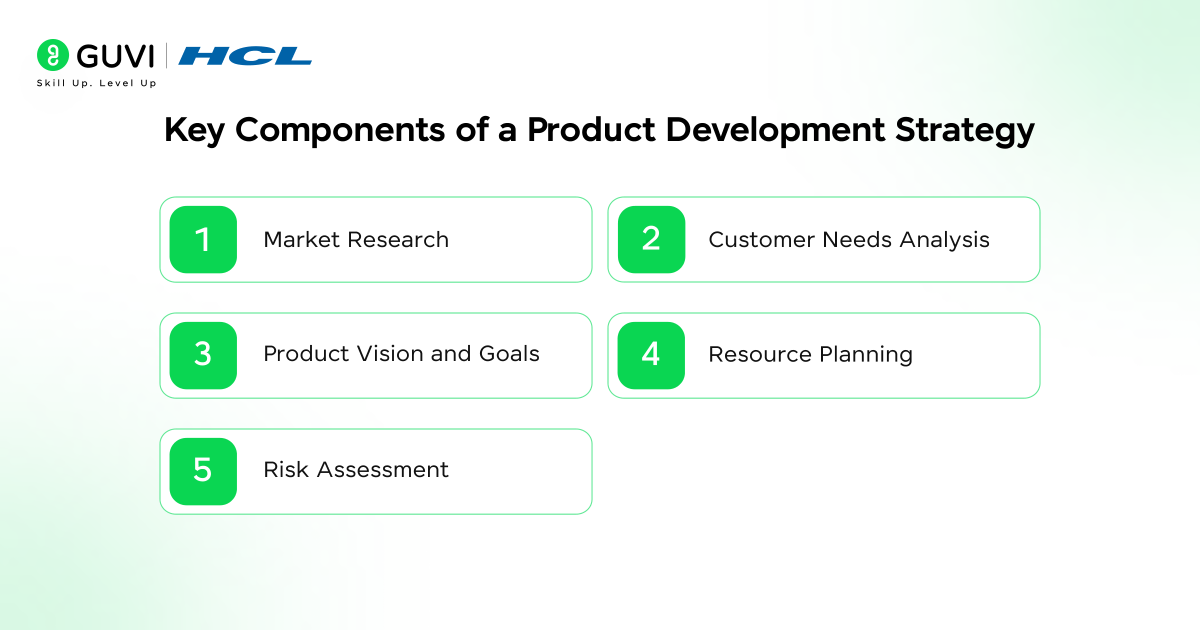
Building a successful product development strategy needs several foundational elements.
Market Research
Market research helps businesses understand industry trends, customer behavior, and competitor offerings. It provides insights into unmet needs and potential opportunities that can shape product decisions.
Customer Needs Analysis
Understanding customer pain points is critical for creating products that deliver value. Customer interviews, surveys, feedback forms, and behavioral analytics can reveal what users truly need.
Product Vision and Goals
A product vision defines the long-term purpose of the product. Clear goals keep teams focused on measurable outcomes rather than simply delivering features.
Resource Planning
Successful product development requires the right mix of talent, budget, tools, and technology. Resource planning helps organizations avoid bottlenecks and keep projects moving forward.
Risk Assessment
Every product carries risks related to technology, market acceptance, competition, and compliance. Identifying potential challenges early allows teams to develop strategies to manage those risks.
How to Build a Product Development Strategy
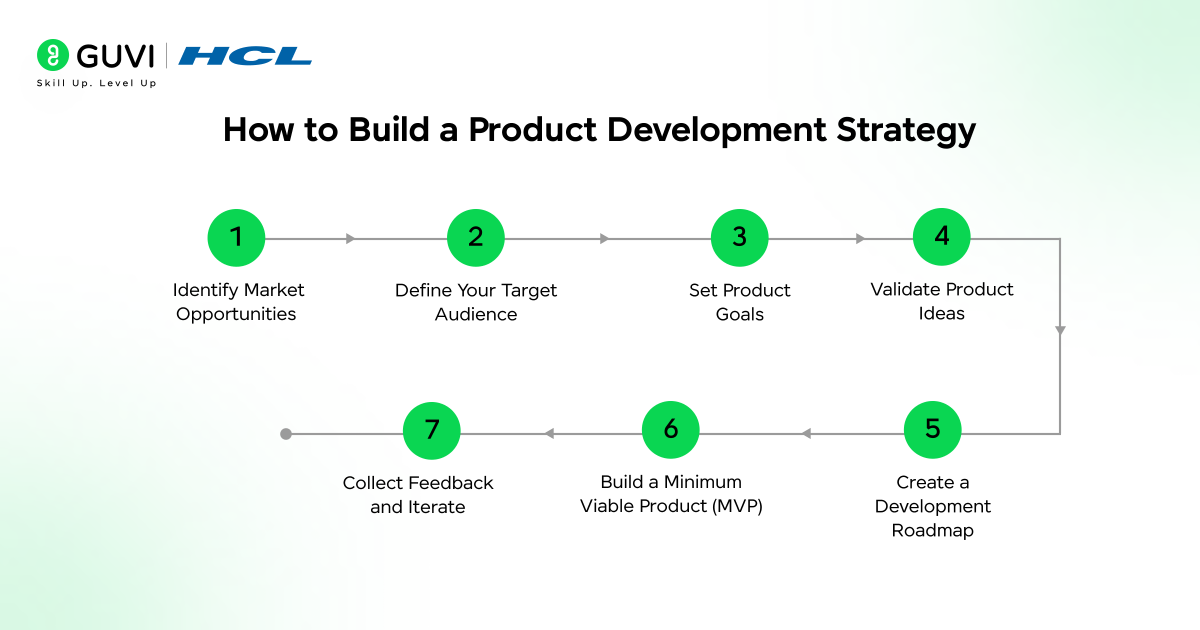
Developing a product development strategy involves a series of structured steps.
Step 1: Identify Market Opportunities
Start by analyzing industry trends, customer pain points, and emerging technologies. Look for gaps in the market where existing solutions do not meet customer expectations.
Competitive analysis can help uncover chances for differentiation and innovation.
Step 2: Define Your Target Audience
Understanding who your product serves is essential.
Create detailed customer personas that include demographics, behaviors, goals, challenges, and purchasing preferences. A clear target audience enables better decision-making throughout development.
Step 3: Set Product Goals
Define specific objectives that align with business outcomes.
Examples include increasing customer retention, expanding market share, generating revenue, or improving operational efficiency. Clear goals provide direction and measurable benchmarks.
Step 4: Validate Product Ideas
Before investing significant resources, validate product concepts through prototypes, surveys, focus groups, or pilot programs.
Validation reduces risk by confirming whether customers are willing to use or buy the product.
Step 5: Create a Development Roadmap
A product roadmap outlines key milestones, priorities, timelines, and feature releases.
Roadmaps help stakeholders stay on the same page while giving development teams a clear plan to execute.
Step 6: Build a Minimum Viable Product (MVP)
An MVP includes the essential features needed to solve a customer problem.
Launching an MVP lets teams gather real-world feedback quickly and make improvements before committing to full-scale development.
Step 7: Collect Feedback and Iterate
Product development is an ongoing process.

Gather customer feedback, monitor performance metrics, and continuously improve the product based on user behavior and market changes.
Want to learn how great user experiences influence product success? Check out our UI/UX Design Guide to explore the principles of user-centered design, prototyping, and usability testing.
Product Development Frameworks You Should Know

Several frameworks can support a successful product development strategy.
Agile Development
Agile focuses on iterative development, collaboration, and continuous improvement. Teams work in short development cycles called sprints, allowing them to respond quickly to changing requirements.
Lean Product Development
Lean emphasizes reducing waste and maximizing customer value. Teams validate assumptions early and prioritize features that deliver measurable outcomes.
Design Thinking
Design Thinking encourages teams to understand user needs, explore innovative solutions, and validate ideas before investing in full-scale development. Learn more through our Design Thinking and Prototyping Guide.
Best Tools for Product Development Strategy
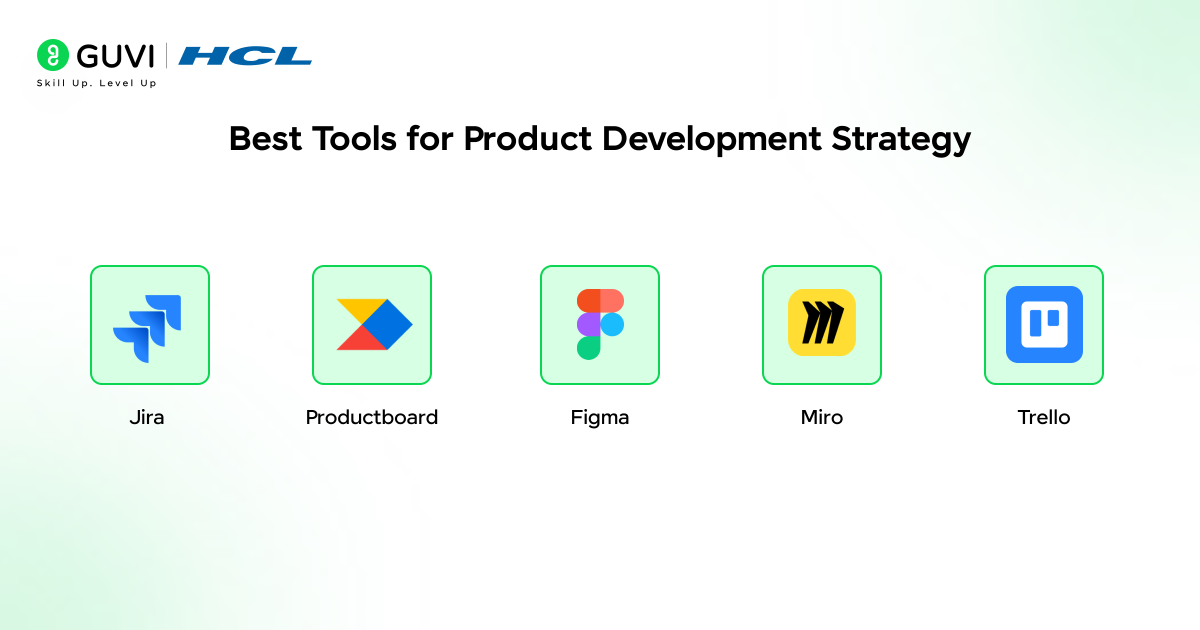
The right tools can simplify planning, collaboration, and execution.
- Jira helps teams manage projects, track tasks, and monitor development progress using Agile workflows.
- Productboard helps product managers prioritize features based on customer feedback and business goals.
- Figma enables collaborative design and rapid prototyping for product teams.
- Miro provides visual collaboration tools for brainstorming, planning, and strategic workshops.
- Trello offers a simple and flexible project management system suitable for teams of all sizes.
AI-powered productivity tools are increasingly helping product teams streamline planning, documentation, and workflow management. Learn how they are being used in our Cursor for Product Managers guide.
Common Product Development Strategy Mistakes to Avoid
Many organizations face similar challenges during product development.
One common mistake is building products based on assumptions instead of customer research. Another is prioritizing feature quantity over customer value.
Poor stakeholder alignment can also lead to conflicting priorities and delayed releases. Failing to measure performance after launch prevents teams from identifying opportunities for improvement.
Avoiding these pitfalls can significantly increase the chances of product success.
After learning how to build a successful product development strategy, learners can enhance their product management expertise through HCL GUVI’s Product Management Programme, covering product strategy, customer research, market analysis, product lifecycle management, and real-world business applications.
How AI Is Transforming Product Development Strategy

Artificial intelligence is changing modern product development.
AI-powered analytics can process large datasets to identify customer preferences, market trends, and emerging opportunities. Product teams can use machine learning models to predict customer behavior and prioritize development efforts.
AI-driven automation also helps streamline repetitive tasks, allowing teams to concentrate on strategic initiatives.
As AI becomes more common, organizations that integrate intelligent decision-making into their product development strategies may gain a significant advantage.
Real World Example of a Successful Product Development Strategy
A well-known example is Spotify.
Spotify continuously gathers user feedback, analyzes listening behavior, and tries out new features. Rather than relying solely on large product launches, the company follows an iterative development approach that allows it to enhance user experiences over time.
Features such as personalized recommendations, curated playlists, and AI-driven discovery tools show how customer insights and data can guide successful product innovation.
Future of Product Development Strategy
The future of product development will be more data-driven, customer-focused, and AI-enhanced.
Organizations are adopting predictive analytics to anticipate customer needs before they arise. Digital twins, advanced simulation technologies, and AI-powered product management tools are also changing how teams plan and execute product initiatives.
Businesses that embrace continuous learning, experimentation, and technological innovation will be better equipped to create successful products in fast-changing markets.
Conclusion
A product development strategy lays the groundwork for turning ideas into successful products. By combining market research, customer validation, strategic planning, and iterative development, businesses can reduce risks and increase their chances of success.
Organizations that continuously gather feedback, embrace innovation, and leverage new technologies such as AI will be better prepared to meet changing customer expectations and stay ahead of the competition.
FAQs
1. What is a product development strategy?
A product development strategy is a structured plan that guides the creation, launch, and improvement of a product while aligning customer needs with business objectives.
2 . Why is a product development strategy important?
It helps organizations reduce risks, allocate resources effectively, validate product ideas, and improve the likelihood of market success.
3. What are the stages of product development?
The typical stages include idea generation, market research, validation, planning, development, testing, launch, and continuous improvement.
4 . How does Agile support product development?
Agile enables teams to deliver products incrementally, gather feedback quickly, and adapt to changing customer requirements through iterative development cycles.
5.How can AI improve product development strategy?
AI helps organizations analyze customer data, predict market trends, automate workflows, prioritize features, and make more informed product decisions.
Success Stories

About the Author
Vishalini Devarajan
An Aerospace Engineer turned content writer, I focus on making complex concepts easy to understand through well-structured, reader-friendly blogs. Whether it’s a technical topic or a non-technical one, I love creating content that is clear, engaging, and impactful.
View all posts by Vishalini Devarajan
Connect with me @












Did you enjoy this article?