


Product Management Articles
Enterprise Product Management: Unique Challenges, Skills & Strategy
B2B vs B2C Product Management: Key Differences, Skills, Strategy & Career Scope
Working with Engineers as a Product Manager: A Practical Guide


Get In Touch For Details! Request More Information

Product Strategy vs Product Roadmap: A Complete Comparison
Jul 20, 2026 6 Min Read 563 Views
(Last Updated)
Imagine you want to travel from your current city to another country. Your strategy is why you are going, what you want to achieve, and what success looks like. Your roadmap is the specific route you will take, the cities you will stop in, and when you will arrive at each stop.
Product strategy and product roadmap are often confused because they work together, but they are fundamentally different. Strategy answers “why” and “what”. Roadmap answers “when” and “how”. Understanding product strategy vs roadmap helps you build products that matter and execute them successfully.
If you are a product manager, business leader, or anyone involved in product development, understanding the difference between product strategy vs roadmap is essential. They both matter, but they serve different purposes and require different thinking.
This guide explains product strategy vs roadmap, why both matter, how they relate, and how to create effective versions of each.
Table of contents
- Quick TL;DR Summary
- What Is Product Strategy?
- What Is a Product Roadmap?
- Showing progress over time
- Product Strategy vs Roadmap: Key Differences
- How Product Strategy Drives Roadmap
- Why You Need Both Product Strategy and Roadmap
- Creating Effective Product Strategy
- Step 1: Understand your customers
- Step 2: Analyze the market
- Step 3: Define your differentiation
- Step 4: Set ambitious goals
- Step 5: Align the team
- Step 6: Measure success
- Creating Effective Product Roadmaps
- Step 1: Start with strategy
- Step 2: Understand dependencies
- Step 3: Estimate effort
- Step 4: Prioritize ruthlessly
- Step 5: Create realistic timelines
- Step 6: Share the roadmap
- Step 7: Update regularly
- Common Mistakes with Product Strategy vs Roadmap
- Conclusion
- FAQs
- How often should I update product strategy?
- What if my strategy changes mid-year?
- How detailed should my roadmap be?
- Should I share the entire roadmap with customers?
- Can product strategy fit on one page?
Quick TL;DR Summary
- This guide explains the key differences between product strategy and product roadmap, showing how strategy sets direction while roadmap executes that direction.
- You will learn that product strategy is long-term thinking about why you are building a product and who it is for, while product roadmap is short to medium-term planning about what features you will build and when.
- The guide covers how product strategy drives roadmap creation, why you need both, and how they work together to create successful products.
- Step-by-step examples show how to develop product strategy and create roadmaps that align with that strategy.
- You will understand common mistakes when confusing strategy and roadmap, and how to communicate each effectively to different audiences.
Product Strategy vs Product Roadmap
Product strategy and product roadmap serve different but closely connected purposes in product management. Product strategy defines the long-term vision, goals, target customers, and competitive positioning of a product. It answers questions such as why the product exists, who it serves, and how it will create value over time. Product roadmap, on the other hand, is the tactical execution plan that outlines the features, initiatives, and milestones the team intends to deliver over a specific period. In simple terms, product strategy sets the direction, while the product roadmap translates that direction into actionable plans and timelines.
What Is Product Strategy?
- The long-term vision
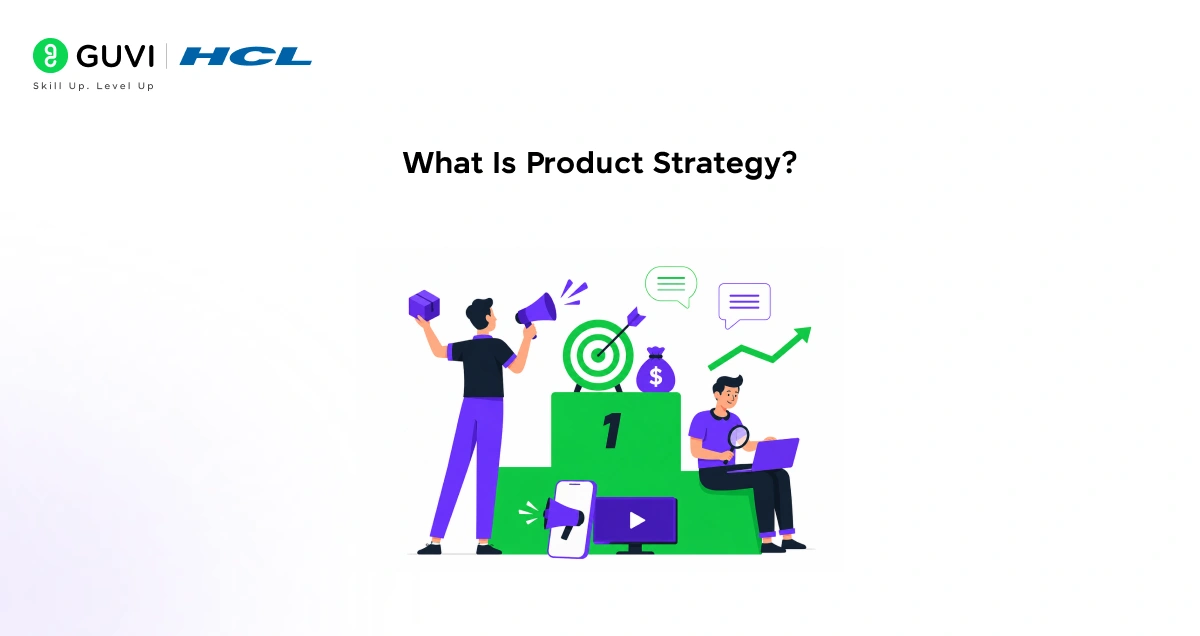
Product strategy is the big-picture thinking about your product’s direction over years. It answers fundamental questions about what your product is, who it is for, and why it matters.
- Answering the why
Product strategy explains why your product exists and why customers should care. It is not about specific features, but about the fundamental value your product delivers.
- Understanding your market position
Strategy defines where your product fits in the market, who your competitors are, and why customers should choose you over alternatives.
- Setting success metrics
Strategy defines what success looks like. Is it revenue, user growth, market share, or customer satisfaction? These metrics guide all decisions.
- Guiding priorities
Strategy helps you say no. When new ideas come up, strategy provides a filter. Ideas that align with strategy move forward. Ideas that do not get rejected.
- Adapting to change
Good strategy is flexible enough to adapt to market changes while maintaining core direction. You might change tactics but stick with your strategic direction.
- Examples of product strategy
“We will become the easiest video editing tool for social media creators” “We will build the safest way for seniors to manage their finances” “We will create the most reliable shipping software for small businesses”
Read More: Generating Concepts for Product Design: Step-by-Step Guide
What Is a Product Roadmap?
- The execution plan
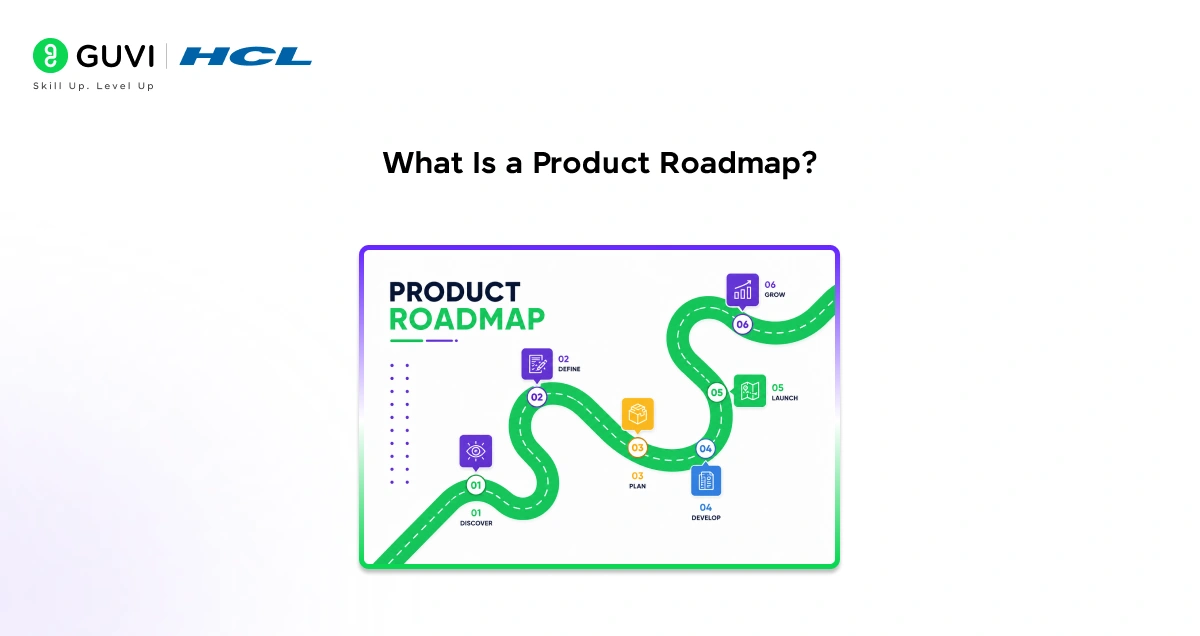
A product roadmap is a detailed plan showing what you will build over the next quarters or year. It breaks strategy into specific features and timelines.
- Organizing work for teams
The roadmap shows teams what to work on and in what order. It prioritizes features based on strategic importance and resource availability.
Showing progress over time
Roadmaps show when features will be delivered. They create accountability and help stakeholders understand when to expect new capabilities.
- Balancing competing priorities
Multiple ideas compete for limited resources. The roadmap decides which features get built first and which get delayed.
- Communicating plans to stakeholders
Stakeholders want to know what is coming. Roadmaps show executives, investors, and customers what you plan to deliver.
- Remaining flexible
Good roadmaps have some flexibility. You might adjust timelines based on challenges or new information. But the overall direction stays true to strategy.
- Examples of roadmap items
Q1: Build mobile app for iOS
Q2: Add collaboration features
Q3: Integrate with Slack and Teams
Q4: Launch AI-powered recommendations
Many product failures can be traced back to problems in product strategy rather than poor execution. A team may deliver every feature on time and follow the roadmap perfectly, yet still struggle if the product is aimed at the wrong market, solves a low-priority problem, or lacks a compelling value proposition. This is why successful product organizations place significant emphasis on customer research, market validation, positioning, and strategic alignment before investing heavily in development. A roadmap is ultimately a tool for executing a strategy; when the underlying strategy is sound, execution becomes more focused and effective. When the strategy is flawed, even flawless execution may fail to create meaningful customer value or business impact.
Product Strategy vs Roadmap: Key Differences
| Aspect | Product Strategy | Product Roadmap |
| Time Horizon | Years and decades | Quarters and months |
| Scope | Big-picture thinking about the entire business | Specific features and projects |
| Focus | Why and what | When and how much |
| Audience | Board members, investors, executives | Teams doing the work, customers waiting for features |
| Flexibility | Stable, changes rarely | Flexible, adjusted frequently |
| Detail Level | General principles and direction | Specific features with estimated dates |
| Success Measure | Market position, customer value, revenue | On-time delivery, feature completion, quality |
| Change Frequency | Reviewed annually or when market shifts | Updated quarterly or with new information |
| Created By | Executive team, product leadership | Product managers with input from teams |
| Example | “Become the leading AI assistant for customer service teams” | “Build chatbot training module in Q1, integrate with CRM in Q2” |
Organizations with a clearly documented product strategy are generally better positioned to align teams, prioritize investments, and make consistent decisions than those operating without one. A written strategy provides a shared understanding of target customers, market opportunities, business goals, and the principles that guide product decisions. Yet many companies either lack a formal product strategy or fail to revisit it as customer needs and market conditions evolve. Regularly communicating and updating product strategy helps ensure that roadmaps, feature prioritization, and day-to-day execution remain connected to long-term business objectives, reducing the risk of teams drifting in different directions.
Ready to turn product vision into execution? Join IIM Indore’s 8-month Certificate Programme in Product Management (CP PM) and gain the skills to create winning product strategies and roadmaps.
How Product Strategy Drives Roadmap
- Strategy comes first
You create a strategy before the roadmap. Strategy answers why you are building. The road map shows how you will execute that strategy.
- Strategy filters roadmap ideas
Ideas that align with strategy move forward. Ideas that do not get rejected, no matter how good they sound. Strategy keeps you focused.
- Strategy helps prioritize
When deciding between features, ask which serves your strategy better. This prioritization goes into the roadmap.
- Strategy guides resource allocation
Strategy shows where to invest. If your strategy is to be the most secure option, you invest in security. Roadmap shows how that investment happens over time.

- Strategy provides context
Teams executing the roadmap understand why features matter. This context comes from understanding the strategy. Purpose motivates better execution.
- Example: Strategy to Roadmap
Strategy: “Make financial investing accessible to beginners with no prior knowledge”
Roadmap items that support this strategy:
- Simplify signup process to 3 minutes
- Create educational content about investing basics
- Build guided investment wizard
- Add investment recommendations for beginners
- Create mobile app for easy access
Roadmap items that do NOT support this strategy (would be rejected):
- Advanced technical analysis tools
- API for professional traders
- High-frequency trading capabilities
Why You Need Both Product Strategy and Roadmap
- Strategy without roadmap
If you have strategy but no roadmap, teams do not know what to build. You have a vision but no execution plan. Progress stalls.
- Roadmap without strategy
If you have a roadmap but no strategy, you might build features that do not matter. You execute perfectly on the wrong direction. This is worse than no roadmap.
- Together they are powerful
Strategy gives direction and purpose. Roadmap shows how to get there step by step. Together they align the entire organization and deliver meaningful products.
Creating Effective Product Strategy
Step 1: Understand your customers
Talk to customers about their problems. What frustrates them? What are they willing to pay for? Strategy comes from understanding customer needs deeply.
Step 2: Analyze the market
Understand competitors, market size, and trends. Your strategy must address a real market opportunity. Small or shrinking markets lead to failed products.
Step 3: Define your differentiation
Why would customers choose you over alternatives? What is unique about your approach? Your differentiation becomes the core of your strategy.
Step 4: Set ambitious goals
Define where you want to be in 3-5 years. What market position do you want? How big do you want to be? These goals guide all decisions.
Step 5: Align the team
Share your strategy with the entire team. Make sure everyone understands and agrees. Strategy only works when the whole organization is aligned.
Step 6: Measure success
Define metrics that show if your strategy is working. Are you gaining market share? Growing revenue? Meeting customer satisfaction targets?
Creating Effective Product Roadmaps
Step 1: Start with strategy
Every roadmap item must support your strategy. Before adding something to the roadmap, ask: does this serve our strategic direction?
Step 2: Understand dependencies
Some features depend on others. Building collaboration features might depend on first building core functionality. Map out these dependencies.
Step 3: Estimate effort
Assess how much work each feature requires. Some features are simple. Others are complex. Estimation helps you be realistic about timelines.
Step 4: Prioritize ruthlessly
You cannot build everything at once. Use frameworks to prioritize. Common frameworks include value versus effort, customer impact, and strategic importance.
Step 5: Create realistic timelines
Be honest about what you can deliver. Under-promise and over-deliver builds trust. Over-promise and under-deliver damages credibility.
Step 6: Share the roadmap
Communicate roadmaps to executives, teams, and customers. Different audiences need different levels of detail. Share broadly.
Step 7: Update regularly
Update your roadmap quarterly or when significant changes occur. As you learn more, adjust plans accordingly. Keep the roadmap living and current.
To learn more on Product Strategy & Roadmap , enroll in IIM Indore’s 8-month Certificate Programme in Product Management (CP PM). This comprehensive program helps you develop the skills and confidence to build, launch, and scale products that drive growth and innovation in today’s AI-powered economy, equipping you with industry-relevant expertise to excel in strategic product leadership roles.
Common Mistakes with Product Strategy vs Roadmap
- Confusing strategy and roadmap
The biggest mistake is treating them as the same thing. Strategy is why. Roadmap is how. Keep them separate but connected.
- Roadmap without clear strategy
Building a roadmap without underlying strategy leads to random features. You stay busy but do not make progress toward meaningful goals.
- Strategy that is too vague
“Be the best product” is not a strategy. Effective strategy is specific about who you serve, what problems you solve, and how you differ.
- Changing strategy too often
Strategy should be stable. If you change strategy every quarter, teams cannot execute effectively. Give strategy at least a year to work.
- Ignoring market feedback when updating strategy
If customer feedback shows your strategy is wrong, be willing to change it. Strategy should evolve as you learn, but not based on whims.
- Making roadmap too detailed
Roadmaps beyond 6 months out are often wrong. Create detailed roadmaps for the next quarter, general roadmaps for further out.
- Not communicating roadmap to teams
Teams should understand why each feature matters. Share the roadmap broadly. Help people connect their work to the larger strategy.
Conclusion
Product strategy and product roadmap are both essential but serve different purposes. Strategy provides direction and answers why you are building. Roadmap provides execution plan and shows when features ship.
Strategy comes first. You develop strategy based on customer needs, market opportunity, and your unique differentiation. Then you create roadmaps to execute that strategy.
Both need to be communicated clearly to different audiences. Strategy aligns leadership and guides major decisions. Roadmap aligns teams and tracks execution.
The most successful products have clear strategy that remains stable and flexible roadmaps that adapt to changing conditions. Together, they create products that matter and reach their potential.
FAQs
1. How often should I update product strategy?
Review strategy annually or when major market shifts occur. Change it rarely, only when significant evidence suggests a new direction is needed. Constant strategy changes confuse teams.
2. What if my strategy changes mid-year?
Communication is key. Explain why the strategy is changing. Help teams understand what this means for the current roadmap. Adjust the roadmap to align with new strategy.
3. How detailed should my roadmap be?
Current quarter should be very detailed. Next quarter moderately detailed. Beyond that, general direction only. Detailed planning beyond 6 months usually becomes wrong.
4. Should I share the entire roadmap with customers?
Share what customers care about, not internal technical details. Share timeline and capabilities coming, but maintain some flexibility. Never commit to specific launch dates too far in advance.
5. Can product strategy fit on one page?
Yes, the best strategies are concise and clear. If you cannot fit your strategy on one page, it is probably too complicated. Simplicity helps with alignment.
Success Stories

About the Author
Vishalini Devarajan
An Aerospace Engineer turned content writer, I focus on making complex concepts easy to understand through well-structured, reader-friendly blogs. Whether it’s a technical topic or a non-technical one, I love creating content that is clear, engaging, and impactful.
View all posts by Vishalini Devarajan
Connect with me @










Did you enjoy this article?