


Product Management Articles
Enterprise Product Management: Unique Challenges, Skills & Strategy
B2B vs B2C Product Management: Key Differences, Skills, Strategy & Career Scope
Working with Engineers as a Product Manager: A Practical Guide


Get In Touch For Details! Request More Information

Product Manager Salary in India 2026: Freshers to Senior PMs
Jul 20, 2026 5 Min Read 1966 Views
(Last Updated)
Product manager salaries in India have jumped dramatically in the last two years. A fresher PM can now earn 12 to 20 lakhs right out of college. A mid-level PM with five years of experience breaks 40 to 60 lakhs. A senior PM or director easily hits 1 crore or more.
But here is the catch: the salary you actually earn depends entirely on three things. The type of PM role you target. The company you work for. And how strategically you negotiate and switch roles throughout your career.
This guide breaks down exactly what Product Manager Salary are at every level in India, what drives those salaries, and how to position yourself to earn the maximum in your career.
Table of contents
- Quick TL;DR Summary
- Product Manager Salary in India 2026: The Complete Picture
- How PM Salary Changes by Specialization
- Key Insights
- Which Companies Pay the Most for PMs?
- PM Salary by Location in India
- Why PM Salaries Jump: From 12 Lakhs to 1 Crore
- The Salary Progression Timeline
- How to Negotiate PM Salary at Every Level
- Conclusion
- FAQs
- What is the average PM salary in India for freshers?
- How much does a senior PM earn in India?
- Which PM specialization pays the most in India?
- How much should a mid-level PM earn in India?
- Do PMs at Google earn more than PMs at startups?
Quick TL;DR Summary
- You will see exact salary ranges for every PM level from fresher to CPO, with data from AmbitionBox, Glassdoor, Levels.fyi, and industry reports.
- The guide breaks down how different PM specializations (consumer, B2B, TPM, growth, platform) pay differently at each level.
- You will learn which companies pay the most, what drives salary increases, and how to negotiate at every stage.
- The guide includes real strategies for jumping from 12 lakhs to 50 lakhs to 1 crore based on role choices and career moves.
- You will leave knowing exactly what salary is realistic at your level and how to get paid more.
What Exactly Is a Product Manager?
A product manager is the professional responsible for determining what products or features should be built, why they are important, and whether they successfully solve the intended customer or business problem. Positioned at the intersection of engineering, design, and business, product managers align cross-functional teams around a shared vision and strategy. They prioritize opportunities, gather customer insights, define product requirements, and measure outcomes to ensure that products deliver value to users while supporting organizational goals.
Curious about a career in product management? Take the next step with IIM Indore’s 8-month Certificate Programme in Product Management (CP PM) and learn how to create products that drive innovation, growth, and business success.
Product Manager Salary in India 2026: The Complete Picture
Before diving into specializations and companies, here is the full salary landscape so you understand what is realistic at each career stage.
- Fresher / APM (0 to 2 Years)
| Career Stage | Experience | Salary Range (₹) | Source |
| Fresher / Associate Product Manager (APM) | 0–2 Years | 10–30 lakhs | AmbitionBox – Associate Product Manager Salary |
| Mid-Level Product Manager | 2–5 Years | 20–70 lakhs | AmbitionBox – Product Manager Salary (2-5 Years Experience) |
| Senior Product Manager / Lead PM | 5–8 Years | 45 lakhs–1.5 crores | AmbitionBox – Senior Product Manager Salary |
| Director of Product / Principal PM | 8–12 Years | 75 lakhs–2.5 crores | AmbitionBox – Director of Product Management Salary |
| VP of Product / Chief Product Officer (CPO) | 12+ Years | 1.5–5+ crores | ProductLeadership – CPO and VP Product Salary |
Key Takeaway: Product Manager salaries in India range from ₹10 lakhs for freshers to ₹5+ crores for senior product leaders, with compensation increasingly driven by stock options, bonuses, and equity as you move up the career ladder.
Read More: Cursor for Product Managers: A Complete Guide to AI Workflows
How PM Salary Changes by Specialization
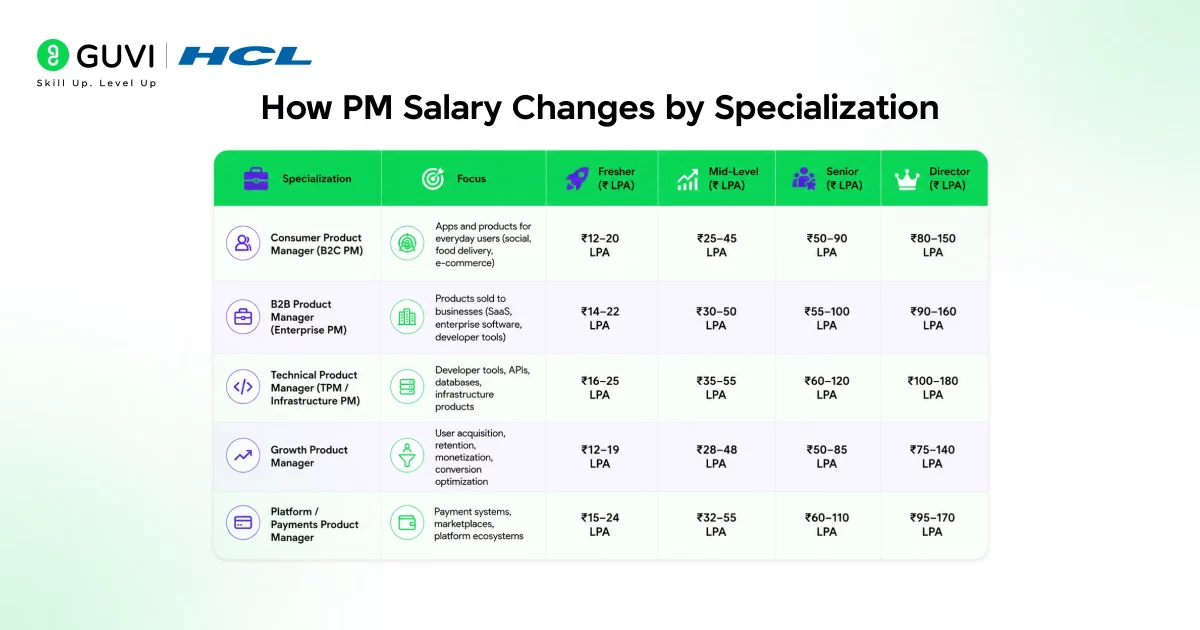
| Specialization | Focus | Fresher (₹ LPA) | Mid-Level (₹ LPA) | Senior (₹ LPA) | Director (₹ LPA) |
| Consumer Product Manager (B2C PM) | Apps and products for everyday users (social, food delivery, e-commerce) | 12–20 lakhs | 25–45 lakhs | 50–90 lakhs | 80–150 lakhs |
| B2B Product Manager (Enterprise PM) | Products sold to businesses (SaaS, enterprise software, developer tools) | 14–22 lakhs | 30–50 lakhs | 55–100 lakhs | 90–160 lakhs |
| Technical Product Manager (TPM / Infrastructure PM) | Developer tools, APIs, databases, infrastructure products | 16–25 lakhs | 35–55 lakhs | 60–120 lakhs | 100–180 lakhs |
| Growth Product Manager | User acquisition, retention, monetization, conversion optimization | 12–19 lakhs | 28–48 lakhs | 50–85 lakhs | 75–140 lakhs |
| Platform / Payments Product Manager | Payment systems, marketplaces, platform ecosystems | 15–24 lakhs | 32–55 lakhs | 60–110 lakhs | 95–170 lakhs |
Key Insights
- Consumer Product Manager (B2C PM): Fastest feedback loops and visible impact through large user bases.
- B2B Product Manager (Enterprise PM): Typically earns 5–10% more than B2C PMs at senior levels due to higher contract values and strategic decision-making.
- Technical Product Manager (TPM): Highest barrier to entry but often pays 15–25% more than other PM specializations at the same level.
- Growth Product Manager: Strong focus on measurable business outcomes and revenue impact.
- Platform / Payments Product Manager: Often among the highest-paying PM specializations because of direct financial impact and ownership of critical revenue infrastructure.
Technical Product Managers (TPMs) often command higher compensation than traditional consumer-focused Product Managers because they combine product strategy with deep technical understanding, enabling them to work closely with engineering teams on complex platforms, infrastructure, and enterprise systems. Industry compensation reports frequently show TPM roles earning a premium at many technology companies, reflecting the specialized skills required to bridge business objectives and technical execution. Over the course of a career, even modest differences in starting compensation can compound significantly through salary increases, bonuses, stock grants, and promotions, making technical product management an attractive career path for professionals with both product and technical expertise.
Which Companies Pay the Most for PMs?
Not all companies pay the same for the same role. Here is where to target based on compensation:
| Company | Type | Fresher Range | Senior Range |
| Tech Company | 22 to 30 lakhs | 90 to 150 lakhs | |
| Amazon | Tech Company | 18 to 28 lakhs | 80 to 140 lakhs |
| Microsoft | Tech Company | 20 to 30 lakhs | 85 to 145 lakhs |
| Meta | Tech Company | 18 to 28 lakhs | 80 to 135 lakhs |
| Flipkart | E-commerce | 15 to 22 lakhs | 60 to 100 lakhs |
| Swiggy | E-commerce | 14 to 20 lakhs | 55 to 90 lakhs |
| Razorpay | Fintech | 16 to 24 lakhs | 70 to 120 lakhs |
| Unacademy | EdTech | 12 to 17 lakhs | 40 to 70 lakhs |
The pattern is clear: global tech companies pay 30 to 50 percent more than Indian startups for the same role. Within that, fintech and B2B SaaS pay more than e-commerce and edtech.
PM Salary by Location in India
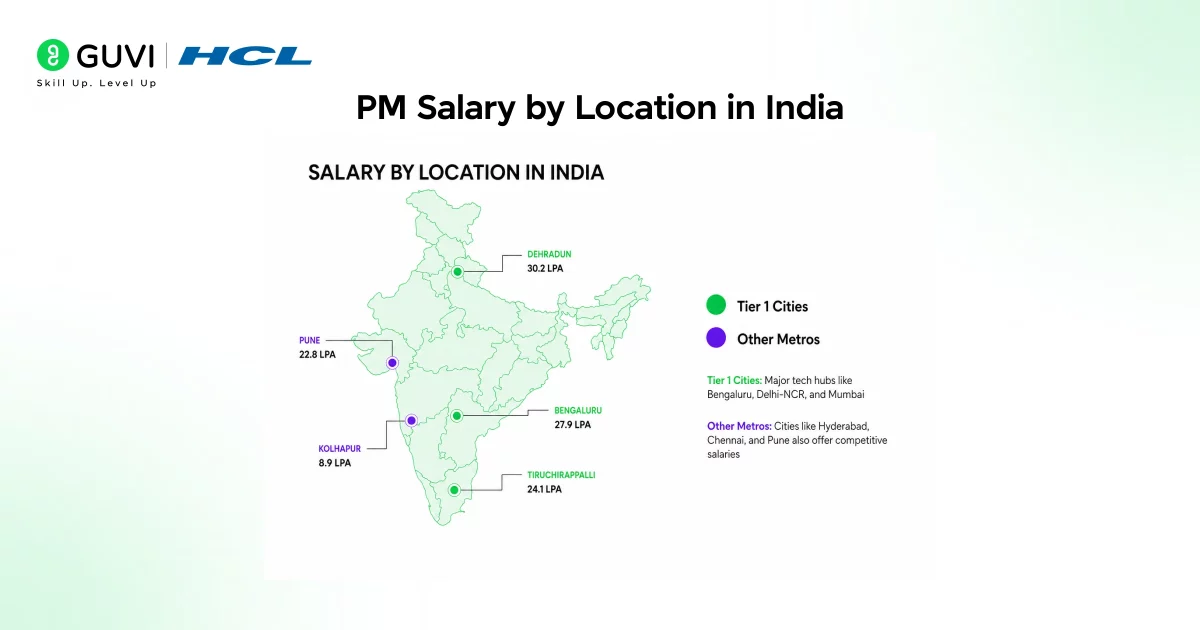
| City | Fresher (₹ LPA) | Mid-level (₹ LPA) | Senior (₹ LPA) | Source |
| Bangalore | 15–22 lakhs | 32–55 lakhs | 60–110 lakhs | AmbitionBox – Product Manager Salary Bangalore |
| Mumbai | 14–20 lakhs | 30–50 lakhs | 55–100 lakhs | AmbitionBox – Product Manager Salary Mumbai |
| Delhi / NCR | 13–19 lakhs | 28–48 lakhs | 50–95 lakhs | AmbitionBox – Product Manager Salary Delhi |
| Chennai | 12–18 lakhs | 26–45 lakhs | 45–80 lakhs | AmbitionBox – Senior PM Salary Chennai |
| Hyderabad | 12–18 lakhs | 27–46 lakhs | 50–90 lakhs | AmbitionBox – Product Manager Salary Hyderabad |
Note: Bangalore and Mumbai offer 10 to 15 percent higher salaries than tier-2 cities for the same role and experience level.
Why PM Salaries Jump: From 12 Lakhs to 1 Crore
Your salary does not just go up because you have been doing the job longer. It jumps based on specific decisions and moves. Here is what drives the biggest increases:
- Switching Companies (Biggest Single Jump)
Staying at one company: your salary grows 8 to 15 percent annually Switching to a better role: your salary often jumps 40 to 100 percent
A PM earning 25 lakhs at a startup who switches to Google in a senior role can jump to 60 to 80 lakhs. That is a jump that would take 10 years of internal promotions to achieve.
- Choosing the Right Specialization
Consumer PM to TPM: 15 to 25 percent higher salary at same company and level Growth PM to Platform PM: 10 to 20 percent higher s3+ salary The earlier you make this choice in your career, the bigger the cumulative impact.
- Going from Startup to Public Company
Startup: base salary + equity that may or may not have value Public company: base salary + stock that vests monthly with real value The difference in total compensation can be 50 to 200 percent at senior levels.

A senior PM at a startup earning 60 lakhs base might get the same base at a public company but gain 50 lakhs of stock vesting annually. That is nearly 3x the total compensation.
- Demonstrating Business Impact
PMs who can quantify revenue impact, user growth, or retention improvements get promoted faster and get bigger raises.
A PM who can show their roadmap drove 30 percent revenue growth gets promoted and earns 50 percent more. A PM with no documented impact stays in place.
- Building Credibility at Top Companies
Year at Google > Year at unknown startup for your next role negotiation
The company brand matters enormously. A PM who spent 3 years at Google as a senior PM can command 50 to 100 percent higher salary at their next company compared to a PM with the same tenure at an unknown company.
To learn more on how to become a Product Manager and their salary, enroll in IIM Indore’s 8-month Certificate Programme in Product Management (CP PM). This comprehensive program helps you develop the skills and confidence to build, launch, and scale products that drive growth and innovation in today’s AI-powered economy, equipping you with industry-relevant expertise to excel in strategic product leadership roles.
The Salary Progression Timeline
Here is what realistic salary growth looks like for a PM who makes smart career moves:
| Career Stage | Experience | Salary | Role | Company Type | What Happens |
| Year 0 (Fresher) | 0 Years | 15 lakhs | Associate Product Manager | Well-funded Series B to C startup | Learn basics, ship features, build credibility |
| Year 2 (First Switch) | 2 Years | 28–35 lakhs | Product Manager | Scale-up or top tech company | Get promoted internally or switch for a bigger title and salary. First major jump |
| Year 4–5 (Second Switch) | 4–5 Years | 50–65 lakhs | Senior Product Manager | Established tech company or public company | Build a strong track record and command a higher salary and better equity terms. Second major jump |
| Year 7–8 (Director Move) | 7–8 Years | 80–120 lakhs | Director of Product / Lead PM | Public company or well-funded startup | Own a larger scope. Equity starts vesting meaningfully. Third major jump |
| Year 12+ (VP / CPO) | 12+ Years | 1+ crore | VP of Product or Chief Product Officer | Public company or leading startup | Run the entire product organization. Equity and bonuses become substantial. Fourth major jump |
Key Insight: The biggest salary increases typically happen when switching companies rather than through internal promotions. Strategic job changes can significantly accelerate compensation growth for Product Managers.
Career mobility can have a significant impact on compensation growth in Product Management. While internal promotions often provide steady salary increases and expanded responsibilities, external job changes can sometimes result in larger compensation jumps because companies frequently pay a premium to attract experienced talent. As a result, many PMs strategically evaluate new opportunities every few years to accelerate their career progression and earning potential. However, compensation is only one factor in long-term career success—factors such as skill development, leadership opportunities, equity grants, work-life balance, and the quality of products being built can be equally important when deciding whether to stay or move.
How to Negotiate PM Salary at Every Level
Your ability to negotiate directly determines your lifetime earnings. Most PMs leave 5 to 15 lakhs on the table by not negotiating. Here is how to do it right:
- As a Fresher / APM
Negotiation leverage: Portfolio quality, interview performance, any competing offers What to push for: 10 to 20 percent higher base, equity terms, signing bonus How: Get multiple offers. Use better offers to negotiate with your top choice. Most companies have some wiggle room on first offers.
- As a Mid-Level PM
Negotiation leverage: Track record of shipped features, business impact data, competing offers What to push for: 20 to 40 percent higher than current total comp, better stock vesting, performance bonus structure How: Know the exact range at your target company before interviewing. Ask for the top of that range or higher.
- As a Senior PM
Negotiation leverage: Proven business impact, team building track record, recruiter interest What to push for: 30 to 50 percent higher than current comp, significant equity grants, signing bonus, title How: Negotiation is expected at this level. Do not accept the first offer. Have a walk-away number. Be prepared to walk away.
Conclusion
Product manager salaries in India have become genuinely lucrative, but only if you make the right moves at the right time.
Start at a credible company, even if the initial salary is not the highest. Build real impact and a strong track record. Then switch companies strategically every 3 to 5 years to better roles at companies that pay more. Choose a specialization that aligns with where you can deliver value and where the compensation aligns with your goals. Negotiate hard at every stage.
The path from 15 lakhs as a fresher to 1 crore plus as a director or VP is real and achievable. Hundreds of PMs have done it. You can too. It takes strategic career planning, strong execution, and willingness to move when better opportunities emerge.
FAQs
1. What is the average PM salary in India for freshers?
Freshers at well-funded startups: 12 to 18 lakhs Freshers at scale-ups: 15 to 22 lakhs Freshers at top tech companies: 20 to 30 lakhs
2. How much does a senior PM earn in India?
At strong product companies: 50 to 75 lakhs At public tech companies: 70 to 120 lakhs At top-tier tech firms: 100 to 150 lakhs
3. Which PM specialization pays the most in India?
TPM and Platform PM roles pay 15 to 25 percent more than consumer or growth PM roles at the same level. If you want the highest salary, technical knowledge pays.
4. How much should a mid-level PM earn in India?
At startups: 25 to 40 lakhs At mature tech companies: 35 to 55 lakhs At public companies: 45 to 70 lakhs
5. Do PMs at Google earn more than PMs at startups?
Yes, significantly. A senior PM at Google earns 80 to 150 lakhs. A senior PM at a startup earns 45 to 70 lakhs. The difference is 50 to 100 percent or more.
Success Stories

About the Author
Vishalini Devarajan
An Aerospace Engineer turned content writer, I focus on making complex concepts easy to understand through well-structured, reader-friendly blogs. Whether it’s a technical topic or a non-technical one, I love creating content that is clear, engaging, and impactful.
View all posts by Vishalini Devarajan
Connect with me @










Did you enjoy this article?