


Product Management Articles
Enterprise Product Management: Unique Challenges, Skills & Strategy
B2B vs B2C Product Management: Key Differences, Skills, Strategy & Career Scope
Working with Engineers as a Product Manager: A Practical Guide


Get In Touch For Details! Request More Information
The Product Life Cycle Management Explained: A Practical Guide
Aug 18, 2026 6 Min Read 577 Views
(Last Updated)
Every product you have ever used your phone, your favourite app, the laptop you are reading this on went through a journey before it reached you. Someone had an idea, that idea became a prototype, the prototype became a product, the product hit the market, and at some point, it will be replaced by something newer. That entire journey, from the very first idea to the day a product is retired, is what Product Life Cycle Management is all about.
Most people think product management ends at launch. It does not. The way a product is handled after it goes live how it is marketed at different stages, when to invest in improvements, when to know it is time to move on has just as much impact on business success as the original design. Companies that understand this tend to build products that last longer, earn more, and serve customers better.
In this article, we will break down exactly what Product Life Cycle Management (PLM) is, walk through each stage a product goes through, explain the three pillars that hold PLM together, and show you why this concept matters in the real world.
Table of contents
- TL;DR
- Understanding the Product Life Cycle
- The Three Core Elements of PLM
- Why PLM Matters: The Business Case
- Factors That Shape the Product Life Cycle
- PLM Across Different Industries
- How to Measure PLM Success
- PLM and Digital Transformation
- Common Pitfalls to Avoid
- Final Thoughts
- FAQ
- Q: How is PLM different from product management or PIM/ERP systems?
- Q: When should a company invest in PLM software?
- Q: How do I know if a product needs regeneration or reintroduction?
- Q: What KPIs matter most for PLM success?
- Q: How do modern technologies (AI, IoT, cloud) change PLM?
TL;DR
- Product Life Cycle Management (PLM) manages a product from idea through development, launch, growth, maturity, decline, and possible regeneration/reintroduction to retirement.
- PLM connects people, processes, and technology so teams collaborate, track versions, and move faster while reducing errors and cost.
- The seven practical stages: Development, Introduction, Growth, Maturity, Decline, Regeneration, Reintroduction each needs different priorities (R&D, awareness, scaling, retention, cost‑cutting, innovation, relaunch).
- Measure PLM success with time‑to‑market, product quality/defects, development costs, change‑order frequency, and customer satisfaction (NPS). Use data to decide whether to invest, extend, or retire a product.
- PLM is more than software it’s an organizational transformation that benefits from phased rollouts, integration with ERP/MES/PIM, and modern tech (cloud, AI, IoT) to enable continuous improvement and sustainability.
What Is Product Life Cycle Management (PLM)?
Product Life Cycle Management (PLM) is the end-to-end process of managing a product from its initial idea and design phase through development, launch, growth, and eventual retirement. It integrates people, processes, and technology to ensure that every stage of the product’s lifecycle is handled efficiently and strategically. PLM helps organizations reduce costs, accelerate product development, improve collaboration, and maximize the overall value delivered throughout the product’s life.
What’s next after understanding the product life cycle? Learning how to lead it. Join HCL GUVI’s Product Management Programme by IIM Indore and master the skills to build and grow successful products.
Understanding the Product Life Cycle
- Before we get into the management side of things, it helps to understand what the product life cycle actually looks like. At its core, the product life cycle concept recognizes that every product has a finite lifespan, and that its journey in the market can be divided into distinct phases.
- These phases represent the evolution of a product’s popularity, sales, and profitability over time.
- Think of any product you can name digital cameras, smartphones, electric vehicles. Each of them has passed through recognizable phases: a launch period where everyone is discovering it, a growth period where sales take off, a plateau where the market stabilizes, and eventually a slowdown where newer alternatives start pulling attention away.
- Recognizing which phase a product is in helps a company make much smarter decisions about where to spend money, what to communicate to customers, and what comes next.
- By recognizing where a product stands within its life cycle, companies can tailor their strategies to maximize profits, allocate resources effectively, and plan for the future. It also informs pricing, promotion, distribution, and product improvement or diversification decisions.
Read More: Product Manager Roadmap 2026: From Beginner to Industry-Ready PM
The Three Core Elements of PLM
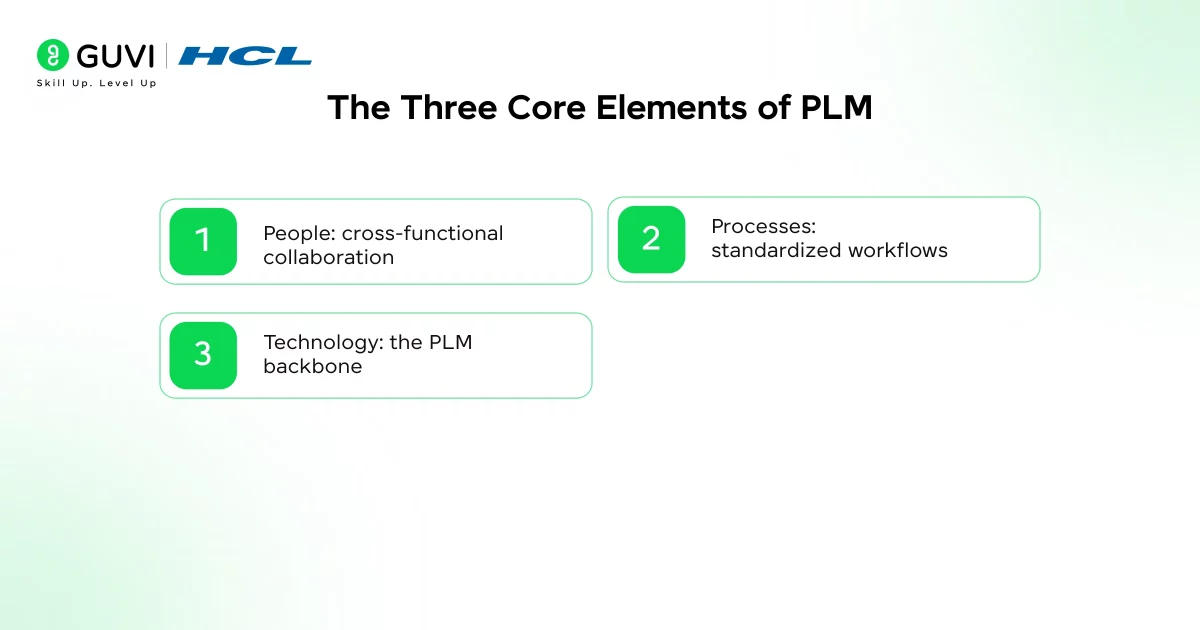
- People: cross-functional collaboration
- Effective PLM depends on teams, design, engineering, marketing, sales working together with clear communication and shared goals. PLM breaks down silos so decisions are faster, information isn’t lost, and the product benefits from aligned priorities.
- Processes: standardized workflows
- Streamlined, repeatable processes reduce errors and speed time-to-market. Well-defined approval flows, change-tracking, and handoffs are the connective tissue of PLM that keep development, manufacturing, and distribution operating smoothly.
- Technology: the PLM backbone
- PLM software manages product data, documentation, version control, and real-time collaboration. The right tools enable secure sharing and coordination; without them, growing product complexity tends to overwhelm people and processes.
Why PLM Matters: The Business Case
- You might be wondering why companies invest so heavily in PLM systems. The answer becomes clear when you look at what happens without one.
- Without a unified system, teams often work in silos, data becomes inconsistent and decisions slow down. PLM solves this by acting as a single source of truth for all product-related information. Engineers, designers, suppliers and service teams can collaborate in real time using shared, accurate data. This structure reduces errors, shortens development cycles and ensures everyone works toward the same goals.
- The numbers back this up. Studies show that companies using PLM experience up to 30% faster time-to-market and 25% lower development costs.
- These improvements are driven by better collaboration, fewer errors and smarter decision-making.
- For any company dealing with complex products, whether in manufacturing, technology, pharmaceuticals, or consumer goods, those figures represent a very significant competitive advantage.
- PLM adds measurable value across operations from engineering to supply chain management. It automates repetitive tasks and manages workflows to save time and reduce errors.
- Early visibility into design and production prevents rework and reduces material waste. Connected teams can experiment and iterate quickly in response to market changes.
Product Lifecycle Management (PLM) started as a way to manage increasing product complexity but today sits at the core of digital transformation, with modern PLM platforms acting as a single source of truth that connects design data, supplier specifications, manufacturing plans, and field telemetry; companies using PLM often report faster time-to-market and lower development costs due to improved coordination and reduced silos, and beyond efficiency it now also supports sustainability goals such as material traceability and circular-economy workflows while increasingly integrating AI-driven decision-making to optimize product development across the entire lifecycle.
Factors That Shape the Product Life Cycle
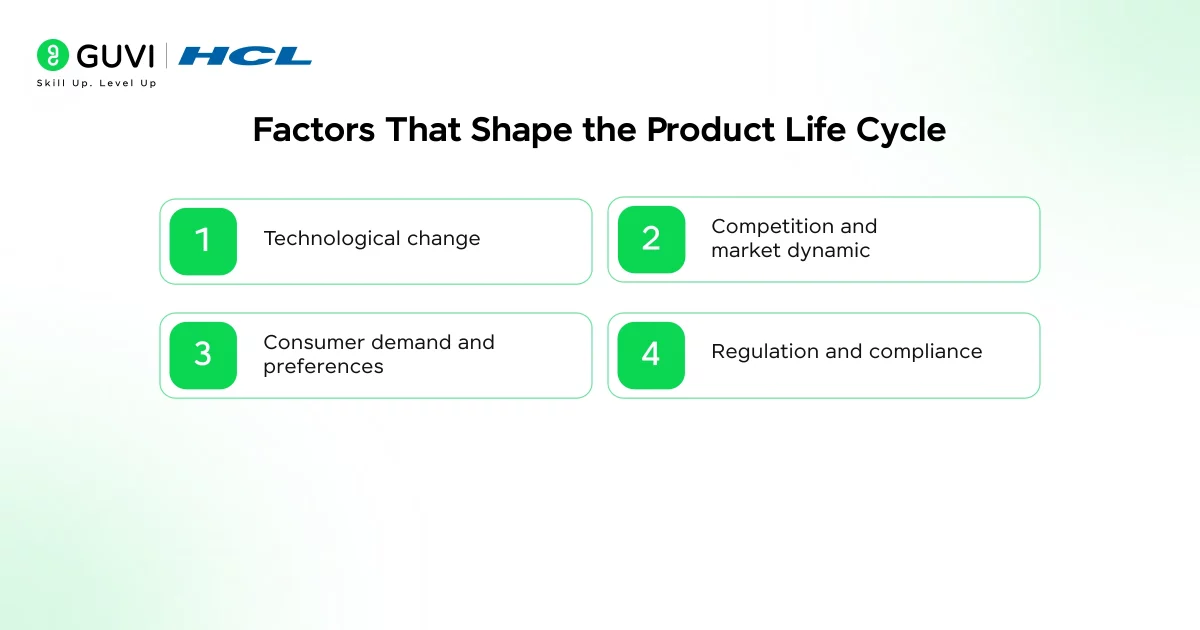
- Technological change
- Advances in technology can shorten or extend product life cycles. New tech can make products obsolete quickly (for example, streaming vs. DVD rentals), or it can rejuvenate products when new capabilities are added that renew customer interest.
- Competition and market dynamics
- The intensity of competition and level of market saturation shape how long a product stays in each stage. High competition and crowded markets tend to shorten life cycles; products that match evolving consumer preferences maintain growth and maturity longer.
- Consumer demand and preferences
- Shifts in customer needs, tastes, and buying behavior directly influence product momentum. Staying aligned with demand through updates, positioning, or feature changes helps prolong growth and delay decline.
- Regulation and compliance
- Regulatory requirements especially in regulated industries (pharma, aerospace, automotive, food) affect development timelines, market entry, and ongoing changes. Robust PLM processes and documentation reduce regulatory risk and support faster, compliant movement across life-cycle stages.
PLM Across Different Industries
- Automotive
- PLM in automotive covers concept design, engineering validation, safety testing, supplier coordination, production planning, and recalls. It ensures traceability across complex assemblies and supports regulatory compliance and after‑sales updates.
- Pharmaceuticals
- In pharma, PLM tracks research data, clinical trial documentation, regulatory submissions, and batch records. It enforces strict version control and audit trails required for safety, approvals, and product lifecycle documentation.
- Consumer electronics
- PLM manages fast iteration cycles, component sourcing, firmware/software updates, and time‑to‑market pressures. It helps coordinate design changes, supplier parts, and certification efforts under tight release schedules.
- Aerospace and defense
- PLM supports precision engineering, complex system integration, stringent regulatory compliance, and collaboration across global teams and contractors. It’s essential for lifetime traceability, configuration management, and maintenance planning.
- Fashion and food
- Fashion uses PLM for seasonal collections, material sourcing, and design-to-production workflows. Food manufacturing applies PLM principles to ingredient sourcing, recipe/version control, packaging updates, and regional compliance requirements.

How to Measure PLM Success
Implementing PLM is one thing, knowing whether it is working is another. There are several metrics that tend to give a clear picture of how well a PLM strategy is performing.
- Time to market is one of the most important metrics how long does it take to bring a new product to market? A shorter time to market can give a competitive advantage. Product quality, measured by defect rates, directly impacts customer satisfaction and repeat business. Cost of goods sold reflects manufacturing and selling efficiency. Customer satisfaction and Net Promoter Score round out the picture by showing whether the product is actually delivering value to the people using it.
- Beyond these high-level indicators, companies should also track things like the number of engineering change orders per product.
- How often teams have to redo work because of missed information, and how quickly the organization responds to market feedback.
- These operational signals tell you whether the people, processes, and technology elements of your PLM system are actually functioning as intended.
You just explored the product life cycle and how to use it practically in product decisions. Take it further with HCL GUVI’s Product Management Program by IIM Indore. Learn to build, launch, and scale products with expert guidance from IIM Indore. Start your product management journey here
PLM and Digital Transformation
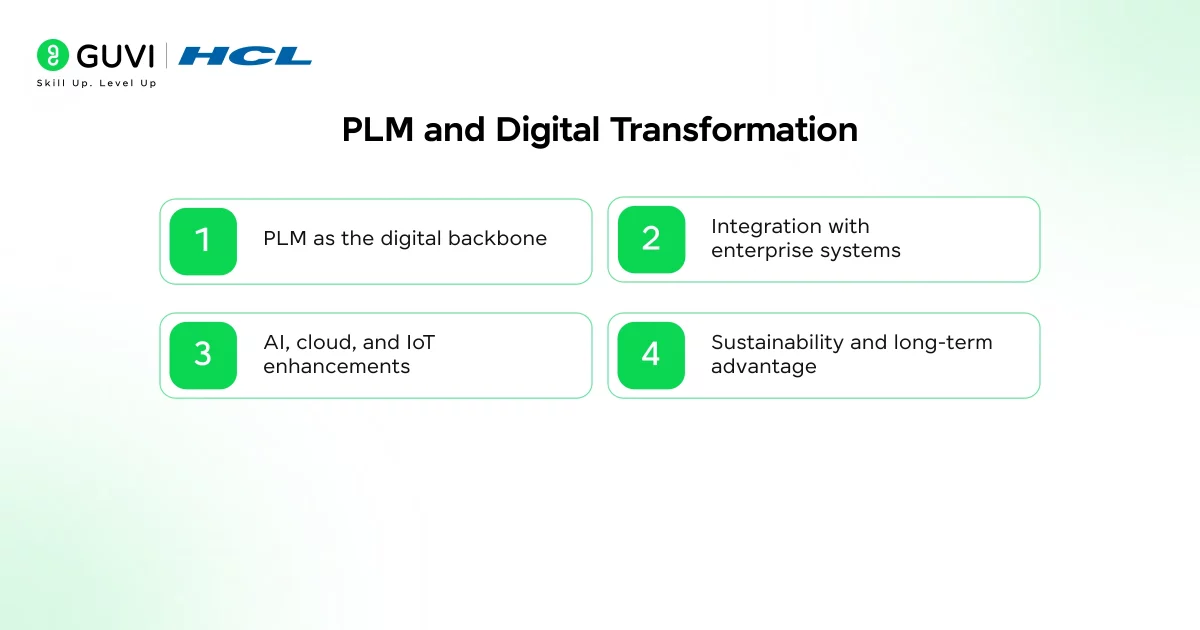
- PLM as the digital backbone
- PLM provides a single source of truth for product information, which is essential as companies connect more systems, generate more data, and operate across geographies. Centralized product data reduces duplication and keeps engineering, production, and customer-facing channels consistent.
- Integration with enterprise systems
- PLM links product data to ERP (enterprise resource planning), MES (manufacturing execution), and PIM (product information management). This integration eliminates manual handoffs, synchronizes workflows, and ensures accurate information flows across the organization.
- AI, cloud, and IoT enhancements
- Artificial intelligence augments PLM by predicting outcomes and automating repetitive tasks. Cloud platforms enable faster deployment and global collaboration. IoT supplies real-world usage data that creates continuous feedback loops between products in the field and design teams.
- Sustainability and long-term advantage
- PLM supports sustainability goals through responsible material selection, tracking for recycling programs, and enabling circular‑economy practices. Organizations that embed AI, cloud, IoT, and sustainability into PLM build durable competitive advantages.
Common Pitfalls to Avoid
- Even companies that recognize the value of PLM can struggle with implementation if they approach it purely as a software project rather than an organizational transformation.
- The biggest mistake is thinking that buying PLM software is the same as doing PLM. Implementing PLM is not only a technical project but also an organizational transformation. Success depends on careful planning, stakeholder engagement, and effective change management.
- Without getting the right people involved early and communicating the purpose clearly across departments, even the most powerful PLM tool will sit underused.
- Another common issue is trying to do too much too soon. A phased rollout that starts with the most pressing pain points, whether that is document control, change management, or cross-team visibility, tends to build momentum and trust much more effectively than a big-bang implementation that overwhelms teams.
Final Thoughts
Product life cycle management is fundamentally about being intentional at every stage of a product’s journey. It means understanding where a product is right now, anticipating what comes next, and having the systems and processes in place to respond effectively.
Whether a product is just entering the market or navigating a maturity plateau, the companies that manage that journey deliberately rather than reacting to it tend to come out ahead.
As markets move faster, customer expectations rise, and product complexity grows, PLM is no longer just a nice-to-have for large manufacturers. It is becoming the operational backbone that allows any organization to build, grow, and evolve its products with confidence.
FAQ
Q: How is PLM different from product management or PIM/ERP systems?
A: PLM focuses on lifecycle data and engineering/process workflows (design, BOMs, version control, change orders). Product management focuses on strategy, roadmap, and market success. PIM/ERP handle product information for commerce and resource/planning PLM often integrates with them to share accurate engineering data.
Q: When should a company invest in PLM software?
A: Invest when product complexity, regulatory requirements, supplier count, or cross‑team coordination start causing errors, delays, or costly rework. Start small (document control, change management) and expand, rather than buying a monolith and expecting instant results.
Q: How do I know if a product needs regeneration or reintroduction?
A: Look for declining sales driven by shifting needs or tech (not just marketing seasonality), remaining brand equity or assets that can be repurposed, and a plausible, costed plan to redesign or reposition the offering. If reinvention costs exceed expected returns, consider discontinuation instead.
Q: What KPIs matter most for PLM success?
A: Time‑to‑market, defect/recall rates, engineering change order (ECO) frequency, development cost per product, on‑time delivery to production, and customer satisfaction/NPS. Track operational signals (rework rates, approval cycle times) to spot process bottlenecks.
Q: How do modern technologies (AI, IoT, cloud) change PLM?
A: Cloud PLM enables global collaboration and faster deployment; IoT supplies real-world usage data that feeds continuous improvement; AI helps predict failures, prioritize design changes, and automate routine tasks (e.g., parts classification), making PLM more proactive and data‑driven rather than purely document-centric.
Success Stories

About the Author
Vishalini Devarajan
An Aerospace Engineer turned content writer, I focus on making complex concepts easy to understand through well-structured, reader-friendly blogs. Whether it’s a technical topic or a non-technical one, I love creating content that is clear, engaging, and impactful.
View all posts by Vishalini Devarajan
Connect with me @







Did you enjoy this article?