


Product Management Articles
Enterprise Product Management: Unique Challenges, Skills & Strategy
B2B vs B2C Product Management: Key Differences, Skills, Strategy & Career Scope
Working with Engineers as a Product Manager: A Practical Guide


Get In Touch For Details! Request More Information
How AI is changing the Product Manager role in 2026
Aug 19, 2026 6 Min Read 937 Views
(Last Updated)
A year-old product manager’s Tuesday looks outdated: writing PRDs by hand, spending days on interview synthesis, waiting on data tickets, and doing quarterly competitive decks. Those slow workflows are being compressed, automated, or sped up, and PMs who don’t adapt are falling behind.
Companies like Google, Notion, and Atlassian now run AI‑augmented product teams, shifting the question from “should we use AI?” to “how deeply is it integrated?” Adopting AI-driven workflows is rapidly becoming a baseline requirement for competitive PMs.
In this article, we will break down exactly how AI is reshaping the product manager role in 2026, which skills are becoming non-negotiable, what the day-to-day actually looks like now, and what genuinely still requires human judgment, no matter how good the tools get.
Table of contents
- TL;DR
- Why the PM Role Is Changing Right Now
- How AI Is Changing the Day-to-Day PM Workflow
- The AI Product Manager Skills That Matter in 2026
- New Roles Emerging in Product Teams
- How AI Is Changing Product Discovery
- What AI Cannot Replace in Product Management
- Ethical Responsibilities That Come with the Territory
- What This Means for Your PM Career
- Final Thoughts
- FAQs
- Q: Do PMs need to become data scientists or engineers to work with AI?
- Q: What daily PM tasks does AI actually replace or speed up?
- Q: How should PMs evaluate AI recommendations (roadmaps, prioritization)?
- Q: What ethical responsibilities do AI‑augmented PMs have?
- Q: How should a PM start upskilling for an AI‑augmented role?
TL;DR
- AI augments product management: it automates research, synthesis, spec drafting, and routine analysis so PMs can focus more on strategy, prioritization, and judgment.
- Data literacy and prompt engineering are now baseline skills; PMs must validate AI outputs (SQL basics, analytics tools, A/B testing knowledge).
- AI speeds discovery and competitive monitoring (continuous CI), shortens experiment cycles, and enables real‑time product insights via natural‑language queries.
- New roles (AI Product Owner, Data‑Informed PM) and leaner team structures are emerging; human skills empathy, stakeholder alignment, and strategic tradeoffsremain irreplaceable.
- Ethical oversight, bias mitigation, and accountability are core responsibilities: PMs must ensure AI-driven decisions are fair, transparent, and aligned with user trust.
What Does an AI Product Manager Actually Do?
An AI Product Manager is responsible for guiding the development and success of AI-powered products while leveraging artificial intelligence tools to improve productivity and decision-making. In 2026, AI product managers use AI systems to accelerate market research, analyze customer feedback, generate documentation, run experiments, and monitor product performance. However, their primary value comes from applying human judgment to product strategy, prioritization, stakeholder alignment, ethical considerations, and complex decisions that require business context and critical thinking. Rather than replacing the role, AI has shifted product managers toward higher-value responsibilities focused on vision, leadership, and outcome-driven decision-making.
Why the PM Role Is Changing Right Now
The reason this shift is happening now, rather than gradually over a decade, comes down to the pace of software development.
- AI-assisted coding, automated prototyping, workflow automation, and generative AI tools are reducing the time required to move from idea to execution.
- According to GitHub, developers using GitHub Copilot completed certain coding tasks up to 55 percent faster during controlled testing.
- Coordination and status updates will matter less; PMs should spend that saved time on high-level strategy: setting product vision, prioritizing bets, and defining success metrics that guide fast experiments.
- Judgment and decision-making become the core differentiator: interpret AI-generated insights, weigh trade-offs (user need, technical risk, business value), and make tough calls that align stakeholders.
- Strengthen skills AI can’t replace: customer empathy, synthesis across ambiguous signals, and persuasive storytelling to rally teams and executives around the roadmap.
How AI Is Changing the Day-to-Day PM Workflow
- User research and synthesis: AI cuts weeks-long cycles to minutes by auto-summarizing transcripts, tickets, NPS, and reviews into themes, personas, and sentiment. PMs must craft better questions, validate AI outputs, and surface the nuance the model misses.
- Competitive intelligence: AI agents continuously track competitor releases, pricing, reviews, and blogs, turning competitive analysis into a real-time input. PMs who integrate this into weekly routines make faster positioning decisions.
- PRDs and specs: LLMs draft structured PRDs from briefs, user stories, and acceptance criteria in minutes. PMs shift from writing to critically reviewing drafts, focusing on edge cases, dependencies, and launch risks.
- Roadmap prioritization: AI analyzes past feature performance, engagement, tickets, and revenue to recommend priorities with reasoning. PMs must verify optimization objectives and override models when strategic context demands.
- Real-time data analysis: Natural-language querying and analytics AI let PMs ask immediate product questions (no SQL) and get readable explanations. Data teams move to higher-value modeling while PMs handle daily analytics queries.
The AI Product Manager Skills That Matter in 2026
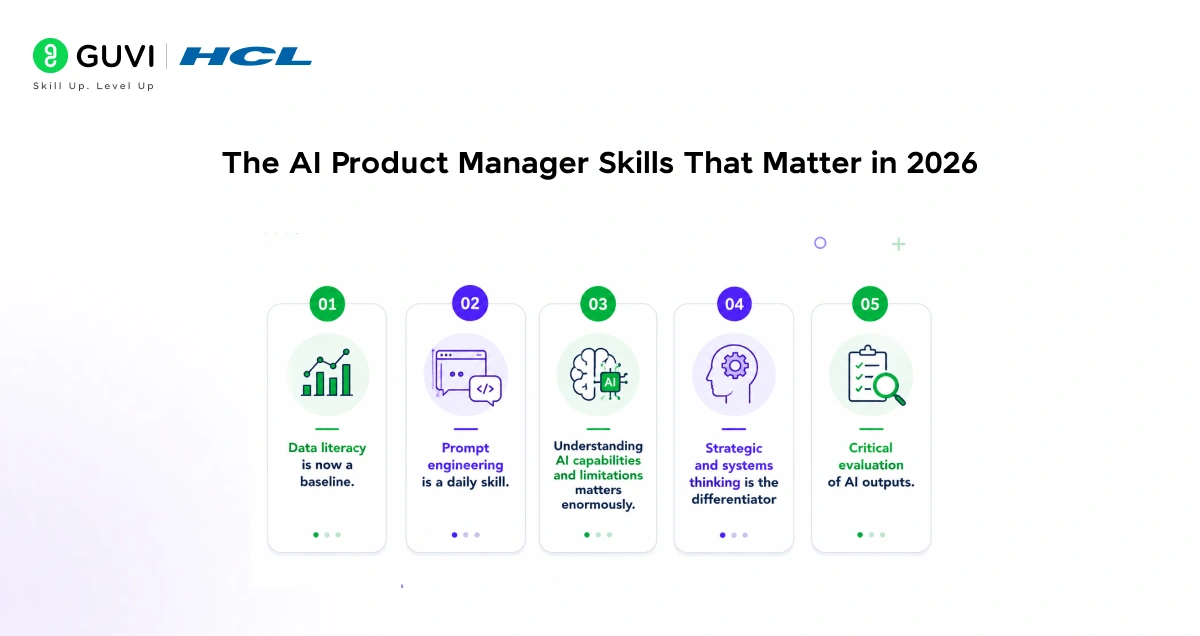
Understanding what is changing in the role is useful. Knowing which specific skills to build is more useful. Here is what actually separates high-performing PMs in an AI-augmented environment.
- Data literacy is now a baseline. SQL basics, familiarity with product analytics tools, and a working understanding of A/B testing are now baseline expectations at many companies. PMs must validate and contextualize AI outputs, not just accept them. AI accelerates data processing, but PMs must interpret results and align them with business realities.
- Prompt engineering is a daily skill. Skillful prompt crafting ensures AI generates accurate, relevant, and actionable results for tasks like roadmap prioritization, customer insight synthesis, spec writing, and competitive analysis. This is now a daily skill, not a developer hobby. A PM who cannot direct an AI tool effectively is the equivalent of a PM who cannot run a stakeholder meeting effectively; it is a core part of the job.
- Understanding AI capabilities and limitations matters enormously. PMs must clearly understand what AI can and cannot do. This prevents overreliance, ensures ethical use, and reinforces AI as a tool to augment, not replace, human judgment.
Knowing the difference between a RAG system and a fine-tuned model, understanding hallucination risks, and knowing when not to trust an AI output are now practical PM skills.
- Strategic and systems thinking is the differentiator. As AI automates more operational work, product managers are increasingly expected to focus on decision quality, prioritization, customer understanding, and long-term product direction.
AI can generate information quickly. It still struggles with organizational context, market nuance, timing decisions, and strategic trade-offs. Two companies can access the same AI tools and build completely different products based on the quality of the judgment behind the machine.
- Critical evaluation of AI outputs. AI generates fast. PMs need to review well. Spotting what a PRD draft missed, what a research synthesis oversimplified, or what a data summary distorted is what separates effective AI-augmented PMs from careless ones. Speed without accuracy creates expensive rework.
New Roles Emerging in Product Teams
The AI wave is not just changing how existing PMs work it is creating new roles that did not exist in their current form even two years ago.
- The AI Product Owner sits at the intersection of product strategy and AI system behavior, responsible for defining what an AI-powered feature should do, how its outputs should be evaluated, and where human oversight must remain.
- The Data-Informed PM uses AI tools to continuously monitor product health, user behavior, and experiment results, feeding those insights directly into roadmap decisions.
- These are not just title variations. They represent genuinely different areas of responsibility that require different skill sets ones that blend traditional product thinking with a working understanding of how AI systems behave in production.
How AI Is Changing Product Discovery
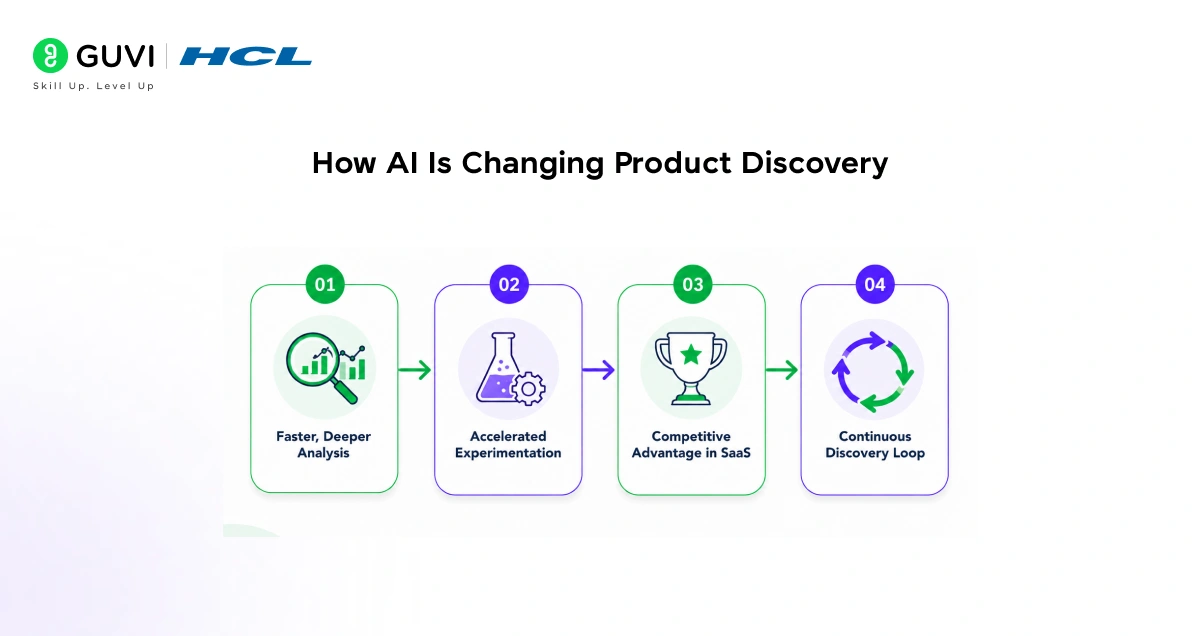
- Faster, Deeper Analysis
AI lets teams analyze thousands of tickets, reviews, transcripts, and feedback in a fraction of the time, surfacing patterns and friction points that were previously hidden. - Accelerated Experimentation
With faster insights, teams move from idea to prototype to test and iterate more quickly, shortening experimentation cycles. - Competitive Advantage in SaaS
In fast-moving SaaS markets, the ability to learn and iterate faster than competitors is a strategic differentiator. - Continuous Discovery Loop
Discovery shifts from a discrete phase to a continuous loop of insight, experiment, and adjustment, making product learning an ongoing rhythm.
By 2026, many product teams use Large Language Models (LLMs) and Retrieval-Augmented Generation (RAG) systems as part of their daily workflow. These tools can rapidly analyze customer feedback, summarize research interviews, draft product requirement documents, and surface market or competitor insights that previously required hours of manual effort. AI-powered analytics platforms also allow teams to query data using natural language, reducing dependence on specialized reporting workflows. As AI handles more of the information gathering and synthesis process, the most valuable product management skills are increasingly the ability to ask insightful questions, evaluate AI-generated outputs critically, and translate faster insights into better strategic decisions and customer outcomes.

What AI Cannot Replace in Product Management
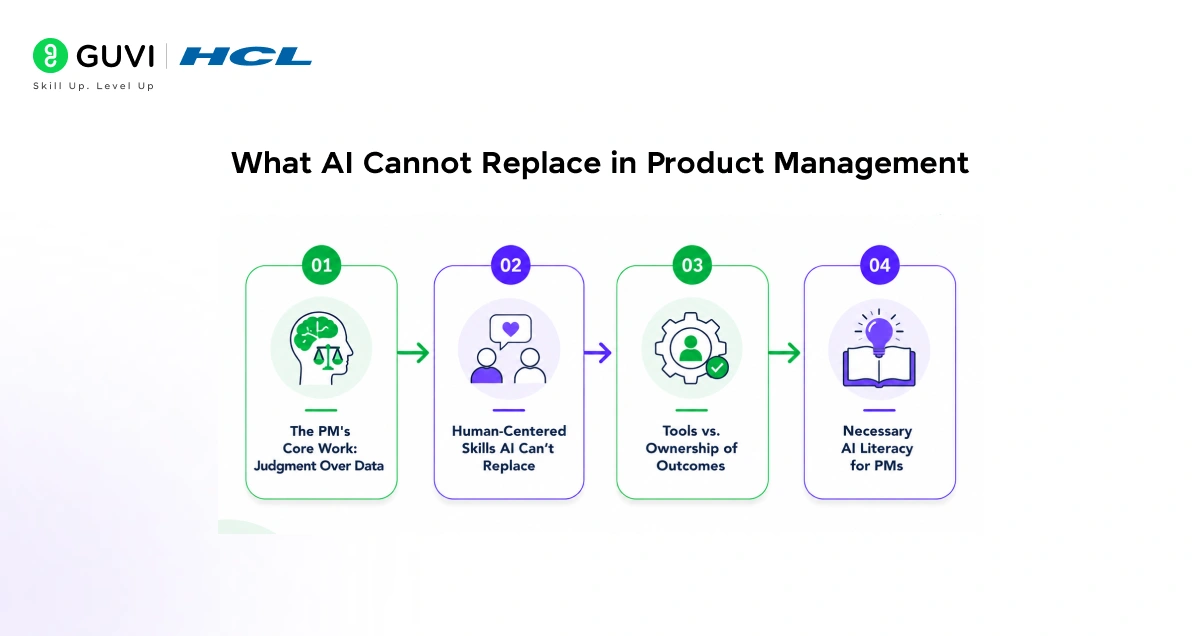
- The PM’s Core Work: Judgment Over Data
AI can speed up information gathering, but product management’s hardest tasks aren’t about collecting facts they’re about deciding what matters. Prioritization trade-offs, strategic timing, and product positioning require human judgment that balances ambiguous signals, competing goals, and long-term vision.
- Human-Centered Skills AI Can’t Replace
Areas that consistently demand people skills remain squarely with PMs: organizational alignment, leadership influence, customer empathy, and building stakeholder trust. AI cannot decide which customer problem is worth solving or mend a burned engineering team after repeated pivots.
- Tools vs. Ownership of Outcomes
AI is a tool to make PMs faster and more efficient, not a decision-maker. The person directing the tool owns the outcome; “the model said so” is not a product strategy. PMs must be able to explain, challenge, and override AI recommendations.
- Necessary AI Literacy for PMs
To use AI responsibly, PMs must understand enough about how their tools work to catch errors and biases and to make final calls aligned with strategy and human context. That knowledge lets them leverage AI while preserving accountability and trust.
Ethical Responsibilities That Come with the Territory
With greater AI capability comes genuine responsibility that PMs cannot outsource to their tools.
- Algorithmic bias is a real risk. AI trained on skewed data can produce skewed recommendations in feature prioritization, user segmentation, or pricing models.
- PMs must actively monitor for this. Similarly, using customer data to train AI-powered insights requires clear privacy standards and transparent data practices. Trust with users is built slowly and lost quickly.
- Product managers in 2026 are increasingly the people in the room most responsible for how AI systems affect users.
- That means staying aware of how decisions are being made, what data is being used, and what populations might be impacted in ways the system was not designed to anticipate.
What This Means for Your PM Career
The trajectory here is clear. AI skills are becoming a career differentiator at every level. Junior PMs who demonstrate AI fluency are landing roles faster.
- Senior PMs who combine strategic vision with AI capability are getting promoted into heads of product and CPO tracks. The PM who sits still on this is not staying neutral they are falling behind.
- The good news is that adapting does not require becoming an engineer or a data scientist.
- It requires being curious, building working familiarity with the tools your team uses, developing the judgment to know when to trust AI output and when to challenge it, and doubling down on the strategic and interpersonal skills that no tool can replicate.
- The future product manager will likely spend less time managing processes and more time shaping direction, prioritization, decision quality, customer understanding, and product strategy.
- That is actually a better job description than the one most PMs had five years ago if you are prepared for it.
You just learned which AI product manager skills are changing in 2026 and why they matter.
Take it further with HCL GUVI’s Product Management Program by IIM Indore.
Learn to build, launch, and scale AI-powered products with expert guidance from IIM Indore.
Final Thoughts
The product manager role is not being automated. It is being elevated but only for the people who adapt. AI is stripping away the slow, manual, and repetitive layers of the job. What is left is the hard part: strategic clarity, cross-functional judgment, deep customer understanding, and the ability to make good decisions under uncertainty.
The PMs who will define product teams over the next few years are the ones who combine genuine product thinking with real AI fluency. They know what AI does well, where it fails, and how to direct it effectively.
They move faster, decide better, and build with more confidence. Getting there is less about mastering every tool and more about staying curious, staying honest about your skill gaps, and committing to building the things that actually make the work better.
FAQs
Q: Do PMs need to become data scientists or engineers to work with AI?
A: No. You don’t need to be an expert coder or ML researcher. You do need data literacy (basic SQL, analytics tools, A/B testing) and the ability to craft high‑quality prompts, interpret model outputs, and validate results with business context.
Q: What daily PM tasks does AI actually replace or speed up?
A: AI speeds or automates interview transcription & synthesis, competitive monitoring, first‑draft PRDs/specs, basic analytics queries, and routine reporting. It reduces grunt work, not the decision‑making that follows.
Q: How should PMs evaluate AI recommendations (roadmaps, prioritization)?
A: Treat AI output as a structured recommendation: check the data sources, understand the objective function (what it optimized for), validate with key metrics and qualitative user evidence, and consider strategic or political factors the model can’t capture.
Q: What ethical responsibilities do AI‑augmented PMs have?
A: Ensure training and input data don’t encode harmful biases, protect user privacy, be transparent about automated decisions affecting users, and maintain human oversight for sensitive outcomes. PMs should define monitoring, rollback, and remediation plans for AI features.
Q: How should a PM start upskilling for an AI‑augmented role?
A: Begin with practical steps: learn basic SQL and your product analytics tool, practice prompt engineering with the LLMs your org uses, study A/B testing fundamentals, and lead a small AI‑assisted project (e.g., automate interview synthesis or pilot AI‑driven competitive tracking) to build hands‑on experience and demonstrate value.
Success Stories

About the Author
Vishalini Devarajan
An Aerospace Engineer turned content writer, I focus on making complex concepts easy to understand through well-structured, reader-friendly blogs. Whether it’s a technical topic or a non-technical one, I love creating content that is clear, engaging, and impactful.
View all posts by Vishalini Devarajan
Connect with me @








Did you enjoy this article?