


DevOps Articles
How to Move from IT Operations to DevOps: A Practical Transition Plan
How Network Administrators Can Transition into DevOps Engineering
Is DevOps Training a Good Investment for Experienced IT Professionals?

Get In Touch For Details! Request More Information
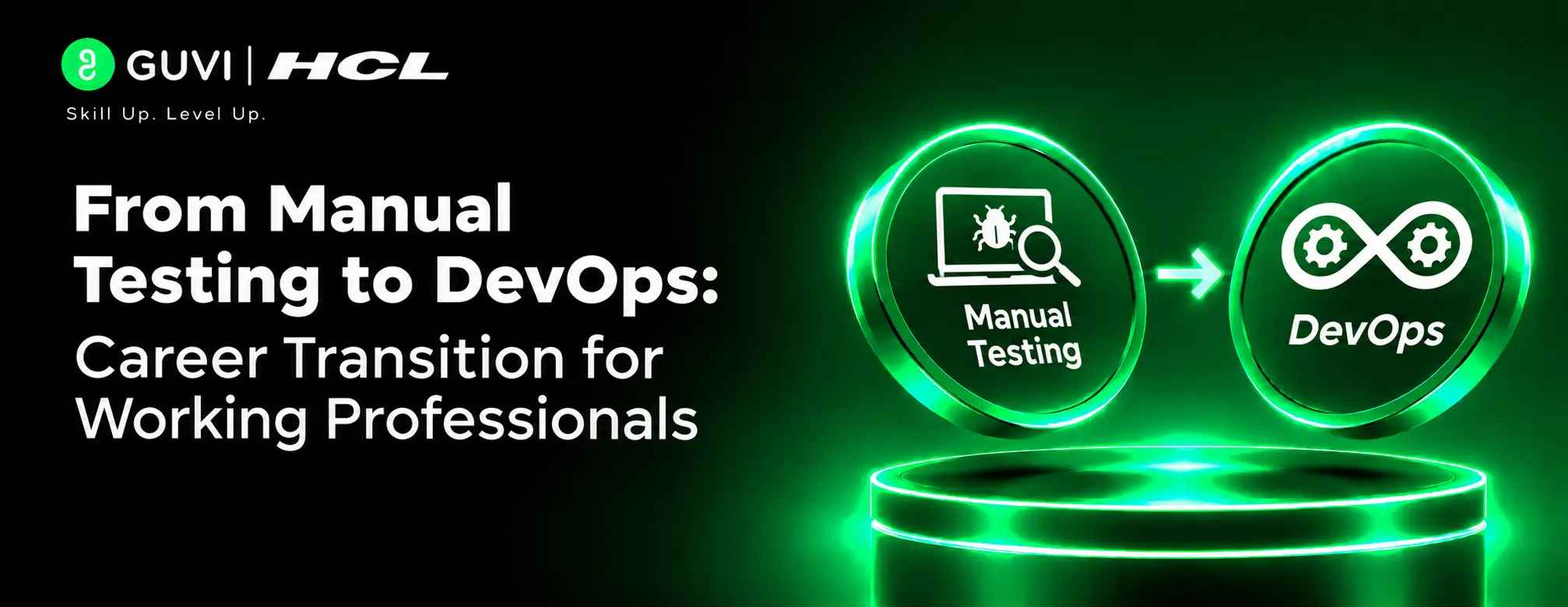
From Manual Testing to DevOps: Career Transition for Working Professionals
Nov 11, 2026 3 Min Read 5 Views
(Last Updated)
Manual testing professionals play an important role in software development by identifying defects, validating application behaviour, and ensuring product quality. Their experience with test cases, bug reporting, and release validation provides a useful foundation for moving into DevOps engineering.
Table of contents
- TL;DR
- Quick Answer
- Understand How Manual Testing Connects to DevOps
- Identify Your Transferable Skills
- Understand the Change in Responsibilities
- Build the Technical Foundation
- Learn Linux and Command-Line Basics
- Develop Basic Programming and Scripting Skills
- Understand Git and Networking
- Learn Cloud Computing and DevOps Tools
- Choose a Cloud Platform
- Understand CI/CD Pipelines
- Learn Containerisation
- Build Practical DevOps Experience
- Create an Automated Testing and Deployment Project
- Apply Automation in Your Current Role
- Plan Your Transition as a Working Professional
- Follow a Consistent Learning Schedule
- Update Your Resume and Explore Relevant Roles
- Conclusion
- Frequently Asked Questions
- Can a manual tester become a DevOps Engineer?
- Is coding required to move from manual testing to DevOps?
- Which DevOps tools should manual testers learn first?
- Is automation testing necessary before learning DevOps?
- Can working professionals learn DevOps while keeping their current jobs?
- Which cloud certification is useful for aspiring DevOps Engineers?
- What challenges do manual testers face when moving to DevOps?
TL;DR
- Manual testing experience provides a foundation in software quality and release validation.
- Learn Linux, scripting, Git, networking, and cloud fundamentals.
- Develop skills in CI/CD, Docker, Kubernetes, and Infrastructure as Code.
- Build practical automation and deployment projects.
- Use existing workplace experience to prepare for DevOps opportunities.
Quick Answer
| Manual testing professionals can transition into DevOps by learning scripting, cloud computing, version control, containerisation, and CI/CD tools. Their understanding of software testing and defect management can help them contribute to automated testing and deployment workflows. |
Understand How Manual Testing Connects to DevOps
1. Identify Your Transferable Skills
Manual testing involves more than executing test cases. Professionals develop an understanding of application behaviour, software requirements, and release quality.
Your existing experience may include:
- Creating and executing test cases.
- Identifying, documenting, and tracking defects.
- Performing regression and functional testing.
- Validating application releases.
- Collaborating with developers and product teams.
2. Understand the Change in Responsibilities
- Manual testers primarily evaluate application functionality and report defects. DevOps Engineers work across the software delivery lifecycle, connecting development, testing, deployment, and operations.
- The transition requires moving beyond manually validating individual features towards understanding how applications are built, packaged, deployed, and maintained.
Build the Technical Foundation
1. Learn Linux and Command-Line Basics
Linux is widely used in cloud environments, application hosting, and DevOps infrastructure. Begin with fundamental administrative operations:
- Navigating directories and managing files.
- Understanding users and permissions.
- Managing processes and services.
- Installing software packages.
- Reading logs and identifying errors.
Practise these commands in a virtual machine or Linux environment. Understanding the command line will make it easier to work with deployment servers and automation tools.
2. Develop Basic Programming and Scripting Skills
You do not need to become a full-time software developer, but scripting is important for automating repetitive tasks.
Start with Python or Bash. Focus on:
- Variables, conditions, and loops.
- Functions and basic error handling.
- Reading and writing files.
- Working with APIs.
- Executing system commands.
For practice, write a small script that reads test results, checks application availability, or generates a report from sample data.
3. Understand Git and Networking
Git helps teams maintain code, track modifications, and collaborate on shared projects. Learn how to create repositories, commit changes, manage branches, and resolve conflicts.
Also revise networking concepts such as:
- IP addresses and DNS.
- TCP/IP communication.
- HTTP and HTTPS.
- SSH connections.
- Ports, firewalls, and load balancing.
These fundamentals help explain how applications communicate with servers and external services.
Learn Cloud Computing and DevOps Tools
1. Choose a Cloud Platform
Select one cloud provider initially: AWS, Microsoft Azure, or Google Cloud.
Learn its core services:
- Compute: Virtual machines and processing resources.
- Storage: Cloud-based object and file storage.
- Networking: Virtual networks, subnets, and routing.
- Security: Identity management and access permissions.
- Monitoring: Resource utilisation and service availability.
2. Understand CI/CD Pipelines
Continuous Integration and Continuous Delivery (CI/CD) automate the process of integrating code changes, running tests, and deploying applications.
Explore Jenkins or GitHub Actions. Understand how a pipeline can:
- Retrieve source code from a repository.
- Build the application.
- Execute automated tests.
- Generate deployment packages.
- Release the application to a target environment.
3. Learn Containerisation
Docker packages applications and their dependencies into containers, helping maintain consistency across development, testing, and production environments.
Start by learning how to:
- Create a Dockerfile.
- Build and manage container images.
- Run and stop containers.
- Configure application ports.
- View container logs.
Ready to move beyond traditional IT roles? HCL GUVI’s AI Cloud Computing & DevOps Programme helps you develop practical cloud and DevOps skills through expert-led learning, real-world projects and career preparation.
Build Practical DevOps Experience
1. Create an Automated Testing and Deployment Project
Build an end-to-end project that connects your testing knowledge with DevOps practices.
Include:
- Source code stored in GitHub.
- Automated tests for application functionality.
- Docker-based application packaging.
- Deployment to a test environment.
- Basic health checks.
- Pipeline failure notifications or logs.
Document the test scenarios, pipeline stages, deployment process, and troubleshooting steps. This project demonstrates how software quality checks can become part of an automated release workflow.

2. Apply Automation in Your Current Role
- Look for opportunities to improve repetitive testing activities. For example, you could identify frequently executed regression test cases that are suitable for automation.
- Work with developers or automation engineers to understand how test scripts are integrated into existing pipelines. This experience can help you connect your current responsibilities with DevOps workflows.
Testing is an important part of CI/CD because automated checks can identify defects before an application is deployed. This makes manual testing experience relevant when designing reliable software delivery workflows.
Plan Your Transition as a Working Professional
1. Follow a Consistent Learning Schedule
Balancing a full-time job with technical learning requires realistic planning. Avoid trying to master every DevOps tool simultaneously.
A practical sequence is:
- First stage: Linux, networking, Git, and scripting.
- Second stage: Cloud fundamentals and Docker.
- Third stage: CI/CD, Terraform, and Ansible.
- Final stage: Kubernetes fundamentals and project implementation.
Adjust the pace according to your existing knowledge and available study time.
2. Update Your Resume and Explore Relevant Roles
- Highlight your manual testing experience alongside newly developed technical skills in your resume clearly.
- Include practical contributions involving test execution, defect investigation, release validation, scripting, and automated pipelines. Add links to completed projects and mention certifications where relevant.
Conclusion
Moving from manual testing to DevOps requires expanding your understanding of software quality into automation, infrastructure, and application delivery. Build on your existing testing experience, learn essential technologies progressively, and practise through an end-to-end project.
For working professionals, consistent learning and opportunities to participate in automated workflows can make the transition more manageable.
Frequently Asked Questions
1. Can a manual tester become a DevOps Engineer?
Yes. Manual testers can transition by learning Linux, scripting, cloud platforms, CI/CD, containers, and infrastructure automation. Their testing experience provides useful knowledge of software quality.
2. Is coding required to move from manual testing to DevOps?
Basic programming and scripting are important. Python and Bash are useful starting points for automating tasks and working with deployment environments.
3. Which DevOps tools should manual testers learn first?
Start with Git, Linux, Python or Bash, Docker, and one CI/CD platform. Progress to Terraform, Ansible, cloud services, and Kubernetes.
4. Is automation testing necessary before learning DevOps?
No. You can learn DevOps without first becoming an automation tester. However, understanding automated testing concepts will help you work with CI/CD pipelines.
5. Can working professionals learn DevOps while keeping their current jobs?
Yes. Follow a realistic study schedule, practise consistently, and prioritise tools based on your career goals. Building one complete project is more useful than learning many technologies superficially.
6. Which cloud certification is useful for aspiring DevOps Engineers?
Choose a certification aligned with your preferred platform, such as AWS, Microsoft Azure, or Google Cloud. Check the current certification requirements before enrolling.
7. What challenges do manual testers face when moving to DevOps?
Manual testers may find scripting, cloud infrastructure, and CI/CD tools challenging initially. Hands-on practice and structured learning can help them develop the technical skills needed for the transition.
Success Stories

About the Author
HCL GUVI
This article was selected and published as part of the HCL GUVI AI Blogathon 2026, an initiative designed to encourage students, AI enthusiasts, and aspiring tech writers to simplify complex AI concepts through impactful technical content. The contest recognized high-quality, original, and insightful AI-focused blogs, with selected authors receiving publication opportunities on the HCL GUVI blog platform along with official author credits and recognition.
View all posts by HCL GUVI
Connect with me @




















Did you enjoy this article?