


DevOps Articles
From Manual Testing to DevOps: Career Transition for Working Professionals
How Network Administrators Can Transition into DevOps Engineering
Is DevOps Training a Good Investment for Experienced IT Professionals?

Get In Touch For Details! Request More Information
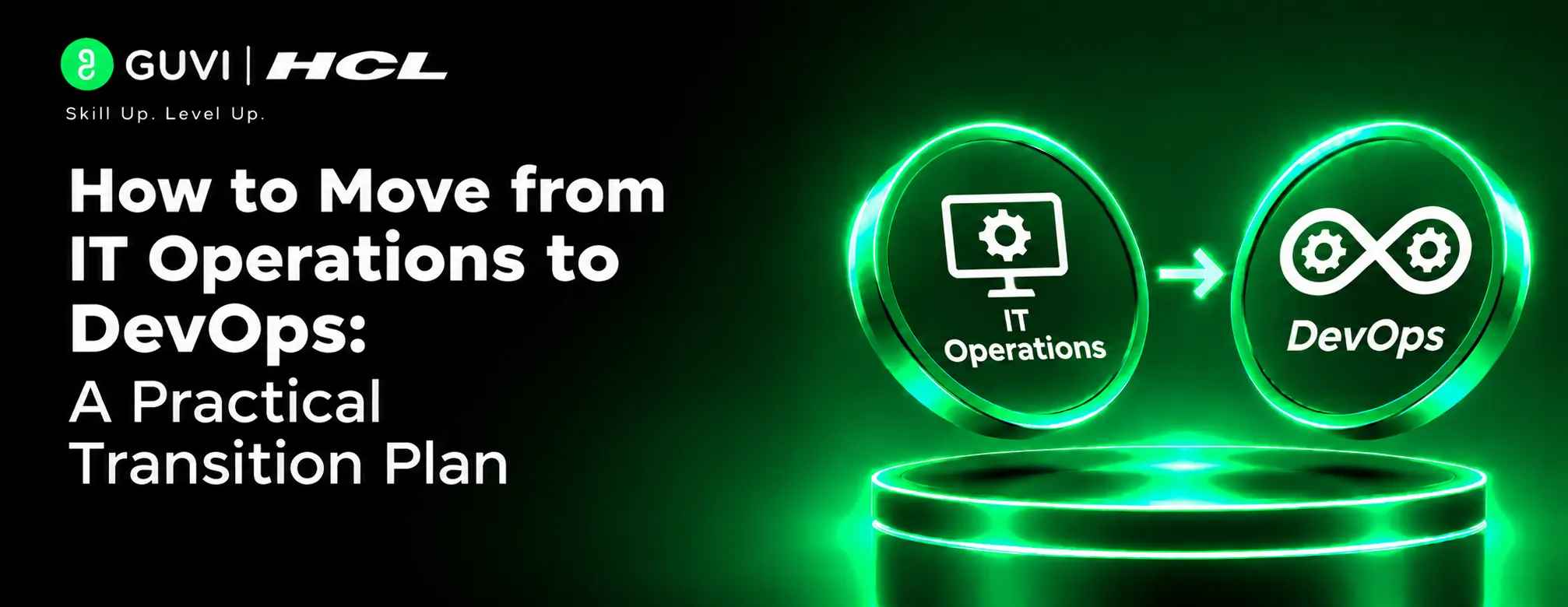
How to Move from IT Operations to DevOps: A Practical Transition Plan
Nov 11, 2026 3 Min Read 9 Views
(Last Updated)
IT Operations professionals already understand the systems, infrastructure, and processes that keep business applications running. Their experience with system administration, incident management, and performance monitoring provides a useful foundation for moving into DevOps engineering.
However, DevOps introduces a different approach to managing IT environments. Moving into this field requires a structured learning plan, practical implementation, and an understanding of modern engineering tools.
Table of contents
- TL;DR
- Quick Answer
- Understand the Shift from IT Operations to DevOps
- Identify Your Existing Technical Experience
- Understand What Changes in DevOps
- Build the Essential Technical Foundation
- Strengthen Linux and Scripting Skills
- Learn Git and Version Control
- Develop Cloud and Automation Knowledge
- Choose a Cloud Computing Platform
- Understand Infrastructure as Code
- Learn Modern Software Delivery Practices
- Understand CI/CD Pipelines
- Work with Containers and Orchestration
- Prepare for DevOps Job Opportunities
- Build a Relevant Technical Portfolio
- Update Your Resume and Apply Strategically
- Conclusion
- Frequently Asked Questions
- Can an IT Operations professional become a DevOps Engineer?
- Which skills should IT Operations professionals learn first?
- Is programming mandatory for a DevOps career?
- Which cloud platform is best for learning DevOps?
- How important is Kubernetes for beginners?
- Can IT Operations experience help during DevOps interviews?
- How long does it take to transition from IT Operations to DevOps?
TL;DR
- Build on your existing IT Operations and infrastructure experience.
- Develop skills in Linux, scripting, Git, and cloud computing.
- Learn CI/CD, containers, and Infrastructure as Code.
- Practise automation through hands-on projects.
- Gain practical exposure and prepare for DevOps opportunities.
Quick Answer
| IT Operations professionals can transition into DevOps by expanding their infrastructure knowledge into scripting, cloud platforms, automation, containerisation, and CI/CD. Start by identifying transferable skills, then learn essential technologies and practise using them in real-world scenarios. |
Understand the Shift from IT Operations to DevOps
1. Identify Your Existing Technical Experience
IT Operations involves maintaining the availability, performance, and reliability of business systems. Depending on your current responsibilities, you may already have experience with:
- Server administration and maintenance.
- Incident and problem management.
- System performance monitoring.
- Backup and recovery procedures.
- Access management and security controls.
- Infrastructure troubleshooting.
2. Understand What Changes in DevOps
DevOps extends traditional operational responsibilities by introducing automation throughout the software delivery lifecycle.
The transition involves learning to:
- Automate repetitive infrastructure tasks.
- Integrate development and operational workflows.
- Manage application releases through pipelines.
- Provision infrastructure using configuration files.
- Monitor applications after deployment.
Build the Essential Technical Foundation
1. Strengthen Linux and Scripting Skills
Linux administration is an important foundation for working with cloud servers, containers, and deployment environments.
Focus on learning:
- Command-line navigation and file management.
- Process and service administration.
- User permissions and access controls.
- Package installation and updates.
- System logs and resource utilisation.
2. Learn Git and Version Control
DevOps teams use version control to track modifications, collaborate on projects, and maintain configuration history.
Start with Git fundamentals:
- Creating and cloning repositories.
- Committing and pushing changes.
- Creating and merging branches.
- Reviewing code modifications.
- Resolving merge conflicts.
Develop Cloud and Automation Knowledge
1. Choose a Cloud Computing Platform
Cloud platforms provide computing, networking, storage, and security services that support modern application environments.
Choose one platform initially:
- AWS: Explore EC2, S3, IAM, and VPC.
- Microsoft Azure: Understand Virtual Machines, Storage Accounts, and Virtual Networks.
- Google Cloud: Practise Compute Engine, Cloud Storage, and Virtual Private Cloud.
Create a small test environment and practise launching virtual machines, configuring access, and managing resources. Understanding these services will help you move from maintaining traditional infrastructure to managing cloud-based environments.
2. Understand Infrastructure as Code
- Infrastructure as Code (IaC) allows engineers to define infrastructure through reusable configuration files.
- Learn Terraform to understand how cloud resources can be provisioned and updated systematically. Practise creating virtual machines, networks, and security configurations.
- Also explore Ansible for configuration management. It helps automate software installation, service configuration, and administrative tasks across multiple systems.
DevOps practices can improve operational consistency by using version-controlled infrastructure configurations and automated deployment pipelines. This allows teams to track changes, reproduce environments, and identify problems more systematically.
Learn Modern Software Delivery Practices
1. Understand CI/CD Pipelines
Continuous Integration and Continuous Delivery automate different stages of software development and release management.

Learn how Jenkins or GitHub Actions can:
- Retrieve application code from a repository.
- Run automated tests.
- Build application packages.
- Deploy approved changes.
- Report pipeline failures.
2. Work with Containers and Orchestration
- Docker packages applications and their dependencies into portable containers. This reduces inconsistencies between development, testing, and production environments.
- Practise creating Dockerfiles, building images, managing containers, and configuring application ports.
- After learning the fundamentals, explore Kubernetes. It helps manage containerised workloads through deployment management, scaling, and service discovery.
Ready to move beyond traditional IT roles? HCL GUVI’s AI Cloud Computing & DevOps Programme helps you develop practical cloud and DevOps skills through expert-led learning, real-world projects and career preparation.
Prepare for DevOps Job Opportunities
1. Build a Relevant Technical Portfolio
Maintain a GitHub repository containing your completed projects, scripts, and configuration files.
Each project should explain:
- The problem being addressed.
- The technologies used.
- The implementation process.
- The final outcome.
- Challenges encountered and their solutions.
Avoid uploading sensitive company information or credentials. Use sample configurations and test environments instead.
2. Update Your Resume and Apply Strategically
Present your IT Operations experience through specific technical contributions. Highlight infrastructure management, incident resolution, monitoring, scripting, and automation wherever applicable.
Include relevant certifications and practical projects in your resume, but distinguish between technologies you have studied and those you have implemented.
Consider applying for positions such as:
- Junior DevOps Engineer.
- Cloud Operations Engineer.
- Infrastructure Automation Engineer.
- Site Reliability Engineering Associate.
- Build and Release Engineer.
Conclusion
Moving from IT Operations to DevOps is a practical career progression for professionals willing to expand their technical responsibilities. Build on your infrastructure experience, develop automation skills, and understand how applications move from development to production. Most importantly, demonstrate your knowledge through working projects rather than relying exclusively on certifications or theoretical learning.
Frequently Asked Questions
1. Can an IT Operations professional become a DevOps Engineer?
Yes. Professionals with experience in system administration, infrastructure monitoring, and incident management can transition by learning scripting, cloud computing, CI/CD, and automation tools.
2. Which skills should IT Operations professionals learn first?
Start with Linux, Python or Bash, Git, and networking fundamentals. Then progress to cloud platforms, Docker, Terraform, and CI/CD tools.
3. Is programming mandatory for a DevOps career?
Basic programming and scripting knowledge is important. Python and Bash are particularly useful for automating infrastructure tasks and managing operational workflows.
4. Which cloud platform is best for learning DevOps?
AWS, Microsoft Azure, and Google Cloud are suitable options. Choose one based on your learning objectives and the requirements of your target job roles.
5. How important is Kubernetes for beginners?
Kubernetes is valuable for managing containerised applications, but beginners should understand Docker and basic container networking first. You can learn orchestration concepts once those fundamentals are clear.
6. Can IT Operations experience help during DevOps interviews?
Yes. Examples involving incident resolution, infrastructure troubleshooting, system monitoring, and automation can demonstrate relevant operational knowledge. Practical project experience strengthens these examples.
7. How long does it take to transition from IT Operations to DevOps?
There is no fixed timeline. It depends on your existing technical knowledge, learning schedule, and opportunities to practise. Consistent learning and completed projects can help you become prepared for suitable entry-level positions.
Success Stories

About the Author
HCL GUVI
This article was selected and published as part of the HCL GUVI AI Blogathon 2026, an initiative designed to encourage students, AI enthusiasts, and aspiring tech writers to simplify complex AI concepts through impactful technical content. The contest recognized high-quality, original, and insightful AI-focused blogs, with selected authors receiving publication opportunities on the HCL GUVI blog platform along with official author credits and recognition.
View all posts by HCL GUVI
Connect with me @




















Did you enjoy this article?