


Artificial Intelligence and Machine Learning Articles
How to Audit LLM Models for Backdoors: Tools & Frameworks for Developers
AI Governance & Compliance in Web Apps: Why You Can’t Ignore Data Risk When Using LLMs
How to Evaluate LLMs for Production: Beyond Benchmarks (A Developer’s Guide)


Get In Touch For Details! Request More Information

Is the Machine Learning Market Saturated? A Reality Check for 2026
Feb 06, 2026 6 Min Read 3142 Views
(Last Updated)
Is the machine learning market finally reaching a breaking point, or is the talk about saturation just another misconception? Thousands of learner in training programs each year entering into the ML and businesses installing and implementing various forms of Artificial Intelligence and Generative Artificial Intelligence (AI/ GenAI) make it difficult for those considering careers in this shift to realistically figure out what their career potential may look like in 2026.
This blog gives a clear explanation on is machine learning market saturated reality check for 2026 by analysing ML jobs 2026 reality check, AI job market 2026, ML engineer demand in 2026, and the broader future of machine learning jobs.
Let’s break down what you can actually expect in the coming year.
Quick answer:
No, the machine learning market is not saturated in 2026. ML jobs are still growing, but competition is tougher. Companies now prefer engineers who know ML + GenAI, MLOps, and domain skills. Skilled, practical candidates have strong opportunities, while theory-only learners may struggle.
Table of contents
- Why People Think the ML Market Is Saturated
- 2026 Reality Check: Is the Machine Learning Market Saturated?
- ML Engineer Demand in 2026
- AI Job Market 2026 – Key Trends
- ML + GenAI Is the New Standard
- MLOps Skills Are Becoming Mandatory
- Domain Knowledge Matters More
- More Startups → More ML Jobs
- Machine Learning Career Scope
- ML Salary in 2026
- Approx salary ranges (India):
- ML vs GenAI Job Demand: Who Wins in 2026?
- What this means for jobs in 2026
- Why ML Still Offers Strong Career Growth in 2026?
- Every industry needs predictive intelligence
- AI depends on ML
- ML models require continuous improvement
- Shortage of real skilled professionals
- Where ML Job Competition Is High
- Machine learning job advice for 2026
- Learn ML + GenAI Together
- Build End-to-End Projects
- Learn MLOps (at least basics)
- Strengthen Data Engineering Skills
- Build a Strong Portfolio
- Apply to the Right Roles
- ML Jobs 2026: Final Reality Check
- Wrapping up:
- FAQs
- Will the machine learning market be saturated in 2026?
- Will ML engineers remain in demand in 2026?
- Will GenAI replace machine learning jobs?
- What is the reason why most of the people find it difficult to secure ML jobs?
Why People Think the ML Market Is Saturated
The reasons why this suspicion has become so popular are few:
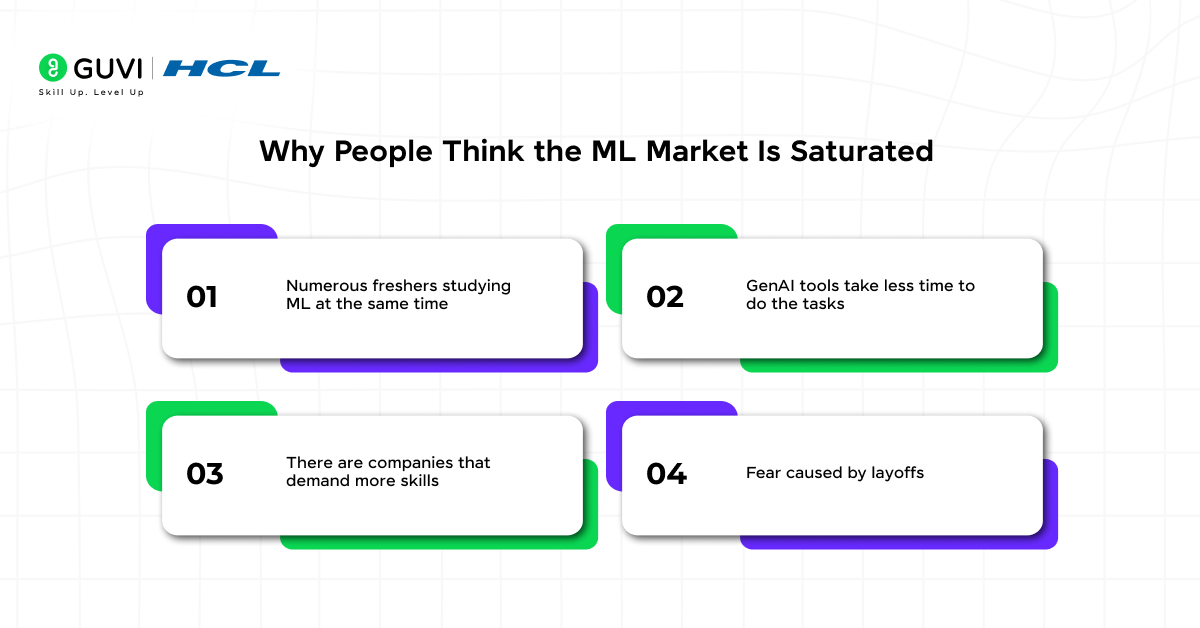
1. Numerous freshers studying ML at the same time
Online courses for ML have become very accessible. Millions of learners nowadays finish ML basics every year, and this generates the fear of ML job competition.
2. GenAI tools take less time to do the tasks
Generative AI (such as GPT and other LLMs) can produce ML code, search datasets and even produce models. This made people ask:
Is AI replacing ML jobs?
The short response: AI is not taking over whole jobs; it is automating part of them.
3. Some companies demand more skills
Businesses do not want pure theory-based ML knowledge anymore. They want useful skills such as:
- MLOps
- Cloud deployment
- Real-world data handling
- Domain understanding
This change has left a gap between what the learners know and what the companies demand.
4. Fear caused by layoffs
The most recent layoffs in Big Tech were panic-inducing despite the fact that the hiring in the field of ML and AI is still increasing in other industries such as healthcare, finance, logistics, cybersecurity, and manufacturing.
So… is machine learning actually saturated?
Let’s look at the facts.
2026 Reality Check: Is the Machine Learning Market Saturated?
The truth: ML is not saturated, but the hiring landscape has changed.
Several individuals believe that the market of ML is saturated due to the high number of freshers who learn ML simultaneously. But companies are not seeking basic ML; they are seeking realistic, production-ready competencies in ML.
In 2026, the demand has not reduced. Rather, the requirements have shifted. The companies have required ML engineers to know:
- Real-world datasets
- ML pipelines
- Cloud platforms
- Deployments
- MLOps
- GenAI and LLM integration
This is the reason why beginners believe that there is no room left in the market, while skilled ML engineers still get plenty of opportunities.
The other significant transformation is the emergence of GenAI. GenAI has not eliminated ML jobs but instead, it has generated new hybrid positions such as:
- ML + GenAI Engineer
- AI Engineer
- MLOps Engineer
- LLM Developer
These positions were not in existence earlier, and that is, the employment market has not been shrinking; on the contrary, it is growing.
So what is saturated?
- Basic ML knowledge
- Theory-only learners
- Small notebook projects
- Individuals with familiarity only with Python + scikit-learn.
What is not saturated?
- ML with cloud + deployment
- ML with GenAI
- ML with domain knowledge
- ML engineering at the production level.
Also read: How to Choose the Right Machine Learning Algorithm?
In simple words:
The competitive environment in the ML field in 2026 is not oversaturated.
Candidates who graduate beyond beginner-level ML still have strong opportunities.

ML Engineer Demand in 2026
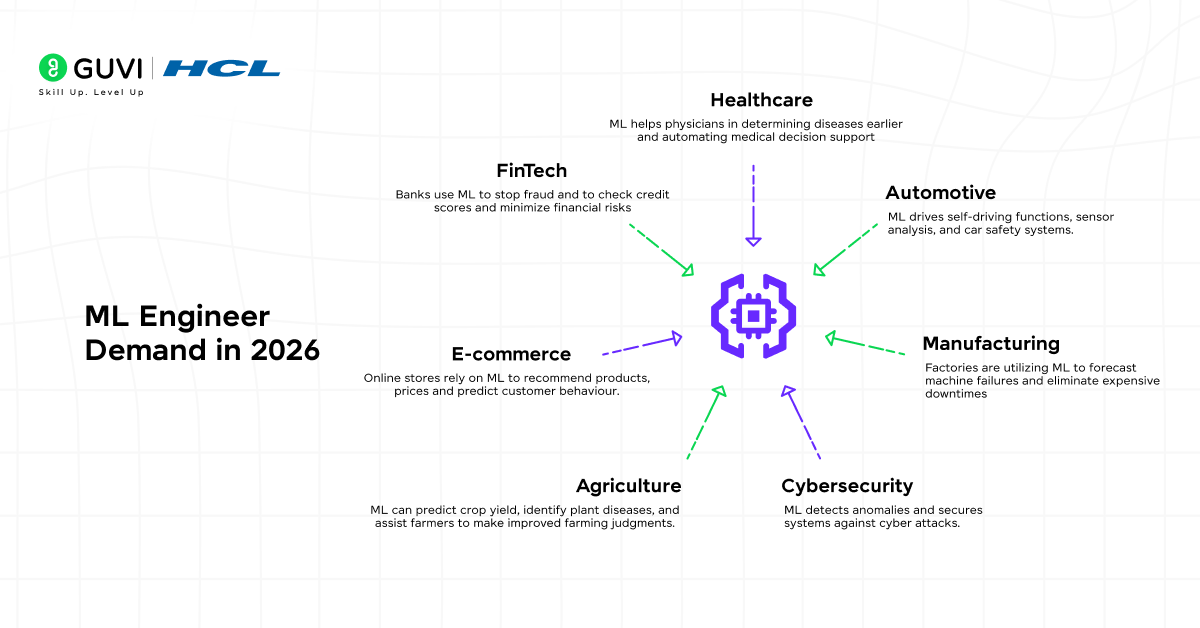
- Healthcare – ML helps physicians in determining diseases earlier and automating medical decision support.
- FinTech – Banks use ML to stop fraud, to check credit scores, and minimise financial risks.
- E-commerce – Online stores rely on ML to recommend products, prices, and predict customer behaviour.
- Agriculture – ML can predict crop yield, identify plant diseases, and assist farmers in making improved farming judgments.
- Cybersecurity – ML detects anomalies and secures systems against cyber attacks.
- Manufacturing– Factories are utilising ML to forecast machine failures and eliminate expensive downtimes.
- Automotive – ML drives self-driving functions, sensor analysis, and car safety systems.
Also read: Complete Machine Learning Syllabus: Roadmap with Resources
AI Job Market 2026 – Key Trends
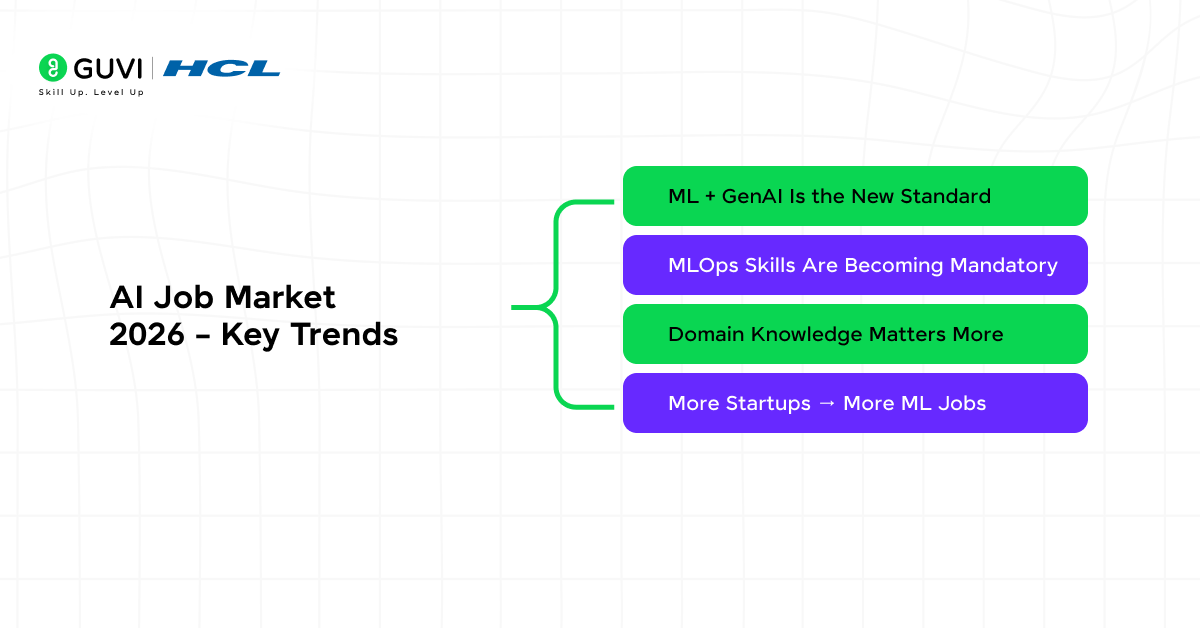
1. ML + GenAI Is the New Standard
- ML engineers are now expected to know GenAI, LLMs, prompt engineering, multimodal models, and RAG.
- This shift is creating hybrid roles like AI Engineer, GenAI Specialist, and LLM Developer.
2. MLOps Skills Are Becoming Mandatory
- Businesses want models that work in the production line, and not experiments.
- Such skills as CI/CD, Kubernetes, model monitoring, and automated retraining are required.
3. Domain Knowledge Matters More
- ML alone is not sufficient; engineers have to be aware of industry-specific issues.
- Example: ML in healthcare needs to know about patient data; ML in FinTech needs to know about compliance and risk knowledge.
4. More Startups → More ML Jobs
- Thousands of ML jobs are being generated across the world because of the rise of AI startups.
- ML engineers are favoured by startups because they are able to work end-to-end on data to deployment.
Also read: Top 65+ Machine Learning Interview Questions and Answers
Machine Learning Career Scope
ML has a good and growing career base despite the rumours.
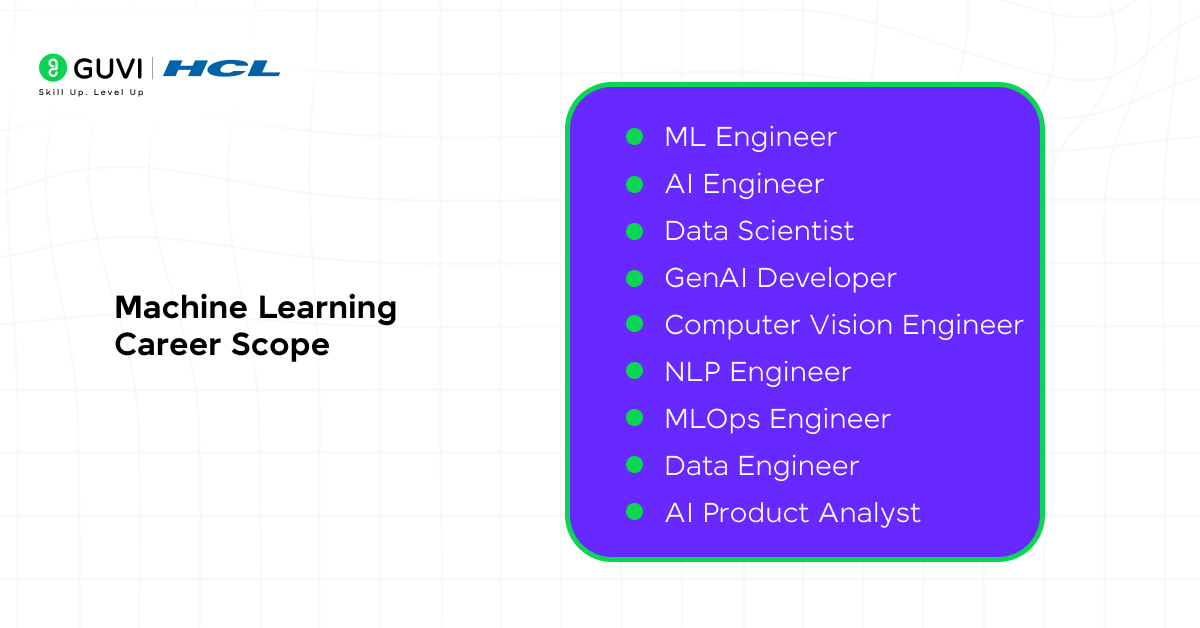
Popular ML roles in 2026:
- ML Engineer
- AI Engineer
- Data Scientist
- GenAI Developer
- Computer Vision Engineer
- NLP Engineer
- MLOps Engineer
- Data Engineer
- AI Product Analyst
Such diversity indicates that the number of ML jobs has not yet fallen.
ML Salary in 2026
Salaries continue to rise because skilled ML talent is still limited.
Approx salary ranges (India):
- Entry-level ML Engineer: ₹6 –12 LPA
- Mid-level ML Engineer: ₹12 – 25 LPA
- Senior ML Engineer: ₹25 – 50+ LPA
- MLOps Engineer: ₹20 – 40 LPA
- AI/GenAI Specialist: ₹18 – 45 LPA
For more clear information you can refer to Glassdoor or AmbitionBox for the salary updation.
ML vs GenAI Job Demand: Who Wins in 2026?
One of the most widespread questions of learners is:
“Will GenAI replace ML jobs?”
The answer to this question is: No, GenAI will not displace ML engineers.
However, it will replace engineers who just have theoretical knowledge and cannot deal with actual production systems.
GenAI tools automate certain functions, such as rapid prototyping, code snippets, or data summaries.
Nevertheless, they are not capable of substituting the more sophisticated capabilities to develop trustworthy ML solutions.
Also read: Must-Have Machine Learning Skills in 2026
The reasons why GenAI is not able to substitute ML engineers
So this includes several tasks that cannot be performed by machines yet:
- Model understanding: Understanding how and why a model can act in a particular manner and how to do it better.
- Troubleshooting: Detection of bugs, data problems and failure of pipelines.
- Deployment: Installation of APIs, scaling models, and ensuring production infrastructure.
- Ethical consideration: Fairness, privacy and safety in AI systems.
- Business fit: Understanding how AI will be used in the revenue, cost savings, or customer value.
- Data engineering: Dusting, manipulating, and controlling real-world data.
GenAI can assist in these activities, but not be entirely accountable for them.
What this means for jobs in 2026
Rather than substituting each other, it is likely that the number of ML and GenAI jobs will increase as companies require:
- ML engineers who understand traditional algorithms.
- Experts of GenAI who interact with LLMs and multimodal models.
- Engineers who can use both skills to create smarter solutions are considered to be hybrid.
Therefore, engineers who are knowledgeable in ML fundamentals + GenAI workflows will be the true winners in 2026 and not either of those two.
Why ML Still Offers Strong Career Growth in 2026?
Many students fear that with the rise of GenAI, the demand for ML engineers will decrease.
However, in reality, ML remains one of the finest and safest long-term career options.
Here’s why:
1. Every industry needs predictive intelligence
Machine Learning is behind nearly all the data-driven decisions in contemporary businesses.
Companies use ML for:
- demand forecasting
- fraud detection
- customer personalization
- risk scoring
- Repetitive tasks can be automated.
- real-time analytics
Such applications cannot be replaced by GenAI, and every industry, such as finance, health, e-commerce, agriculture, and logistics rely on these uses.
Also read: How to Become a Machine Learning Architect in 2026?
2. AI depends on ML
GenAI was not an alternative to ML, but it was based on it.
All Large Language Models (LLMs), vision models and speech models are based on the following principles of ML:
- probability
- optimization
- neural networks
- unsupervised learning and supervised learning.
It is impossible to work with GenAI without the basic knowledge of ML.
That is why employers prefer to hire engineers with knowledge of ML fundamentals + GenAI processes.
3. ML models require continuous improvement
Machine Learning is not something that you can create and forget.
Real-world models need:
- retraining
- tuning
- updating with new data
- monitoring performance
- fixing data drift and bias
Due to this reason, businesses require advanced ML engineers to maintain the software in the long term which cannot be automated entirely by GenAI.
Also read: Top 6 Machine Learning Classification Algorithms You Must Know
4. Shortage of real skilled professionals
Though millions of individuals learn ML, only a minor percentage of them can be called employment-ready.
The majority of learners stop at theory, basic Python, or small projects.
Companies, however, need engineers who can handle:
- real datasets
- deployment
- MLOps
- model evaluation
- business problem-solving
This talent gap means companies are still hiring aggressively for ML roles in 2026.
Where ML Job Competition Is High
Machine Learning has gained popularity to the extent that there are a large number of freshers joining the industry each year.
Most of them, however, follow the same pattern of learning to cause very high competition in some regions.
Who faces the most competition?
- Who faces the most competition?
These learners solve Kaggle problems but don’t know how to handle messy, real-world business data.
- People who know only theory
They only know algorithms on paper, but they cannot apply them in the manufacturing sector.
- Students who have no project experience in the real world
Their projects are purely academic or YouTube-based projects , which are not aligned with the real company needs.
- Those who skip deployment skills
They can train models, but they can’t deploy them as APIs, integrate them with apps, or maintain them.
The reason why the competition is high with this group
If someone learns only the basics, like:
- linear regression
- logistic regression
- basic CNNs
- a few small datasets
- easy Jupyter Notebook applications.
…then they look exactly like thousands of other learners.
This means everyone has the same skill level, so companies find it hard to identify who is actually job-ready.
That is why the competition becomes extremely high in this basic category.
Machine learning job advice for 2026
To get a job in 2026, you need to upgrade in the right direction
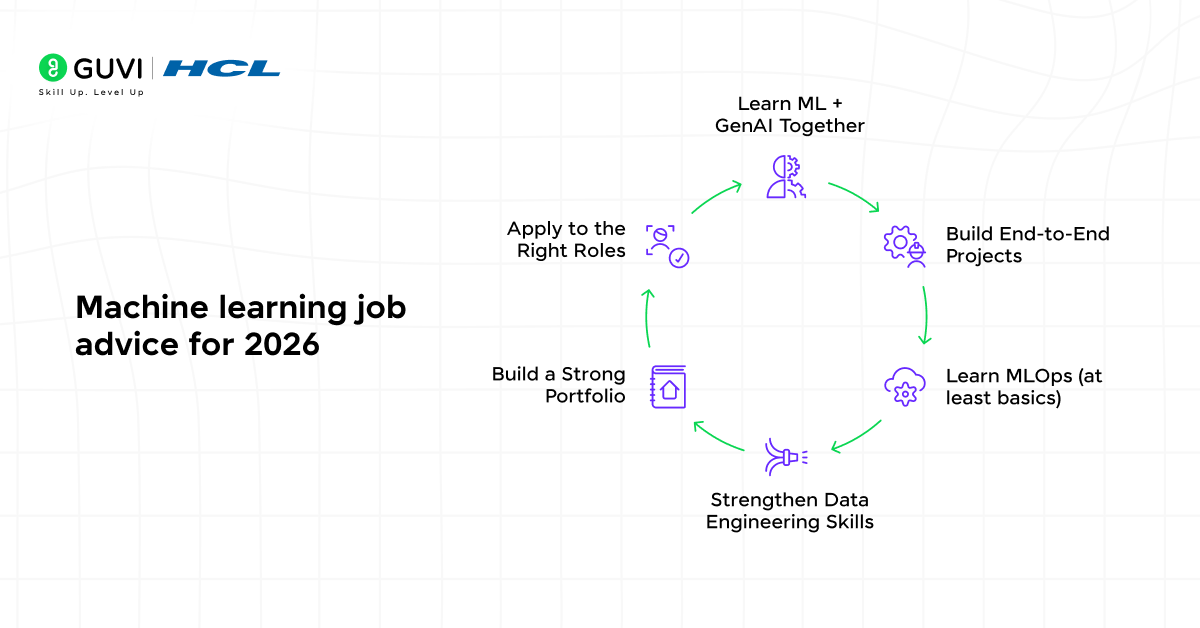
1. Learn ML + GenAI Together
Top skills:
- LLM basics
- GPT-style models
- embeddings
- fine-tuning
- vector databases
- RAG pipelines
2. Build End-to-End Projects
Your projects must include:
- data cleaning
- model building
- evaluation
- deployment (FastAPI/Streamlit)
- Docker
- cloud hosting
3. Learn MLOps (at least basics)
Understand:
- CI/CD
- ML pipelines
- monitoring
- logging tools
This automatically increases employability.
4. Strengthen Data Engineering Skills
ML engineers MUST know:
- SQL
- ETL
- Airflow
- data modeling
- real-time pipelines
5. Build a Strong Portfolio
Show recruiters:
- GitHub
- case studies
- Kaggle contributions
- deployed apps
- LinkedIn presence
This is your personal brand.
6. Apply to the Right Roles
Rather than just applying to a position of Data Scientist, target:
- ML Engineer
- AI Engineer
- MLOps Engineer
- GenAI Developer
- Data Engineer
- AI Research Associate
The roles are expanding at a higher rate.
ML Jobs 2026: Final Reality Check
| Area | Status (2026) |
| Basic ML | Saturated |
| Intermediate ML | Competitive |
| Advanced ML | High demand |
| ML + GenAI | Huge demand |
| ML + MLOps | Very high demand |
| ML salaries | Increasing |
| AI career growth 2026 | Strong |
| Future of ML jobs | Expanding |
Ready to become a smarter, future-ready developer? Strengthen your AI-assisted coding skills with HCL GUVI’s AI ML Course With Intel & IITM Pravartak Certification and learn how to build safe, efficient, and industry-level applications with confidence.
Wrapping up:
So what now: Should You Choose ML as a Career in 2026? The answer is you can, as Machine learning is one of the fastest-growing technologies and careers, there is zero reason not to choose ML. If you continuously upskill with ML + GenAI + MLOps + deployment, your career will be future-proof. Hope this blog helped you know whether or not ML is saturated.
FAQs
1. Will the machine learning market be saturated in 2026?
No. The ML market is not overcrowded, whereas the beginner level is.
2. Will ML engineers remain in demand in 2026?
Yes. The demand among MLEs is increasing because firms require predictive models, automation, personalization, risk analysis and optimization systems.
3. Will GenAI replace machine learning jobs?
No. GenAI does not substitute entire ML jobs but only basic tasks.Engineers with the knowledge of both GenAI and traditional ML are going to be very useful.
4. What is the reason why most of the people find it difficult to secure ML jobs?
Since the majority of learners end on theory, Kaggle-style projects, or simple Jupyter notebooks.Firms require engineers who can handle sloppy information and develop real-world systems that can be deployed.
Success Stories

About the Author
Vishalini Devarajan
An Aerospace Engineer turned content writer, I focus on making complex concepts easy to understand through well-structured, reader-friendly blogs. Whether it’s a technical topic or a non-technical one, I love creating content that is clear, engaging, and impactful.
View all posts by Vishalini Devarajan
Connect with me @












Did you enjoy this article?