


Artificial Intelligence and Machine Learning Articles
AI/ML Skills Gap 2026: Why Companies Can't Find Job-Ready Talent
20 AI/ML Interview Questions Recruiters Can Use Without a Tech Background - Best Guide
How Industry-Backed AI/ML Bootcamps Are Changing the AI/ML Hiring Pipeline - Best Guide 2026
From IT Support to AI Engineer: A Realistic Career Switch Guide 2026


Get In Touch For Details! Request More Information
Kubeflow vs MLflow: Choosing the Right Tool for Your Machine Learning Pipeline
Nov 18, 2025 6 Min Read 3055 Views
(Last Updated)
Ever wondered why some machine learning teams scale effortlessly while others struggle to manage their models? The answer often lies in the tools that power their MLOps pipelines and two of the most prominent contenders are Kubeflow and MLflow. Both platforms promise to streamline model development, deployment, and tracking, but they take very different paths to get there. Comprehending how they compare can help you choose the right foundation for your AI workflow.
Let’s break down the differences between Kubeflow vs. MLflow to see which one aligns best with your operational and scalability goals:
Table of contents
- What is Kubeflow?
- Core Components of Kubeflow
- Benefits of Kubeflow
- Seamless Integration with Kubernetes
- High Scalability Across Environments
- End-to-End Pipeline Automation
- Support for Multi-Tenancy and Collaboration
- Customizable Modular Architecture
- Top Applications of Kubeflow
- Large-Scale Deep Learning Model Training
- Edge AI Deployment and Management
- Federated Learning Workflows
- Continuous Integration and Delivery for ML (CI/CD for AI)
- AI-Driven Supply Chain Forecasting
- Top Companies Using Kubeflow
- What is MLflow?
- Core Components of MLflow
- MLflow Manual Tracking Example
- Benefits of MLflow
- Unified Experiment Management
- Framework-Agnostic Flexibility
- Efficient Model Versioning and Tracking
- Ease of Deployment Across Environments
- Collaborative Workflow Support
- Top Applications of MLflow
- Cross-Team Model Experimentation
- Regulatory and Compliance Reporting
- Multi-Model Deployment Pipelines
- Experiment Optimization with Auto-Logging
- Cloud-Native AI Lifecycle Management
- Top Companies Using MLflow
- Kubeflow vs MLflow: A Comprehensive Comparison
- Kubeflow: Expanding Toward Intelligent Orchestration
- MLflow: Reinventing Experimentation and Model Governance
- Conclusion
- FAQs
- Can Kubeflow and MLflow be used together for MLOps?
- Which is better for large-scale machine learning: Kubeflow or MLflow?
- Is MLflow easier to learn than Kubeflow?
What is Kubeflow?
Kubeflow is an open-source platform designed to simplify the deployment and management of machine learning models on Kubernetes. It builds a structured environment where data scientists and engineers can develop and scale AI workflows within containerized systems. The platform thrives in organizations handling complex, distributed workloads that demand precise resource control and scalability.
Core Components of Kubeflow
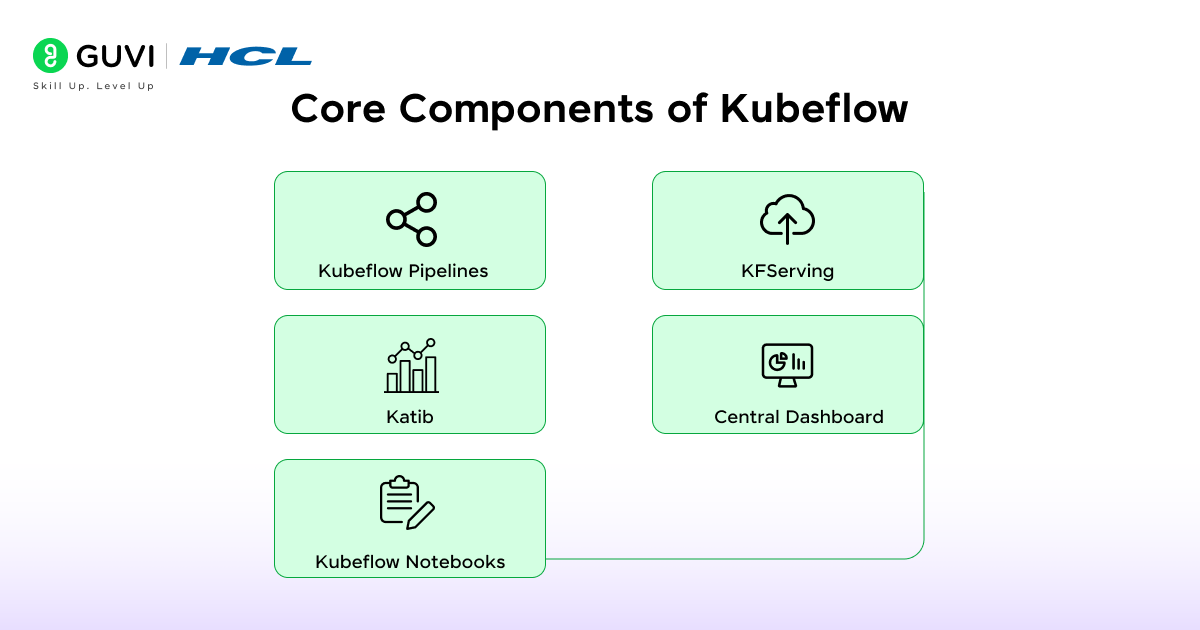
Kubeflow is structured around several modular components that work together to streamline machine learning operations. Each part contributes to building, deploying, and managing AI systems at scale:
- Kubeflow Pipelines: This component supports the creation and execution of end-to-end ML workflows. Teams can design, automate, and reuse pipeline steps, which promotes reproducibility across experiments.
- KFServing: KFServing deals with model serving on Kubernetes. It allows deployment of models as microservices while reinforcing scalability and resource efficiency through serverless architecture.
- Katib: Katib provides automated hyperparameter tuning and supports multiple optimization algorithms. It assists teams in improving model accuracy by experimenting systematically.
- Kubeflow Notebooks: Kubeflow integrates Jupyter notebooks directly within its environment. This connection allows data scientists to move smoothly from interactive experimentation to production-level workflows.
- Central Dashboard: The dashboard acts as a unified control interface. It offers visibility across components, simplifying navigation, resource allocation, and operational monitoring.
Kubeflow Pipelines SDK Example:
# Kubeflow Pipelines SDK
import kfp
from kfp import dsl

def preprocess_op(data_path):
    return dsl.ContainerOp(
        name='Preprocess Data',
        image='preprocess-image:latest',
        arguments=['--data_path', data_path]
    )

def train_op(data):
    return dsl.ContainerOp(
        name='Train Model',
        image='train-image:latest',
        arguments=['--data', data]
    )

@dsl.pipeline(
    name='My ML Pipeline',
    description='A sample ML pipeline'
)
def my_pipeline(data_path: str):
    preprocess_task = preprocess_op(data_path)
    train_task = train_op(preprocess_task.output)

# Compile and run the pipeline
kfp.compiler.Compiler().compile(my_pipeline, 'pipeline.yaml')
client = kfp.Client()
client.create_run_from_pipeline_func(my_pipeline, arguments={})
Benefits of Kubeflow
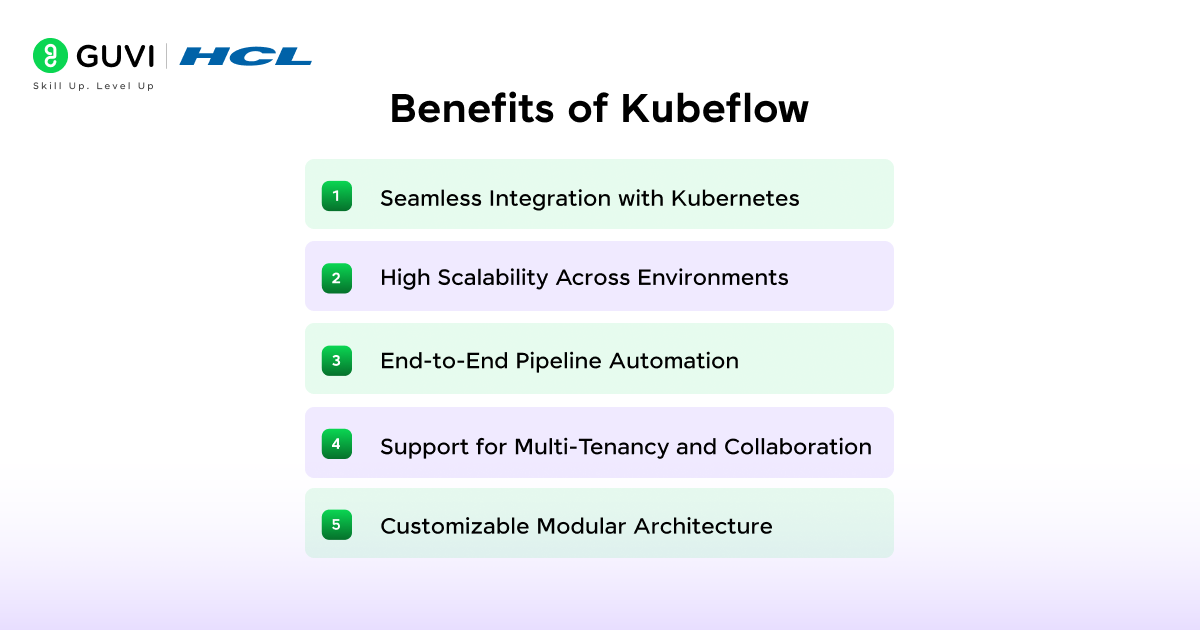
1. Seamless Integration with Kubernetes
Kubeflow aligns naturally with Kubernetes, allowing fine-grained control over computation and storage resources. This tight integration ensures reliable orchestration and distributed training at scale.
2. High Scalability Across Environments
Kubeflow adapts to the needs of expanding workloads without compromising performance. It supports organizations to scale horizontally across clusters, supporting both on-premise and hybrid cloud environments.
3. End-to-End Pipeline Automation
Kubeflow facilitates teams to define and execute multi-step pipelines as Directed Acyclic Graphs (DAGs), where each stage: data preprocessing, model training, and evaluation, is containerized and automatically scheduled. Automation minimizes manual overhead and enforces reproducibility. It also guarantees consistent execution across experiments.
4. Support for Multi-Tenancy and Collaboration
Kubeflow allows teams to share infrastructure securely through project isolation and role-based access control. Collaboration remains efficient while maintaining organizational compliance and governance.
5. Customizable Modular Architecture
Each Kubeflow component, from pipelines to serving layers, functions independently. This modularity provides the flexibility to integrate specialized tools or replace individual components without breaking the ecosystem.
Top Applications of Kubeflow
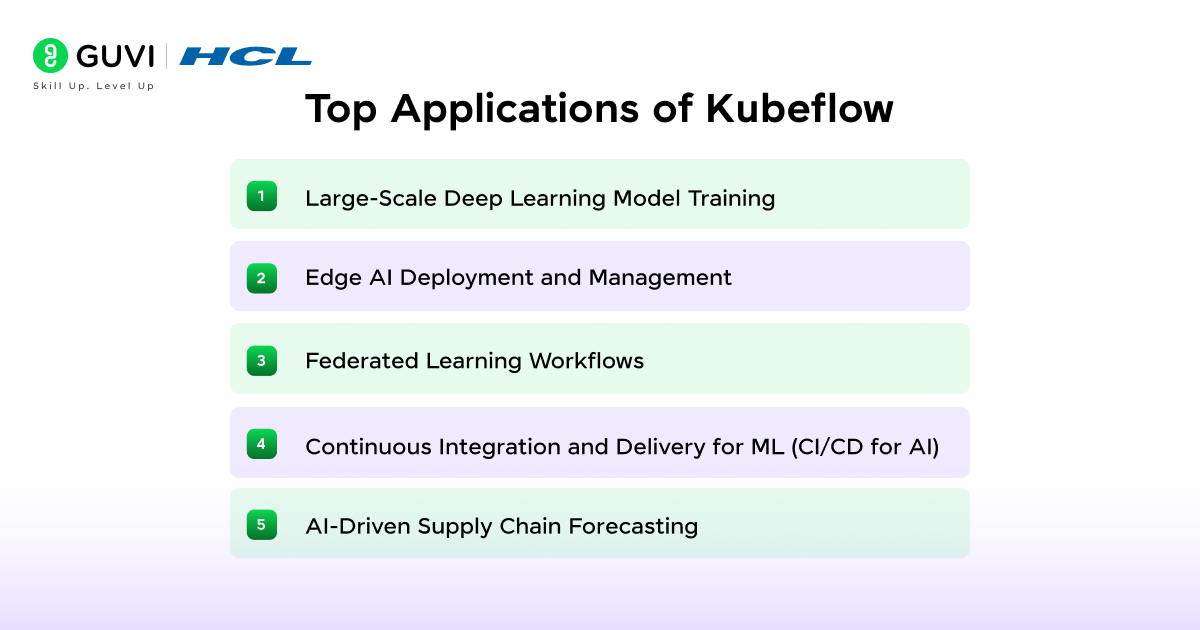
1. Large-Scale Deep Learning Model Training
Kubeflow supports distributed training across GPU and TPU clusters, which allows deep learning teams to manage computation at massive scales. It partitions workloads efficiently and synchronizes updates across nodes. It levels up model convergence speed in high-demand research and enterprise environments.
2. Edge AI Deployment and Management
Enterprises adopting hybrid architectures use Kubeflow to deploy machine learning models at the edge. It supervises inference workloads across on-premise clusters and remote devices, providing consistency in updates and performance even under limited network conditions.
3. Federated Learning Workflows
Kubeflow facilitates federated learning setups where data remains decentralized. Hospitals and telecom providers can collaborate on shared model improvement without transferring sensitive information, maintaining privacy while advancing collective accuracy.
4. Continuous Integration and Delivery for ML (CI/CD for AI)
Kubeflow integrates directly with DevOps tools to implement CI/CD for AI pipelines. Automated testing, retraining, and deployment workflows reduce friction between model development and production environments, assuring that models stay up-to-date as data evolves.
5. AI-Driven Supply Chain Forecasting
Kubeflow powers predictive pipelines that integrate real-time data from logistics and inventory systems. It automates the retraining of demand forecasting models as new information streams in, providing accuracy in volatile markets.
Top Companies Using Kubeflow
- IBM: Leverages Kubeflow to manage scalable and containerized machine learning workflows across hybrid cloud environments.
- NVIDIA: Uses Kubeflow for distributed training and orchestration of large AI workloads on GPU-powered systems.
- Orange: Implements Kubeflow to automate ML pipelines and streamline model deployment across its data infrastructure.
What is MLflow?
MLflow is an open-source platform created to manage the complete lifecycle of machine learning models. It focuses on experiment tracking and reproducible runs. It also concentrates on model versioning across different environments. MLflow organizes workflows by capturing parameters and artifacts that emerge during experimentation, which helps teams trace model performance over time. The platform’s simplicity lies in its framework-agnostic approach, which allows integration with TensorFlow and PyTorch without heavy configuration.
Core Components of MLflow
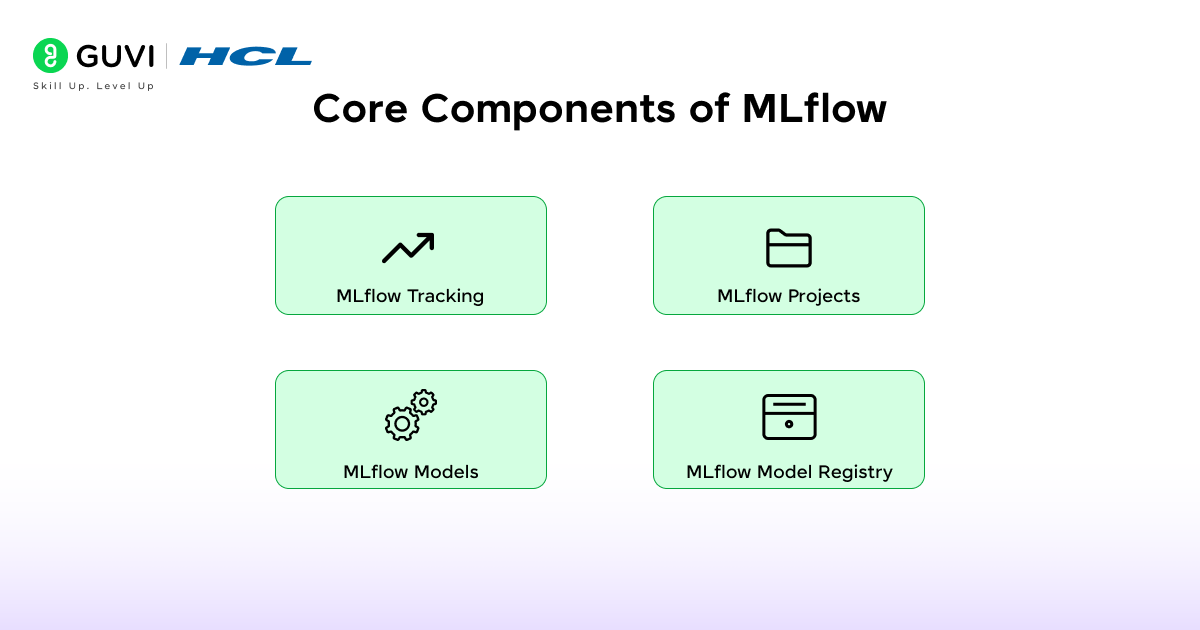
MLflow organizes the machine learning lifecycle into four key components that enhance traceability and deployment consistency:
- MLflow Tracking: This module records parameters, metrics, and artifacts from each experiment. It allows users to compare runs and identify models with the best performance.
- MLflow Projects: Projects package code, dependencies, and configurations into reusable formats. They make model experiments reproducible across different environments and teams.
- MLflow Models: The Models component manages the storage, versioning, and deployment of trained models. It supports multiple formats such as TensorFlow, PyTorch, and Scikit-learn.
- MLflow Model Registry: The registry provides a centralized system for managing model versions, stages, and approvals. It guarantees that production deployments remain traceable and governed under organizational policies.
MLflow Manual Tracking Example
import mlflow
from sklearn.model_selection import train_test_split
from sklearn.ensemble import RandomForestClassifier
from sklearn.metrics import accuracy_score

mlflow.set_tracking_uri("http://localhost:5000")
mlflow.set_experiment("my_experiment")

with mlflow.start_run():
    # Load and preprocess data
    X, y = load_data()
    X_train, X_test, y_train, y_test = train_test_split(X, y, test_size=0.2)

    # Train model
    model = RandomForestClassifier()
    model.fit(X_train, y_train)

    # Log parameters
    mlflow.log_param("n_estimators", model.n_estimators)
    mlflow.log_param("max_depth", model.max_depth)

    # Log metrics
    y_pred = model.predict(X_test)
    accuracy = accuracy_score(y_test, y_pred)
    mlflow.log_metric("accuracy", accuracy)

    # Log model
    mlflow.sklearn.log_model(model, "random_forest_model")

# Retrieve and print the run ID
current_run = mlflow.active_run()
print(f"MLflow Run ID: {current_run.info.run_id}")
Benefits of MLflow
1. Unified Experiment Management
MLflow consolidates parameters, metrics, and artifacts into a single tracking interface. This unified record enriches visibility across experiments and simplifies model comparison and refinement.
2. Framework-Agnostic Flexibility
MLflow operates seamlessly across popular ML frameworks like TensorFlow, PyTorch, and Scikit-learn. Teams can experiment freely without the constraints of a specific technology stack.
3. Efficient Model Versioning and Tracking
The MLflow Model Registry maintains version control for all trained models. It tracks lineage from development to production, ensuring reproducibility and compliance in data-driven projects.

4. Ease of Deployment Across Environments
MLflow supports diverse deployment targets such as Docker, cloud services, and REST APIs. This flexibility allows teams to move models effortlessly from notebooks to production-grade systems.
5. Collaborative Workflow Support
MLflow promotes collaboration by allowing multiple contributors to share and compare experiments. This shared visibility fosters accountability and accelerates innovation in team-based ML initiatives.
Top Applications of MLflow
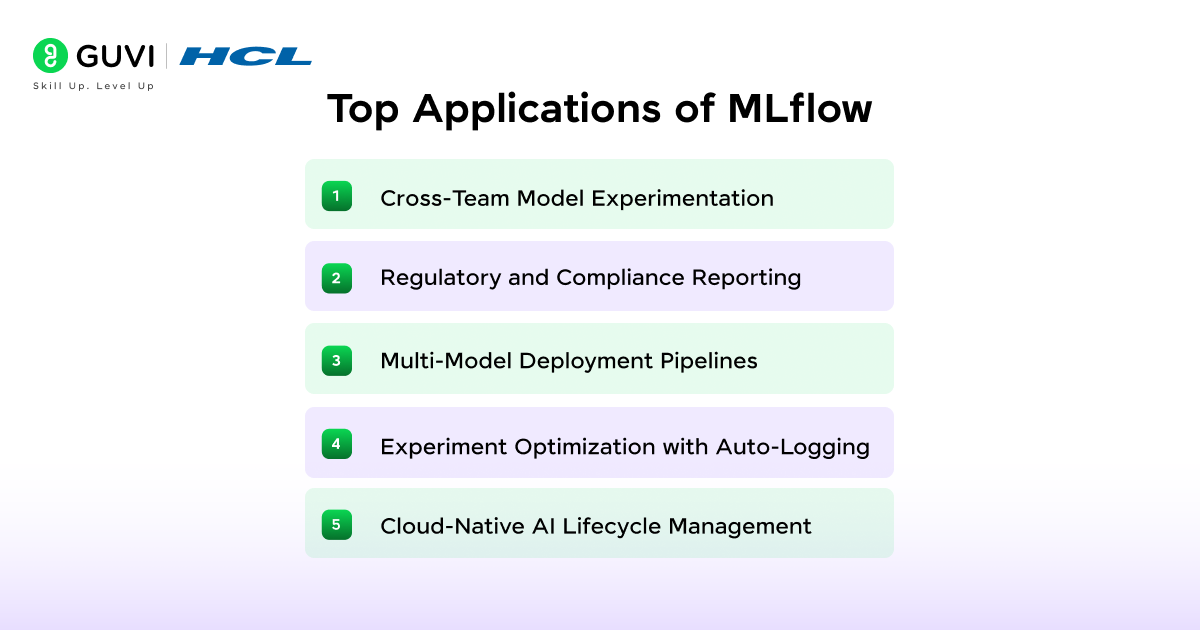
1. Cross-Team Model Experimentation
MLflow enables distributed data science teams to collaborate across projects without losing version control. Each experiment, along with its parameters and outcomes, remains traceable through shared tracking servers, which ensures continuity when models pass between teams.
2. Regulatory and Compliance Reporting
Industries such as healthcare and finance use MLflow’s model registry and audit logs to maintain transparency. Every model change is recorded, making it easier to satisfy legal requirements for explainability and traceability in AI-driven systems.
3. Multi-Model Deployment Pipelines
Enterprises managing numerous models in production rely on MLflow for deployment automation. It supports transitions between staging and live environments while maintaining control over rollback and approval stages. This structured governance reduces operational risk.
4. Experiment Optimization with Auto-Logging
MLflow integrates with libraries that automatically log metrics and parameters during training. This automation eliminates manual tracking errors. It speeds up experimentation cycles and empowers teams to identify high-performing models faster.
5. Cloud-Native AI Lifecycle Management
Cloud providers leverage MLflow to standardize ML workflows across environments. Its API integrations authorize seamless movement between local development, cloud storage, and production APIs. It strengthens workflow portability in enterprise AI use cases.
Top Companies Using MLflow
- Databricks: Integrates MLflow natively into its platform to track experiments, manage model versions, and simplify ML lifecycle management.
- Hepsiburada: Adopts MLflow for centralized tracking of experiments and performance metrics across multiple data science teams.
- Peloton: Uses MLflow to monitor model performance and maintain reproducibility across large-scale recommendation systems.
Understanding the differences between Kubeflow and MLflow is just the beginning; mastering how to build, train, and deploy AI models end-to-end is what truly sets you apart. Our Artificial Intelligence & Machine Learning Course with Intel Certification helps you gain hands-on experience in Python, MLOps, model lifecycle management, and deployment frameworks like Kubeflow, MLflow, and TensorFlow. Learn from industry mentors, earn your Intel-backed certification, and become a job-ready AI professional today!
Kubeflow vs MLflow: A Comprehensive Comparison
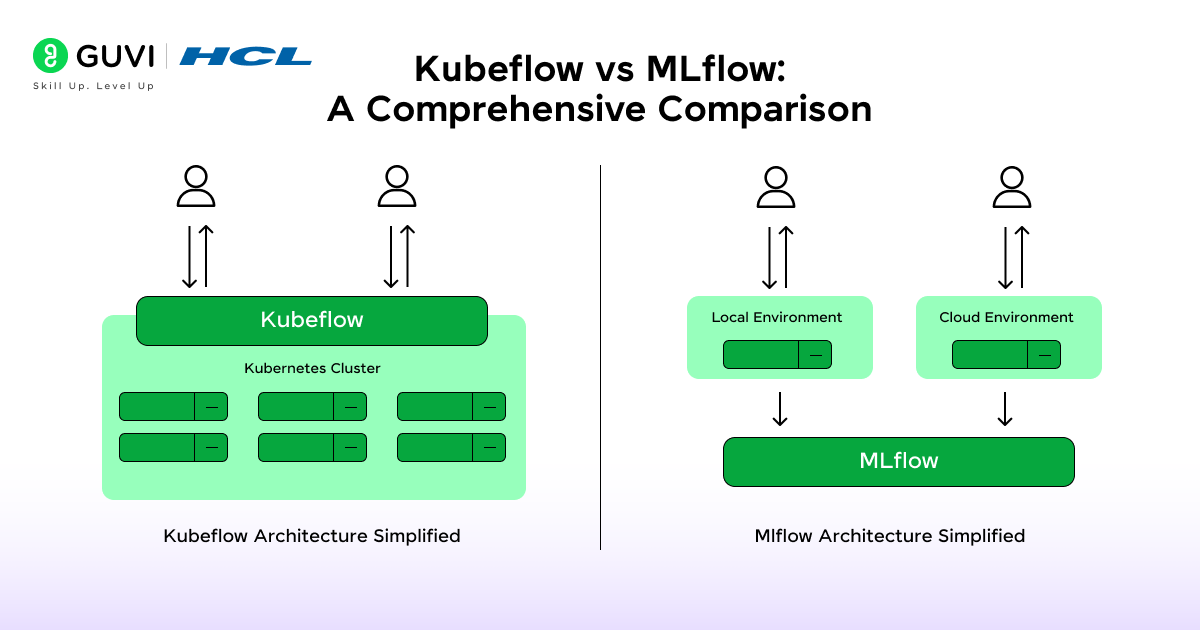
| Feature | Kubeflow | MLflow |
| Primary Purpose | End-to-end MLOps platform for orchestrating, training, and deploying models on Kubernetes. | Lifecycle management tool for tracking, versioning, and deploying machine learning models. |
| Architecture | Kubernetes-native system with modular components such as Pipelines, KFServing, Katib, and Notebooks. | Framework-agnostic setup built around Tracking, Projects, Models, and Model Registry. |
| Pipeline Management | Uses Kubeflow Pipelines to automate multi-step ML workflows as DAGs. | Lacks native orchestration; integrates with Airflow, Prefect, or ZenML for pipeline automation. |
| Model Serving | KFServing deploys models as scalable, serverless microservices on Kubernetes. | Deploys models via REST API, Docker, or cloud platforms, requiring manual coordination. |
| Distributed Training | Supports distributed training through TensorFlow, PyTorch, and MXNet operators. | Limited native support; depends on external frameworks for parallel training. |
| Hyperparameter Optimization | Katib automates tuning with multiple optimization algorithms. | Depends on tools like Optuna or Hyperopt for hyperparameter optimization. |
| Scalability | Designed for large, distributed ML workloads across hybrid and multi-cloud setups. | Better suited for small or mid-scale projects; scalability depends on infrastructure. |
| Ease of Use | Requires Kubernetes expertise and detailed configuration. | Easier to install and manage, accessible for teams with minimal DevOps background. |
| Collaboration and Governance | Includes RBAC, multi-tenancy, and a unified dashboard for shared operations. | Enables shared experiment tracking and model registry; governance is lighter. |
| Integration Flexibility | Integrates with Kubernetes-native tools like Istio, Argo, and Prometheus. | Connects easily with TensorFlow, PyTorch, Scikit-learn, and cloud services. |
| Deployment Environments | Ideal for on-premises, hybrid, and multi-cloud Kubernetes clusters. | Works across local, containerized, and cloud setups with minimal setup. |
| Ideal Use Cases | Best for enterprises managing complex, production-scale ML pipelines. | Suited for teams focusing on tracking, reproducibility, and model management. |
| Learning Curve | Steeper, due to Kubernetes dependency and operational complexity. | Gentle, designed for quick adoption by data science teams. |
| Community and Ecosystem | Backed by Google Cloud and CNCF with strong enterprise support. | Supported by Databricks and an active open-source community. |
Future of Kubeflow and MLflow
Kubeflow: Expanding Toward Intelligent Orchestration
Kubeflow is moving beyond traditional pipeline automation toward intelligent orchestration powered by adaptive scheduling and policy-driven governance. Upcoming developments aim to merge real-time analytics with continuous deployment. They will allow pipelines to self-optimize based on workload patterns. As enterprises transition to hybrid and edge AI infrastructures, Kubeflow’s deep Kubernetes integration will make it the backbone of scalable and container-native AI ecosystems.
MLflow: Reinventing Experimentation and Model Governance
MLflow’s roadmap focuses on reinforcing trust and automation in the model lifecycle. Improved lineage tracking, governance APIs, and integration with generative AI models will redefine how organizations monitor and audit performance in production. MLflow is expected to become the core framework for unified experiment management across multi-cloud environments with an emphasis on interoperability. It will bridge the gap between data science exploration and enterprise-grade deployment.
Conclusion
Selecting between Kubeflow and MLflow relies on the scale and maturity of your machine learning operations. Kubeflow is outstanding for organizations managing large and distributed ML workloads that demand orchestration and scalability across Kubernetes-powered environments. In contrast, MLflow shines in lightweight and framework-agnostic workflows, offering flexibility and seamless experiment tracking.
Together, they represent two ends of the MLOps spectrum: one built for robust and enterprise-grade orchestration, the other for agile and collaborative experimentation. They also represent the direction of enterprise AI: one where compliance and continuous learning define the next generation of operational excellence. The smartest teams often combine both, using Kubeflow for orchestration and MLflow for tracking to achieve a unified and transparent AI pipeline.
FAQs
1. Can Kubeflow and MLflow be used together for MLOps?
Yes. Many enterprises integrate Kubeflow and MLflow to build robust MLOps pipelines. Kubeflow manages orchestration and scaling on Kubernetes, while MLflow tracks experiments, metrics, and model versions, creating a unified, end-to-end machine learning workflow.
2. Which is better for large-scale machine learning: Kubeflow or MLflow?
For large-scale or Kubernetes-based machine learning pipelines, Kubeflow is more suitable due to its native support for distributed training and pipeline automation. However, MLflow excels in tracking, versioning, and lightweight deployments across multi-cloud environments.
3. Is MLflow easier to learn than Kubeflow?
Yes. MLflow offers a simpler setup and user-friendly interface that’s ideal for data science teams without deep DevOps experience. In contrast, Kubeflow has a steeper learning curve since it requires knowledge of Kubernetes, container orchestration, and cluster management.
Success Stories

About the Author
Vaishali
I'm a seasoned writer with four years of experience across technical, non-technical, and just about every genre or niche you can imagine. Adaptable and curious, I enjoy exploring new topics and making information engaging and easy to understand. Fueled by a steady stream of tea, I approach each project with creativity, reliability, and genuine enthusiasm for storytelling.
View all posts by Vaishali
Connect with me @











Did you enjoy this article?