


Artificial Intelligence and Machine Learning Articles
Finance Manager to Data Analytics: Career Growth, Salary and Seniority
How to Evaluate LLM Outputs in Production Deployments
AI/ML Skills Gap 2026: Why Companies Can't Find Job-Ready Talent
20 AI/ML Interview Questions Recruiters Can Use Without a Tech Background - Best Guide

Get In Touch For Details! Request More Information
Game Playing in Artificial Intelligence: A Full Guide
Jul 20, 2026 5 Min Read 978 Views
(Last Updated)
Long before “artificial intelligence” became a household phrase, researchers sat with board games asking whether a computer could learn to play well enough to beat a human. Game playing proved an ideal testbed: games are rule-bound, measurable, and repeatable, so they let scientists create clear challenges, compare methods, and evaluate progress in a controlled setting.
The history of game-playing AI tracks the field’s breakthroughs. Each conquered game contributed new techniques chess, highlighted deep search and evaluation functions, Go pushed Monte Carlo methods combined with neural networks, and video games are driving advances in real-time decision-making under uncertainty techniques that later informed areas from self-driving cars to medical diagnostics.
In this article, we will walk through everything you need to understand about game playing in artificial intelligence, from the foundational algorithms that power classical games to the deep learning and reinforcement learning techniques behind the most impressive modern AI systems and why all of this matters far beyond the games themselves.
Table of contents
- TL;DR
- Why Games Matter So Much for AI Research
- A Brief History of Game Playing AI
- Early Experiments: Tic-Tac-Toe and the First Game Programs
- Learning to Improve: Samuel’s Checkers and Machine Learning
- Chess as the Ultimate Challenge: The Road to a World Champion
- The Game Search Tree: The Foundation of Game AI
- Minimax: The Core Algorithm Of Gaming
- Deep Blue: Chess AI's Greatest Milestone
- Reinforcement Learning: Teaching AI Through Experience
- Real-World Applications Beyond Games
- Wrapping Up
- FAQs
- Why are games useful for AI research?
- What is the game tree?
- How do Minimax and alpha‑beta pruning work together?
- Why was Go so hard for traditional methods?
- What made AlphaGo and its successors so effective?
TL;DR
- Games have been a core AI testbed because they’re rule-bound, measurable, and repeatable.
- Early programs (Tic‑Tac‑Toe, Checkers) showed computers could learn and improve through self-play.
- Minimax with alpha‑beta pruning powered chess engines and enabled Deep Blue’s 1997 win.
- Go requires new ideas: Monte Carlo Tree Search guided by deep neural networks (AlphaGo).
- Self-play reinforcement learning (AlphaGo Zero, AlphaZero) removed human bias and achieved superhuman play.
- Modern game AI (OpenAI Five and AlphaStar) tackles real‑time, imperfect‑information, and multiagent problems, with lessons applied beyond games (autonomy, finance, and medicine).
What Is Game Playing in AI?
Game playing in AI refers to the development of intelligent systems capable of playing games at or beyond human-level performance. These systems use techniques such as minimax, alpha-beta pruning, Monte Carlo tree search, and reinforcement learning to explore possible moves, evaluate game states, and improve strategies through experience and repeated gameplay.
Why Games Matter So Much for AI Research
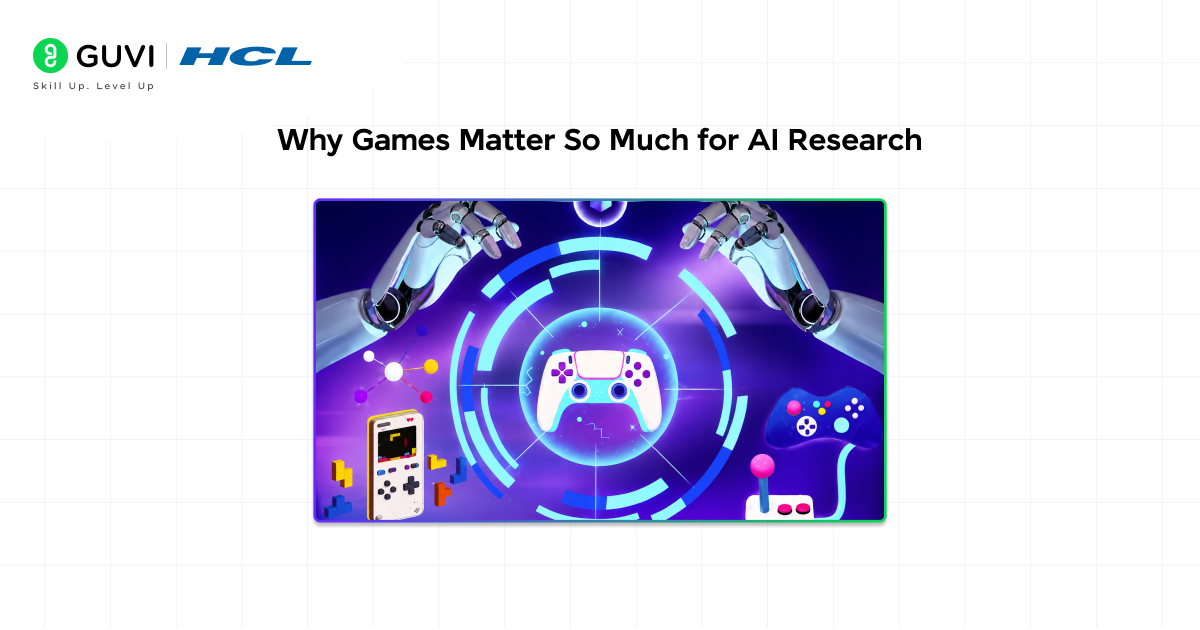
- Games have been central to AI research from the very beginning, and for good reason. Game-playing AI not only solves entertainment challenges but also advances research in problem-solving, planning, and adaptive learning across industries.
- Victories in high-profile game challenges serve as powerful and easily understandable benchmarks for the progress of artificial intelligence. When Deep Blue defeated Kasparov, or AlphaGo defeated Lee Sedol, these events captured global attention in a way that abstract research papers rarely do.
- They provide clear, quantifiable milestones demonstrating the advancing capabilities of machines in domains previously thought to require uniquely human skills like strategic thinking.
- Games also offer a safe and controlled environment for testing algorithms. You can run millions of simulations, measure exactly how well the system performs, and iterate quickly.
- Games have served as stepping stones along the path to solving advanced real-world challenges for decades, from Backgammon in 1992 to Chess in 1997 to Atari in 2013. The skills learned in games, such as planning under uncertainty, evaluating outcomes, and adapting to an opponent, transfer directly to real-world AI applications.
A Brief History of Game Playing AI
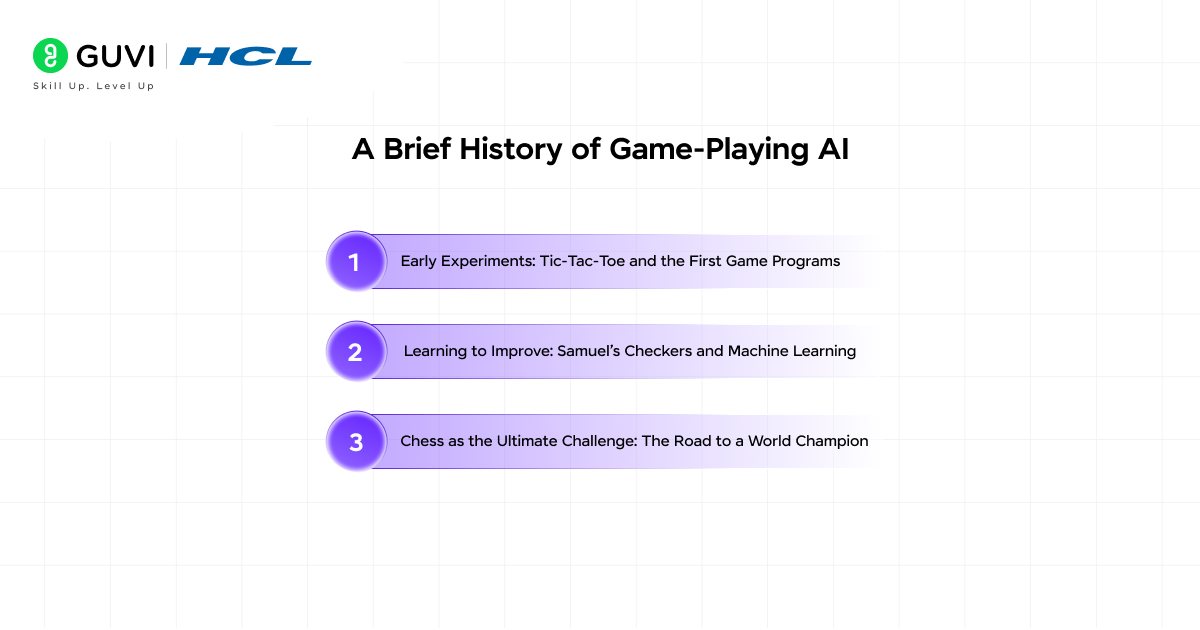
1. Early Experiments: Tic-Tac-Toe and the First Game Programs
The history of game-playing AI stretches back farther than many realize. Long before AI became an established discipline, computer scientists used games as practical tests for machine intelligence. In 1952, A. S. Douglas created one of the first successful game programs, a Tic-Tac-Toe player that demonstrated a computer could master a simple strategic task.
2. Learning to Improve: Samuel’s Checkers and Machine Learning
Ambition grew from those early successes. In the late 1950s, Arthur Samuel developed a checkers program that introduced an important idea: a program could get better through experience. Samuel’s system learned by playing games sometimes against itself, pioneering a learning approach that later underpinned major advances in AI.
3. Chess as the Ultimate Challenge: The Road to a World Champion
Chess soon became the field’s defining challenge. It offered enough complexity to be meaningful while remaining structured enough for algorithmic study. For decades, researchers aimed to create a chess-playing program capable of beating a human world champion, a goal that remained a central driving force until it was finally achieved in 1997.
The Game Search Tree: The Foundation of Game AI
- The Game Tree: Positions and Possibilities
To understand how AI plays games, start with the game search tree. At any point in a game, there are several legal moves; each move leads to a new position, and each new position offers its own set of replies. This branching structure of moves and positions forms the game tree.
- Roots and Leaves: Current Position to Terminal Outcomes
The root of the tree is the current position. The leaves at the bottom are terminal positions where the game ends in a win, a loss, or a draw. The AI’s goal is to search the tree and choose the path from the root to the best possible outcome, assuming the opponent also plays optimally.
- Why Exhaustive Search Fails: Scale in Real Games
Some games, like Tic-Tac-Toe, have small enough trees to be searched exhaustively. Chess, however, has an average branching factor of about 35 legal moves per position and games that stretch many moves deep, making a complete search impossible.
That combinatorial explosion is why smart algorithms that prune, evaluate, and selectively explore the tree rather than brute-force every path are essential to game-playing AI.
Minimax: The Core Algorithm Of Gaming
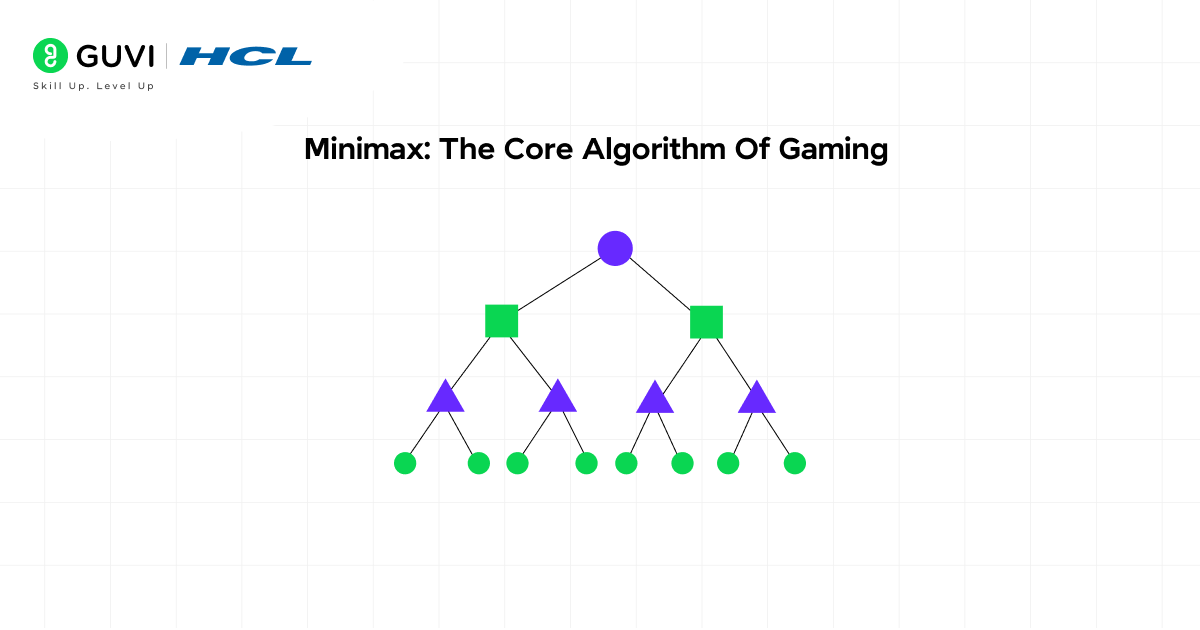
- The minimax algorithm is the starting point for understanding game-playing AI. It formalizes the intuition that a good player tries to maximize their own outcome while assuming the opponent tries to minimize it.
- In a Minimax search, the current player is labeled MAX and always tries to choose the move that leads to the highest evaluation. The opponent is labeled MIN and always tries to choose the move that leads to the lowest evaluation.
- The algorithm alternates between these two perspectives as it searches deeper into the tree, backing up values from evaluated leaf nodes to determine the best move at the root.
- The evaluation at each leaf node is provided by an evaluation function, which assigns a numerical score to a position based on features like material balance, piece activity, king safety, and other domain-specific factors. The quality of this evaluation function is what separates a strong chess engine from a weak one.
- Minimax is correct in the sense that it always finds the optimal move, assuming both players play perfectly. Its limitation is computational.
- The number of nodes it needs to evaluate grows exponentially with search depth, which is why alpha-beta pruning is almost always applied alongside it.
Deep Blue: Chess AI’s Greatest Milestone
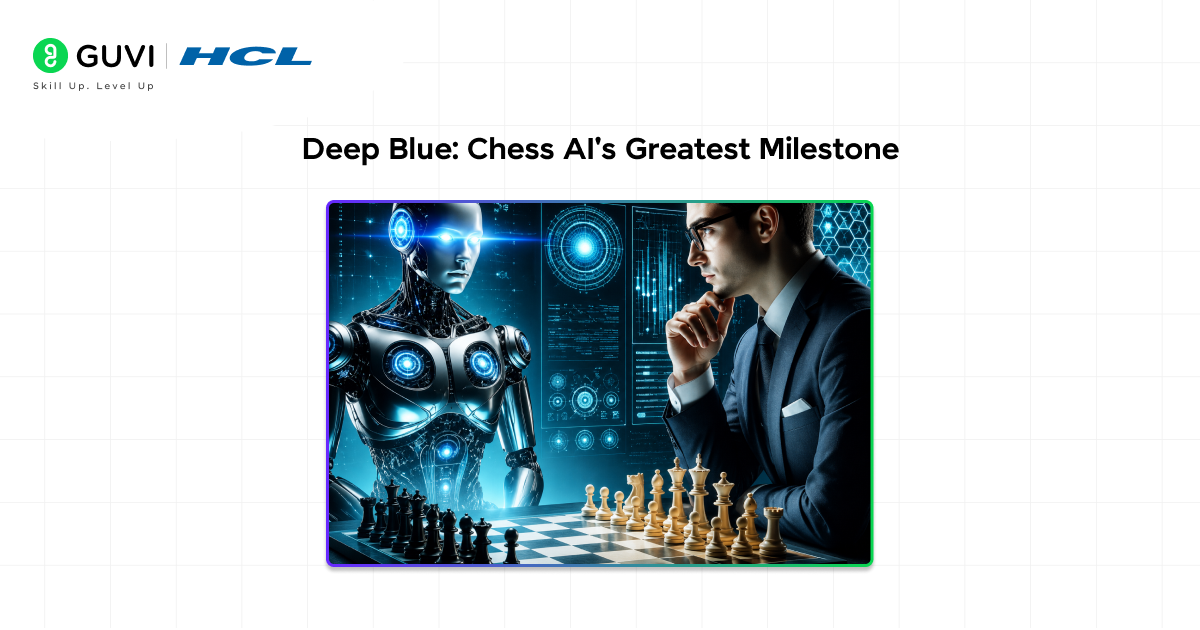
- In 1997, IBM’s Deep Blue defeated world chess champion Garry Kasparov. By leveraging minimax and alpha-beta pruning, Deep Blue showcased AI’s ability to analyze millions of moves per second and predict optimal strategies.
- Deep Blue evaluated around 200 million positions per second, a feat made possible by custom hardware chips designed specifically for chess computation.
- It searched to depths of 12 to 16 moves ahead in typical positions and even deeper in critical tactical situations. The system also incorporated extensive opening book knowledge and an endgame tablebase covering all positions with five or fewer pieces.
- While brute-force search was effective for chess, given sufficient computational power, it hit fundamental limitations when faced with the exponentially larger state spaces of Go or the real-time, imperfect information complexities of later games.
- Deep Blue’s approach was essentially an enormously powerful version of what Shannon and Turing had envisioned in the 1940s. For Go, a completely different approach would be needed.
Many landmark breakthroughs in artificial intelligence began as game-playing research projects. IBM’s Deep Blue relied on specialized hardware and large-scale search to evaluate around 200 million chess positions per second, ultimately defeating world champion Garry Kasparov in 1997. Years later, AlphaGo Zero demonstrated a radically different approach by learning entirely through self-play starting from random moves, without using human game data, yet still surpassing previous Go-playing systems. These projects helped shape modern AI research in search, reinforcement learning, and autonomous learning systems.

Reinforcement Learning: Teaching AI Through Experience
- Reinforcement learning is the technique that powers the most sophisticated game-playing AI systems in existence today. Unlike supervised learning, which trains on labeled examples, reinforcement learning teaches an agent through trial and error.
- In reinforcement learning, applications of AI in games involve agents that train together, learning to coordinate their actions and develop sophisticated team strategies.
- The applications of reinforcement learning in AI games are vast and varied. RL agents have surpassed human-level performance in some games, showcasing the potential of AI to master complex tasks through learning and adaptation.
- The key innovation that made reinforcement learning so effective for games was self-play, where the AI trains by playing against copies of itself.
- This creates an opponent that always matches the current level of the learner, providing a continuously improving training signal. The core innovation was replacing human-designed evaluation functions with a deep neural network trained through self-play.
- This allowed the agent to develop its own understanding of game positions, free from human bias and limitations, leading to creative and sometimes counterintuitive winning moves.
Real-World Applications Beyond Games
The techniques developed through game-playing AI have found their way into real-world applications across many industries.
- Algorithms use simulation-based decision trees to anticipate and react to nearby vehicle behaviors in autonomous driving. Financial trading bots use game-theoretic models to simulate adversarial conditions and adjust strategies based on competitors. In cybersecurity, AI systems model attacker and defender interactions as game-theoretic problems, continuously adapting to new threats.
- The broader principle behind all of these applications is the same one that drives game-playing AI. An intelligent agent needs to evaluate its current situation, consider possible future states, and choose the action most likely to lead to a good outcome, all while accounting for the actions of other agents who may have conflicting goals. This is exactly the problem structure that game AI was designed to solve, which is why the techniques transfer so readily.
- Games like StarCraft are an excellent training ground to advance approaches to robust and flexible agents that can cope with complex, real-world domains, as players must use limited information to make dynamic and difficult decisions that have ramifications on multiple levels and timescales.
If you’re serious about mastering game-playing in artificial intelligence, including Minimax, alpha‑beta pruning, evaluation functions, and AI game‑tree search, you don’t want to miss the chance to enroll in HCL GUVI’s Artificial Intelligence & Machine Learning Course, co‑designed by Intel.
Wrapping Up
Game playing has always been more than a technical challenge in artificial intelligence. It has been a proving ground, a benchmark, and a source of fundamental insights that have shaped the entire field.
From the Minimax algorithm powering early chess programs to the deep reinforcement learning behind AlphaGo and OpenAI Five, every generation of game-playing AI has pushed the boundary of what machines can do.
What makes this story especially meaningful is that each breakthrough in game playing brought with it new techniques that went far beyond games. Alpha-beta pruning improved decision-making in planning systems. Neural network evaluation functions led to advances in computer vision.
Self-play reinforcement learning is now being applied to everything from robotics to drug discovery. Games gave AI researchers a clean, measurable environment to develop and test powerful ideas, and those ideas are now reshaping the real world in ways that matter far more than winning a game of chess.
FAQs
Why are games useful for AI research?
They provide controlled, measurable environments where algorithms can be tested at scale, compared objectively, and iterated quickly using millions of simulations.
What is the game tree?
A game tree is the branching structure of all possible moves and resulting positions from the current state; the root is the current position and leaves are terminal outcomes (win/loss/draw).
How do Minimax and alpha‑beta pruning work together?
Minimax models optimal play by alternating MAX and MIN decisions; alpha‑beta pruning cuts branches that cannot influence the final result, greatly reducing nodes evaluated and allowing deeper search.
Why was Go so hard for traditional methods?
Go’s average branching factor (250) and vast state space make exhaustive search infeasible, and expert intuition about board strength resisted simple analytic evaluation functions.
What made AlphaGo and its successors so effective?
They combined Monte Carlo Tree Search with deep neural networks (policy and value networks) and large-scale self-play reinforcement learning, enabling focused search guided by learned intuition rather than handcrafted evaluation.
Success Stories

About the Author
Vishalini Devarajan
An Aerospace Engineer turned content writer, I focus on making complex concepts easy to understand through well-structured, reader-friendly blogs. Whether it’s a technical topic or a non-technical one, I love creating content that is clear, engaging, and impactful.
View all posts by Vishalini Devarajan
Connect with me @











Did you enjoy this article?