


Artificial Intelligence and Machine Learning Articles
AI/ML Skills Gap 2026: Why Companies Can't Find Job-Ready Talent
20 AI/ML Interview Questions Recruiters Can Use Without a Tech Background - Best Guide
How Industry-Backed AI/ML Bootcamps Are Changing the AI/ML Hiring Pipeline - Best Guide 2026
From IT Support to AI Engineer: A Realistic Career Switch Guide 2026


Get In Touch For Details! Request More Information
Claude API Pricing Breakdown: Token Costs and Tiers
Aug 05, 2026 3 Min Read 538 Views
(Last Updated)
Understanding Claude API pricing is essential for estimating AI costs and choosing the right model. Anthropic charges based on input and output tokens rather than API requests, making pricing different from traditional subscription models. Learning how token-based pricing works helps developers optimize costs and build efficient AI applications.
Table of contents
- TL;DR Summary
- 📊 Data Point
- Understanding Claude API Pricing
- How Claude API Pricing Works
- Step 1: Input Tokens
- Step 2: Output Tokens
- Step 3: Choose the Right Model
- Step 4: Calculate API Costs
- Step 5: Optimize Token Usage
- Claude API Pricing Tiers
- Claude Opus
- Claude Sonnet
- Claude Haiku
- Tips to Reduce Claude API Costs
- Conclusion
- FAQs
- How does Claude API pricing work?
- What are input and output tokens?
- Which Claude model is the most affordable?
- How can I reduce Claude API costs?
- Does Claude API pricing include a free tier?
- Which Claude model should I choose?
- Where can I check the latest Claude API pricing?
TL;DR Summary
- Claude API pricing is based on the number of input and output tokens processed by the model.
- Anthropic offers multiple Claude models with different pricing tiers for varying performance and use cases.
- Larger, more capable models cost more per million tokens, while lightweight models provide a budget-friendly option.
- Additional features like prompt caching and batch processing can significantly reduce API costs.
- Understanding Claude API pricing helps developers optimize AI applications without overspending.
📊 Data Point
Anthropic charges for Claude API usage based on input tokens (the text you send to the model) and output tokens (the text generated by Claude). Different Claude models have different prices per million input and output tokens, enabling developers to choose the most suitable balance between cost and performance.
Source: Anthropic API Pricing Documentation
Understanding Claude API Pricing
Before estimating your API expenses, it’s important to understand how Anthropic charges for Claude API usage. Unlike traditional software subscriptions that charge a flat monthly fee, the Claude API follows a pay-as-you-go pricing model. This means you only pay for the number of tokens processed by the model during each request.
A token is a small unit of text that Claude uses to process prompts and generate responses. Both the text you send (input tokens) and the text Claude generates (output tokens) contribute to your total API cost.
The final price depends on several factors, including:
- The Claude model you choose
- The number of input tokens
- The number of output tokens
- Optional features such as prompt caching or batch processing
This flexible pricing structure allows developers to select models based on their application’s performance requirements and budget.
How Claude API Pricing Works
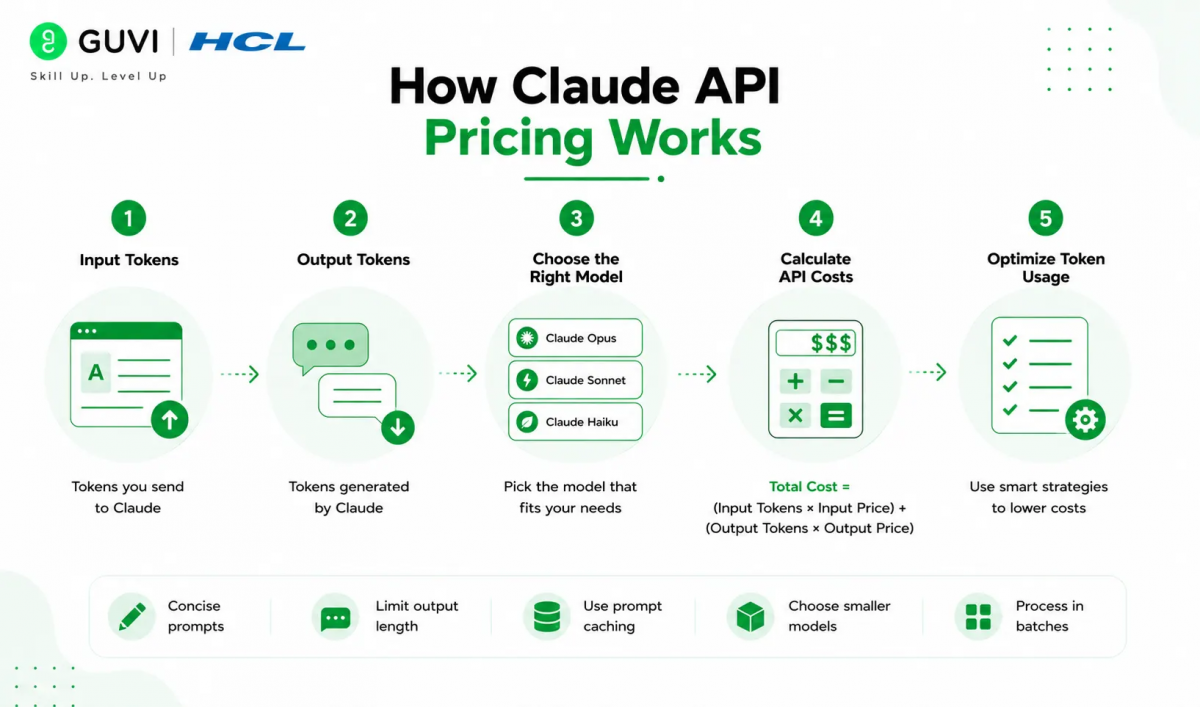
Anthropic charges for Claude API usage based on the number of input and output tokens processed during each request. Your total cost depends on the selected Claude model and the number of tokens consumed.
Step 1: Input Tokens
Input tokens include everything you send to Claude, such as prompts, system instructions, and conversation history. Longer prompts use more tokens, increasing API costs.
Step 2: Output Tokens
Output tokens are the responses generated by Claude. Since these are billed separately, limiting response length can help reduce overall costs.
Step 3: Choose the Right Model
Anthropic offers Claude Opus, Sonnet, and Haiku, each with different pricing and capabilities. Selecting the right model for your workload is one of the easiest ways to optimize spending.
Step 4: Calculate API Costs
Your API bill is calculated using the following formula:
Total Cost = (Input Tokens × Input Price) + (Output Tokens × Output Price)
Monitoring token usage helps estimate monthly expenses and avoid unexpected charges.
Step 5: Optimize Token Usage
You can lower Claude API costs by:
- Writing concise prompts
- Limiting output length
- Using prompt caching
- Choosing smaller models for simple tasks
- Processing workloads in batches where supported
Claude API Pricing Tiers
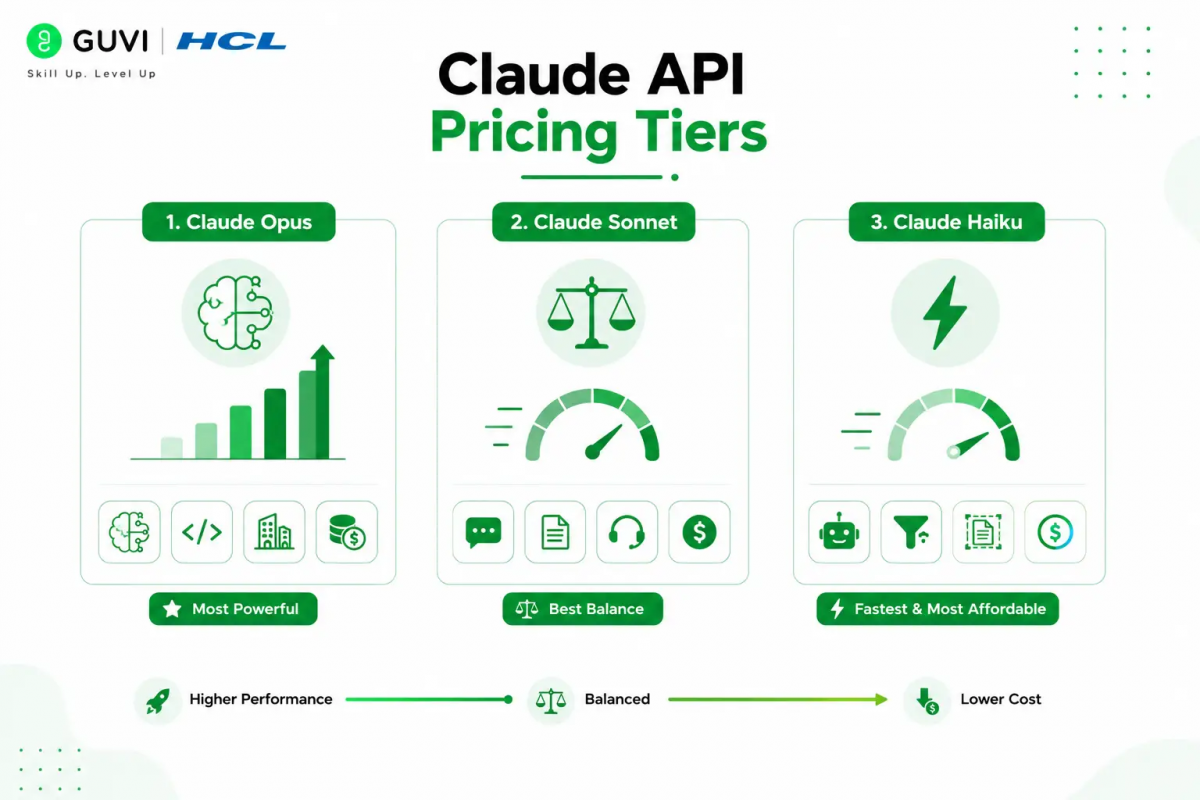
Anthropic offers several Claude models with different pricing, performance, and capabilities. Since API pricing is token-based, choosing the right model helps balance cost and performance.
Claude Opus
Claude Opus is Anthropic’s most powerful model, designed for complex reasoning, advanced coding, research, and enterprise applications. It delivers the highest performance but also has the highest token pricing.
Claude Sonnet
Claude Sonnet offers an excellent balance between intelligence, speed, and affordability. It’s ideal for AI chatbots, content generation, document summarization, customer support, and general software development.

Claude Haiku
Claude Haiku is Anthropic’s fastest and most affordable model. It is best suited for high-volume tasks such as chatbots, text classification, content moderation, text extraction, and other lightweight AI applications where speed and low cost are priorities.
If you’re new to large language models, HCL GUVI’s AI & Machine Learning Course teaches tokenization, prompt engineering, API integration, and practical AI application development using modern foundation models.
Even a 10–20% reduction in token usage can translate into substantial monthly cost savings for applications that process millions of AI API requests. Optimizing prompts by removing unnecessary instructions, reducing repetitive context, and sending only relevant information is one of the simplest and most effective ways to improve AI infrastructure efficiency while lowering operational costs.
Tips to Reduce Claude API Costs
Reduce your Claude API costs with these simple practices:
- Write concise prompts to reduce input tokens.
- Limit output length to avoid unnecessary token usage.
- Choose the right model based on your workload.
- Use prompt caching for repeated instructions.
- Monitor token usage to identify optimization opportunities.
To understand AI APIs, tokenization, prompt engineering, and LLM concepts in greater detail, explore HCL GUVI’s AI Ebook, which covers these topics with practical examples.
Conclusion
Understanding Claude API pricing helps developers estimate costs and build more efficient AI applications. By choosing the right Claude model, monitoring token usage, and optimizing prompts, you can control expenses without sacrificing performance. Using features like prompt caching and efficient prompt design further improves cost efficiency, making Claude API suitable for projects of all sizes.
FAQs
1. How does Claude API pricing work?
Claude API pricing is based on token usage. Developers are charged separately for input tokens (the text sent to the model) and output tokens (the text generated by the model). The total cost depends on the Claude model selected and the number of tokens processed.
2. What are input and output tokens?
Input tokens are the prompts, instructions, and conversation history you send to Claude. Output tokens are the responses generated by the AI. Both contribute to the overall API cost, with pricing varying by model.
3. Which Claude model is the most affordable?
Claude Haiku is Anthropic’s most cost-effective model. It is designed for lightweight tasks such as chatbots, text classification, content moderation, and other high-volume applications where speed and affordability are priorities.
4. How can I reduce Claude API costs?
You can lower Claude API costs by writing concise prompts, limiting response lengths, choosing the appropriate Claude model, using prompt caching for repeated instructions, monitoring token usage, and optimizing workflows before deploying applications at scale.
5. Does Claude API pricing include a free tier?
Anthropic may offer free credits or promotional access for certain users or platforms, but standard Claude API usage is generally billed on a pay-as-you-go basis. Developers should check Anthropic’s official pricing page for the latest plans, credits, and eligibility requirements.
6. Which Claude model should I choose?
The best model depends on your use case. Claude Opus is suitable for advanced reasoning and complex tasks, Claude Sonnet offers an excellent balance of performance and cost for most business applications, and Claude Haiku is ideal for fast, low-cost, high-volume workloads.
7. Where can I check the latest Claude API pricing?
Since Anthropic periodically updates its models and pricing, the most accurate and up-to-date information is available on the official Anthropic API pricing documentation. Reviewing the official pricing page before estimating project costs ensures you’re using the latest rates and available features.
Success Stories

About the Author
Vishalini Devarajan
An Aerospace Engineer turned content writer, I focus on making complex concepts easy to understand through well-structured, reader-friendly blogs. Whether it’s a technical topic or a non-technical one, I love creating content that is clear, engaging, and impactful.
View all posts by Vishalini Devarajan
Connect with me @












Did you enjoy this article?