


Artificial Intelligence and Machine Learning Articles
AI/ML Skills Gap 2026: Why Companies Can't Find Job-Ready Talent
20 AI/ML Interview Questions Recruiters Can Use Without a Tech Background - Best Guide
How Industry-Backed AI/ML Bootcamps Are Changing the AI/ML Hiring Pipeline - Best Guide 2026
From IT Support to AI Engineer: A Realistic Career Switch Guide 2026


Get In Touch For Details! Request More Information

Claude Model Comparison 2026: Which Model Is Best for Developers?
Sep 23, 2026 5 Min Read 2526 Views
(Last Updated)
Building a single AI model for every purpose is no longer common practice. Selecting the right Claude model is as important as the task itself, because performance, cost, and output quality depend heavily on that choice.
This article will provide you with a Claude Model comparison: Haiku, Sonnet and Opus to compare each model, their capabilities, ideal uses, and the differences in their performances, so you can make an informed decision about selecting the appropriate model for your use case.
Table of contents
- AI Overview
- What Are Claude Models
- Key Differences Between Haiku, Sonnet, and Opus
- Claude Haiku 4.5
- Claude Sonnet 5
- Claude Opus 5
- Claude Fable 5.1
- Claude Model Comparison 2026: Fable vs Opus vs Sonnet vs Haiku
- Complete Claude Model Comparison in India 2026
- How These Models Behave in Real Scenarios
- Practical Comparison Mindset
- How Claude Models Are Evolving (Latest Trends)
- Rising Capability of Lightweight Models
- Shift Toward Cost Efficient AI Usage
- Reduced Dependence on High End Models
- Choosing the Right Claude Model for Your Use Case
- Content Creation
- Automation and Chatbots
- Complex Tasks
- When Not to Use Each Claude Model
- Common Mistakes When Selecting Claude Models
- Overutilizing High-End Models Such As Opus
- Forgetting Costs for Large-Scale Operations
- Committing to a Single Model Across the Board
- Neglecting Model Testing
- Conclusion
- FAQs
- What is the difference between Claude Haiku, Sonnet, and Opus?
- Which Claude model is best for beginners?
- Is Claude Opus worth the cost?
- Can I use Claude Haiku for content writing?
- When should I switch between Claude models?
- Which Claude model is best for automation and chatbots?
- Is Claude Sonnet 5 better than Claude Opus 5?
AI Overview
Claude models from Anthropic are designed for different levels of speed, reasoning, cost, and task complexity. In 2026, the lineup includes models such as Claude Fable 5.1, Opus 5, Sonnet 5, and Haiku 4.5, each targeting different workloads.
For developers, the right Claude model depends on whether the priority is advanced coding and long-running tasks, balanced performance, or fast and cost-efficient processing.
TL;DR:
- Haiku is the fastest and most cost-efficient Claude model, perfect for low-complexity, high volume tasks.
- Sonnet provides a balanced ratio of performance to cost, ideal for most real-world tasks.
- Opus is the most powerful of the Claude models, designed for complex reasoning and higher-accuracy tasks.
- The right model depends on matching its capabilities with the task requirements.
What Are Claude Models
Claude models are a type of AI chatbot that was developed by Anthropic. They can be used for various types of work due to differences in speed, cost, and reasoning capability.
By dividing Claude models up into various levels, users are not wasting high-capability AI to do simple work which can be completed in lower-level AI models. Claude models are often used in work involving creative content, automation, chatbots, and data analysis which requires speed and quality work at the same time.
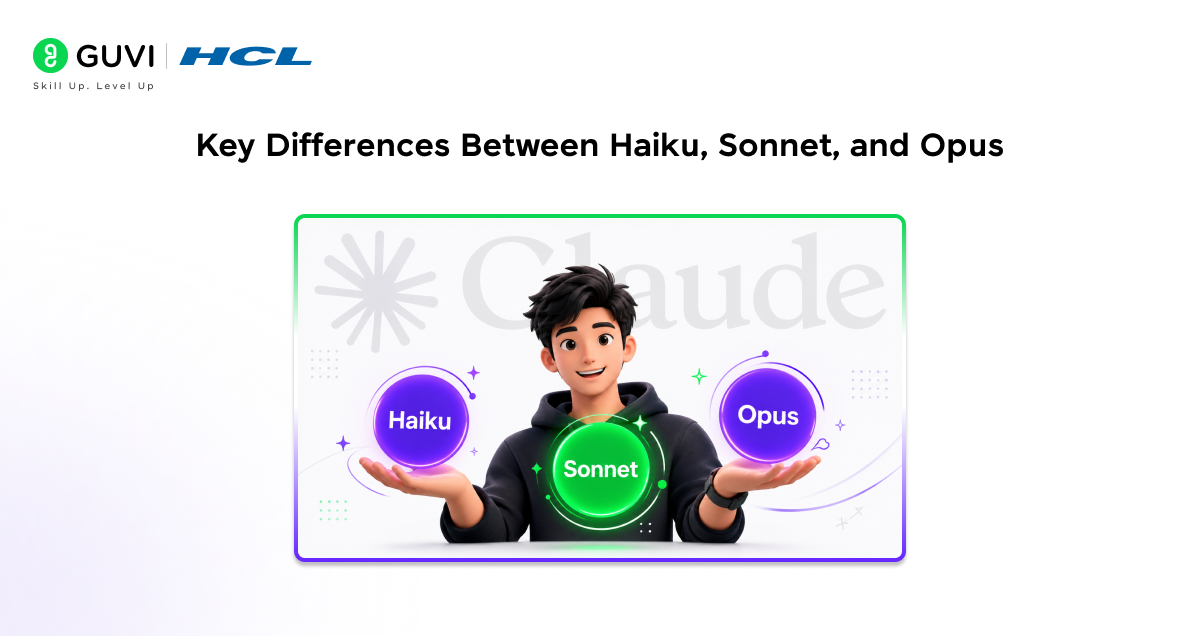
Key Differences Between Haiku, Sonnet, and Opus
Claude Haiku 4.5
Haiku is built for speed and efficiency. It works extremely well in high-throughput environments where rapid responses are needed, such as chatbots, summarization, and basic repetitive automation.
It is also very cost-effective, allowing it to scale without increasing operational costs. However, Haiku cannot handle advanced reasoning or multi-step processes well. It is best suited for simple, fast, and large-scale use cases.
Claude Sonnet 5
Sonnet strikes a good balance in terms of speed, cost, and reasoning ability. It is a strong choice for a wide range of everyday applications such as content writing, automation, and standard business workflows.
It offers better reasoning than Haiku while maintaining competitive speed and moderate cost, making it a reliable option for daily use. It is often the default choice when consistency and cost are prioritized over cutting-edge performance.
Claude Opus 5
Opus is an advanced model designed for deep reasoning and detailed output. It can handle multi-step logic, complex instructions, and in-depth analysis with a higher level of accuracy.
Due to its deeper processing capabilities, Opus is slower and more expensive than Sonnet or Haiku, making it less suitable for high-volume or real-time tasks.
It is best used for research or technical troubleshooting, where accuracy and depth of analysis are more important than speed.
Claude Fable 5.1
Claude Fable 5.1 is Anthropic’s current highest-capability generally available model. It is designed for ambitious, long-running coding, research, and knowledge-work tasks. Anthropic launched Fable 5.1 in September 2026 at $10 per million input tokens and $50 per million output tokens.
Claude Model Comparison 2026: Fable vs Opus vs Sonnet vs Haiku
| Claude Model | Best Suited For | Speed | Reasoning | API Pricing* |
|---|---|---|---|---|
| Claude Fable 5.1 | Advanced coding, research, long-running agentic work | Moderate | Very high | $10 / $50 per 1M input/output tokens |
| Claude Opus 5 | Complex coding, agents, professional work | Moderate | Very high | $5 / $25 per 1M input/output tokens |
| Claude Sonnet 5 | Coding, business workflows, everyday AI tasks | Fast | High | $2 / $10 per 1M input/output tokens |
| Claude Haiku 4.5 | High-volume, low-latency applications | Very fast | Moderate | $1 / $5 per 1M input/output tokens |
Complete Claude Model Comparison in India 2026
Claude models are available to developers and businesses in India through Anthropic’s Claude platform and supported cloud providers. The choice of model should depend on the workload rather than location alone.
For Indian developers and students, Haiku 4.5 can be useful for high-volume, cost-sensitive applications, while Sonnet 5 is suited to general coding and professional workflows. Opus 5 and Fable 5.1 are designed for more demanding reasoning, coding, research, and agentic workloads.
When comparing API costs, Indian users should also consider the USD-to-INR exchange rate, taxes, usage volume, and the application’s token consumption rather than comparing only the listed dollar price.
How These Models Behave in Real Scenarios
Imagine you are building a chatbot that handles thousands of user queries per minute. In this case, Haiku becomes the obvious choice because it responds instantly and keeps costs low. Using Opus here would slow down responses and unnecessarily increase expenses without adding meaningful value.
Now consider a content workflow where you need blog drafts, summaries, or structured outputs. Sonnet fits best here because it maintains a balance between speed and quality. It produces more refined outputs than Haiku without the cost overhead of Opus, making it practical for everyday tasks.
If you are working on technical problem-solving, detailed reports, or multi-step reasoning, Opus becomes the better option. It takes longer, but the depth and accuracy of its output justify the trade-off.
Practical Comparison Mindset
Haiku, Sonnet, and Opus make more sense when viewed as levels of work required. Not every task requires deep reasoning, and not all tasks benefit from speed alone.
Haiku is suitable for tasks that can be completed quickly and simply. Sonnet works well for tasks that require performance, structure, and clarity. Opus becomes useful when high accuracy and complex reasoning are needed.
This perspective makes the decision more practical. It is not about selecting the most powerful model, but about choosing the one that matches the task complexity.
How Claude Models Are Evolving (Latest Trends)

Previously the approach was to utilize the highest available capability model for a task but now the objective is to choose the most efficient model for the task. The main factors driving this are cost, speed and ability to scale the AI system without placing heavy load.
Rising Capability of Lightweight Models
Lightweight models are improving with each version like in the case of Haiku. These models were limited to really simple tasks but they are now capable of managing a variety of tasks reasonably well.
This helps users to reduce cost by using these much faster models than before for most tasks.
Shift Toward Cost Efficient AI Usage
Users who were previously picking the most capable model by default are now trying to use an effective model for required tasks and avoiding unnecessary expense.
This is especially important for large scale usage and small savings can lead to great difference.
If you want to understand how these AI model shifts connect to real world applications and generative AI fundamentals, you can explore this beginner friendly guide here.
Reduced Dependence on High End Models
While high-end models such as Opus still play a role, they are no longer the go-to option. They are being reserved for tasks which require advanced levels of reasoning and higher accuracy. For most of the general tasks a model that balances capability and efficiency is preferred to control the cost.

Modern Claude usage is also expanding into system level integrations like MCP servers, enabling models to connect with external tools and environments.
Most users rely on a single Claude model for all tasks, but real efficiency comes from switching models based on task complexity. Using lighter models for simple tasks and more advanced ones for complex problems can significantly improve performance while reducing unnecessary costs at scale.
Choosing the Right Claude Model for Your Use Case

Content Creation
Sonnet is a strong choice for writing tasks like blogging, summarizing, or basic copywriting. Haiku can be used for repetitive and simple writing tasks when you need content quickly.
Opus is better suited for more descriptive and in-depth content that requires greater detail and precision than speed.
Automation and Chatbots
For automation and chatbot use cases, Haiku is a suitable choice as it runs faster and can manage a high volume of requests and interactions, keeping responses fast and reliable.
Sonnet can be used when more advanced reasoning or context-based interactions are required. Opus is generally not recommended for automation and chatbot use.
In more advanced automation setups, Claude Code and MCP based workflows are also used to improve structured task execution and developer level control.
Complex Tasks
If your task requires in-depth analysis, extensive research, or technical troubleshooting, Opus is the optimal model for you. Opus is engineered to execute more intricate commands, generate detailed results, and achieve enhanced accuracy levels.
Sonnet can manage moderately intricate tasks where balancing performance and budget is critical. Haiku may struggle with complex reasoning tasks.
When Not to Use Each Claude Model
Understanding when not to use each model is just as important as knowing their strengths. It helps avoid poor performance, unnecessary cost, and inefficient usage in real-world tasks.
Haiku
Haiku should not be used for tasks that require deep reasoning, multi step logic, or high accuracy outputs. It can struggle when instructions are complex, layered, or highly specific.
Sonnet
Sonnet is not ideal for advanced analytical work that involves long reasoning chains, technical depth, or highly precise decision making. In such cases, it may lose consistency in output quality.
Opus
Opus should not be used for high volume, repetitive, or cost sensitive tasks where speed and efficiency matter more than deep reasoning. It becomes inefficient when used for simple or large scale workloads.
Common Mistakes When Selecting Claude Models
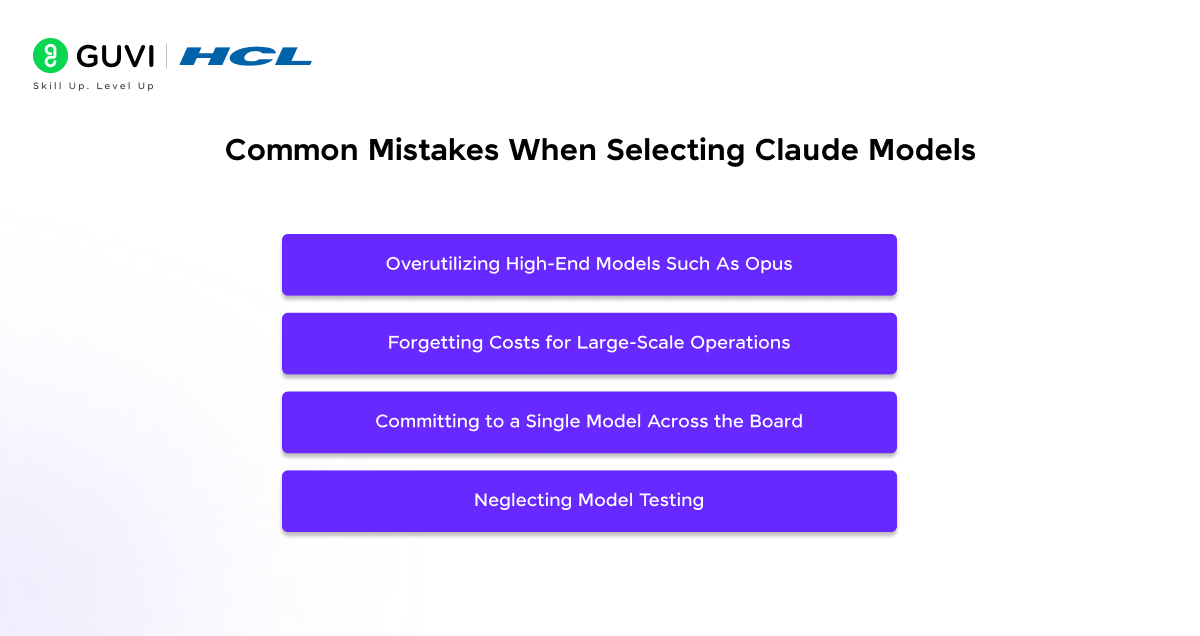
Despite the distinct advantages, many users make easily preventable errors in model selection, primarily arising from overestimations and neglect of practicalities:
Overutilizing High-End Models Such As Opus
Many assume the highest-performance model always delivers the best outcomes. This isn’t true; the use of Opus for rudimentary tasks does nothing to increase efficiency, but merely incurs additional costs.
Forgetting Costs for Large-Scale Operations
An adequate task execution on a small scale can be problematic when performed on a large one. Slight deviations in costs for individual queries escalate significantly when performed at scale; selecting Haiku over another option in such scenarios can provide a notable difference.
Committing to a Single Model Across the Board
Using the same model for all operations can result in reduced efficiency. Different tasks demand varied levels of complexity in reasoning and using the same model across the board often leads to a disparity between cost and performance.
Neglecting Model Testing
Skipping any trial is another oversight. Until tested on your specific use case, one can barely ascertain which model works best. Minor test cases can considerably cut down on both costs and time.
To take this understanding further and build practical, industry aligned skills in Artificial Intelligence and Machine Learning Course, this HCL GUVI program with IIT Madras Pravartak is a strong next step to turn conceptual knowledge into real world capability.
Conclusion
The real value of Claude models comes from using them with intention rather than habit. Instead of relying on a single option for every task, understanding when to use different models leads to better results, smoother workflows, and more efficient use of resources.
When the choice is guided by the nature of the task, performance improves naturally and unnecessary cost is avoided. This is what separates basic usage from truly effective use of AI systems.
FAQs
1. What is the difference between Claude Haiku, Sonnet, and Opus?
The main difference lies in speed, cost, and reasoning capability. Haiku is optimized for fast and simple tasks, Sonnet offers balanced performance for most use cases, and Opus is designed for complex tasks that require deeper reasoning and higher accuracy.
2. Which Claude model is best for beginners?
Sonnet is the best starting point for most users. It provides reliable results across different tasks without being too expensive or too limited in capability.
3. Is Claude Opus worth the cost?
Opus is worth it only for tasks that require advanced reasoning, such as research or technical analysis. For simple tasks, it often increases cost without adding value.
4. Can I use Claude Haiku for content writing?
Haiku can handle basic drafts and summaries. For higher quality writing, Sonnet is usually a better choice.
5. When should I switch between Claude models?
Switch based on task complexity. Use Haiku for simple tasks, Sonnet for general use, and Opus for advanced reasoning.
6. Which Claude model is best for automation and chatbots?
Haiku is ideal due to speed and cost efficiency. Sonnet works better when responses need more context and quality.
7. Is Claude Sonnet 5 better than Claude Opus 5?
They are designed for different trade-offs. Sonnet 5 is positioned as a faster and lower-cost model, while Opus 5 targets more demanding reasoning, coding, and agentic workloads. The better option depends on the task, required quality, latency, and budget.
Success Stories

About the Author
Vishalini Devarajan
An Aerospace Engineer turned content writer, I focus on making complex concepts easy to understand through well-structured, reader-friendly blogs. Whether it’s a technical topic or a non-technical one, I love creating content that is clear, engaging, and impactful.
View all posts by Vishalini Devarajan
Connect with me @













Did you enjoy this article?