


Artificial Intelligence and Machine Learning Articles
AI/ML Skills Gap 2026: Why Companies Can't Find Job-Ready Talent
20 AI/ML Interview Questions Recruiters Can Use Without a Tech Background - Best Guide
How Industry-Backed AI/ML Bootcamps Are Changing the AI/ML Hiring Pipeline - Best Guide 2026
From IT Support to AI Engineer: A Realistic Career Switch Guide 2026


Get In Touch For Details! Request More Information
Is Vibe Coding the Future of Software Development? (2026)
Jul 03, 2026 7 Min Read 1428 Views
(Last Updated)
In February 2025, AI scientist Andrej Karpathy posted a tweet that changed how the world thinks about programming. He described a new way of writing software: you tell an AI what you want in plain English, it writes the code, and you just check if it works. He called it “vibe coding.” Within weeks, the phrase had exploded across developer communities worldwide. By the end of 2025, Collins Dictionary named vibe coding its Word of the Year. By early 2026, the debate is essentially over. Everybody does it.
But is vibe coding actually the future? Or is it a powerful shortcut with a hidden cost? This blog gives you the honest answer, backed by real numbers and real examples from 2026.
Quick Answer
Vibe coding is already the present. 92% of US developers use AI coding tools daily. 46% of all new code written by active developers now comes from AI. The vibe coding tools market is valued at $4.7 billion in 2026 and is projected to reach $12.3 billion by 2027. The question is no longer whether vibe coding is the future. The question is how to use it well.
Table of contents
- What is Vibe Coding?
- Vibe Coding by the Numbers
- What Vibe Coding Does Well
- Speed That Was Previously Impossible
- What It Eliminates for Developers
- What It Enables for Non-Developers
- The Real Risks of Vibe Coding
- Security: The Biggest Concern
- Maintenance: The Hidden Time Bomb
- The Productivity Paradox
- Code Quality
- Vibe Coding vs Traditional Coding: A Balanced View
- Is Vibe Coding Replacing Developers?
- What Vibe Coding Looks Like in Practice
- The Future of Vibe Coding
- Who Should Start Learning Vibe Coding?
- Tips for Using Vibe Coding Responsibly
- 💡 Did You Know?
- Conclusion
- FAQs
- Is vibe coding suitable for complete beginners with no coding experience?
- Will vibe coding replace software developers?
- What are the biggest risks of vibe coding?
- What is the best vibe coding tool for a beginner in 2026?
- Is vibe coding just another name for no-code or low-code?
What is Vibe Coding?
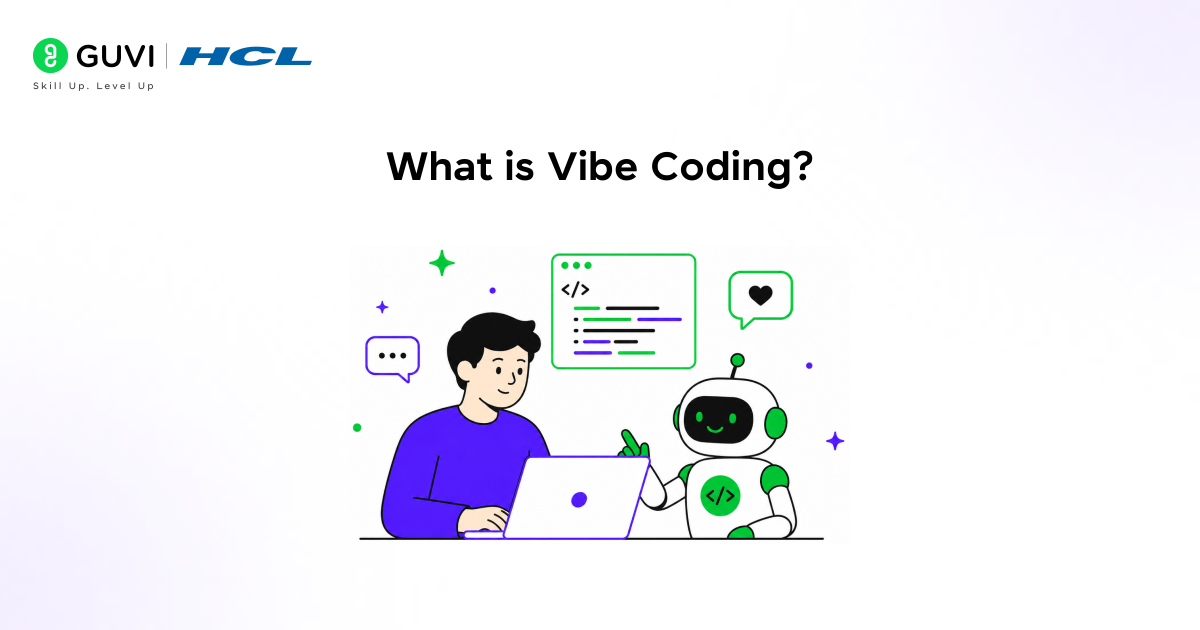
Vibe coding is a way of building software where you describe what you want in plain, everyday language and an AI tool writes the actual code for you. Instead of learning syntax, memorising functions, or wrestling with error messages, you write something like: “Build me a login page with email and Google sign-in” and the AI creates it.
The term comes from Karpathy’s original framing: “You fully give in to the vibes, embrace exponentials, and forget that the code even exists.” The idea is that you focus on the outcome, the vision, the product, and let the AI handle the implementation.
The tools that power vibe coding today:
- Cursor: The most popular AI-first code editor among professional developers. Crossed $2 billion in annualised revenue by early 2026.
- GitHub Copilot: The most widely deployed AI coding assistant globally, with 90% of Fortune 100 companies using it.
- Lovable: A browser-based builder for non-developers. Scaled to $100 million in ARR within eight months.
- Bolt.new: Fast front-end prototyping from a single prompt.
- Replit: Beginner-friendly platform with embedded AI agents.
- Claude Code: Anthropic’s terminal-based coding agent with strong reasoning capabilities.
Thought to ponder: A graphic designer with no programming experience built a children’s app that turns emojis into stories for his 5-year-old. A non-developer launched a native iOS app and started earning money within three weeks. What does it mean for society when building software is no longer limited to people who can code?
Hint: It means the gap between having an idea and shipping it has collapsed. Vibe coding does not eliminate the need for good thinking, but it removes the technical barrier that used to sit between your idea and the world. That is a genuinely transformative change.
Vibe Coding by the Numbers
The data from 2025 and 2026 paints a clear picture. Vibe coding approach is not a niche experiment. It is mainstream.
| Stat | Figure | Source |
| US developers using AI tools daily | 92% | Industry research, 2026 |
| Global developers using AI tools weekly | 82% | Industry research, 2026 |
| Share of all new code that is AI-generated | 46% | GitHub, 2026 |
| Y Combinator startups with 95%+ AI-generated codebases | 25% | Y Combinator, Winter 2025 |
| Fortune 500 companies using at least one vibe coding platform | 87% | Industry research, 2025 |
| Developers reporting higher productivity with AI tools | 74% | Industry research, 2025 |
| Vibe coding market value in 2026 | $4.7 billion | Market analysts, 2026 |
| Projected market value by 2027 | $12.3 billion (38% CAGR) | Market analysts, 2026 |
| Gartner forecast: AI-generated code share by end of 2026 | 60% | Gartner |
MIT Technology Review named generative coding one of its 10 Breakthrough Technologies of 2026. The numbers are not projections or optimistic estimates. They are what is happening right now.
Do check out HCL GUVI’s Artificial Intelligence and Machine Learning Course to gain hands-on experience in AI, machine learning, and real-world projects that prepare you for modern software development trends like vibe coding.
What Vibe Coding Does Well
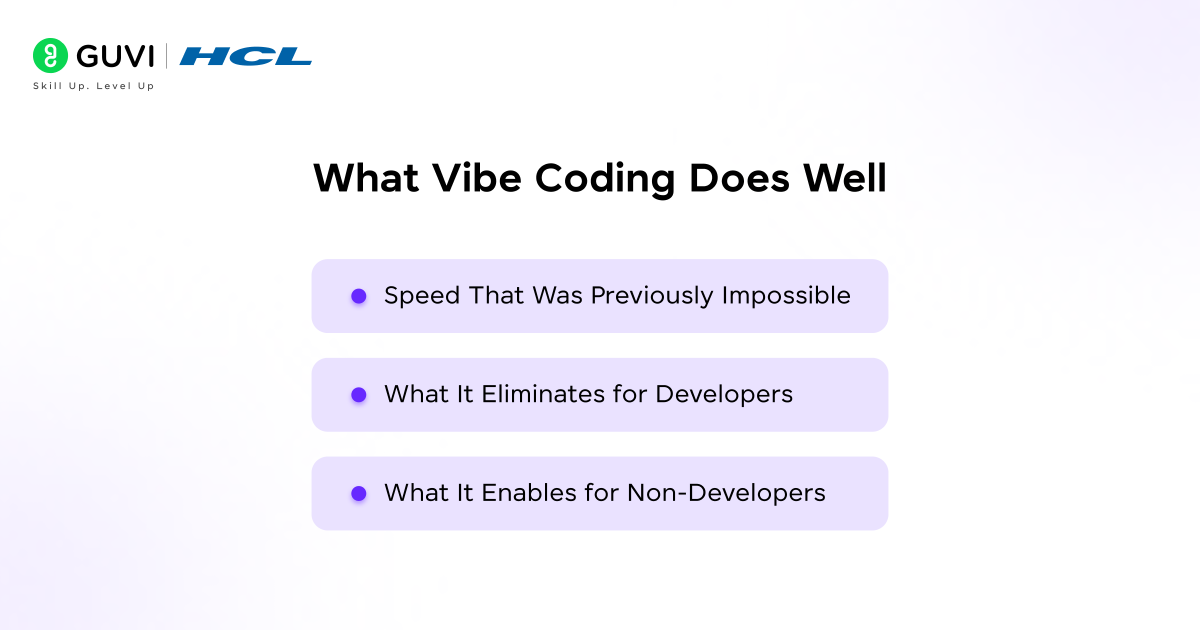
It genuinely changes what is possible for both developers and non-developers. Here is where it delivers real, measurable value.
1. Speed That Was Previously Impossible
- Developers complete tasks 25 to 55% faster with AI assistance, depending on the task type
- Senior developers report an average 81% productivity increase from AI coding tools
- A multiplayer game launched using vibe coding hit $1 million in ARR in just 17 days
- Tasks that used to take weeks now take hours. Entire MVPs can be built in days.
2. What It Eliminates for Developers
It removes the most tedious, repetitive parts of writing software.
- Boilerplate code: Authentication systems, database schemas, CRUD interfaces, form validation. The AI writes these instantly.
- Documentation lookup: No more digging through API docs. Describe what you need in plain English.
- Context switching: Developers spend less time searching documentation and switching between tools.
- Syntax errors: The AI handles the precise grammar of code, so you focus on what the code should do.
3. What It Enables for Non-Developers
This is perhaps the biggest impact of all. For the first time, people without any programming training can build and ship real software.
- Product managers can build internal tools without waiting for engineering bandwidth
- Designers can prototype working products, not just mockups
- Founders can validate ideas by building them, not just pitching them
- Students can bring projects to life without years of prerequisite study
- By 2026, it is estimated that 40% of new SaaS MVPs are built primarily using vibe coding
Riddle: Two people want to build the same app. One is a senior software engineer. One is a marketing manager who has never coded. Both use the same vibe coding tool. Who builds the better app?
Answer: The senior engineer builds the more reliable one. Vibe coding does not eliminate the value of programming knowledge. It amplifies it. A developer who understands code can review what the AI produces, catch security holes, and fix edge cases. A non-developer can build something that works but may not catch problems they do not know to look for. Vibe coding lowers the floor. It does not lower the ceiling.
The Real Risks of Vibe Coding
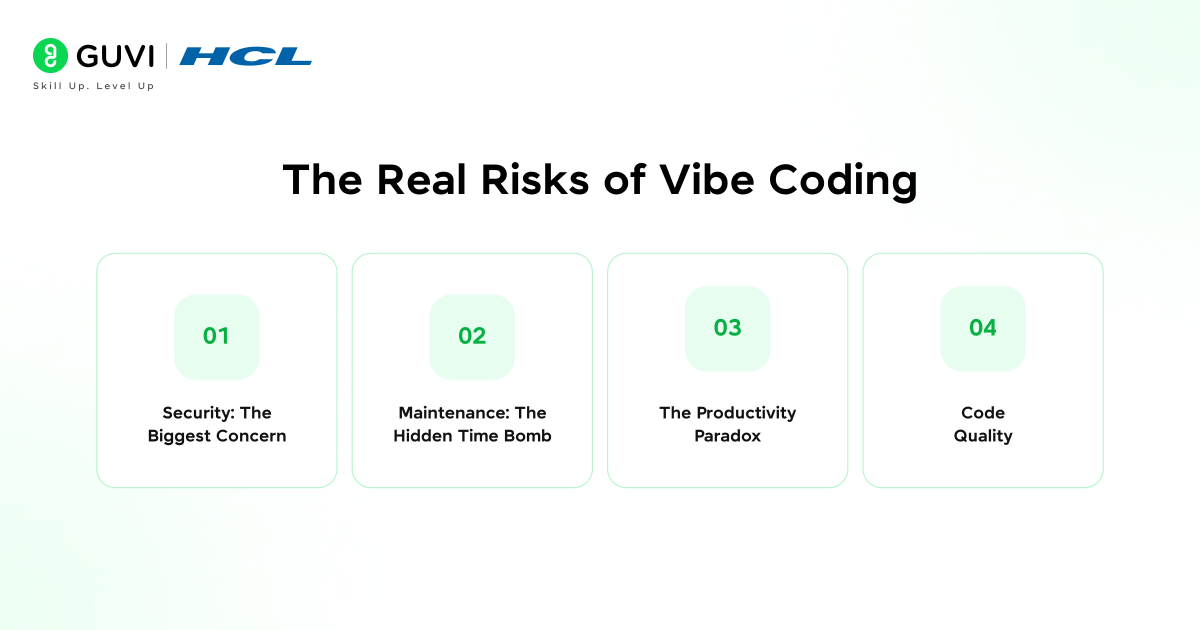
Here is where most enthusiastic articles stop being honest. This approach has genuine, documented problems. You should know them before you rely on it.
1. Security: The Biggest Concern
- 45% of AI-generated code contains security vulnerabilities such as command injection and hardcoded API keys
- A 2025 audit of 1,645 apps built with Lovable found that 10.3% had critical security flaws exposing real user data (CVE-2025-48757)
- A CodeRabbit analysis of 470 pull requests found AI-generated code has 2.74 times higher security vulnerability rates than human-written code
- A 2025 analysis of AI-generated SaaS apps found 62% lacked proper rate limiting on authentication endpoints
The core problem is that AI tools optimize for making code that works, not code that is safe. When 63% of vibe coders are non-developers, many do not know what a security flaw even looks like.
2. Maintenance: The Hidden Time Bomb
One of the most widely shared stories in developer communities in 2025 involved a solo founder who built a complete SaaS product with Cursor. Zero hand-written code. It worked. Users signed up. Then things started breaking. API keys got maxed out. Users were bypassing subscriptions. Random database entries appeared. The developer could not debug it because he had not written it. Every fix Cursor attempted broke something else. The product shut down permanently.
The lesson is not that this approach cannot build a product. It clearly can. The lesson is that it can produce a codebase you cannot maintain. When you do not understand the code, debugging becomes guesswork.
3. The Productivity Paradox
This one is surprising. A METR study in July 2025 ran a randomised controlled trial with experienced open-source developers. Developers using AI tools were 19% slower than those without, despite predicting they would be 24% faster and believing they had been 20% faster after the session. The gains from vibe coding are real for certain tasks, particularly boilerplate and greenfield projects, but experienced developers working on complex, existing codebases do not always benefit.
4. Code Quality
- AI-generated code has 1.7 times more major issues (logic errors, misconfigurations, incorrect dependencies) than human-written code (CodeRabbit, December 2025)
- Logic errors, flawed control flow, and naming inconsistencies are all significantly more common in vibe-generated code
- A January 2026 academic paper titled “Vibe Coding Kills Open Source” argued that vibe coding reduces engagement with open-source maintainers, threatening the ecosystem that AI tools themselves are built on
Vibe Coding vs Traditional Coding: A Balanced View
| Dimension | Vibe Coding | Traditional Coding |
| Speed | Much faster for new projects | Slower, but more deliberate |
| Security | Higher risk by default | Lower risk when done carefully |
| Accessibility | Anyone can build something | Requires significant learning |
| Maintainability | Harder when you did not write it | Easier when you own every line |
| Best for | Prototypes, MVPs, internal tools | Production systems, complex apps |
| Productivity (senior devs) | 25-81% faster on familiar tasks | Baseline |
| Productivity (complex existing codebases) | Sometimes slower | Better control |
The honest summary: vibe coding is excellent for building, risky for deploying, and excellent again when combined with a developer who reviews what the AI produces.

Is Vibe Coding Replacing Developers?
No. And the evidence is clear on this.
AI-assisted development is not eliminating developers. It is changing what developers do. The most in-demand skill in 2026 is not writing syntax. It is judgment: knowing what to build, reviewing what AI produces, catching what AI misses, and steering the product in the right direction.
Organisations embracing this approach are shifting their hiring priorities. They want developers who can effectively prompt and validate AI systems, not just memorise syntax. That is a different skill set, but it is still a technical skill set.
The developers at risk are not the ones who know how to code deeply. They are the ones who only know how to copy-paste from Stack Overflow. AI tools automate the surface-level parts of programming. It cannot replace architectural thinking, security expertise, or domain knowledge.
What changes for developers in 2026:
- Less time writing boilerplate. AI handles setup, scaffolding, and repetitive patterns.
- More time on architecture. Decisions about how systems are designed matter more than ever.
- Review is a core skill. Reading AI-generated code critically is now a daily task.
- Prompt quality matters. Developers who describe problems precisely get better AI output.
What Vibe Coding Looks Like in Practice
The best developers in 2026 use a workflow called the “graduate workflow”:
- Prototype fast using browser-based tools like Bolt or Lovable. Get something working quickly to validate the idea.
- Review and clean the generated code. Identify anything that looks wrong, insecure, or hard to maintain.
- Migrate to production tools like Cursor or Claude Code for refinement, security hardening, and deployment.
- Test ruthlessly. Verify that AI-generated code handles edge cases, authentication flows, and error states correctly.
- Deploy with monitoring. AI-built apps need more observability, not less, because failure modes are less predictable.
The differentiator in 2026 is not whether your team uses AI tools. Every team does. The differentiator is whether you verify what AI produces before it reaches real users.
The Future of Vibe Coding
The trajectory is clear. The adoption curve will not shrink. Here is what industry analysts and researchers expect in the next few years:
- 60% of all new code will be AI-generated by end of 2026 (Gartner)
- The global AI coding tools market will surpass $25 billion by 2030
- Voice-to-code interfaces will emerge, letting developers describe applications verbally
- Domain-specific AI will create coding assistants with deep knowledge of healthcare, finance, and legal compliance
- The EU AI Act (full effect 2026) will require model provenance tracking and human audit trails for critical AI-generated systems
- AI agents will handle entire development workflows: requirements, coding, testing, deployment, and monitoring
The Stanford Continuing Studies programme already offers a course called “Vibe Coding: Building Software in Conversation with AI.” That alone tells you something. When elite universities build their curriculum around a two-year-old term, the trend has left the experimental phase.
Who Should Start Learning Vibe Coding?
It is not just for developers. It is for anyone who wants to build something.
| Who | Why Vibe Coding Makes Sense |
| Developers | 25-81% productivity boost on routine tasks |
| Founders and entrepreneurs | Ship ideas in days, not months |
| Designers | Build working prototypes, not just mockups |
| Product managers | Create internal tools without waiting for engineering |
| Students | Build real projects for portfolios without years of study |
| Anyone with an idea | The barrier between idea and product has never been lower |
Do check out HCL GUVI’s free 5-day AI & ML Email Course that delivers daily lessons covering AI basics, real-world applications, career insights, and project roadmaps to help beginners understand how AI and machine learning are shaping modern software development.
Tips for Using Vibe Coding Responsibly
- Review every line before deploying. “It runs” does not mean “it is safe.” Read what the AI produces, especially authentication and database code.
- Test edge cases yourself. AI-generated code handles happy paths well. It often misses what happens when things go wrong. Test every failure scenario manually.
- Never hardcode secrets. Vibe coding tools sometimes suggest putting API keys directly in code. Always use environment variables.
- Learn enough to review. You do not need to be a senior developer to use vibe coding well, but you need enough knowledge to recognise a problem when you see one.
- Start with prototypes. Vibe coding is safest for MVPs and internal tools. Move to production carefully, with proper code review and security scanning.
- Use version control from day one. Run git init at the start of every project. AI-generated code changes fast and you will want to roll back.
💡 Did You Know?
- Collins Dictionary named vibe coding its Word of the Year for 2025, reflecting how rapidly the term entered mainstream culture and professional discourse.
- Cursor, the AI-first code editor considered the leading vibe coding tool for professional developers, reportedly crossed $100 million in ARR and reached a $9 billion valuation by its Series C funding round.
- The global AI coding investment wave is staggering. Between 2022 and 2025, AI coding tools attracted $9.4 billion in equity funding. Cursor alone raised $900 million in its Series C.
Conclusion
The question “Is this the future?” was fair in mid-2025. By April 2026, the answer is clear. It is not arriving. It is already here, already mainstream, and already reshaping how software gets built.
The real questions worth asking now are more practical. How do you use AI-assisted development without introducing security holes you cannot see? How do you build fast without creating a codebase you cannot maintain? How do you develop the judgment to review AI output effectively?
The tools will keep getting better. The tools will improve. The models will get smarter. The workflows will mature. The developers and builders who learn to work with it now, critically and carefully, will have a significant head start on everyone who waits.
Start small. Build something. Review what the AI produces. Ship it. Then build something bigger.
FAQs
1. Is vibe coding suitable for complete beginners with no coding experience?
Yes. Many successful apps in 2026 have been built by non-developers using vibe coding tools. The key is starting with simple, well-defined projects and learning to review AI output at a high level. The lower the stakes of the project, the safer it is to explore vibe coding as a complete beginner.
2. Will vibe coding replace software developers?
No. It changes what developers do, not whether they are needed. AI handles boilerplate and routine code generation. Developers are shifting toward architecture, code review, security, and directing AI effectively. The skill profile changes, but the demand for technical judgment remains.
3. What are the biggest risks of vibe coding?
Security vulnerabilities in AI-generated code are the biggest concern. Studies show 45% of AI-generated code contains vulnerabilities. Other risks include maintenance problems when you do not understand the code, logic errors that are hard to catch without testing, and technical debt that accumulates faster than in traditional development.
4. What is the best vibe coding tool for a beginner in 2026?
For complete beginners, Lovable and Bolt.new are the most accessible. Both are browser-based and require no setup. For developers who want a full-featured editor, Cursor is the most popular professional choice. GitHub Copilot is the widest-deployed option across enterprise teams.
5. Is vibe coding just another name for no-code or low-code?
No. No-code and low-code tools use pre-built components and drag-and-drop interfaces. These tools use AI to generate real, executable code from natural language. You get the flexibility of real code with the speed of natural language. The output is actual software, not a template with limited customisation.
Success Stories

About the Author
Jebasta
I translate the language of data into stories that anyone can understand. As a writer with a data science background, I simplify analytics, AI, and decision-making so beginners and enthusiasts can confidently explore the world of data.
View all posts by Jebasta
Connect with me @




Did you enjoy this article?