


Artificial Intelligence and Machine Learning Articles
Finance Manager to Data Analytics: Career Growth, Salary and Seniority
How to Evaluate LLM Outputs in Production Deployments
AI/ML Skills Gap 2026: Why Companies Can't Find Job-Ready Talent
20 AI/ML Interview Questions Recruiters Can Use Without a Tech Background - Best Guide


Get In Touch For Details! Request More Information
What is Ensemble Learning in Machine Learning?
Jun 07, 2026 4 Min Read 742 Views
(Last Updated)
Machine learning models often face challenges like overfitting, underfitting, and unreliable predictions when they depend on a single algorithm. This is where ensemble learning becomes a powerful concept in machine learning.
Instead of relying on one model, ensemble learning combines several models to enhance prediction accuracy, stability, and overall performance. Many successful AI systems, such as recommendation engines, fraud detection systems, and search algorithms, use ensemble methods behind the scenes.
In this article, you’ll discover what ensemble learning is, how bagging, boosting, and stacking work, the differences between popular algorithms like Random Forest, AdaBoost, and XGBoost, and why ensemble methods are key to modern machine learning.
Table of contents
- TL:DR
- What is Ensemble Learning?
- Why is Ensemble Learning Important?
- Understanding the Bias-Variance Tradeoff
- What are Weak Learners in Ensemble Learning?
- Bagging in Ensemble Learning
- How Bagging Works
- Random Forest and Bagging
- Boosting in Ensemble Learning
- How Boosting Works
- AdaBoost Explained
- XGBoost Explained
- Stacking in Ensemble Learning
- How Stacking Works
- Bagging vs Boosting vs Stacking
- Real World Applications of Ensemble Learning
- Finance
- Healthcare
- E-Commerce
- Cybersecurity
- Autonomous Systems
- Challenges of Ensemble Learning
- When Should You Use Ensemble Methods?
- Conclusion
- FAQs
- What is ensemble learning in machine learning?
- What is the difference between bagging and boosting?
- Is Random Forest a boosting algorithm?
- Why is XGBoost popular?
- What are weak learners in ensemble learning?
TL:DR
- Ensemble learning merges multiple machine learning models to enhance prediction accuracy and lessen errors.
- Popular ensemble methods include bagging, boosting, and stacking.
- Random Forest employs bagging, while AdaBoost and XGBoost utilize boosting techniques.
- Ensemble methods address the bias-variance tradeoff more effectively than single models.
- Ensemble learning finds applications in fraud detection, recommendation systems, healthcare, and finance.
What is Ensemble Learning?
Ensemble learning is a machine learning technique that combines multiple models, known as base models or weak learners, to make better predictions than a single model can.
The main idea is straightforward. Instead of placing full trust in one model, several models collaborate to make predictions. This typically results in improved accuracy, better generalization, and more stable outputs.
Why is Ensemble Learning Important?
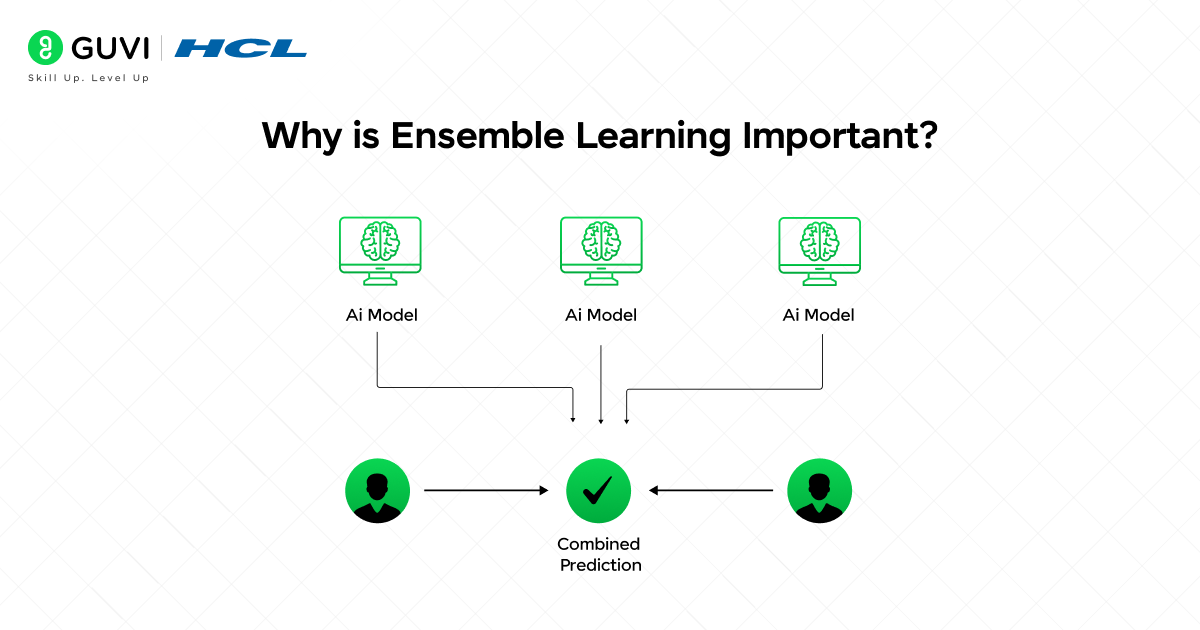
Single machine learning models often struggle with complex datasets. Some models may exhibit high bias, while others may suffer from high variance.
Ensemble methods help balance these issues by leveraging the strengths of multiple models.
Key advantages include:
- Higher prediction accuracy
- Reduced overfitting
- Better generalization
- Improved robustness
- More stable predictions
This is why ensemble methods frequently appear in successful Kaggle solutions and production-quality AI systems.
Understanding the Bias-Variance Tradeoff
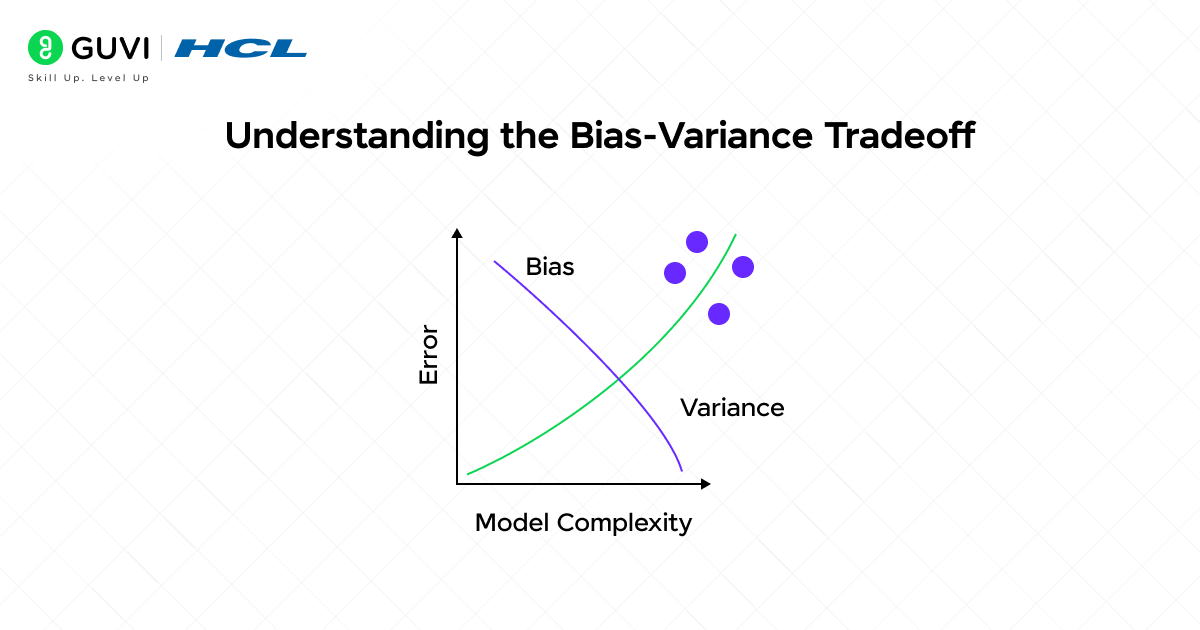
Before diving into ensemble methods, it’s important to grasp the bias-variance tradeoff.
Total Error = Bias² + Variance + Irreducible Error
Bias occurs when a model is too simple and fails to recognize patterns in the data.
Variance occurs when a model becomes overly sensitive to training data, leading to poor performance on unseen data.
Ensemble learning helps minimize either bias, variance, or both, depending on the technique used.
What are Weak Learners in Ensemble Learning?
A weak learner is a model that performs only slightly better than random guessing.
Examples include:
- Small decision trees
- Simple linear classifiers
- Basic regression models like Logistic Regression
Individually, weak learners may not yield great results. However, when combined properly, they can form highly effective predictive systems.
Boosting algorithms particularly depend on weak learners.
Bagging in Ensemble Learning
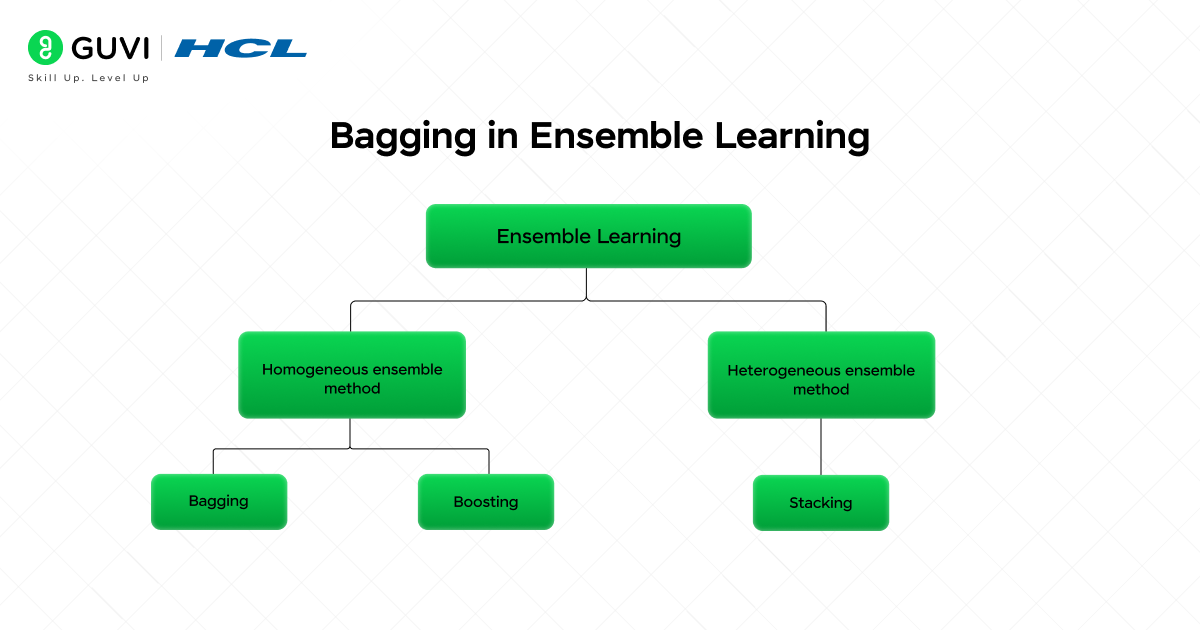
Bagging stands for Bootstrap Aggregating. It is an ensemble method mainly aimed at reducing variance.
In bagging, multiple models are trained independently using random subsets of training data. Their predictions are then combined through averaging or majority voting.
How Bagging Works
- Random subsets are created from the original dataset.
- Multiple base models are trained separately.
- Each model makes predictions independently.
- Final predictions are combined.
Bagging enhances stability and reduces overfitting.
Random Forest and Bagging
f(x) = (1/N) ∑(i=1 to N) fi(x)
Random Forest is one of the most widely used bagging algorithms and is also considered one of the top machine learning classification algorithms.
It combines several decision trees trained on random subsets of data and features. The final output is produced through majority voting or averaging.
Benefits of Random Forest include:
- High accuracy
- Reduced overfitting
- Handles missing data well
- Performs well for classification and regression
Random Forests are widely used in healthcare, banking, cybersecurity, and recommendation systems.
Curious about how these concepts work? Download HCL GUVI’s free AI ebook to learn more about machine learning concepts, Ensemble Learning, and real-world AI applications.
Boosting in Ensemble Learning
Boosting is an ensemble method that focuses on reducing bias.
Unlike bagging, boosting trains models sequentially. Each new model attempts to correct the mistakes of previous models.
The goal is to gradually enhance model performance step by step.
How Boosting Works
- Train the first weak learner.
- Identify incorrect predictions.
- Assign more importance to difficult samples.
- Train another learner, focusing on previous mistakes.
- Repeat until performance improves.
Boosting often generates very effective models.
AdaBoost Explained
AdaBoost stands for Adaptive Boosting.
It gives higher weights to incorrectly classified samples so that future models concentrate on the more challenging cases.
F(x) = ∑(m=1 to M) αmhm(x)
Advantages of AdaBoost include:
- Simple implementation
- Improved accuracy
- Effective with weak learners
- Works well for binary classification problems
However, AdaBoost can be sensitive to noisy datasets and outliers.
XGBoost Explained
XGBoost stands for Extreme Gradient Boosting.
It is one of the most effective and widely adopted machine learning algorithms today. XGBoost gained popularity due to its performance in machine learning competitions and real-world AI applications.
Key features of XGBoost include:

- Parallel processing
- Regularization support
- Missing value handling
- High scalability
- Faster training speed
XGBoost is often used in:
- Fraud detection
- Search ranking
- Customer analytics
- Financial forecasting
- Recommendation systems
Many companies prefer XGBoost because it balances speed, accuracy, and scalability effectively.
During the Netflix Prize competition, one of the biggest breakthroughs in recommendation systems came from the use of ensemble modeling, where multiple algorithms were combined to achieve better predictive performance than any single model alone. This approach helped Netflix significantly improve its recommendation accuracy by blending the strengths of different methods.
Similarly, in modern Kaggle competitions, top-performing solutions rarely rely on a single algorithm. Instead, competitors frequently use techniques like stacking, boosting, and model blending to combine diverse learners into a stronger final predictor. This ensemble strategy consistently leads to more robust and accurate models across a wide range of machine learning tasks.
Stacking in Ensemble Learning
Stacking is an advanced ensemble technique where multiple models are combined using another model called a meta learner.
Instead of simple averaging or voting, stacking intelligently learns how to combine predictions. You can also explore this detailed guide on Stacking in Machine Learning to understand how meta learners work in ensemble systems.
How Stacking Works
- Multiple base models are trained.
- Each model generates predictions.
- Predictions become inputs for a meta model.
- The meta model produces the final prediction.
Stacking often combines models like:
- Decision Trees
- Logistic Regression
- Random Forest
- Gradient Boosting
- Neural Networks
This approach can yield highly accurate systems when implemented correctly.
Bagging vs Boosting vs Stacking
- Bagging focuses on reducing variance through parallel training.
- Boosting aims to reduce bias through sequential learning.
- Stacking combines different models using a meta learner.
Each method has unique strengths depending on the dataset and the machine learning problem.
Real World Applications of Ensemble Learning
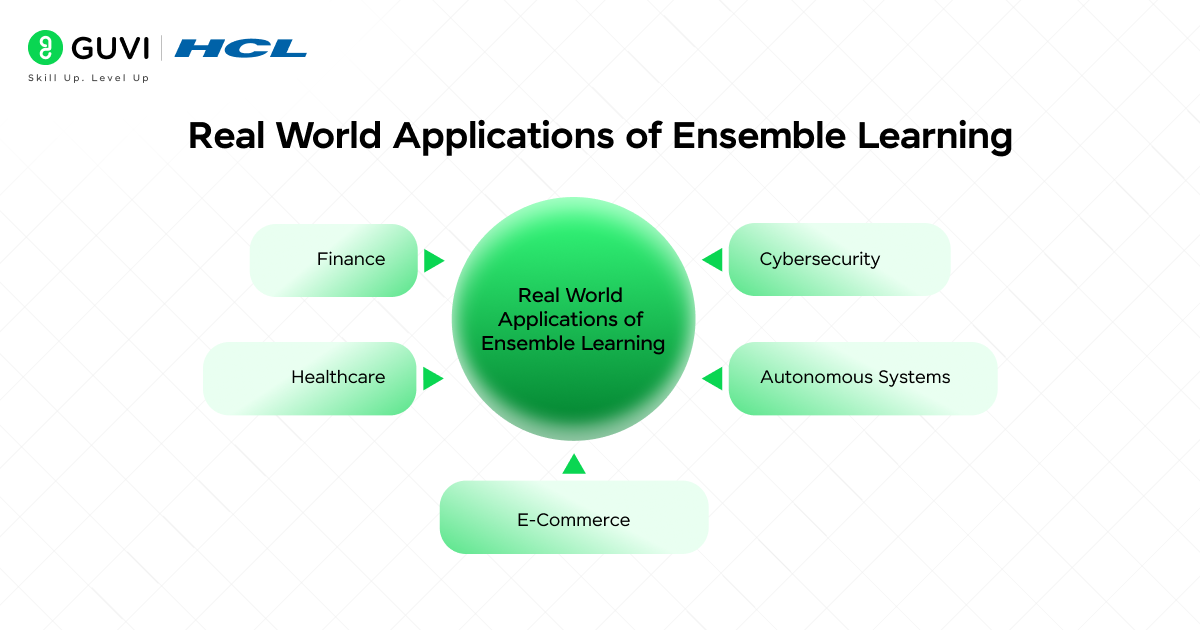
Ensemble learning is applied across many industries due to its strong predictive performance.
Finance
Banks employ ensemble methods for fraud detection, credit scoring, and risk prediction.
Healthcare
Hospitals use ensemble learning for disease prediction and medical diagnosis systems.
E-Commerce
Recommendation engines implement ensemble models to personalize product suggestions.
Cybersecurity
Ensemble methods assist in detecting spam, malware, and suspicious network activities.
Autonomous Systems
Self-driving systems depend on ensemble models for object detection and decision making.
Challenges of Ensemble Learning
Despite its benefits, ensemble learning has some limitations.
Common challenges include:
- Higher computational cost
- Increased training time
- Complex implementation
- Difficult model interpretation
- Larger memory usage
For small datasets or simple tasks, single models might still be more practical.
When Should You Use Ensemble Methods?
Ensemble learning is most effective when:
- Prediction accuracy is critical
- Single models show inconsistent performance
- Datasets are complex
- Overfitting needs to be minimized
- High competition performance is necessary
However, for simpler applications, lightweight models may still suffice.
After exploring ensemble techniques, learning algorithms like Decision Trees and Gradient Boosting can help you build a solid foundation in machine learning.
You can also learn more by HCL GUVI’s AI and Machine Learning courses for hands-on experience with ensemble methods and practical ML projects.
Conclusion
Ensemble learning is one of the most effective techniques in machine learning because it combines the strengths of multiple models to generate better predictions.
Methods like bagging, boosting, and stacking address issues related to bias, variance, and model instability. Algorithms such as Random Forest, AdaBoost, and XGBoost have become industry standards due to their exceptional performance in real-world applications.
As machine learning systems continue to evolve, ensemble methods will remain vital in developing accurate and scalable AI solutions.
FAQs
1. What is ensemble learning in machine learning?
Ensemble learning is a technique that merges multiple machine learning models to improve prediction accuracy and performance.
2. What is the difference between bagging and boosting?
Bagging train models independently to reduce variance, while boosting train models sequentially to reduce bias.
3. Is Random Forest a boosting algorithm?
No, Random Forest is a bagging algorithm based on multiple decision trees.
4. Why is XGBoost popular?
XGBoost is popular due to its high accuracy, fast performance, regularization support, and scalability.
5. What are weak learners in ensemble learning?
Weak learners are simple models that perform slightly better than random guessing and are combined to form stronger predictive systems.
Success Stories

About the Author
Vishalini Devarajan
An Aerospace Engineer turned content writer, I focus on making complex concepts easy to understand through well-structured, reader-friendly blogs. Whether it’s a technical topic or a non-technical one, I love creating content that is clear, engaging, and impactful.
View all posts by Vishalini Devarajan
Connect with me @











Did you enjoy this article?