


Artificial Intelligence and Machine Learning Articles
Finance Manager to Data Analytics: Career Growth, Salary and Seniority
How to Evaluate LLM Outputs in Production Deployments
AI/ML Skills Gap 2026: Why Companies Can't Find Job-Ready Talent
20 AI/ML Interview Questions Recruiters Can Use Without a Tech Background - Best Guide

Get In Touch For Details! Request More Information
Characteristics of AI: The Defining Features of AI
Jul 14, 2026 6 Min Read 999 Views
(Last Updated)
Imagine a system that learns from experience without being explicitly programmed, recognizes patterns humans cannot see, and makes decisions in milliseconds across millions of data points simultaneously. This is artificial intelligence demonstrating its core characteristics that separate it from traditional software.
AI is fundamentally different from conventional computer programs. Traditional software follows fixed rules. AI systems learn patterns from data and adapt their behavior based on experience. A calculator performs the same operations forever. An AI system improves over time, handles situations it has never seen before, and solves problems in ways its creators did not anticipate.
Understanding the characteristics of AI is essential whether you are building AI systems, evaluating AI tools, or simply trying to understand what AI can and cannot do.
This guide explains the core characteristics that make artificial intelligence intelligent and what they mean for real-world applications.
Table of contents
- Quick TL;DR Summary
- Why AI Characteristics Matter More Than Definitions
- Core Characteristics of Artificial Intelligence
- How AI Characteristics Enable Real-World Applications
- Evaluating AI Systems By Their Characteristics
- Step 1: Test Learning Capability
- Step 2: Evaluate Adaptability to Change
- Step 3: Assess Reasoning Capabilities
- Step 4: Challenge Problem-Solving Skills
- Step 5: Test Perception Accuracy
- Step 6: Examine Language Understanding
- Step 7: Measure Autonomy Level
- Characteristics That Distinguish Strong AI From Weak AI
- Conclusion
- FAQs
- What is the most important characteristic of AI?
- Can AI have some characteristics but not others?
- How do AI characteristics relate to machine learning?
- What characteristics do current AI systems lack?
- How can I tell if a system really has AI characteristics or is just traditional software?
Quick TL;DR Summary
- This guide explains the fundamental characteristics that define artificial intelligence and distinguish it from traditional software systems.
- You will learn about learning ability, adaptability, reasoning, problem-solving, perception, and natural language processing as core AI capabilities.
- The guide covers how these characteristics work together to enable AI systems to handle complex tasks that require human-like intelligence.
- Real-world examples demonstrate each characteristic in action across different AI applications and use cases.
- You will understand which characteristics matter most for different types of AI systems and how to evaluate whether a system truly exhibits intelligent behavior.
What Are the Characteristics of AI?
The characteristics of AI are the core capabilities that allow artificial intelligence systems to perform tasks that normally require human intelligence. These characteristics include learning from data, adapting to changing situations, reasoning and problem-solving, understanding language, perceiving environments through vision or sensors, making decisions, and interacting naturally with humans. Together, these abilities enable AI systems to operate more intelligently and flexibly than traditional rule-based software.
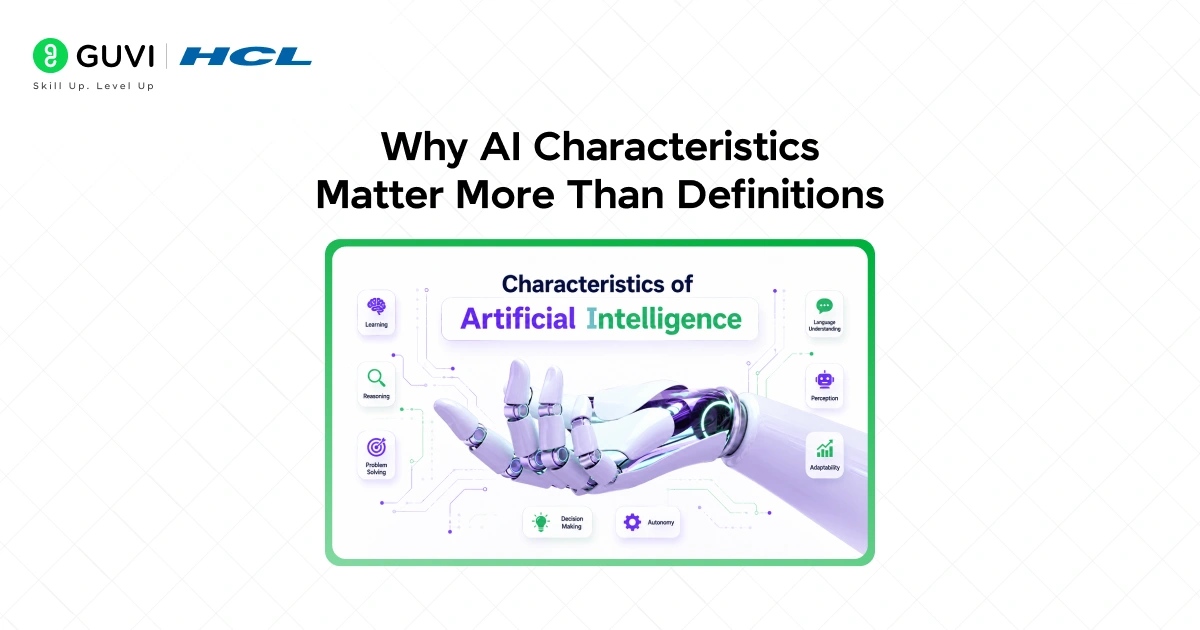
Why AI Characteristics Matter More Than Definitions
- Characteristics define what AI can actually do
Knowing that something is called AI tells you nothing about its capabilities. Understanding its specific characteristics tells you whether it can learn from new data, handle unexpected situations, or reason through complex problems. The characteristics determine the practical value of an AI system for your specific needs.
- Not all AI systems have all characteristics
Some AI systems excel at pattern recognition but cannot reason logically. Others can process language but cannot learn from new examples without retraining. The specific combination of characteristics determines what problems an AI system can solve. Matching characteristics to requirements is how you choose the right AI approach.
- Characteristics reveal limitations and risks
Understanding which characteristics an AI system lacks helps you identify failure modes and risks. A system that can learn but cannot explain its reasoning might make decisions you cannot audit. A system that perceives but cannot adapt might fail when conditions change. Knowing the characteristics tells you where problems will emerge.
- Marketing claims versus actual capabilities
Many products claim to use AI without exhibiting the core characteristics of intelligent systems. They might use simple rules or statistical methods with no learning or adaptation. Evaluating actual characteristics cuts through marketing hype and reveals whether a system is genuinely intelligent or just conventional software with an AI label.
- Characteristics evolve as AI advances
What counts as a defining characteristic of AI changes as the field progresses. Tasks that once required human intelligence become routine automation. Understanding current characteristics helps you track where the boundary between AI and traditional software lies today and anticipate where it will move tomorrow.
Read More: How AI Works? A Comprehensive Guide
Core Characteristics of Artificial Intelligence

- Learning Ability: Improving Performance From Experience
AI systems learn patterns from data without explicit programming
Learning is the most fundamental characteristic of AI. Traditional programs do exactly what programmers tell them to do forever. AI systems examine data, identify patterns, and adjust their behavior to improve performance. A spam filter learns which emails are junk by analyzing thousands of examples and gets better over time without anyone writing new rules.
- Adaptability: Adjusting to New Situations
AI systems modify their behavior when conditions change
Adaptability means AI can handle situations different from what it encountered during training. A recommendation system adapts when user preferences shift. An autonomous vehicle adapts to weather conditions it has never seen before. This separates AI from brittle rule-based systems that break when conditions vary.
- Reasoning: Drawing Logical Conclusions
AI systems infer new knowledge from existing information
Reasoning is the ability to derive conclusions from available evidence using logical processes. AI systems can perform deductive, inductive, and abductive reasoning. Expert systems use reasoning to solve problems in specialized domains. Reasoning allows AI to go beyond memorization to actually think through problems.
- Problem Solving: Finding Solutions to Complex Challenges
AI systems search through possibilities to achieve goals
Problem-solving involves defining objectives and finding solutions that meet constraints. AI excels at optimization problems where the goal is finding the best solution among countless options. Route planning, resource allocation, and scheduling are tasks where AI outperforms humans by evaluating far more possibilities.
- Perception: Understanding Sensory Information
AI systems interpret images, sounds, and other sensory data
Perception is the ability to extract meaning from raw sensory input like images, audio, or video. Computer vision allows AI to recognize objects and scenes. Speech recognition converts audio into text. Perception connects AI to the physical world and is essential for robotics, autonomous vehicles, and medical imaging.
- Natural Language Processing: Understanding and Generating Human Language
AI systems comprehend and produce text and speech
Natural language processing enables AI to work with human language. AI can understand text, answer questions, translate between languages, and generate coherent written content. NLP requires handling ambiguity and context dependence, enabling chatbots, virtual assistants, and content generation systems.
- Autonomy: Operating Without Human Intervention
AI systems make decisions and take actions independently
Autonomy is the ability to operate without constant human guidance. Autonomous AI systems perceive their environment, make decisions based on their goals, and take actions to achieve objectives. Self-driving cars and trading algorithms demonstrate autonomy by responding faster than humans and operating continuously.
The idea of AI learning from experience dates back to 1959, when Arthur Samuel developed a checkers-playing program that improved its performance through self-play. Over time, the system became skilled enough to defeat Samuel himself, marking one of the earliest demonstrations that machines could go beyond simply following fixed instructions and instead improve autonomously through experience. Samuel’s work became a foundational milestone in the history of machine learning and adaptive AI systems.
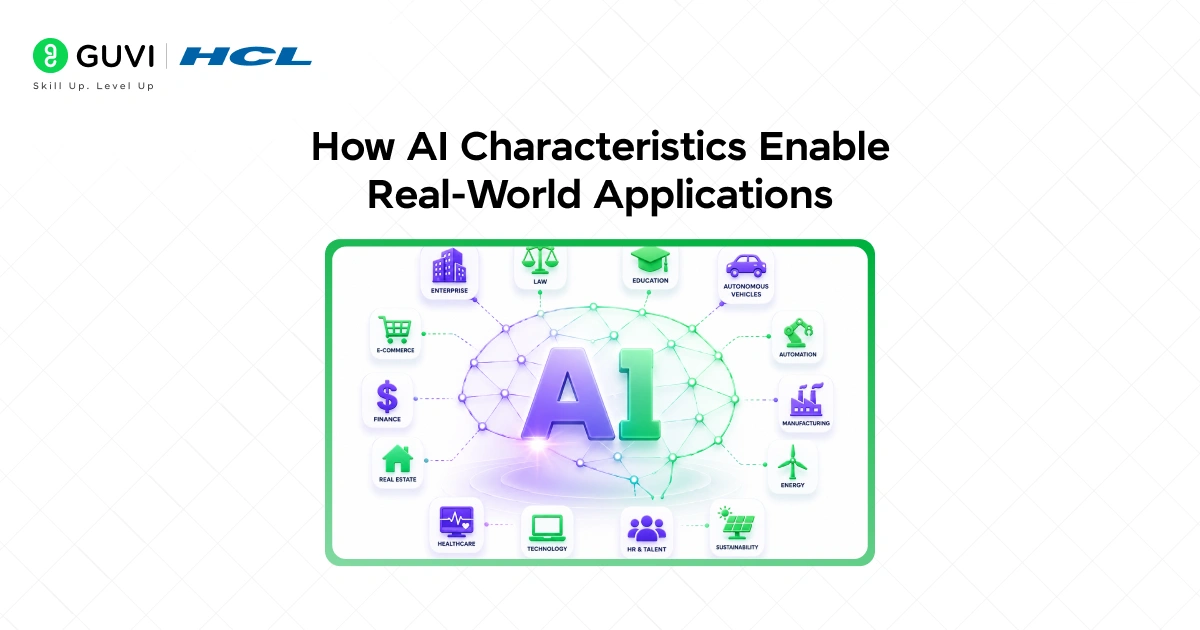
How AI Characteristics Enable Real-World Applications
- Image recognition combines perception and learning
Medical imaging AI uses perception to analyze X-rays, MRIs, and CT scans. Learning allows the system to improve accuracy as it sees more cases. The combination enables detection of tumors, fractures, and abnormalities that might be missed by human examination. Perception provides the raw capability while learning provides continuous improvement from experience.
- Virtual assistants combine NLP, reasoning, and problem-solving
Voice assistants understand spoken requests through natural language processing. They reason about user intent and context to determine appropriate responses. They solve problems like finding information, setting reminders, or controlling smart home devices. The integration of multiple characteristics creates useful interactive systems that understand and help with everyday tasks.
- Autonomous vehicles combine perception, learning, and adaptability
Self-driving cars perceive their environment through cameras, lidar, and radar. They learn driving patterns from massive amounts of training data. They adapt to varying road conditions, traffic patterns, and weather. Autonomy allows them to make split-second decisions without human input. All these characteristics must work together reliably for safe operation.

Want to understand the characteristics of AI? Download HCL GUVI’s free Generative AI ebook to master core concepts, practical safeguards, and real-world implementation strategies.
Evaluating AI Systems By Their Characteristics
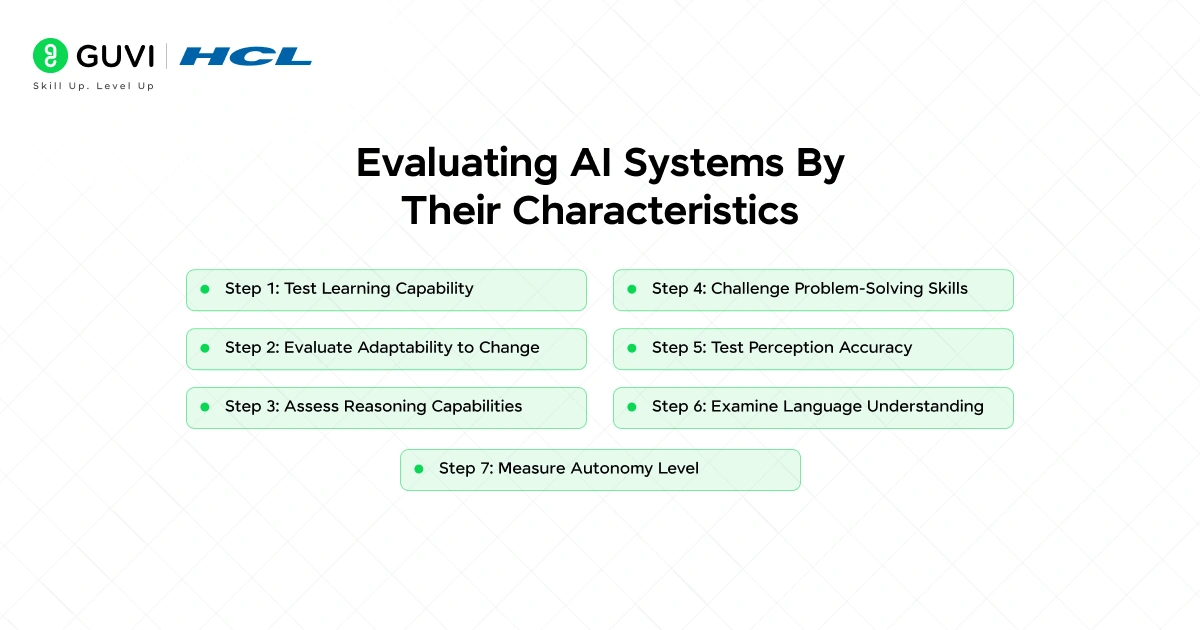
Here is how to assess whether an AI system genuinely exhibits intelligent characteristics.
Step 1: Test Learning Capability
Verify the system improves with new data
Check whether the system’s performance actually improves as it processes more examples. A true learning system should handle new similar cases better over time. Test it with novel examples and observe whether accuracy increases after training on those examples. Systems that cannot learn are not exhibiting this core AI characteristic regardless of their marketing claims.
Step 2: Evaluate Adaptability to Change
Introduce variations and measure response
Change the input conditions, data distributions, or environment and observe how the system responds. Does it maintain reasonable performance or fail completely? Adaptive systems handle variations gracefully. Brittle systems break when conditions differ from training. This reveals whether the system has genuine adaptability or just memorized specific patterns.
Step 3: Assess Reasoning Capabilities
Present problems requiring logical inference
Give the system tasks that require drawing conclusions from available information rather than pattern matching. Can it answer questions requiring multi-step reasoning? Does it make logical inferences? Systems with reasoning capabilities can handle novel logic problems. Systems without reasoning can only match patterns they have seen before.
Step 4: Challenge Problem-Solving Skills
Pose complex optimization or planning tasks
Present problems with multiple constraints and objectives. Does the system find good solutions or just return memorized responses? True problem-solving involves exploring solution spaces and optimizing. Simple lookup tables or basic rules are not problem-solving even if they sometimes produce correct answers.
Step 5: Test Perception Accuracy
Provide varied sensory inputs
For systems claiming perception capabilities, test with diverse images, audio, or sensor data including edge cases. Does it accurately extract information from noisy, ambiguous, or unusual inputs? Genuine perception handles variability. Simple template matching fails when conditions vary.
Step 6: Examine Language Understanding
Use nuanced, ambiguous, or context-dependent language
For NLP systems, test with language requiring contextual understanding, handling ambiguity, or dealing with unusual phrasing. Can it understand implied meaning, sarcasm, or context-dependent interpretation? True language understanding goes beyond keyword matching to comprehend actual meaning.
Step 7: Measure Autonomy Level
Observe decision-making without human intervention
Determine how much human guidance the system requires. Does it make independent decisions or need constant oversight? What happens when unexpected situations arise? True autonomy means the system handles novel situations appropriately without human intervention for every decision.
The famous Turing Test, proposed by Alan Turing in 1950, was one of the earliest attempts to define artificial intelligence through observable behavior rather than internal mechanisms. Turing argued that if a machine could engage in conversation so convincingly that a human could not reliably distinguish it from another person, the machine could reasonably be considered intelligent. Although modern AI research now focuses more on specific capabilities and measurable performance, the Turing Test established the influential idea that intelligence should be evaluated by what a system can actually do.
Characteristics That Distinguish Strong AI From Weak AI
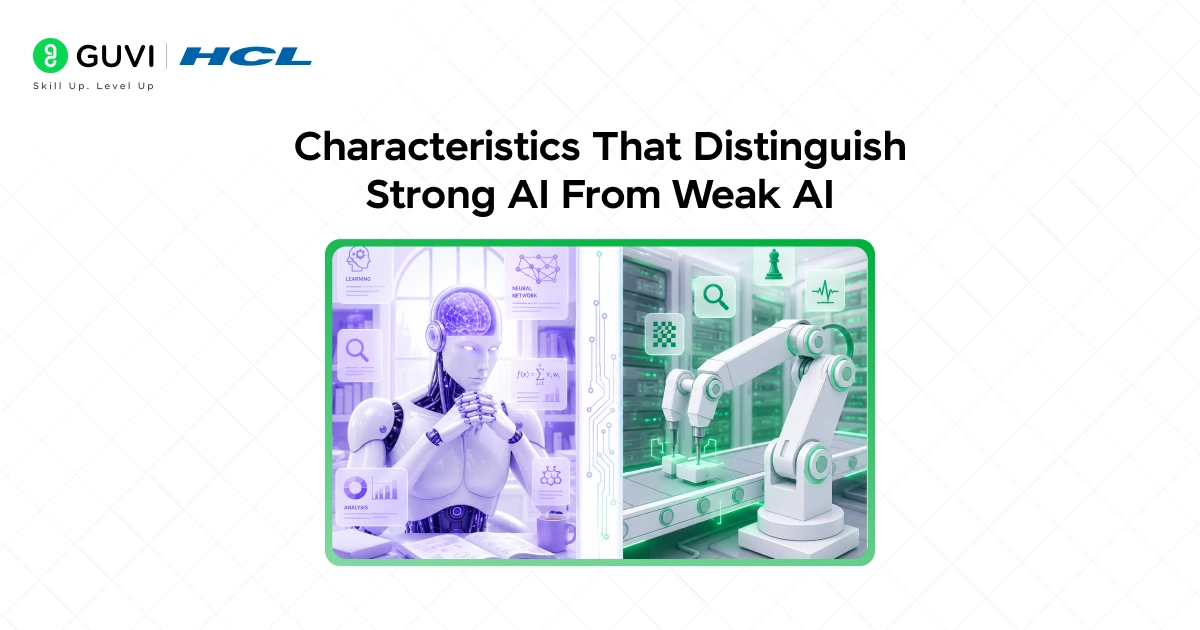
- Weak AI: Narrow capabilities for specific tasks
Most current AI systems are weak or narrow AI. They exhibit some AI characteristics but only within limited domains. A chess-playing AI is intelligent at chess but cannot drive a car or understand language. Image recognition AI can identify objects but cannot reason about relationships. Weak AI has specialized intelligence without general capabilities.
- Strong AI: General intelligence across domains
Strong AI, also called artificial general intelligence (AGI), would exhibit all AI characteristics across any domain like humans do. It could learn new tasks, reason about unfamiliar problems, adapt to any environment, and transfer knowledge between completely different domains. No current AI systems are strong AI. This remains a theoretical goal rather than current reality.
To learn more about AI characteristics and how to build intelligent systems, do not miss the chance to enroll in this HCL GUVI’s AI and Machine Learning course covering AI fundamentals, machine learning techniques, neural networks, and practical implementation through hands-on projects and expert guidance with certification.
Conclusion
The characteristics of AI define what makes artificial intelligence intelligent. Learning ability, adaptability, reasoning, problem-solving, perception, natural language processing, and autonomy are the core capabilities that separate AI from traditional software.
Not every AI system exhibits all characteristics. Understanding which specific capabilities a system has reveals what problems it can solve and where it will fail. Matching AI characteristics to your requirements is how you choose the right approach for your needs.
AI characteristics continue to evolve as the field advances. The boundary between AI and conventional software constantly shifts as new techniques emerge and existing capabilities mature.
Whether you are building AI systems, evaluating AI tools, or simply trying to understand what AI can do, focus on actual characteristics rather than marketing claims. The characteristics tell you what the system can actually accomplish.
FAQs
1. What is the most important characteristic of AI?
Learning ability is the most fundamental characteristic. The ability to improve from experience without explicit programming is what makes AI different from traditional software. Without learning, a system is just following fixed rules regardless of how complex those rules are.
2. Can AI have some characteristics but not others?
Yes. Most AI systems are specialized with only some characteristics. An image recognition system has perception and learning but no language processing. A chess AI has problem-solving but no perception of the physical world. Different applications require different combinations of characteristics.
3. How do AI characteristics relate to machine learning?
Machine learning is the primary technique that gives AI its learning characteristic. Other characteristics like perception and NLP are often implemented using machine learning methods. Machine learning is not the only AI technique but it is the foundation for most modern AI characteristics.
4. What characteristics do current AI systems lack?
Most current AI lacks common sense reasoning, causal understanding, general adaptability across domains, true creativity, and the ability to learn from very few examples like humans do. They also lack consciousness and self-awareness though whether these are necessary for intelligence is debated.
5. How can I tell if a system really has AI characteristics or is just traditional software?
Test whether it learns and improves from data rather than following fixed rules. Check if it handles situations it was not explicitly programmed for. Verify it adapts when conditions change. If it cannot do these things, it is traditional software regardless of marketing claims.
Success Stories

About the Author
Vishalini Devarajan
An Aerospace Engineer turned content writer, I focus on making complex concepts easy to understand through well-structured, reader-friendly blogs. Whether it’s a technical topic or a non-technical one, I love creating content that is clear, engaging, and impactful.
View all posts by Vishalini Devarajan
Connect with me @












Did you enjoy this article?