


Artificial Intelligence and Machine Learning Articles
AI/ML Skills Gap 2026: Why Companies Can't Find Job-Ready Talent
20 AI/ML Interview Questions Recruiters Can Use Without a Tech Background - Best Guide
How Industry-Backed AI/ML Bootcamps Are Changing the AI/ML Hiring Pipeline - Best Guide 2026
From IT Support to AI Engineer: A Realistic Career Switch Guide 2026


Get In Touch For Details! Request More Information

Informed vs Uninformed Search in AI
Aug 19, 2026 6 Min Read 683 Views
(Last Updated)
Artificial Intelligence is built on problem-solving and decision-making. Whenever AI systems find routes, solve puzzles, recommend content, or make predictions, search algorithms work behind the scenes.
Some algorithms explore solutions blindly, while others use heuristics and intelligent estimates to make faster decisions. These approaches are known as uninformed and informed search.
In this blog, you will learn how informed and uninformed search works, their differences, major algorithms like BFS, DFS, and A*, along with real-world AI applications.
Table of contents
- TL; DR.
- Understanding Search Problems in AI
- What is Uninformed Search?
- Key Characteristics
- Breadth-first Search
- How BFS Works
- BFS Example
- BFS Python Example
- Advantages of BFS
- Limitations of BFS
- Depth First Search
- How DFS Works
- DFS Python Example
- Advantages of DFS
- Limitations of DFS
- Comparison
- Informed Search Algorithms
- What is Informed Search?
- What is a Heuristic Search?
- Best First Search
- How it Works
- Real World Example
- Advantages of Best First Search
- Disadvantages of Best First Search
- A* Algorithm
- Why A* is Superior
- A* Evaluation Function
- Simple A* Inspired Example
- Simplified Python Example
- Advantages of A* Search
- Limitations of A* Search
- Difference Between Informed and Uninformed Search.
- When Should You Use Uninformed Search?
- When Should You Use Informed Search?
- Real World Applications of Search Algorithms.
- Navigation Systems.
- Robotics.
- Gaming AI.
- Recommendation Systems.
- Autonomous Vehicles.
- Chatbots and Conversational AI.
- Practical Example: Solving a Maze Using Search Strategies.
- How Uninformed Search Handles It.
- How Informed Search Handles It.
- How Search Algorithms Connect to Modern AI?
- Conclusion.
- FAQs.
- What is the difference between informed and uninformed search in AI?
- Why is BFS called an uninformed search algorithm?
- What is a heuristic in Artificial Intelligence?
- Why is the A* algorithm widely used?
- Which search algorithm is better, BFS or DFS?
- Where are informed search algorithms used in real life?
TL; DR.
- Informed and uninformed search are two major problem-solving approaches used in Artificial Intelligence.
- Uninformed search algorithms explore paths without extra knowledge, while informed search algorithms use heuristics to make smarter decisions.
- Algorithms like BFS and DFS belong to blind search methods, whereas A* and Best First Search are heuristic-based techniques.
- Choosing the right search strategy directly affects speed, memory usage, efficiency, and solution quality.
- Modern AI systems, robotics, recommendation engines, and navigation tools heavily depend on intelligent search strategies.
What is Informed vs Uninformed Search?
Informed and uninformed search are two major approaches used by AI systems to solve problems and navigate state spaces. Uninformed search explores possible paths systematically without using additional knowledge about the goal, while informed search uses heuristics or estimated guidance to prioritize the most promising paths and reach solutions more efficiently.
Understanding Search Problems in AI
Before we get to know any algorithm, it is important to learn what a search problem is in AI.
A search problem usually contains:
- Initial State
- Goal State
- Possible Actions
- Path Cost
- State Space
For instance, a robot is trying to travel across a warehouse. It has to start from one place. Go to a particular shelf. The possible moves are to go right, left, up, or down. Every movement costs something.
The path to the destination constitutes the state space, and the search algorithm determines how the robot will traverse the whole space to find the target.
What is Uninformed Search?
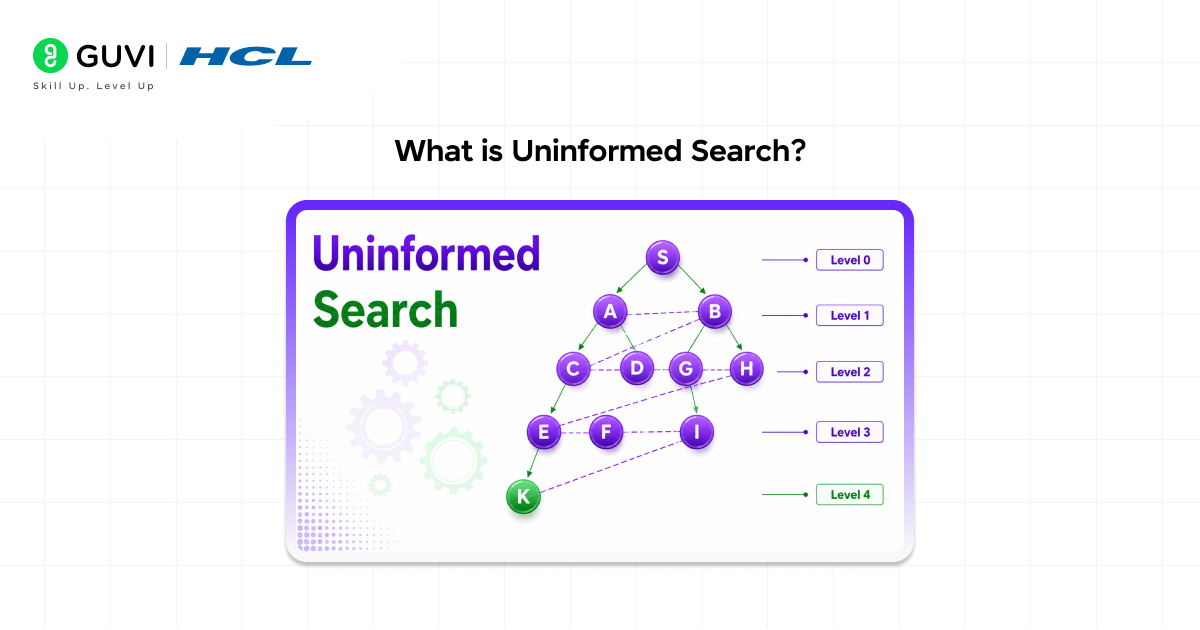
Uninformed search, also known as blind search, is a search technique used in AI to find the goal where there is not much information about the problem itself, besides the problem’s specification.
The search doesn’t know any better direction. It proceeds with a pre-defined step until a solution is found.
These algorithms do not make use of any kind of heuristic or intelligent estimate.
Key Characteristics
- Does not make use of any domain-specific information.
- Follows rules to explore possibilities.
- Consumes too much time/memory.
- Efficient for smaller/simpler state spaces.
- Guarantees finding a solution where available.
Breadth-first Search
BFS explores neighbors level by level and then progresses towards outer levels.
It uses a queue and guarantees the shortest path in unweighted graphs.
How BFS Works
- From the start state, all the neighbor states are visited.
- After that, the neighbors of the neighbors are visited.
- Thus, it searches breadth-wise level by level.
- It works until the goal state is found.
BFS Example
Consider a route on a metro system where the cost of travel between all the two stops is the same, to find the path, BFS would visit all neighbor station first before proceeding to its neighbor station.
BFS Python Example
from collections import deque
graph = {
‘A’: [‘B’, ‘C’],
‘B’: [‘D’, ‘E’],
‘C’: [‘F’],
‘D’: [],
‘E’: [],
‘F’: []
}
def bfs(graph, start):
visited = set()
queue = deque([start])
while queue:
node = queue.popleft()
if node not in visited:
print(node)
visited.add(node)
queue.extend(graph[node])
bfs(graph, ‘A’)
Advantages of BFS
- Finds the shortest path in an unweighted graph.
- Guaranteed to find a solution if available.
- Easy to implement.
Limitations of BFS
- Requires high memory.
- Slow in many cases, especially in bigger states.
- Visits unnecessary states.
Depth First Search
DFS explores from one side first and then backtracks to explore from the other side.
Unlike BFS, which explores level by level, DFS would traverse down a branch as much as possible before backing up to find more branches.
How DFS Works
- From the start state, one child state is chosen.
- Now that the child is explored down until the leaf node, or it can’t go down.
- Backtracking starts from the leaf node, and new possible child states are explored.
DFS Python Example
graph = {
‘A’: [‘B’, ‘C’],
‘B’: [‘D’, ‘E’],
‘C’: [‘F’],
‘D’: [],
‘E’: [],
‘F’: []
}
def dfs(graph, node, visited=None):
if visited is None:
visited = set()
print(node)
visited.add(node)
for neighbor in graph[node]:
if neighbor not in visited:
dfs(graph, neighbor, visited)
dfs(graph, ‘A’)
Advantages of DFS
- Requires less memory.
- Faster in cases where the solution is present very deeply.
- Easy to implement through recursion.
Limitations of DFS
- Does not guarantee to find the shortest path.
- Can go into infinite loops.
- Incomplete.
Comparison
| Feature | BFS | DFS |
| Search style | Level wise | Depth wise |
| Data Structure | Queue | Stack |
| Shortest Path | Yes | No |
| Memory usage | High | Lower |
| Completeness | Complete | Incomplete |
| Best Use Case | Shortest path problems, finding paths to many nodes | Deep exploration of the path |
Informed Search Algorithms

What is Informed Search?
Informed search utilizes an additional amount of information with the intention of guiding the search process.
Instead of visiting the state randomly, an informed algorithm estimates at each step which state is the most useful.
This intelligence usually comes in terms of Heuristics.
What is a Heuristic Search?
A heuristic search can be an estimated measure to define how close a node is to the goal state.
It basically gives an estimated measure.
The heuristic can be represented as:
h(n) = Estimated cost from node n to the goal state
- The smaller the heuristic, the nearer the node is to the goal state.
- Heuristics help in avoiding exploring non-useful states.
Heuristic Function
It is typically defined as h(n).
The quality of a heuristic is measured from 0 to infinity, where 0 denotes not very near to the goal while infinity denotes quite near to the goal state.
Best First Search
Best First Search uses the heuristic to guide the path of search.
At each step, it checks for the node that has the lowest heuristic and then moves to that particular node.
How it Works
- Check the heuristic of all neighbors and expand the state that has the minimum heuristic.
- Repeat the process until the goal is reached.
Real World Example
A robot wants to reach its destination.
A GPS estimates the time it would take to reach a certain place and guides the robot along the path that seems to be nearest to the destination.
Advantages of Best First Search
- It is much faster than a uninformed search.
- Helps to find a solution faster.
- Widely used.
Disadvantages of Best First Search
- Heuristic quality must be good.
- May not always find the optimal path.
- Consumes a large amount of memory.
A* Algorithm
A* search algorithm is one of the best algorithms that uses an additional amount of heuristic to determine whether the given path leads to an optimal path.
A* uses both actual cost and estimated cost to determine an appropriate path.

Why A* is Superior
It reduces the number of states needed to be expanded significantly while still guaranteeing that it would find the optimal path.
A* Evaluation Function
f(n) = g(n) + h(n)
Simple A* Inspired Example
Consider two routes to a certain destination.
One is a small path but congested, while the second one is a longer but clearer road.
A* would calculate the estimated time needed for the task from both the path and then proceed to that path, which gives optimal results.
Simplified Python Example
import heapq
def a_star(graph, start, goal, heuristic):
queue = [(0, start)]
visited = set()
while queue:
cost, node = heapq.heappop(queue)
if node == goal:
return “Goal Reached.”
if node not in visited:
visited.add(node)
for neighbor, weight in graph[node]:
priority = cost + weight + heuristic[neighbor]
heapq.heappush(queue, (priority, neighbor))
return “No Path Found.”
Advantages of A* Search
- Guarantees finding an optimal path.
- Reduces the number of states to be explored.
- Good for both simple and complex paths.
Limitations of A* Search
- If the heuristic function is poor, it might not work efficiently.
- High memory usage.
Google Maps can evaluate enormous numbers of possible routes in milliseconds because modern navigation systems use heuristic-driven optimization techniques inspired by informed search algorithms such as A*. Rather than exploring every road equally, the system intelligently prioritizes paths that are more likely to reach the destination efficiently based on factors like distance, road structure, and live traffic conditions. This ability to guide search using heuristics is one of the major breakthroughs that made intelligent pathfinding practical at global scale.
Difference Between Informed and Uninformed Search.
Understanding the core difference between these approaches is critical in AI design.
| Feature | Uninformed Search | Informed Search |
| Knowledge Used | No extra knowledge | Uses heuristics |
| Intelligence Level | Blind exploration | Guided exploration |
| Speed | Usually slower | Usually faster |
| Efficiency | Lower | Higher |
| Optimality | Depends on the algorithm | Often better optimized |
| Examples | BFS, DFS | A*, Best First Search |
| Real World Suitability | Smaller problems | Complex AI systems |
When Should You Use Uninformed Search?
Uninformed search is still useful even without heuristic guidance.
It works well when:
- Problem size is small.
- No heuristic knowledge exists.
- Simplicity matters more than optimization.
- Guaranteed exploration is needed.
For example, BFS is excellent when finding the shortest path in simple, unweighted graphs.
When Should You Use Informed Search?
Informed search becomes powerful when dealing with large, complex environments.
It is preferred when:
- Speed matters.
- Large search spaces exist.
- Heuristic information is available.
- Optimization is critical.
Modern AI systems heavily depend on informed search because blind exploration becomes impractical at scale.
Real World Applications of Search Algorithms.

Search algorithms are not just academic concepts. They power many technologies people use daily.
1. Navigation Systems.
GPS applications use heuristic-driven pathfinding to calculate efficient travel routes.
2. Robotics.
Robots use informed search to navigate environments while avoiding obstacles.
3. Gaming AI.
NPC characters and game engines use search algorithms for movement and strategy decisions.
4. Recommendation Systems.
Streaming platforms search massive data spaces to predict relevant content.
5. Autonomous Vehicles.
Self-driving systems continuously search for safe and optimized driving paths.
6. Chatbots and Conversational AI.
AI systems search for possible responses and decision trees to generate meaningful interactions.
Practical Example: Solving a Maze Using Search Strategies.
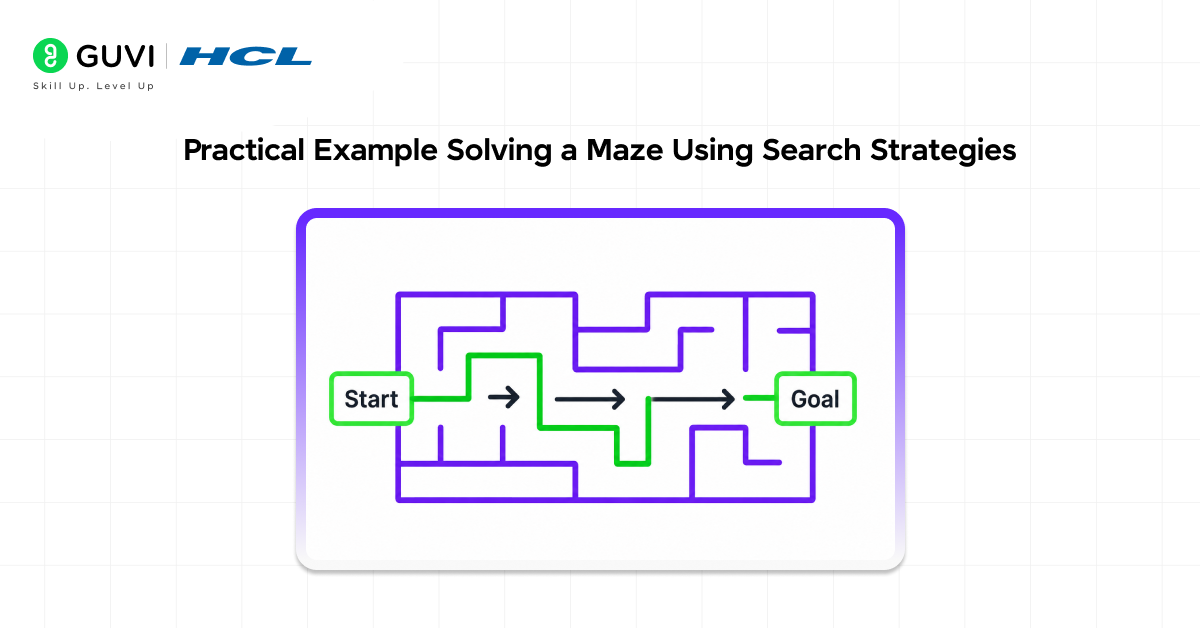
Imagine an AI agent navigating a maze.
The goal is to find the exit as quickly as possible.
How Uninformed Search Handles It.
- BFS explores every nearby path equally.
- DFS follows one route deeply until failure.
- The algorithm has no understanding of which direction is better.
How Informed Search Handles It.
- The system estimates which direction seems closer to the exit.
- Heuristics guide the exploration.
- Unnecessary paths are ignored earlier.
- The exit is found faster.
This single difference explains why heuristic search transformed modern AI systems.
If you want to strengthen your understanding of AI algorithms and intelligent systems, explore ebooks focused on AI problem solving, graph traversal, and heuristic optimization techniques. These resources provide deeper insights into real-world AI search implementations.
How Search Algorithms Connect to Modern AI?

Modern AI is evolving rapidly toward intelligent decision systems.
Search algorithms are now combined with machine learning, reinforcement learning, predictive systems, and neural networks.
For example:
- Reinforcement learning agents search for optimal actions.
- AI copilots search context windows for relevant outputs.
- Autonomous systems search massive possibility spaces in real time.
- Generative AI models optimize response generation through intelligent prediction mechanisms.
Even though modern AI is highly advanced, many foundational ideas still originate from classical AI search strategies.
If you want hands-on experience with Artificial Intelligence, machine learning algorithms, search techniques, and real-world AI projects, HCL GUVI’s AI & Machine Learning Course can help you build strong, practical, and industry-relevant skills.
These programs combine foundational AI concepts with implementation-focused learning, making them valuable for beginners and aspiring AI engineers.
Conclusion.
Understanding search algorithms is essential in Artificial Intelligence.
Uninformed search algorithms like BFS and DFS explore paths without additional knowledge, while informed search algorithms like Best First Search and A* use heuristics to make smarter decisions.
These algorithms form the foundation of modern AI systems, robotics, navigation systems, and intelligent applications.
FAQs.
1. What is the difference between informed and uninformed search in AI?
Uninformed search explores paths without additional knowledge, while informed search uses heuristics to estimate better paths and reach the goal faster.
2. Why is BFS called an uninformed search algorithm?
BFS does not use heuristic guidance or predictions. It systematically explores nodes level by level without understanding which path is closer to the goal.
3. What is a heuristic in Artificial Intelligence?
A heuristic is an estimated measure that helps AI systems predict how close a node or state is to the desired goal.
4. Why is the A* algorithm widely used?
A* efficiently combines actual path cost and heuristic estimates, making it powerful for optimal pathfinding and intelligent navigation systems.
5. Which search algorithm is better, BFS or DFS?
It depends on the problem. BFS is better for shortest path problems, while DFS is useful for deep exploration scenarios with lower memory usage.
6. Where are informed search algorithms used in real life?
They are widely used in GPS navigation, robotics, autonomous vehicles, gaming AI, recommendation systems, and intelligent decision-making applications.
Success Stories

About the Author
Vishalini Devarajan
An Aerospace Engineer turned content writer, I focus on making complex concepts easy to understand through well-structured, reader-friendly blogs. Whether it’s a technical topic or a non-technical one, I love creating content that is clear, engaging, and impactful.
View all posts by Vishalini Devarajan
Connect with me @












Did you enjoy this article?