


Database Articles
SQL Window Functions: Practical Examples Every Analyst Needs
Microservices vs Monolith: Making the Right Architectural Choice


Get In Touch For Details! Request More Information
Consistency in DBMS: ACID Properties For Data Integrity [2026 Guide]
Aug 03, 2026 6 Min Read 15232 Views
(Last Updated)
To ensure reliable data integrity in a Database Management System (DBMS), understanding the ACID properties is essential. These properties help maintain stable, correct, and consistent transactions in the database.
ACID stands for Atomicity, Consistency, Isolation, and Durability. In this blog, we will focus on how Consistency plays a key role in keeping data accurate, reliable, and error-free in DBMS environments.
Table of contents
- TL;DR Summary
- At a Glance: The 4 ACID Properties
- Understanding ACID Properties
- 1) Introduction to ACID Properties in DBMS
- 2) Importance of ACID Properties for Data Integrity
- The 4 ACID Properties Explained With Real Failure Examples
- Unpacking Consistency in DBMS
- 1) Definition of Consistency in DBMS
- 2) Role of Consistency in Ensuring Data Integrity
- Maintaining Consistency
- 1) Techniques for Achieving Consistency
- 2) Challenges in Maintaining Consistency
- ACID vs BASE Properties — NoSQL Databases Comparison
- How PostgreSQL vs MySQL Implement ACID Differently?
- ACID Properties Interview Questions for Backend/Database Roles
- Benefits of Consistency in DBMS
- 1) Ensuring Reliable Transactions
- 2) Enhancing Data Quality and Reliability
- Conclusion
- FAQs
- How does Consistency in DBMS prevent invalid data from being saved?
- What happens when a transaction breaks a database rule?
- Why is Consistency important in financial transactions?
- How do constraints help maintain Consistency in DBMS?
- What problems can occur if Consistency is not maintained?
- How do ACID properties ensure data integrity in DBMS?
TL;DR Summary
- This blog helps you understand ACID properties in DBMS and their role in maintaining basic data integrity and system reliability in an organized way.
- It explains DBMS Consistency in a simple manner, including its definition and its role in maintaining data validity and structure.
- It provides an overview of techniques, challenges, and the benefits of consistency, helping you understand how DBMSs support data quality and reliability.
The term ACID was introduced by Theo Härder and Andreas Reuter in 1983 to describe reliable database transactions.
At a Glance: The 4 ACID Properties
| Property | Full Form | 1-Line Definition |
|---|---|---|
| A | Atomicity | A transaction either completes fully or not at all — no partial updates. |
| C | Consistency | A transaction moves the database from one valid state to another, honoring all rules. |
| I | Isolation | Concurrent transactions don’t interfere with or see each other’s incomplete changes. |
| D | Durability | Once committed, a transaction’s changes survive even a system crash. |
Understanding ACID Properties
To ensure reliable data integrity in Database Management Systems (DBMS), understanding ACID properties is crucial. ACID stands for Atomicity, Consistency, Isolation, and Durability. These properties are fundamental to maintaining the stability and correctness of transactions within a database.
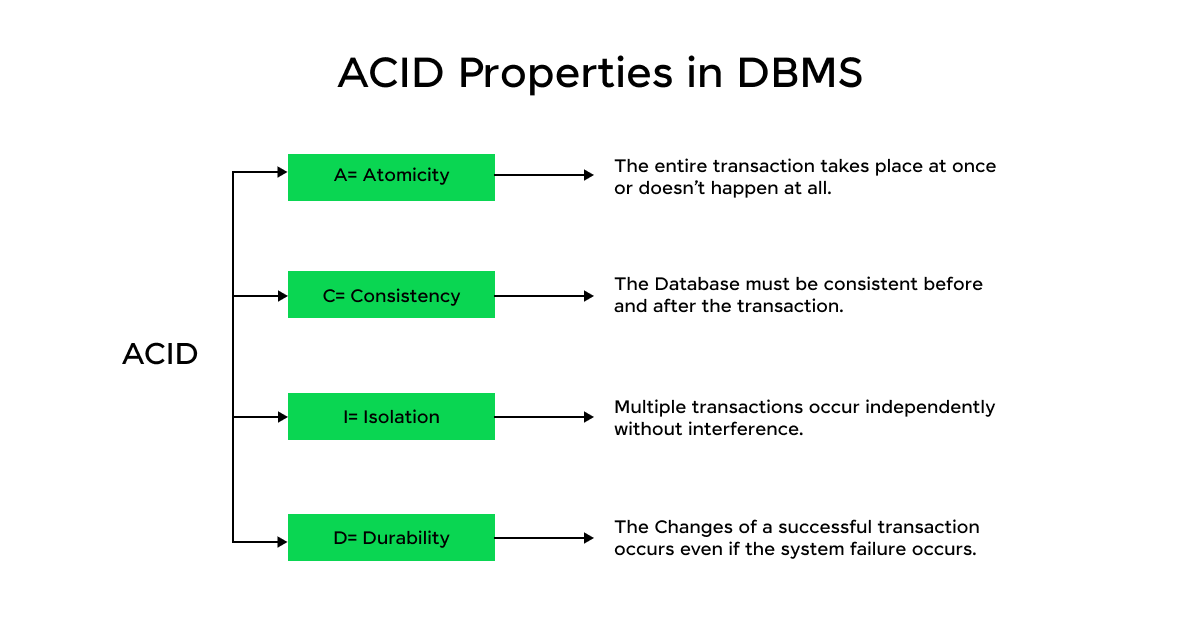
1.1) Introduction to ACID Properties in DBMS
The ACID properties are designed to guarantee that database transactions are processed reliably and ensure data integrity. Here’s a quick overview:
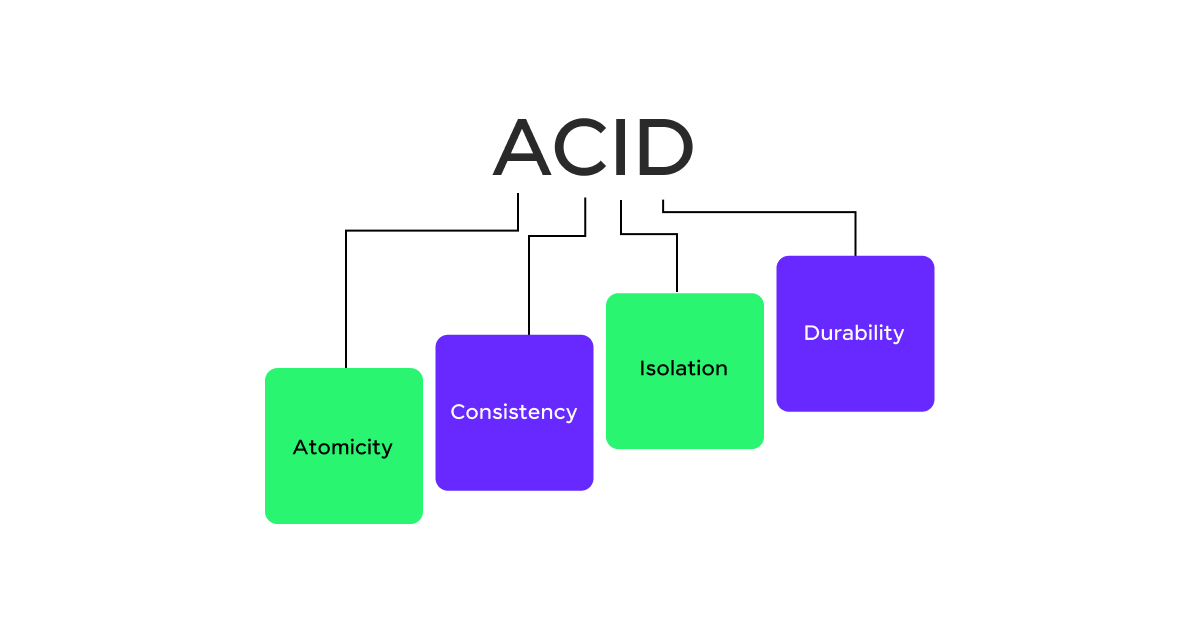
- Atomicity: Ensures that all operations within a transaction are completed successfully. If any part of the transaction fails, the entire transaction is rolled back.
- Consistency: Ensures that a transaction takes the database from one valid state to another while maintaining database rules and constraints.
- Isolation: Ensures that transactions are executed independently of one another, preventing concurrent transactions from interfering with each other.
- Durability: Ensures that once a transaction has been committed, it remains so, even in the event of a system failure.
Build strong skills in Data Science & Analytics with HCL GUVI’s Data Science & Analytics Course, where you can learn how to clean and analyze data, perform EDA, build machine learning models, and apply AI techniques to make smarter, data-driven decisions and unlock real career opportunities.
1.2) Importance of ACID Properties for Data Integrity
Each ACID property plays a critical role in maintaining data integrity and reliability in a DBMS. Here’s how:
- Atomicity: Prevents partial updates to the database, ensuring that either all operations complete or none do. This prevents corruption caused by incomplete transactions.
- Consistency: Guarantees that only valid data following all rules and constraints is saved in the database. This helps in maintaining the correctness of the database state.
- Isolation: Prevents data anomalies by ensuring transactions do not affect each other. This is essential for the accuracy of concurrent transactions.
- Durability: Ensures the permanence of committed transactions, which is necessary for the database’s reliability over time.
Understanding these properties helps you grasp the mechanisms that ensure reliable transactions and data quality in DBMS environments. By mastering these concepts, students and tech professionals can better manage and optimize database systems.
Also Explore: Top 10 Data Integration Project Ideas
The 4 ACID Properties Explained With Real Failure Examples
Each ACID property exists to prevent a specific type of data corruption. The table below shows what breaks when a property is missing:
| ACID Property | Full Form | What It Means | Real Failure Without It |
|---|---|---|---|
| A | Atomicity | All operations in a transaction succeed together, or none are applied. | A funds transfer debits the sender’s account but a crash occurs before the recipient is credited — money simply disappears. |
| C | Consistency | A transaction can only move the database from one valid state to another, per its defined rules and constraints. | An order is marked “Shipped” without ever passing through “Paid,” violating the business rule that shipping requires payment. |
| I | Isolation | Concurrent transactions execute as if they were run one at a time, even when interleaved. | Two customers booking the last seat on a flight both read “1 seat available” at the same time and both bookings succeed — overselling the seat. |
| D | Durability | Once a transaction is committed, its changes persist even through a power failure or crash. | A user’s order confirmation is shown, the server crashes a second later, and on restart the order is gone because it was never written to persistent storage. |
Unpacking Consistency in DBMS
Consistency in DBMS is a core concept within the ACID properties framework, essential for maintaining reliable data integrity. Let’s delve into what consistency means and its role in ensuring the accuracy and reliability of your data.
2.1) Definition of Consistency in DBMS
Consistency means that any transaction in a database must transition from one valid state to another. When a transaction is completed, the database must remain in a consistent state, adhering to all defined rules, constraints, and triggers.
If a transaction violates these rules, it will be rolled back, ensuring no partial changes are saved.
For instance, consider a banking system in which a transfer of funds between accounts must maintain the rule that the total amount of money remains constant.
The database would be inconsistent if a transaction subtracts an amount from one account but fails to add it to the recipient’s account. Consistency ensures that such discrepancies do not occur, maintaining the integrity of your data.
Also Read: Mastering Database Management: A Beginner’s Guide 2026
2.2) Role of Consistency in Ensuring Data Integrity
Consistency plays a pivotal role in ensuring data integrity in a Database Management System (DBMS). By enforcing rules and constraints, a consistent state guarantees that all data remains accurate and trustworthy after any transaction.
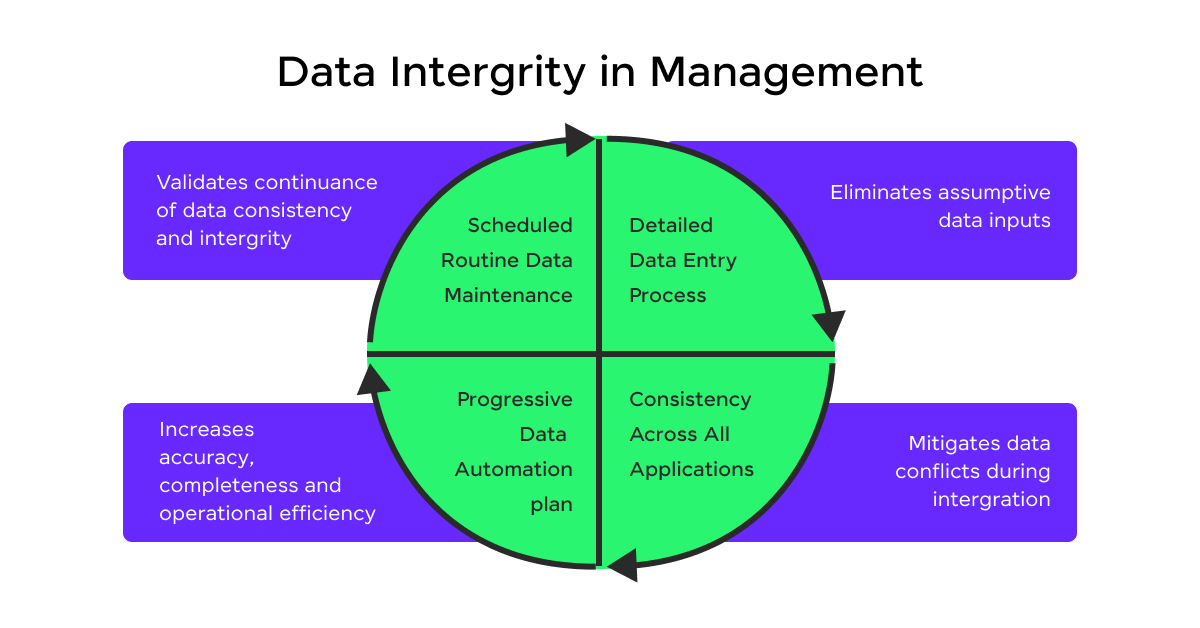
This is crucial for applications that require high reliability, such as financial systems, e-commerce platforms, and healthcare databases. Consider the following table illustrating the impact of consistency on data integrity:
| Transaction Type | Initial State | Transaction Outcome | Final State (Consistent) | Final State (Inconsistent) |
|---|---|---|---|---|
| Fund Transfer | A: $100, B: $50 | A: -$30, B: +$30 | A: $70, B: $80 | A: $70, B: $50 |
| Inventory Update | Item X: 20 units | Item X: -5 units | Item X: 15 units | Item X: 20 units |
| Order Processing | Order: Pending | Order: Completed | Order: Shipped | Order: Pending |
In each scenario, a consistent final state reflects accurate, reliable data, whereas an inconsistent state indicates potential errors and data integrity issues.
These resources will provide more context on the interconnectedness of these properties and their collective role in maintaining a robust database system.
Maintaining Consistency
3.1) Techniques for Achieving Consistency
Consistency in DBMS ensures that only valid data is written to the database, preserving the integrity of the dataset. There are several techniques to achieve consistency in a database management system:
- Constraints: Constraints enforce rules on the data in the database tables. They include primary keys, foreign keys, unique constraints, and check constraints. These rules ensure that the data adheres to the defined standards.
- Normalization: Normalization organizes data to reduce redundancy and improve data integrity. It involves structuring the database into tables and establishing relationships between them, ensuring that data is stored logically.
- Transactions: Transactions are sequences of operations performed as a single unit of work. They follow the ACID properties, ensuring that all operations within a transaction are completed successfully before the transaction is committed to the database. If any operation fails, the entire transaction is rolled back to maintain consistency.
- Triggers: automated actions executed in response to events on a table or view. They can enforce complex business rules and ensure that data modifications adhere to the defined consistency rules.
- Stored Procedures: Stored procedures are precompiled collections of SQL statements that can be executed as a single unit. They can help maintain consistency by encapsulating complex logic and enforcing business rules.
Also Read: Mastering Database Optimization: Advanced Indexing Techniques for Performance
3.2) Challenges in Maintaining Consistency
Maintaining consistency in a DBMS can be challenging due to various factors:

- Concurrency Control: Concurrency control manages simultaneous operations to prevent conflicts and ensure consistency. However, handling multiple transactions that access the same data concurrently can lead to issues such as deadlocks and race conditions.
- Distributed Databases: Data is stored across multiple locations. Ensuring consistency across these locations can be difficult due to network latency, data replication issues, and node failures.
- Data Anomalies: Data anomalies, such as insertion, update, and deletion anomalies, can occur when data is not properly normalized. These anomalies can lead to inconsistencies in the database.
- Complex Business Rules: Enforcing complex business rules can be challenging, especially when they involve multiple tables and relationships. Ensuring that all rules are consistently applied requires careful database design and implementation.
- Hardware and Software Failures: Hardware and software failures can disrupt database operations, leading to inconsistencies. Implementing robust backup and recovery mechanisms is essential to mitigate these risks.
By understanding and addressing these challenges, you can ensure your database remains consistent, thereby enhancing data integrity and reliability.
ACID vs BASE Properties — NoSQL Databases Comparison
Not every database prioritizes strict ACID guarantees. Many NoSQL databases follow the BASE model instead, trading strict consistency for availability and scale.
| Aspect | ACID | BASE |
|---|---|---|
| Stands for | Atomicity, Consistency, Isolation, Durability | Basically Available, Soft state, Eventually consistent |
| Consistency model | Strong — every read reflects the latest committed write | Eventual — reads may briefly return stale data |
| Typical databases | PostgreSQL, MySQL, Oracle, SQL Server | MongoDB, Cassandra, DynamoDB, Couchbase |
| Best suited for | Financial systems, booking systems, anything requiring exact correctness | Large-scale, high-velocity systems like social feeds, analytics, IoT data |
| Trade-off | Prioritizes correctness over raw availability/speed at massive scale | Prioritizes availability and speed, accepting brief inconsistency |
Neither model is “better” — the choice depends on whether your application can tolerate momentary inconsistency in exchange for scale. A banking ledger needs ACID; a social media “like” counter can afford BASE.
For a deeper look at NoSQL structures, see GUVI’s guide on How to Use MongoDB Compass and MongoDB vs SQL: Top Differences Explained.
How PostgreSQL vs MySQL Implement ACID Differently?
Both PostgreSQL and MySQL are ACID-compliant relational databases, but they get there differently — a common interview and real-world decision point.
| Aspect | PostgreSQL | MySQL |
|---|---|---|
| ACID compliance | Full ACID compliance by default across all supported table types | ACID-compliant only with the InnoDB storage engine (default since MySQL 5.5); the older MyISAM engine is not transactional |
| Isolation levels | Supports Read Committed, Repeatable Read, and Serializable, with true Serializable Snapshot Isolation | Supports the same four standard levels via InnoDB, with Repeatable Read as the default |
| Concurrency approach | Multiversion Concurrency Control (MVCC) applied consistently across the engine | MVCC implemented within InnoDB specifically, not database-wide |
| Constraint enforcement | Strict by default; enforces foreign keys, checks, and types rigorously | Configurable strictness via SQL modes; historically more permissive by default in older versions |
ACID Properties Interview Questions for Backend/Database Roles
Common questions interviewers ask to test whether a candidate understands ACID beyond the textbook definition:
- What are the 4 ACID properties, and can you give a real-world example of each?
- What happens to a transaction if isolation is violated — what specific anomalies can occur (dirty read, non-repeatable read, phantom read)?
- How does a database guarantee durability after a sudden power failure?
- What is the difference between ACID and BASE, and when would you choose a BASE-model database instead?
- Which SQL isolation levels exist, and what trade-off does each one make between consistency and concurrency performance?
- Is MongoDB ACID-compliant? [PLACEHOLDER: confirm current MongoDB ACID support scope/version at time of publishing, as multi-document transaction support has evolved across MongoDB releases.]
- How would you design a schema/constraint set to enforce Consistency for a banking application?
For more practice, see GUVI’s SQL Interview Questions hub.
Benefits of Consistency in DBMS
4.1) Ensuring Reliable Transactions
Consistency in DBMS is crucial for reliable transactions. It ensures that a database moves from one valid state to another, preserving data integrity throughout the process.
When you execute a transaction, the DBMS checks that all constraints, such as primary keys, foreign keys, and unique constraints, are satisfied. This prevents invalid data from being written to the database.
For example, if you have a transaction that debits one account and credits another, consistency guarantees that both operations either complete successfully or do not occur at all.
This prevents scenarios where money could be debited from one account without being credited to another, ensuring accurate and reliable transactions.
4.2) Enhancing Data Quality and Reliability
Consistency also enhances data quality and reliability by enforcing rules and constraints on the data. This ensures that the data stored in the database adheres to the defined standards, making it dependable for analysis and reporting.
For instance, consider a database that stores customer information. Consistency ensures that each customer has a unique ID, a valid email address, and a correct phone number format.

This level of data quality is crucial for businesses that rely on accurate customer data for operations and decision-making.
| Benefit | Description |
|---|---|
| Reliable Transactions | Ensures transitions from one valid state to another |
| Data Quality | Enforces rules and constraints for accurate data |
| Data Reliability | Makes data dependable for analysis and reporting |
By maintaining consistency, you ensure that your database remains reliable and trustworthy. It plays a key role in overall data integrity in a DBMS, working in conjunction with other ACID properties such as atomicity and durability.
Want to build a career in Data Science without getting stuck in endless theory? HCL GUVI’s IIT-M Pravartak Certified Data Science Course helps you learn through live classes, real-world projects, expert mentorship, and hands-on learning so you can build practical skills, become placement-ready, and confidently step into the world of data.
Conclusion
In conclusion, understanding ACID properties is essential for maintaining a reliable and efficient database system, as these principles ensure data integrity, accuracy, and consistency across all transactions. When properly implemented, they help prevent errors, maintain stable operations, and ensure that every database action is processed in a controlled and dependable way, ultimately making the entire DBMS more secure, stable, and trustworthy.
Also Read: Comprehensive guide on DBMS Trends
FAQs
How does Consistency in DBMS prevent invalid data from being saved?
Consistency ensures all ACID rules and constraints are followed before a transaction is completed.
What happens when a transaction breaks a database rule?
The transaction is rolled back, and no changes are stored in the database as per ACID properties.
Why is Consistency important in financial transactions?
It ensures that every debit and credit operation follows the correct rules and keeps account data accurate under the ACID principles.
How do constraints help maintain Consistency in DBMS?
Constraints define rules for data entry and stop incorrect or duplicate data from being stored.
What problems can occur if Consistency is not maintained?
Data errors, incorrect records, and unreliable database results can appear, affecting overall system trust.
How do ACID properties ensure data integrity in DBMS?
ACID properties maintain data integrity by ensuring all database operations follow rules and keep data valid and consistent.
Success Stories
















Did you enjoy this article?