


Database Articles
SQL Window Functions: Practical Examples Every Analyst Needs
Microservices vs Monolith: Making the Right Architectural Choice


Get In Touch For Details! Request More Information
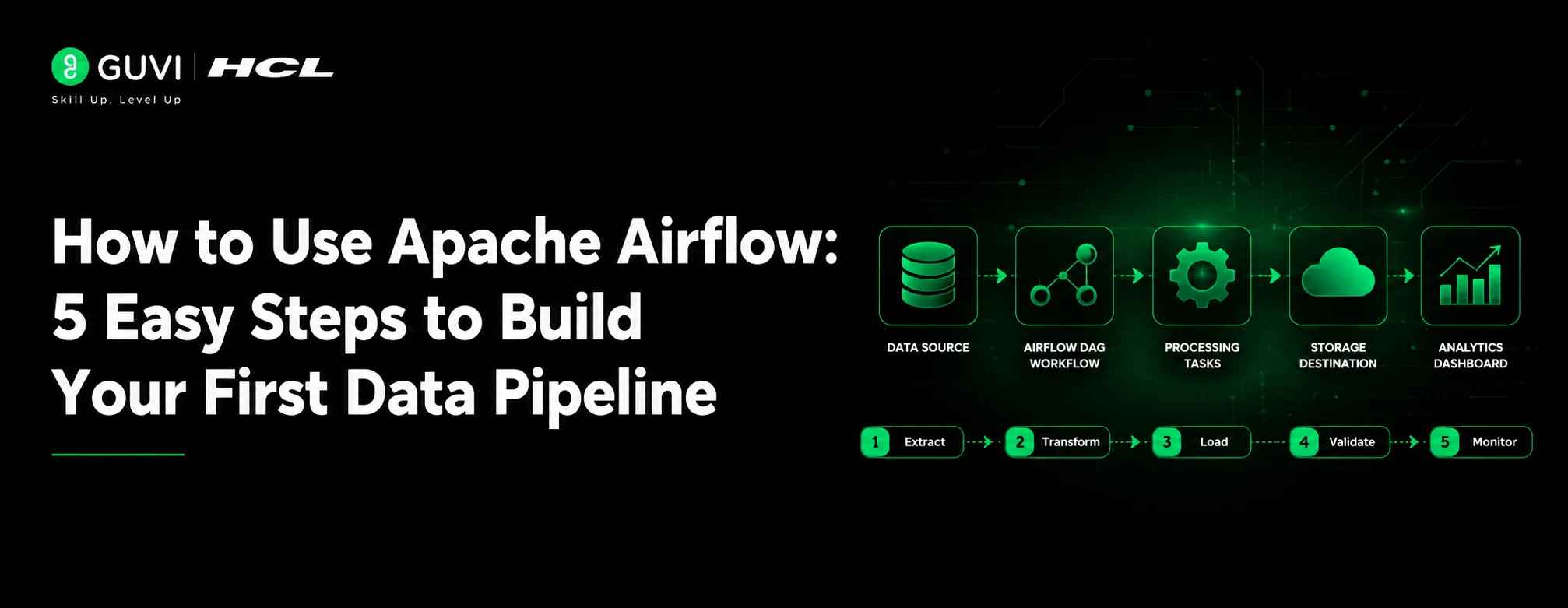
How to Use Apache Airflow: 5 Easy Steps to Build Your First Data Pipeline
Jul 09, 2026 4 Min Read 338 Views
(Last Updated)
Table of contents
- TL;DR
- What Is Apache Airflow?
- Why Is Apache Airflow Important?
- Key Concepts You Need Before Using Airflow
- What Is a DAG?
- Intalling Apache Airflow
- Creating Your First Data Pipeline
- Understanding Scheduling in Airflow
- Real-World Apache Airflow Use Cases
- Data Warehousing
- Business Reporting
- Apache Airflow Career Roadmap
- Salary and Career Benefits
- Common Mistakes Beginners Make
- Creating Huge DAGs
- Ignoring Error Handling
- Hardcoding Values
- Conclusion
- Frequently Asked Questions
- What is Apache Airflow used for?1. What is Apache Airflow used for?
- Is Apache Airflow difficult for beginners to learn?
- Do I need Python to learn Apache Airflow?
- What are DAGs in Apache Airflow?
- Is Apache Airflow only for data engineers?
- How is Apache Airflow different from cron jobs?
- Can Apache Airflow be used with cloud platforms?
- What kind of projects can be built using Apache Airflow?
- Is Apache Airflow a good skill for data engineering careers?
- What should I learn before Apache Airflow?
- Is Apache Airflow an ETL tool?
- Can Apache Airflow handle machine learning workflows?
TL;DR
- Apache Airflow is an open-source workflow automation platform used to schedule and monitor data pipelines.
- A pipeline in Airflow is created using DAGs (Directed Acyclic Graphs).
- Airflow helps automate tasks like ETL, data processing, reporting, and ML workflows.
- You can build your first pipeline using Python with simple operators.
- Learning Airflow is valuable for careers in data engineering, cloud computing, and AI infrastructure.
Data teams today are dealing with a growing challenge: how do you reliably move, transform, and analyze massive amounts of data every day without manually running scripts?
This is where Apache Airflow comes in. As companies become more data-driven, the demand for professionals who can automate workflows, build data pipelines, and manage cloud-based systems is rapidly increasing.
According to industry reports, the global data engineering market is projected to continue strong growth, driven by AI adoption, analytics, and cloud transformation. Tools like Apache Airflow have become essential skills for data engineers, analytics engineers, and DevOps professionals.
In this guide, you will learn how to use Apache Airflow, create your first DAG, schedule a data pipeline, and understand real-world use cases.
What Is Apache Airflow?
Apache Airflow is an open-source workflow orchestration tool that allows you to programmatically create, schedule, monitor, and manage data workflows.
Instead of running scripts manually, Airflow lets you define when tasks should run, what order they should follow, and how failures should be handled.
For example:
A company receives sales data every night. A data engineer needs to:
- Extract data from databases
- Clean and transform it
- Load it into a warehouse
- Generate reports
Without Airflow, this requires manual scheduling. With Airflow, the entire process becomes an automated pipeline.
Why Is Apache Airflow Important?
Modern businesses depend on automated data movement.
A few reasons Airflow is widely used:
- Automates repetitive workflows
- Improves pipeline reliability
- Provides monitoring and logging
- Supports cloud platforms
- Integrates with databases, APIs, and machine learning tools
A recent Stack Overflow Developer Survey showed that Python remains one of the most widely used programming languages, making Airflow accessible because workflows are written in Python.
Another industry trend: companies are investing heavily in AI and analytics infrastructure, increasing the need for data engineers who can maintain reliable pipelines.
Key Concepts You Need Before Using Airflow
Before creating your first pipeline, understand these basic terms.
| Concept | Meaning |
| DAG | A workflow containing connected tasks |
| Task | A single unit of work |
| Operator | Defines what a task does |
| Scheduler | Decides when workflows run |
| Executor | Runs tasks |
| Metadata Database | Stores pipeline information |
What Is a DAG?
A DAG (Directed Acyclic G
raph) is the core concept in Airflow.
It represents your workflow as a sequence of tasks.
Example:
Download Data
↓
Clean Data
↓
Store Results
↓
Send Report
Each step becomes a task inside a DAG.
Intalling Apache Airflow
The easiest way to start is through Python.
First, create a virtual environment:
python -m venv airflow-env
Activate it:
Windows:
airflow-env\Scripts\activate
Mac/Linux:
source airflow-env/bin/activate
Install Airflow:
pip install apache-airflow
Initialize Airflow:
airflow db init
Create a user:
airflow users create \
–username admin \
–firstname Admin \
–lastname User \
–role Admin \
–email [email protected]
Start Airflow:
airflow webserver
In another terminal:
airflow scheduler
Now you can access the Airflow dashboard.
Creating Your First Data Pipeline
Let’s create a simple pipeline that prints messages.
Create a Python file:
first_pipeline.py
Add:
from airflow import DAG
from airflow.operators.python import PythonOperator
from datetime import datetime
def start_task():
print(“Pipeline started”)
def finish_task():
print(“Pipeline completed”)
with DAG(
dag_id=”first_airflow_pipeline”,
start_date=datetime(2025,1,1),
schedule=”@daily”,
catchup=False
):
start = PythonOperator(
task_id=”start”,
python_callable=start_task
)
finish = PythonOperator(
task_id=”finish”,
python_callable=finish_task
)
start >> finish
This creates:
Start Task → Finish Task
Your pipeline now runs automatically every day.
Understanding Scheduling in Airflow
Airflow uses schedules to decide when workflows execute.
Common examples:
| Schedule | Meaning |
| @daily | Runs every day |
| @hourly | Runs every day |
| @weekly | Runs weekly |
| 0 8 * * * | Runs every day at 8 AM |
Cron expressions are commonly used for advanced scheduling.
Example:
schedule=”0 9 * * *”
Real-World Apache Airflow Use Cases
1. Data Warehousing
Companies use Airflow to:
- Extract customer data
- Transform it
- Load it into warehouses
Example:
Database
↓
Airflow
↓
Data Warehouse
↓
Dashboard
2. Machine Learning Pipelines
ML teams automate:
- Data preparation
- Model training
- Model evaluation
- Deployment
A machine learning workflow may look like:
Collect Data
↓
Train Model
↓

Test Accuracy
↓
Deploy Model
3. Business Reporting
Every morning, Airflow can:
- Generate reports
- Update dashboards
- Email summaries
This saves hours of manual work.
Apache Airflow Career Roadmap
If you want to build a career around Airflow, focus on these skills:
| Skill | Why It Matters |
| Python | Build workflows |
| SQL | Work with data |
| Linux | Manage environments |
| Cloud | Deploy pipelines |
| Databases | Store information |
A practical learning path:
- Learn Python basics
- Understand SQL and databases
- Build ETL projects
- Learn Airflow DAG development
- Practice cloud deployment
- Build portfolio projects
Salary and Career Benefits
Apache Airflow skills are valuable because they connect multiple areas:
- Data engineering
- Cloud engineering
- AI infrastructure
- Analytics
Typical roles include:
| Role | Focus |
| Data Engineer | Build pipelines |
| Analytics Engineer | Transform business data |
| ML Engineer | Automate ML workflows |
| Cloud Engineer | Deploy systems |
Salaries vary by location, experience, and company, but data engineering roles remain among the higher-paying technology careers because businesses depend on reliable data systems.
Common Mistakes Beginners Make
1. Creating Huge DAGs
Avoid putting everything into one workflow.
Better:
Create smaller, reusable pipelines.
2. Ignoring Error Handling
Always plan for:
- Failed tasks
- Missing data
- API issues
3. Hardcoding Values
Use Airflow variables and connections instead.
Want to master data pipelines and AI workflows?
Join HCL GUVI’s AI/ML programs to learn Python, SQL, automation, and industry-relevant projects designed to prepare you for real-world tech careers.
Conclusion
Apache Airflow has become one of the most important tools for modern data teams. It helps you automate workflows, improve reliability, and manage complex data operations.
If you want to enter data engineering, learning Airflow is a practical step toward building production-level skills.
Start small:
- Create your first DAG
- Automate a simple workflow
- Connect it to a database
- Build real projects
Your next step: create a mini ETL pipeline using Airflow and add it to your portfolio.
Frequently Asked Questions
1. What is Apache Airflow used for?1. What is Apache Airflow used for?
Apache Airflow is used to automate, schedule, and monitor data workflows. It helps teams build reliable data pipelines, manage task dependencies, run ETL processes, automate reports, and orchestrate machine learning workflows.
2. Is Apache Airflow difficult for beginners to learn?
Apache Airflow is beginner-friendly if you have basic knowledge of Python, SQL, databases, and data workflows. Learning concepts like DAGs, operators, and task scheduling makes it easier to build pipelines.
3. Do I need Python to learn Apache Airflow?
Yes. Apache Airflow workflows are mainly created using Python. You use Python scripts to define DAGs, configure tasks, and control pipeline execution.
4. What are DAGs in Apache Airflow?
A DAG (Directed Acyclic Graph) in Airflow represents a workflow where tasks are organized in a specific order based on their dependencies. It helps Airflow know which tasks should run and when.
5. Is Apache Airflow only for data engineers?
No. While data engineers use Airflow extensively, it is also used by data analysts, machine learning engineers, DevOps professionals, and software engineers for workflow automation.
6. How is Apache Airflow different from cron jobs?
Cron jobs are suitable for simple scheduled tasks, while Apache Airflow is designed for complex workflows. Airflow provides features like task dependencies, monitoring, retries, logging, and visual workflow management.
7. Can Apache Airflow be used with cloud platforms?
Yes. Apache Airflow integrates with popular cloud platforms, databases, data warehouses, and storage services, making it useful for modern cloud-based data engineering workflows.
8. What kind of projects can be built using Apache Airflow?
You can build various automation and data projects using Airflow, including:
ETL and ELT data pipelines
Data warehouse automation workflows
Automated reporting systems
Machine learning model pipelines
Data quality monitoring workflows
9. Is Apache Airflow a good skill for data engineering careers?
Yes. Apache Airflow is a valuable skill for data engineers because companies rely on automated data pipelines to manage analytics, AI, and large-scale data systems.
10. What should I learn before Apache Airflow?
Before learning Airflow, it helps to understand:
Python programming
SQL and databases
Data pipelines and ETL concepts
Basic cloud and DevOps concepts
11. Is Apache Airflow an ETL tool?
Apache Airflow is not an ETL tool itself. It is a workflow orchestration platform that schedules and manages ETL processes by coordinating different data tasks.
12. Can Apache Airflow handle machine learning workflows?
Yes. Airflow can automate ML workflows such as data preparation, model training, testing, deployment, and model monitoring by managing the sequence of ML tasks.
Success Stories

About the Author
Salini Balasubramaniam
A curious, information-savvy writer loves to turn deep insights into authentic and engaging content that connects. With experience in writing for brands and driving audience engagement, I believe that words can make a powerful difference.
View all posts by Salini Balasubramaniam
Connect with me @







Did you enjoy this article?