


Artificial Intelligence and Machine Learning Articles
A/B Testing for Machine Learning Models
Canary Deployment Strategies for ML Models
What is Model Drift Detection: Keeping Models Accurate in Production
Model Versioning in Machine Learning: Best Practices and Strategies


Get In Touch For Details! Request More Information
CI/CD Pipelines for Machine Learning Projects
Sep 01, 2026 4 Min Read 17 Views
(Last Updated)
Building a machine learning model is only the beginning; delivering it reliably requires a well-designed pipeline. CI/CD for machine learning automates code testing, data validation, model training, evaluation, deployment, and monitoring.
This guide explains how ML pipelines differ from traditional software workflows and how to build safer, more repeatable releases.
Table of contents
- TL;DR Summary
- What Is CI/CD for Machine Learning?
- Why Is ML CI/CD Different?
- Core Stages of an ML CI/CD Pipeline
- Source Control
- Data Validation
- Feature Validation
- Automated Testing
- Continuous Training in ML Pipelines
- Deployment Strategies for ML Models
- Canary Deployment
- Shadow Deployment
- Blue-Green Deployment
- A/B Testing
- Monitoring After Deployment
- Common Mistakes to Avoid
- Recommended Tool Categories
- Conclusion
- FAQs
- What is CI/CD for Machine Learning?
- How is ML CI/CD different from software CI/CD?
- What is continuous training?
- Should data be versioned in an ML pipeline?
- What tests should an ML CI/CD pipeline include?
- What is a model registry?
TL;DR Summary
- CI validates code, data, features, and training logic.
- CD packages and releases approved models safely.
- ML pipelines also require continuous training and model monitoring.
- Every model should be linked to its code, data, configuration, and metrics.
- Canary, shadow, and blue-green releases reduce production risk.
Direct Answer
CI/CD for Machine Learning automates the process of validating code, data, features, models, and infrastructure before releasing an ML system. Unlike traditional software CI/CD, an ML pipeline must also handle changing datasets, training jobs, model evaluation, experiment tracking, deployment strategies, monitoring, and retraining. Mature workflows often extend CI/CD with continuous training and feedback loops.
What Is CI/CD for Machine Learning?
CI/CD for Machine Learning applies software engineering automation to the complete machine learning lifecycle.
In traditional software projects:
- Continuous Integration (CI) builds and tests code changes.
- Continuous Delivery (CD) prepares validated software for release.
- Continuous Deployment automatically releases approved changes to production.
Machine learning adds more moving parts. A model’s behavior depends on code, training data, feature transformations, hyperparameters, dependencies, and runtime infrastructure.
A pipeline may therefore need to validate:
- Application code.
- Data schemas and quality.
- Feature transformations.
- Training logic.
- Model accuracy.
- Fairness and safety.
- Serving infrastructure.
- Production performance.
CI/CD for ML automates code, data, and model validation on every commit, then trains, evaluates, registers, and deploys models with safety checks and rollback. Learn AI & ML with HCL GUVI’s Artificial Intelligence and Machine Learning course.
Why Is ML CI/CD Different?
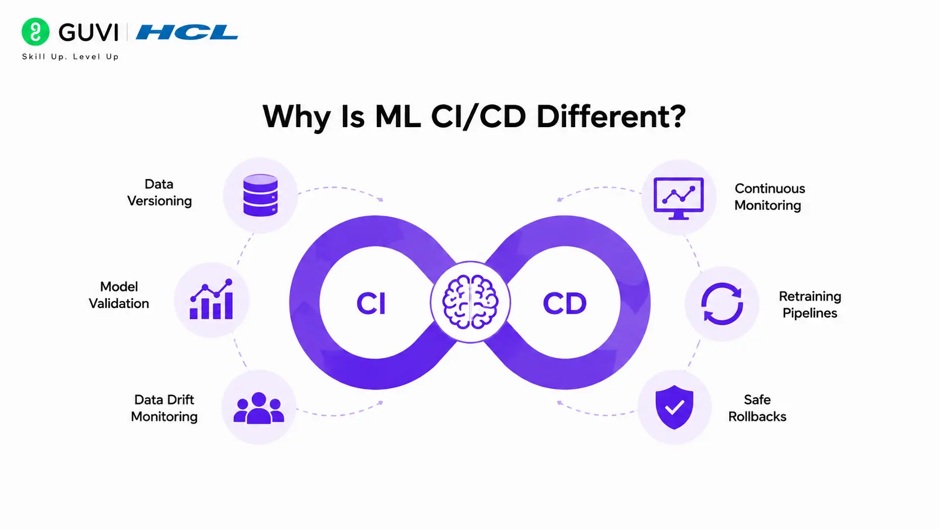
A software build usually produces a package from source code. An ML pipeline may produce a model whose behavior changes when the data changes, even if the source code remains identical.
This creates additional risks:
- Training data may contain schema changes.
- Feature distributions may drift.
- A new library version may change model behavior.
- Retraining may reduce performance.
- Offline accuracy may not translate to production value.
- A model may be correct but too slow to serve.
That is why ML CI/CD cannot stop after running unit tests. It must test the entire path from data ingestion to model serving.
Core Stages of an ML CI/CD Pipeline
A practical pipeline usually contains these stages:
- Source control.
- Data and feature validation.
- Build and dependency installation.
- Automated testing.
- Model training.
- Model evaluation.
- Model registration.
- Deployment to staging.
- Production rollout.
- Monitoring and feedback.
- Pipeline Box
text
Code or data change

         ↓

Validate data and features

         ↓

Build environment

         ↓

Run tests

         ↓

Train model

         ↓

Evaluate quality and safety

         ↓

Register model

         ↓

Deploy to staging

         ↓

Canary, shadow, or blue-green release

         ↓

Monitor and retrain
1. Source Control
Store training code, preprocessing logic, configuration, infrastructure files, and pipeline definitions in version control.
A good repository should make it possible to answer:
- Which code trained this model?
- Which dataset version was used?
- Which features were enabled?
- Which hyperparameters were selected?
- Which dependencies were installed?
- Which evaluation results allowed deployment?
Git is commonly used for code. Data versioning and experiment tracking tools can help manage datasets, experiments, and model artifacts.
2. Data Validation
Data validation is one of the most important differences between normal CI/CD and ML CI/CD.
Automated checks should verify:
- Required columns exist.
- Data types are correct.
- Missing values remain within limits.
- Numeric values are within expected ranges.
- Categories are valid.
- Duplicate records are controlled.
- Labels are available when required.
- Training and serving schemas match.
A pipeline should fail before training if the input data is clearly invalid.
3. Feature Validation
Feature logic must remain consistent across training and production.
Test whether:
- Feature names are stable.
- Transformations produce the expected output.
- Encoders use compatible categories.
- Normalization uses the correct parameters.
- No future information leaks into training.
- Offline and online features use the same definitions.
Feature leakage can create excellent offline metrics and poor production results.
4. Automated Testing
ML pipelines require several test categories.
Unit Tests
Test individual functions such as:
- Data cleaning.
- Feature calculation.
- Label generation.
- Post-processing.
- Prediction formatting.
Integration Tests
Test whether multiple components work together:
- Data ingestion with feature generation.
- Training code with the dataset.
- Model artifacts with the serving API.
- Prediction service with storage and monitoring.
Data Tests
Check schema, distributions, missing values, and invalid records.
Model Tests
Verify that:
- Predictions have the correct shape.
- Output values are valid.
- Inference completes within the latency budget.
- The model does not produce unexpected nulls or infinite values.
Continuous Training in ML Pipelines
Many teams add Continuous Training (CT) to CI/CD. CT retrains a model when new data arrives, performance declines, or a scheduled trigger occurs.
A typical continuous training workflow is:
- Detect new data or model drift.
- Validate the new dataset.
- Run the training job.
- Evaluate the candidate model.
- Compare it with the current production model.
- Register it if it passes quality gates.
- Deploy it through a controlled release.
Formula Box: Retraining Trigger
Retrain ifDdata>τdorPproduction<τp\text{Retrain if} \quad D_{\text{data}} > \tau_d \quad \text{or} \quad P_{\text{production}} < \tau_pRetrain ifDdata>τdorPproduction<τpWhere:

- DdataD_{\text{data}}Ddata is a data-drift score.
- τd\tau_dτd is the permitted drift threshold.
- PproductionP_{\text{production}}Pproduction is measured production performance.
- τp\tau_pτp is the minimum acceptable performance.
Continuous training should not mean automatic production deployment. A retrained model still needs validation, approval, and safe rollout.
Deployment Strategies for ML Models
1. Canary Deployment
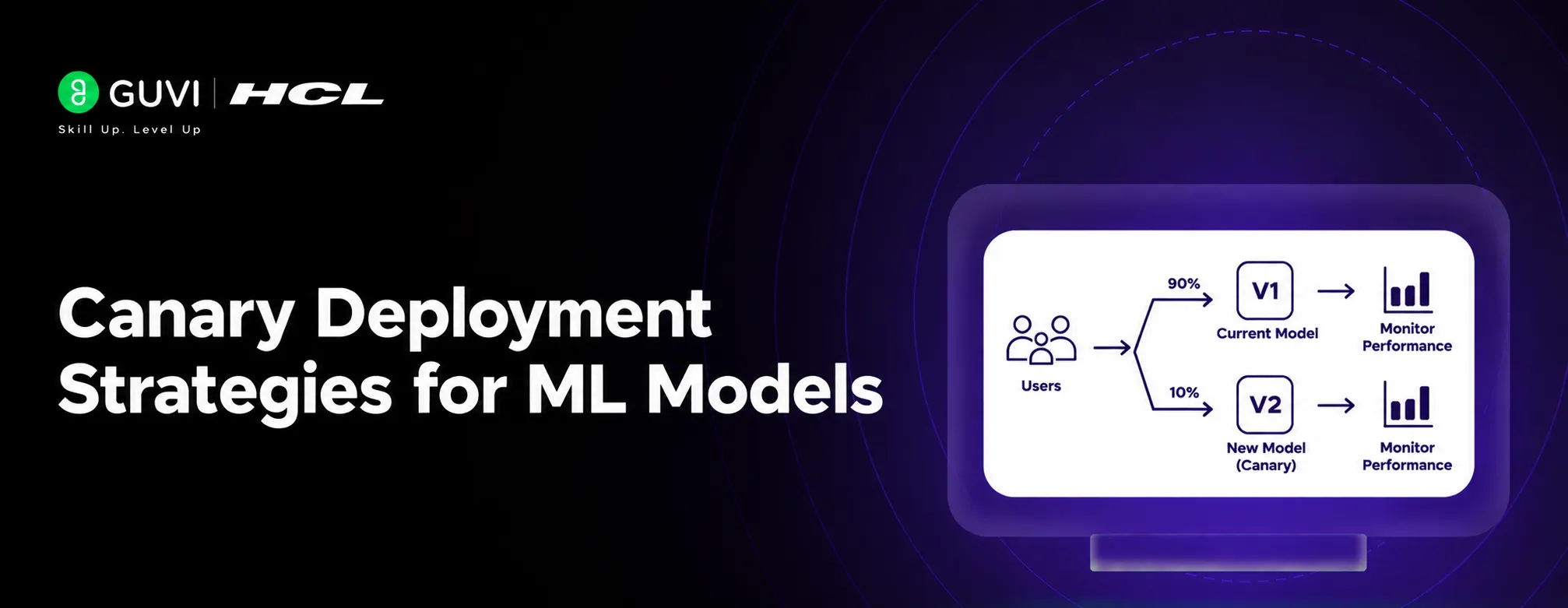
A small percentage of traffic goes to the new model first. Teams monitor it before increasing traffic.
2. Shadow Deployment
The new model receives copies of real requests but does not affect user-visible results. This is useful for comparing predictions, latency, and resource usage safely.
3. Blue-Green Deployment
Two production environments run separately:
- Blue serves the current model.
- Green contains the new model.
Traffic switches to Green only after validation. Rollback can switch traffic back to Blue.
4. A/B Testing
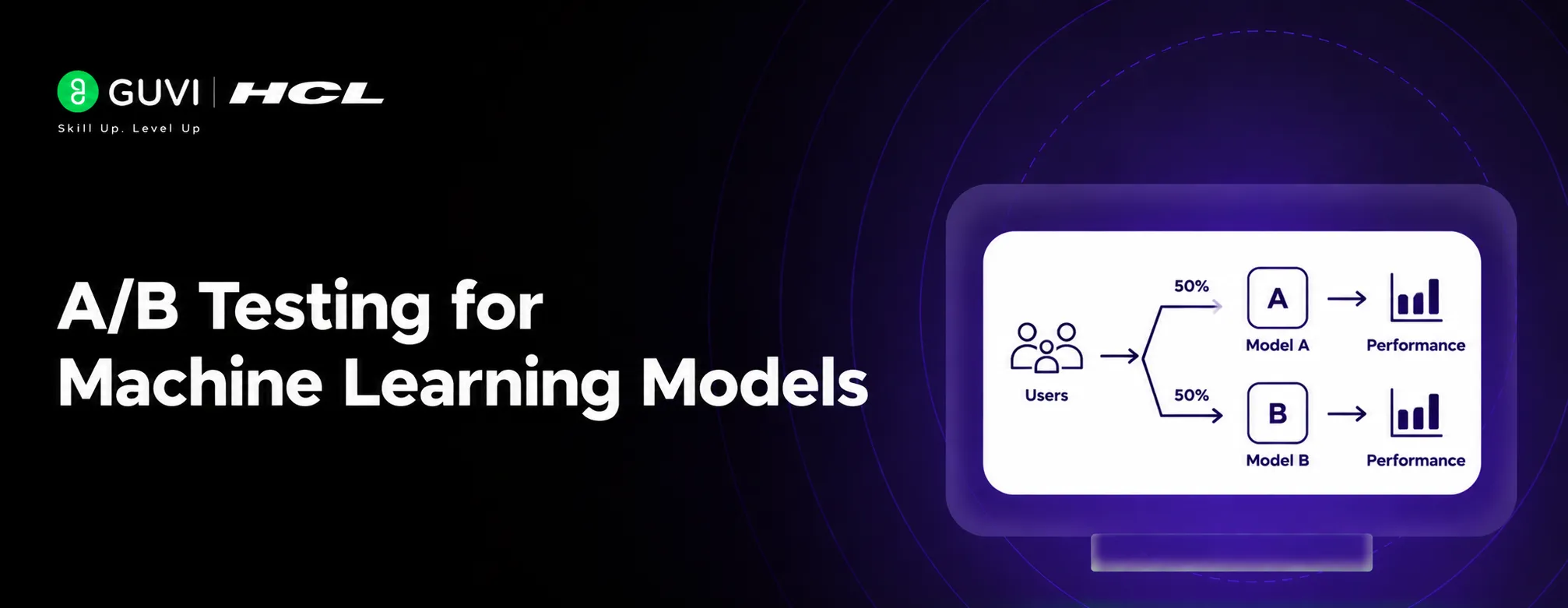
Users are randomly split between model versions, and business outcomes are compared. This is useful when the goal is to measure real-world impact rather than only technical stability.
Monitoring After Deployment
CI/CD does not end when the model reaches production.
Monitor:
- Data drift.
- Prediction drift.
- Model performance.
- Feature availability.
- Latency.
- Throughput.
- Error rates.
- Infrastructure cost.
- Fairness.
- Safety events.
- User or business outcomes.
A production monitoring system should distinguish between:
- Data drift: Input data changes.
- Concept drift: The relationship between inputs and labels changes.
- Performance degradation: Predictions become less accurate.
- Infrastructure degradation: Latency, memory, or availability worsens.
Common Mistakes to Avoid
- Versioning code but not data.
- Deploying models without automated quality gates.
- Testing only training accuracy.
- Ignoring feature-serving differences.
- Treating retraining as automatic approval.
- Using a model registry without clear promotion rules.
- Skipping staging validation.
- Monitoring infrastructure but not predictions.
- Releasing new models without rollback.
- Rebuilding the environment differently in CI and production.
In ML projects, a pipeline can fail even when the application code has not changed because the training data or feature distribution has changed. That is why mature MLOps practices often combine CI/CD with continuous training, data validation, model registries, and production monitoring.
Recommended Tool Categories
| Pipeline need | Common tool categories |
| Source control | Git, GitHub, GitLab |
| CI/CD automation | GitHub Actions, GitLab CI, Jenkins, Semaphore |
| Experiment tracking | MLflow, Weights & Biases |
| Data versioning | DVC, data catalogs, cloud storage |
| Workflow orchestration | Airflow, Kubeflow, Dagster, Metaflow |
| Containerization | Docker |
| Deployment | Kubernetes, cloud endpoints, model servers |
| Monitoring | Prometheus, Grafana, Evidently, cloud monitoring |
| Model registry | MLflow Registry, cloud model registries |
The best toolchain depends on team size, cloud platform, model type, compliance needs, and deployment architecture.
CI/CD for ML automates code, data, and model validation on every commit, then trains, evaluates, registers, and deploys models with safety checks and rollback. Learn AI & ML with HCL GUVI’s Artificial Intelligence and Machine Learning course.
Conclusion
CI/CD for Machine Learning extends software delivery practices to data, features, training, model evaluation, deployment, and monitoring. It helps teams release models more reliably while making experiments reproducible and production failures easier to detect.
A mature ML pipeline does more than run tests on Python code. It validates the data, trains and evaluates the model, records its lineage, deploys it safely, and monitors its behavior after release.
Start with reproducibility and quality gates. Then add continuous training, progressive deployment, automated rollback, and feedback loops as your system grows.
FAQs
What is CI/CD for Machine Learning?
CI/CD for Machine Learning automates the testing, training, validation, deployment, and monitoring of ML systems. It covers code, data, features, models, and infrastructure.
How is ML CI/CD different from software CI/CD?
Software CI/CD mainly validates and deploys code. ML CI/CD must also validate data, feature transformations, model quality, training reproducibility, drift, and production predictions.
What is continuous training?
Continuous training automatically retrains models when new data arrives, performance declines, or a scheduled trigger occurs. The retrained model should still pass quality and safety gates before deployment.
Should data be versioned in an ML pipeline?
Yes. Data versioning helps reproduce a model and identify which dataset created a particular result. Without it, debugging and auditing become much harder.
What tests should an ML CI/CD pipeline include?
A strong pipeline includes unit tests, integration tests, data validation, feature tests, model behavior tests, performance checks, and deployment health checks.
What is a model registry?
A model registry stores model versions, artifacts, metadata, evaluation results, approval status, and deployment history. It provides controlled promotion from development to production.
Success Stories

About the Author
HCL GUVI
This article was selected and published as part of the HCL GUVI AI Blogathon 2026, an initiative designed to encourage students, AI enthusiasts, and aspiring tech writers to simplify complex AI concepts through impactful technical content. The contest recognized high-quality, original, and insightful AI-focused blogs, with selected authors receiving publication opportunities on the HCL GUVI blog platform along with official author credits and recognition.
View all posts by HCL GUVI
Connect with me @



Did you enjoy this article?