


Artificial Intelligence and Machine Learning Articles
CI/CD Pipelines for Machine Learning Projects
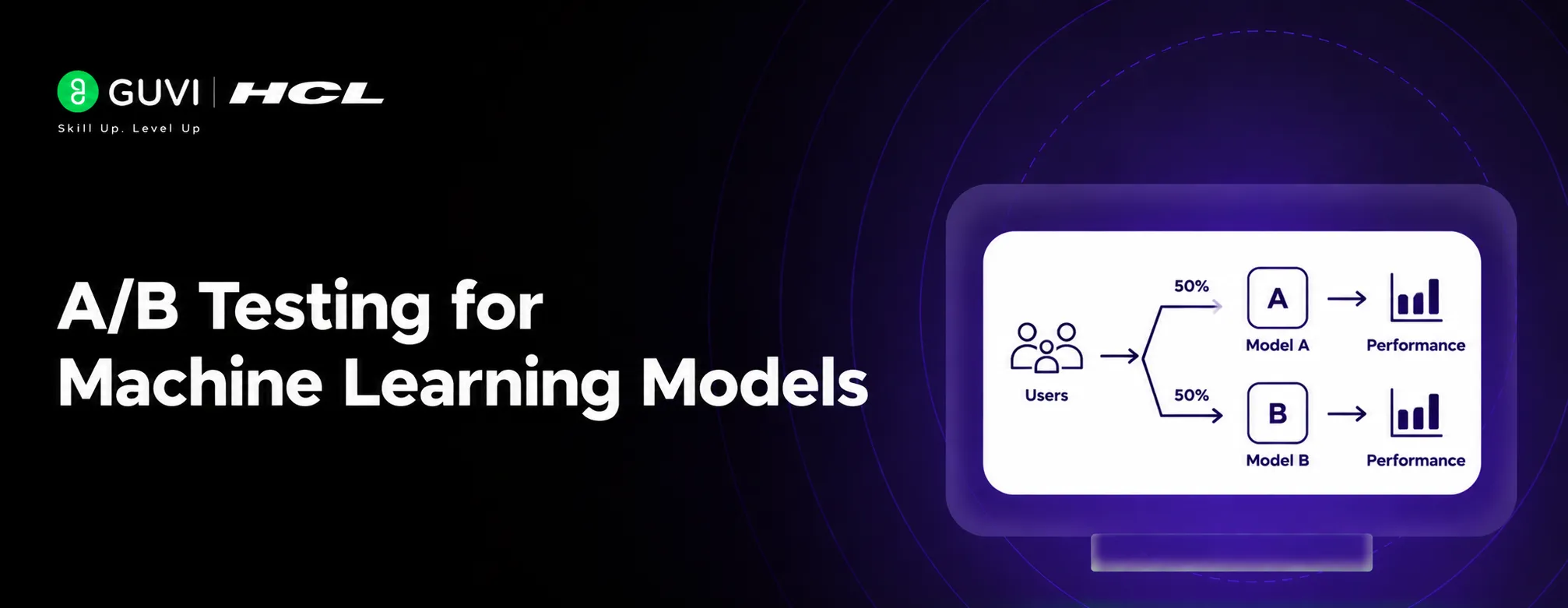
A/B Testing for Machine Learning Models
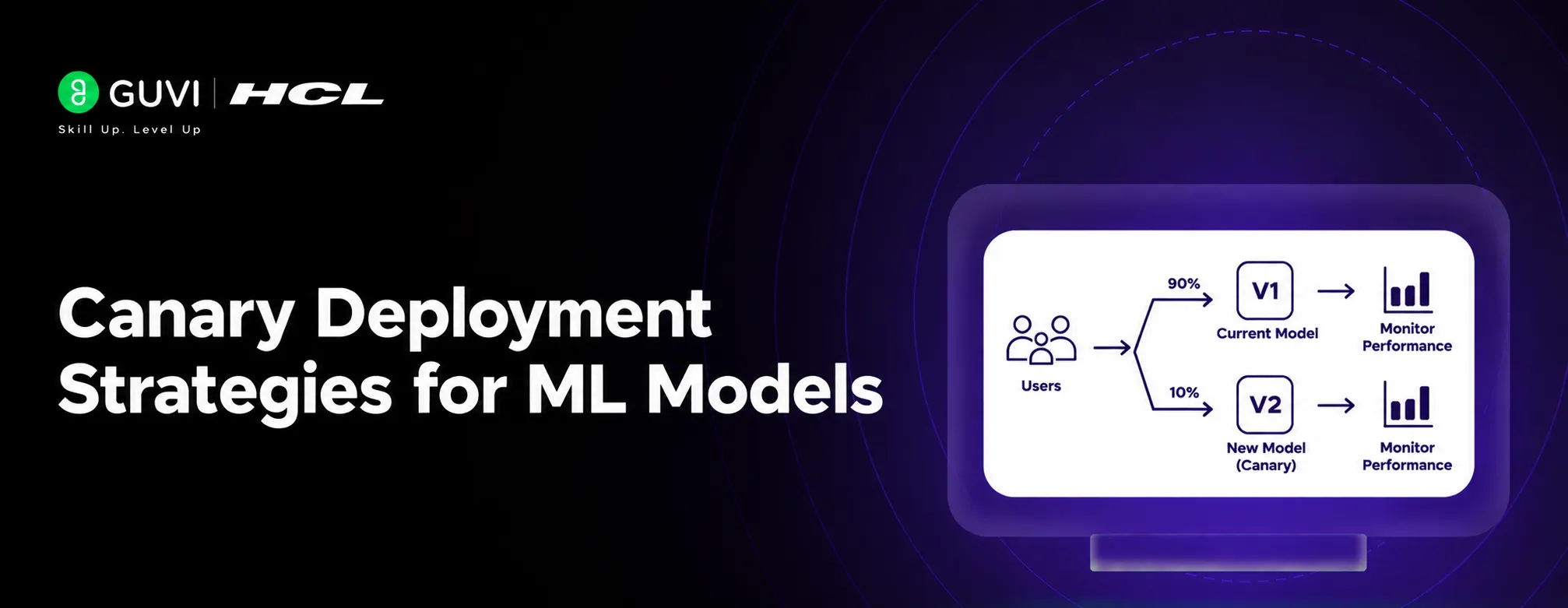
Canary Deployment Strategies for ML Models
What is Model Drift Detection: Keeping Models Accurate in Production


Get In Touch For Details! Request More Information
Model Versioning in Machine Learning: Best Practices and Strategies
Sep 01, 2026 4 Min Read 18 Views
(Last Updated)
Model versioning is the practice of systematically tracking, storing, and managing different versions of machine learning models throughout their lifecycle. It records not just the model weights but also the training data, hyperparameters, code, and evaluation metrics associated with each version, enabling teams to reproduce results, roll back to previous versions, compare performance across experiments, and audit model behavior in production.
Table of contents
- TL;DR Summary
- The Three Levels of Model Versioning
- Level 1: Experiment Tracking
- Level 2: Model Registry
- Level 3: Deployment Versioning
- Semantic Versioning for ML Models
- Tools for Model Versioning
- Tool Comparison
- Metadata Every Model Version Should Record
- Versioning for Fine-Tuned LLMs
- Conclusion
- FAQs
- What is model versioning in machine learning?
- What is the difference between experiment tracking and a model registry?
- Which tool should I use for model versioning?
- What metadata should I record for every model version?
- How does model versioning support A/B testing?
- How is versioning different for fine-tuned LLMs?
TL;DR Summary
- Model versioning tracks every version of a trained model alongside its training data, code, hyperparameters, and evaluation metrics
- Without versioning, reproducing a model or understanding why a production model behaves differently from an earlier version becomes nearly impossible
- The three levels of model versioning are experiment tracking during development, model registry for production-ready models, and deployment versioning for serving infrastructure
- Tools like MLflow, DVC, and Weights and Biases handle experiment tracking while model registries like MLflow Model Registry and AWS SageMaker Model Registry manage production lifecycle
The Three Levels of Model Versioning
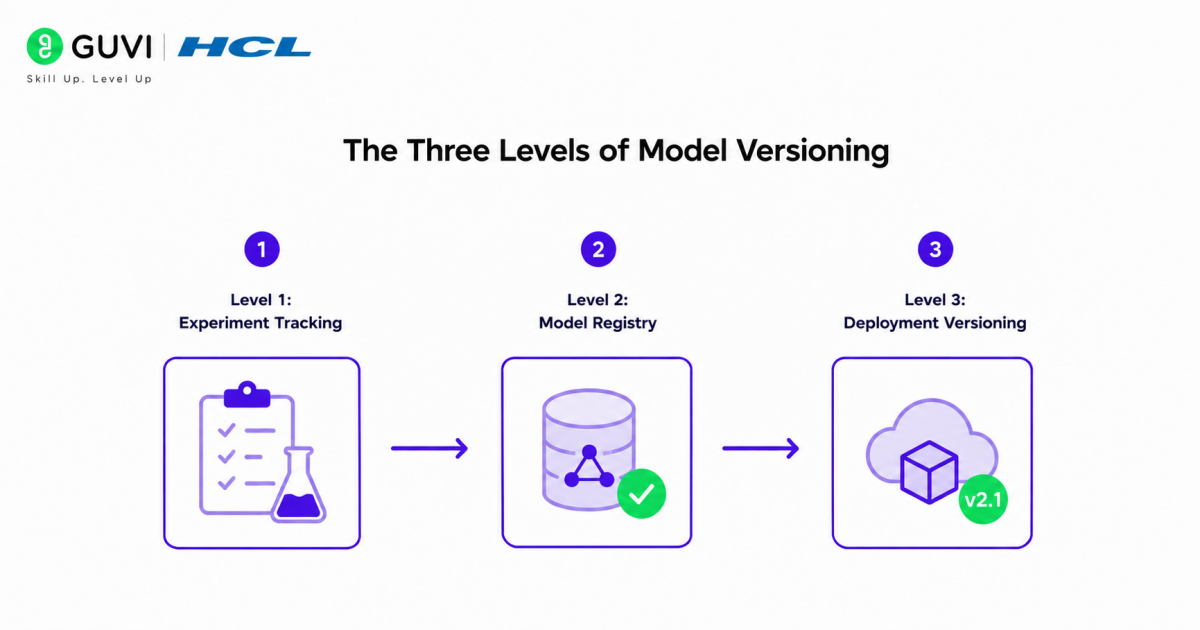
Model versioning happens at three distinct stages in the ML lifecycle, each with different requirements and tools.
Level 1: Experiment Tracking
During development, data scientists run many experiments varying architectures, hyperparameters, and datasets. Experiment tracking captures the inputs and outputs of each run automatically so experiments can be compared and the best configuration identified.
Each tracked experiment records the git commit hash of the code, dataset version or snapshot, all hyperparameters, training and validation metrics at each epoch, system environment including library versions, and the resulting model artifact.
This level answers the question: which experiment configuration produced which result?
Level 2: Model Registry
Not every experiment produces a model worth deploying. A model registry is a centralized store for production-candidate models that have passed evaluation criteria. Models in the registry are explicitly versioned, tagged with lifecycle stages like staging and production, and annotated with evaluation results and approval metadata.
The registry answers the question: which models are production-ready and what are their evaluated capabilities?
Level 3: Deployment Versioning
When a model is deployed, the serving infrastructure must manage multiple versions simultaneously for A/B testing, canary deployments, and rollback capability. Deployment versioning tracks which model version is serving which traffic percentage and maintains the ability to shift or revert traffic routing instantly.
This level answers the question: which model version is serving which users right now, and can we roll back safely?
Want to build strong MLOps skills covering model versioning, experiment tracking, and production deployment workflows? Explore HCL GUVI’s Artificial Intelligence & Machine Learning Course, designed to help you develop the practical ML engineering foundations that production AI roles demand.
Semantic Versioning for ML Models
Semantic versioning, the major.minor.patch convention widely used in software, can be adapted for ML models with meaningful semantics for each version component.
| Version Component | Increment When | Example Change |
| Major (X.0.0) | Architecture changes fundamentally | Switching from LSTM to Transformer |
| Major (X.0.0) | Input or output schema changes | Adding or removing features |
| Major (X.0.0) | Breaking API changes | Changing prediction format |
| Minor (1.X.0) | Retraining on new data | Monthly retraining with fresh data |
| Minor (1.X.0) | Hyperparameter changes | Learning rate or batch size tuning |
| Minor (1.X.0) | Non-breaking capability improvements | Better performance, same interface |
| Patch (1.0.X) | Bug fixes in preprocessing | Fixing a data normalization error |
| Patch (1.0.X) | Dependency updates | Updating library versions |
Major version changes signal that downstream systems consuming the model’s predictions may need to be updated. Minor version changes are drop-in compatible improvements. Patch versions fix problems without changing behavior meaningfully.
Enforcing this convention across a team requires documenting what constitutes a major versus minor change for your specific model and use case, since the boundaries can be ambiguous.
Read More: Machine Learning Pipeline Explained: Beginner to Pro Guide
Tools for Model Versioning
- MLflow
MLflow is the most widely adopted open-source ML versioning platform. It provides experiment tracking through MLflow Tracking, model storage through MLflow Models, and a production lifecycle registry through MLflow Model Registry.
MLflow Tracking automatically logs parameters, metrics, and artifacts when you instrument your training code with a few lines. The Model Registry adds lifecycle management with stages including None, Staging, Production, and Archived, with transitions requiring explicit promotion rather than happening automatically.
MLflow is framework-agnostic and works with scikit-learn, PyTorch, TensorFlow, XGBoost, and most other ML frameworks through built-in autologging or manual logging calls.
- DVC (Data Version Control)
DVC focuses specifically on versioning large data files and model artifacts that cannot be stored in Git. It uses Git for tracking metadata and pointers while storing the actual large files in cloud storage like S3, GCS, or Azure Blob.
DVC is particularly valuable for versioning training datasets alongside model versions, ensuring you can always reconstruct exactly which data was used to train any given model version.
- Weights and Biases (W&B)
Weights and Biases is a commercial experiment tracking platform with a model registry component. It provides richer visualization than MLflow with built-in support for comparing runs across multiple dimensions, tracking system metrics during training, and collaborative experiment management across teams.
Google’s ML infrastructure team published research showing that approximately 30 percent of ML production incidents at large technology companies are caused by model version mismatches, where the model serving a request was a different version than the one evaluated and approved, typically due to deployment automation errors or incomplete version tracking across serving infrastructure.

Tool Comparison
| Tool | Experiment Tracking | Model Registry | Data Versioning | Hosting |
| MLflow | Excellent | Yes | Limited | Self-hosted or managed |
| DVC | Basic | No | Excellent | Self-hosted |
| Weights and Biases | Excellent | Yes | Limited | Cloud SaaS |
| Neptune.ai | Excellent | Yes | Limited | Cloud SaaS |
| Comet ML | Good | Yes | Limited | Cloud SaaS |
Metadata Every Model Version Should Record
The minimum metadata that should be captured for every model version to make versioning genuinely useful rather than just nominal.
| Metadata Category | Specific Fields |
| Identity | Model name, version number, creation timestamp |
| Code | Git commit hash, branch, repository URL |
| Data | Dataset name, version or snapshot ID, split sizes |
| Training | All hyperparameters, framework and library versions |
| Performance | Validation metrics, test metrics, evaluation dataset |
| Environment | Python version, OS, hardware used for training |
| Lineage | Parent experiment run ID, base model if fine-tuned |
| Approval | Reviewer, approval date, deployment decision |
Teams that record only model weights and validation accuracy consistently struggle to reproduce results and debug production issues. Teams that record all of the above can answer almost any question about why a model behaves the way it does.
Netflix runs thousands of ML model versions simultaneously across their recommendation, content valuation, and streaming quality systems. Their internal ML platform enforces model versioning as a hard requirement before any model can be deployed, with automatic rollback triggered when production metrics deviate beyond configured thresholds, a practice that has reduced ML-related production incidents significantly compared to their earlier manual deployment approach.
Versioning for Fine-Tuned LLMs
Fine-tuned large language models require additional versioning considerations beyond what standard ML model versioning covers.
Base model identity matters enormously. A fine-tuned version of Llama 3 8B is fundamentally different from a fine-tuned version of Llama 3 70B even if the fine-tuning dataset is identical. The base model name, version, and source must be part of every fine-tuned model’s metadata.
Fine-tuning data versioning is particularly sensitive. The prompts, completions, and preference data used for instruction tuning and RLHF significantly shape model behavior in ways that evaluation benchmarks may not fully capture. Versioning the exact fine-tuning dataset with DVC or a similar tool is essential for reproducing alignment properties.
Adapter versioning for parameter-efficient fine-tuning methods like LoRA and QLoRA requires storing the adapter weights separately from the base model. The version record must capture both the base model version and the adapter version since both together determine the model’s behavior.
Want to build strong MLOps skills covering model versioning, experiment tracking, and production deployment workflows? Explore HCL GUVI’s Artificial Intelligence & Machine Learning Course, designed to help you develop the practical ML engineering foundations that production AI roles demand.
Conclusion
Model versioning is the foundation that makes every other MLOps practice reliable. Reproducible experiments, safe deployments, confident rollbacks, and meaningful A/B tests all depend on having a clean, complete record of what every model version is and how it was produced.
The teams that invest in model versioning infrastructure early consistently spend less time debugging unexplained production behavior and more time improving model quality.
FAQs
What is model versioning in machine learning?
Model versioning is the systematic tracking of every trained model version alongside the code, data, hyperparameters, and metrics that produced it, enabling reproduction, comparison, rollback, and auditing throughout the model lifecycle.
What is the difference between experiment tracking and a model registry?
Experiment tracking captures all training runs including failed ones for comparison during development. A model registry stores only production-candidate models with explicit lifecycle stages and approval metadata for deployment management.
Which tool should I use for model versioning?
MLflow is the most widely adopted open-source option covering both experiment tracking and model registry. DVC adds data versioning. Weights and Biases offers better visualization and collaboration features as a commercial alternative.
What metadata should I record for every model version?
At minimum: git commit hash, dataset version, all hyperparameters, framework and library versions, training and validation metrics, hardware used, and the identity of whoever approved the model for production.
How does model versioning support A/B testing?
A/B testing routes different traffic percentages to different model versions simultaneously. Clean version tracking in a model registry makes it possible to route, monitor, and shift traffic between specific versions confidently and revert instantly if a version underperforms.
How is versioning different for fine-tuned LLMs?
Fine-tuned LLMs require versioning the base model identity and version in addition to fine-tuning data and adapter weights. The combination of base model version and fine-tuning dataset version together determines the model’s behavior, so both must be captured in the version record.
Success Stories

About the Author
HCL GUVI
This article was selected and published as part of the HCL GUVI AI Blogathon 2026, an initiative designed to encourage students, AI enthusiasts, and aspiring tech writers to simplify complex AI concepts through impactful technical content. The contest recognized high-quality, original, and insightful AI-focused blogs, with selected authors receiving publication opportunities on the HCL GUVI blog platform along with official author credits and recognition.
View all posts by HCL GUVI
Connect with me @



Did you enjoy this article?