


Data Engineering Articles
Apache Iceberg Tutorial: A Practical Guide for Data Engineers
12 Important Data Architect Roles and Responsibilities


Get In Touch For Details! Request More Information
Top 10 YouTube Channels to Learn Data Engineering in 2026
Sep 07, 2026 8 Min Read 31920 Views
(Last Updated)
Data engineering can seem overwhelming when you first encounter terms such as ETL, data pipelines, Apache Spark, Kafka, Airflow, data warehouses and lakehouses. The problem is rarely a lack of learning material. YouTube contains thousands of data engineering tutorials. The real challenge is knowing which channels to follow and what to learn from each one.
Some channels are excellent for SQL and Python fundamentals. Others focus on cloud pipelines, distributed processing or orchestration. A few go deeper into data architecture and explain why production data systems are designed in particular ways. That is why randomly watching tutorials is rarely the best approach.
A stronger strategy is to use different YouTube channels for different stages of your learning journey. Start with programming and databases, move into pipelines and orchestration, and then learn cloud platforms, distributed processing and production architecture. This guide covers the top YouTube channels to learn data engineering in 2026, what each channel is best for and how to turn free tutorials into practical, job-ready skills. Let’s explore more-
Quick Answer: The best YouTube channels to learn data engineering provide structured tutorials on SQL, Python, ETL, data pipelines, cloud platforms, Apache Spark, Airflow, Kafka, dbt and modern data architecture. Beginners should start with foundational channels before moving to project-based and platform-specific content.
- Best for beginners: Alex The Analyst, codebasics and Seattle Data Guy
- Best for projects: Darshil Parmar and DataTalksClub
- Best for architecture: Andreas Kretz and Data with Zach
- Best for big data: Databricks and E-Learning Bridge
- Best for cloud data warehousing: Snowflake Inc.
- Best approach: Watch tutorials, practise each concept and build end-to-end projects instead of learning passively
Table of contents
- Best YouTube Channels for Data Engineering at a Glance
- Darshil Parmar
- Andreas Kretz
- Seattle Data Guy
- Data with Zach
- DataTalksClub
- Databricks
- E-Learning Bridge
- Snowflake Inc.
- Alex The Analyst
- codebasics
- How to Choose the Right Data Engineering YouTube Channel
- Data Engineering Skills to Learn in 2026
- SQL
- Python
- Databases and Data Modelling
- ETL and ELT
- Workflow Orchestration
- Distributed Processing
- Cloud Platforms
- Streaming
- 12-Week YouTube Roadmap for Learning Data Engineering
- Weeks 1–2: SQL
- Weeks 3–4: Python
- Week 5: Databases
- Week 6: ETL
- Week 7: Airflow
- Weeks 8–9: Spark
- Week 10: Cloud
- Week 11: Kafka
- Week 12: Final Project
- Data Engineering Projects to Build While Watching YouTube
- API-to-Database Pipeline
- Scheduled ETL Pipeline
- Cloud Data Pipeline
- Spark Data Processing Project
- Streaming Pipeline
- How to Use YouTube to Learn Data Engineering Effectively
- Watch
- Rebuild
- Modify
- Document
- Can You Become Job-Ready for Data Engineering Using YouTube Alone?
- Common Mistakes When Learning Data Engineering From YouTube
- Watching Too Many Channels
- Learning Tools Before Fundamentals
- Copying Projects Without Understanding Them
- Ignoring SQL
- Avoiding Debugging
- Building Projects Without Documentation
- Conclusion
- FAQ
- Which YouTube Channel Is Best for Learning Data Engineering?
- Can I Learn Data Engineering From YouTube?
- What Should I Learn First for Data Engineering?
- How Long Does It Take to Learn Data Engineering?
- Is Data Engineering Difficult for Beginners?
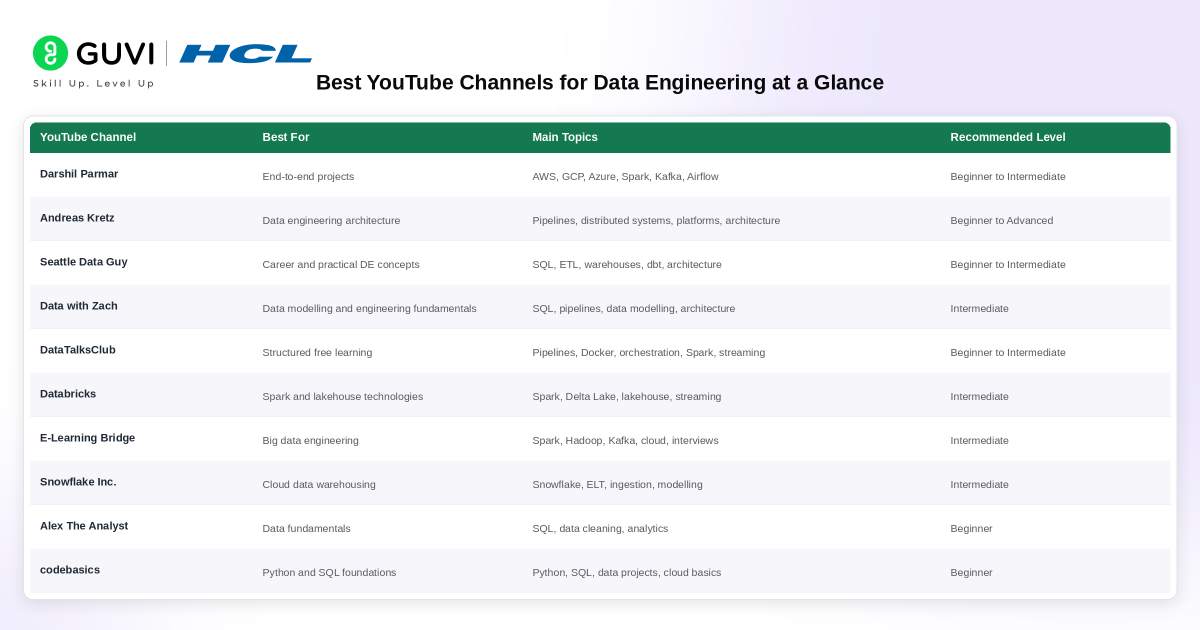
Best YouTube Channels for Data Engineering at a Glance
| YouTube Channel | Best For | Main Topics | Recommended Level |
|---|---|---|---|
| Darshil Parmar | End-to-end projects | AWS, GCP, Azure, Spark, Kafka, Airflow | Beginner to Intermediate |
| Andreas Kretz | Data engineering architecture | Pipelines, distributed systems, platforms, architecture | Beginner to Advanced |
| Seattle Data Guy | Career and practical DE concepts | SQL, ETL, warehouses, dbt, architecture | Beginner to Intermediate |
| Data with Zach | Data modelling and engineering fundamentals | SQL, pipelines, data modelling, architecture | Intermediate |
| DataTalksClub | Structured free learning | Pipelines, Docker, orchestration, Spark, streaming | Beginner to Intermediate |
| Databricks | Spark and lakehouse technologies | Spark, Delta Lake, lakehouse, streaming | Intermediate |
| E-Learning Bridge | Big data engineering | Spark, Hadoop, Kafka, cloud, interviews | Intermediate |
| Snowflake Inc. | Cloud data warehousing | Snowflake, ELT, ingestion, modelling | Intermediate |
| Alex The Analyst | Data fundamentals | SQL, data cleaning, analytics | Beginner |
| codebasics | Python and SQL foundations | Python, SQL, data projects, cloud basics | Beginner |
You do not need to follow every channel from the first day. Choose channels according to the skill you are currently learning.
Top 10 YouTube Channels to Learn Data Engineering in 2026
1. Darshil Parmar
Darshil Parmar is one of the strongest YouTube options for learners who want to understand data engineering through end-to-end projects rather than isolated tool demonstrations.
The channel covers topics such as:
- Python
- SQL
- AWS
- Google Cloud
- Azure
- Apache Spark
- Apache Kafka
- Apache Airflow
- ETL pipelines
- Data lakes
- Data warehouses
What makes the channel particularly useful is the project-oriented approach. Instead of learning AWS S3, Lambda or Spark independently, you can see how different technologies connect inside a complete data pipeline.
For example, a project may begin with raw data, move it into cloud storage, transform the records and then make the processed data available for analytics.
This helps learners understand an important data engineering concept:
Individual tools matter less than understanding how they work together inside a pipeline.
Darshil Parmar is therefore a good choice after learning basic Python and SQL.
Best for: Project-based learners and aspiring data engineers building portfolios.
2. Andreas Kretz
The Andreas Kretz YouTube channel is particularly useful for understanding the architecture behind data engineering.
Many beginners learn individual tools without understanding why those tools exist.
They may know how to create an Airflow DAG but struggle to explain:
- Why orchestration is necessary
- When batch processing is appropriate
- When streaming is useful
- How different storage systems interact
- Why distributed systems are required
- How modern data platforms are structured
This is where architecture-focused learning becomes important.
The channel covers concepts related to:
- Data pipelines
- Distributed systems
- Cloud architecture
- Data platforms
- Databricks
- Big data
- Data engineering careers
The explanations help connect individual technologies to larger system-design decisions.
This makes the channel valuable for learners moving beyond:
How do I use this tool?
toward:
Why would a data engineer choose this tool?
That distinction becomes increasingly important in technical interviews and real engineering work.
Best for: Understanding data architecture and the reasoning behind data engineering systems.
3. Seattle Data Guy
The Seattle Data Guy YouTube channel combines practical data engineering topics with career guidance.
The channel explores areas such as:
- Data pipelines
- SQL
- Data warehouses
- Snowflake
- dbt
- ETL
- Analytics engineering
- Data architecture
- Data engineering careers
One of its biggest advantages is that it provides context around what data engineers actually do at work.
Beginners often imagine that data engineering means spending the entire day writing pipeline code. In reality, engineers also make decisions about data quality, architecture, infrastructure, stakeholder requirements and maintainability.
Seattle Data Guy helps expose learners to this broader perspective.
It is also useful for anyone deciding whether data engineering is the right career because the content discusses industry expectations alongside technical concepts.
Best for: Career switchers and beginners who want a realistic understanding of data engineering work.
4. Data with Zach
Data with Zach is especially valuable for learners who want to strengthen the concepts underneath modern data platforms.
The channel focuses heavily on topics such as:
- SQL
- Data modelling
- Data engineering fundamentals
- Pipeline design
- Data architecture
- Career development
- Engineering practices
SQL deserves particular attention because it remains one of the most fundamental skills for data engineers.
A data engineer frequently needs to:
- Join tables
- Aggregate large datasets
- Create transformations
- Debug incorrect records
- Design analytical models
- Validate pipeline outputs
If SQL is still a weak area, practise queries alongside the channel using this guide to SQL queries with examples.
Data with Zach is particularly helpful once you know basic SQL syntax and want to understand how experienced engineers think about data.
Best for: SQL, data modelling and deeper data engineering fundamentals.
5. DataTalksClub
DataTalksClub is an excellent option for learners who prefer something closer to a structured course delivered through free videos.
Its Data Engineering Zoomcamp covers several stages of a modern data pipeline rather than focusing on one technology.
Learners can encounter topics such as:
- Docker
- Infrastructure
- Workflow orchestration
- Data warehouses
- Analytics engineering
- Apache Spark
- Batch processing
- Streaming
- End-to-end projects
The biggest advantage is structure.
One of the main problems with learning through YouTube is jumping between unrelated videos. A curriculum-based playlist provides a clearer sequence and encourages learners to complete projects rather than simply watch tutorials.
The project component is particularly useful because data engineering portfolios should demonstrate that you can connect multiple systems.
Best for: Learners who want a free, curriculum-style data engineering path.
6. Databricks
The official Databricks YouTube channel is one of the most useful resources once you begin learning distributed data processing and lakehouse technologies.
Databricks is closely associated with technologies and concepts such as:
- Apache Spark
- Delta Lake
- Data engineering pipelines
- Data lakes
- Lakehouse architecture
- Streaming
- Analytics
- Machine learning workloads
The channel includes product tutorials, technical sessions, demonstrations and discussions about modern data platforms.
Beginners do not need to start here immediately.
First become comfortable with:
- Python
- SQL
- Databases
- ETL
- Basic cloud concepts
Then Databricks tutorials become much easier to understand.
If you are starting with the platform, this Databricks beginner guide can help you understand the environment before moving into advanced Spark workflows.
Best for: Apache Spark, Databricks and lakehouse-focused learners.
7. E-Learning Bridge
The E-Learning Bridge YouTube channel is useful for learners moving into the big-data side of data engineering.
The channel covers topics associated with:
- Apache Spark
- PySpark
- Hadoop
- Kafka
- Big data
- Cloud platforms
- Data engineering interviews
Distributed processing is an important transition point in a data engineer’s learning journey.
Working with a CSV file using Pandas is very different from processing datasets distributed across multiple machines.
Tools such as Spark introduce concepts including:
- Partitions
- Executors
- Distributed transformations
- Shuffles
- Fault tolerance
- Cluster processing
Understanding these ideas helps learners progress from small local projects toward scalable data systems.
Best for: Learners preparing for Spark-heavy, big-data or technical interview roles.
8. Snowflake Inc.
The official Snowflake Inc. YouTube channel focuses on modern cloud data warehousing and the Snowflake platform.
Topics commonly relevant to data engineers include:
- Data ingestion
- Data transformation
- Data warehousing
- ELT
- Data sharing
- Data modelling
- Cloud architecture
- Platform administration
Cloud data warehouses play a central role in many modern analytics architectures.
A typical pipeline may look like:
Applications
→ Raw data
→ Cloud storage
→ Transformation
→ Data warehouse
→ BI or analytics
Learning a platform such as Snowflake helps learners understand how organisations centralise analytical data and make it accessible to downstream teams.
Official product channels are especially useful for platform-specific features because the content comes directly from the technology provider.
Best for: Cloud data warehousing and Snowflake-focused roles.
9. Alex The Analyst
The Alex The Analyst YouTube channel focuses more heavily on data analytics than pure data engineering, but it can still be useful during the beginner stage.
The channel covers foundational topics such as:
- SQL
- Data cleaning
- Databases
- Excel
- Data analysis
- Portfolio projects
Why include an analytics-focused channel in a data engineering learning path?
Because beginners need to understand how downstream users work with data.
Data engineers build systems that supply clean and reliable information to:
- Analysts
- Data scientists
- BI teams
- Machine learning engineers
Learning basic analytics makes it easier to understand why schemas, data quality and transformations matter.
However, you should eventually move from analytics tutorials to specialised channels covering pipelines, orchestration, Spark and cloud infrastructure.
Best for: Complete beginners building SQL and data foundations.
10. codebasics
The codebasics YouTube channel is another useful starting point for learners who need stronger programming and database fundamentals before entering advanced data engineering.
Its broader data-focused content can help build skills in:
- Python
- SQL
- Data processing
- Databases
- Cloud concepts
- Data projects
Beginners often make the mistake of starting immediately with Kafka, Spark or Airflow.
That usually creates unnecessary confusion.
You will understand those tools much faster after becoming comfortable with:
Python → SQL → Databases → Data transformation → Pipelines
Use channels such as codebasics for the foundation and then move into specialised data engineering creators.
Best for: Beginners who need to strengthen Python, SQL and practical data skills.
How to Choose the Right Data Engineering YouTube Channel
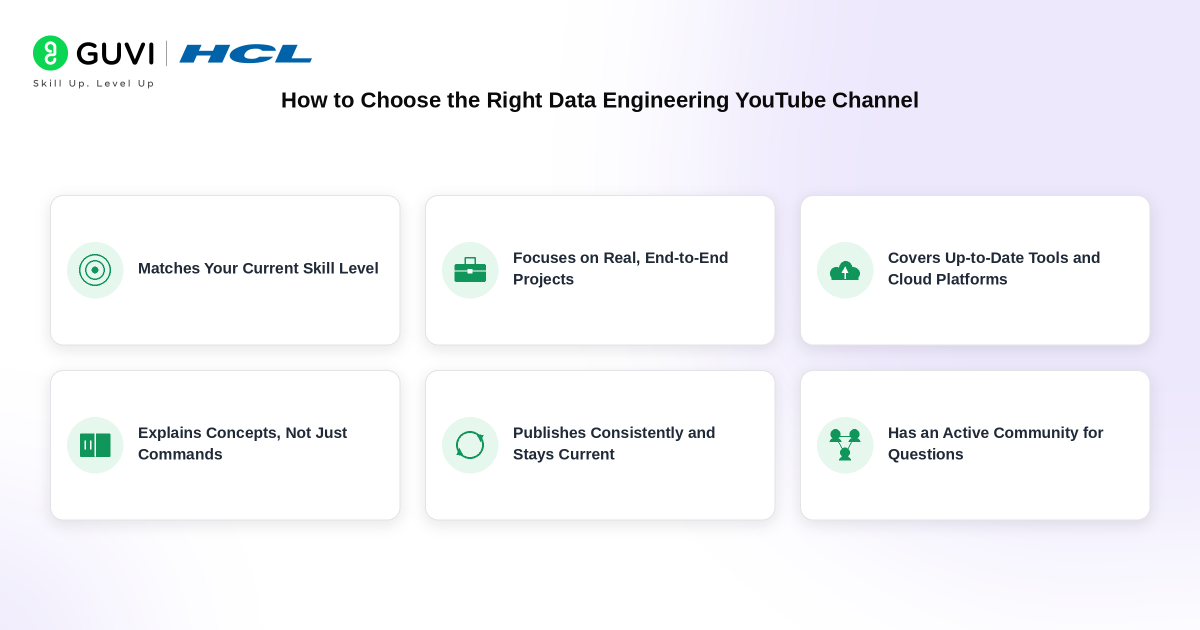
The best channel depends on what you are trying to learn.
Do not choose a channel simply because it has the most subscribers.
Use your current skill gap instead.
| If You Want to Learn | Start With |
|---|---|
| Data engineering basics | Seattle Data Guy |
| Python and SQL foundations | codebasics or Alex The Analyst |
| SQL and data modelling | Data with Zach |
| End-to-end projects | Darshil Parmar |
| Complete structured learning | DataTalksClub |
| Data architecture | Andreas Kretz |
| Apache Spark | Databricks or E-Learning Bridge |
| Big data | E-Learning Bridge |
| Cloud data warehousing | Snowflake Inc. |
| Databricks | Databricks |
A beginner might use two channels simultaneously.
For example:
Foundation channel: codebasics
Project channel: Darshil Parmar
Once your basics improve, you can add specialised resources for Spark, Airflow, Kafka or cloud technologies.

Data Engineering Skills to Learn in 2026
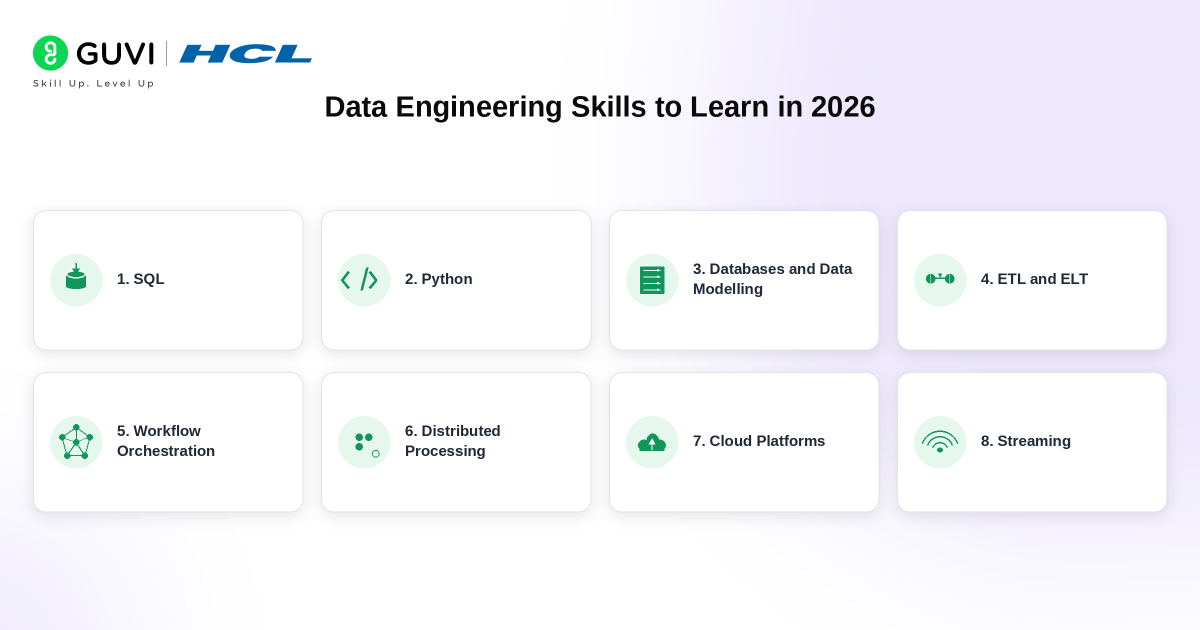
Watching videos becomes much more useful when you know which skills you are trying to build.
A practical learning order is:
1. SQL
Start with:
- SELECT
- WHERE
- GROUP BY
- JOIN
- Subqueries
- CTEs
- Window functions
SQL is essential because data engineering revolves around storing, transforming and querying data.
You can reinforce these skills through SQL project ideas instead of practising syntax alone.
2. Python
Learn enough Python to:
- Read files
- Call APIs
- Manipulate data
- Handle errors
- Work with databases
- Automate tasks
You do not need advanced software engineering before starting data engineering, but your Python foundation should be comfortable.
3. Databases and Data Modelling
Understand:
- Tables
- Primary and foreign keys
- Normalisation
- Indexes
- OLTP vs OLAP
- Fact tables
- Dimension tables
- Star schemas
Good pipelines are not useful if the resulting data model is poorly designed.
4. ETL and ELT
Learn how data moves from source systems into analytical platforms.
Understand the difference between:
ETL: Extract → Transform → Load
and
ELT: Extract → Load → Transform
Then build simple pipelines yourself.
5. Workflow Orchestration
Move into tools such as Apache Airflow once you understand basic pipelines.
Learn:
- DAGs
- Tasks
- Scheduling
- Dependencies
- Retries
- Failure handling
- Monitoring
6. Distributed Processing
Apache Spark becomes useful when datasets become too large or computationally expensive for simple local processing.
Focus on:
- DataFrames
- Transformations
- Actions
- Partitions
- Shuffles
- Spark SQL
7. Cloud Platforms
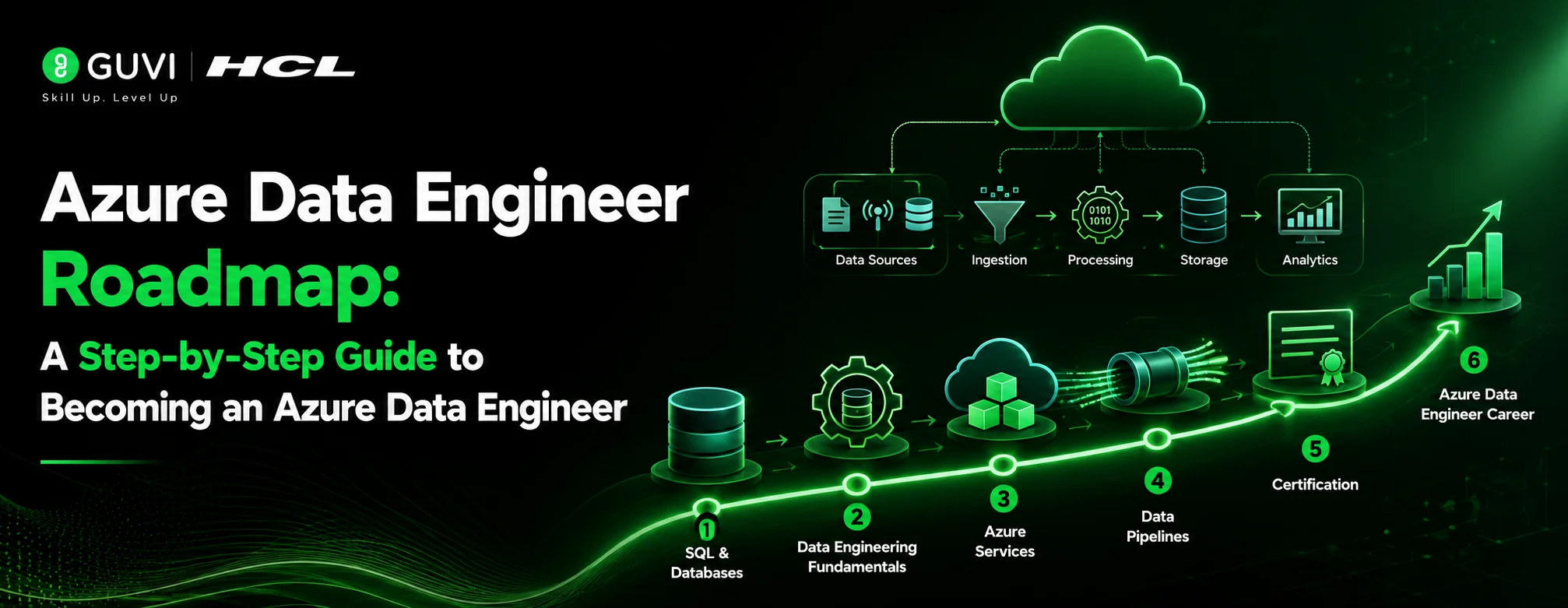
Choose one cloud platform rather than attempting AWS, Azure and GCP simultaneously. If Azure is your target, this Azure Data Engineer roadmap provides a structured progression.
8. Streaming
Once batch pipelines make sense, explore tools such as Kafka.
Understand:
- Producers
- Consumers
- Topics
- Partitions
- Offsets
- Event streams
Do not start with streaming before understanding normal batch pipelines.
12-Week YouTube Roadmap for Learning Data Engineering
YouTube becomes much more effective when you follow a schedule.
| Weeks | Focus | What to Build |
|---|---|---|
| 1–2 | SQL | Query-based mini project |
| 3–4 | Python | Data extraction and cleaning script |
| 5 | Databases | PostgreSQL database |
| 6 | ETL | API-to-database pipeline |
| 7 | Airflow | Scheduled ETL DAG |
| 8–9 | Spark | Large dataset transformation |
| 10 | Cloud | Cloud storage pipeline |
| 11 | Kafka | Simple streaming pipeline |
| 12 | End-to-end project | Portfolio-ready data platform |
Weeks 1–2: SQL
Practise SQL every day.
Do not just watch SELECT and JOIN tutorials.
Create tables and solve queries yourself.
Weeks 3–4: Python
Learn to read:
- CSV
- JSON
- APIs
Then clean and transform those records.
Week 5: Databases
Create a small PostgreSQL database.
Design multiple related tables and load data into them.
Week 6: ETL
Build your first pipeline:
Public API
→ Python
→ Clean data
→ PostgreSQL
Week 7: Airflow
Schedule the same pipeline.
Add:
- Retries
- Logging
- Dependencies
Weeks 8–9: Spark
Rebuild part of the transformation using PySpark.
Compare local processing with distributed concepts.
Week 10: Cloud
Move the project to AWS, Azure or GCP.
Learn cloud storage and one managed data service.
Week 11: Kafka
Build a simple event stream.
The project does not need to be enormous. Focus on understanding producers, consumers and topics.
Week 12: Final Project
Connect several technologies into one complete pipeline and publish the architecture, code and README on GitHub.
Data Engineering Projects to Build While Watching YouTube
Watching tutorials without building anything creates the illusion of progress.
Projects force you to solve problems independently.
1. API-to-Database Pipeline
Build:
Public API
→ Python
→ Data cleaning
→ PostgreSQL
You will practise:
- APIs
- Python
- JSON
- SQL
- Database loading
2. Scheduled ETL Pipeline
Add Airflow:
API
→ Airflow
→ Python transformation
→ PostgreSQL
Include retries and failure logging.
3. Cloud Data Pipeline
Build:
Raw files
→ Cloud storage
→ Transformation
→ Data warehouse
This demonstrates cloud and pipeline skills.
4. Spark Data Processing Project
Take a large dataset and process it using PySpark.
Practise:
- Transformations
- Aggregations
- Partitions
- Spark SQL
5. Streaming Pipeline
Build:
Event producer
→ Kafka
→ Consumer
→ Database
This introduces real-time data engineering concepts.
You can also explore these cloud computing project ideas and adapt one into a data engineering portfolio project.
How to Use YouTube to Learn Data Engineering Effectively
The biggest mistake learners make is treating YouTube like entertainment.
Watching ten hours of tutorials does not equal ten hours of engineering practice.
Use a simple rule:
Watch → Rebuild → Modify → Document
Watch
Follow the tutorial once and understand the architecture.
Rebuild
Close the video and attempt the project yourself.
Modify
Change something.
For example:
- Use a different API
- Change the database
- Add another transformation
- Add error handling
- Schedule the pipeline
- Move it to the cloud
Document
Create a README explaining:
- Problem
- Architecture
- Technologies
- Data flow
- Setup
- Challenges
- Improvements
This turns a tutorial into your own learning project.
A good weekly routine might be:
- Day 1: Learn the concept
- Day 2: Follow a tutorial
- Day 3: Rebuild without the tutorial
- Day 4: Add your own feature
- Day 5: Document the project
- Weekend: Review and practise interview questions
This approach prevents endless tutorial consumption.
Can You Become Job-Ready for Data Engineering Using YouTube Alone?
YouTube can teach a large portion of the technical knowledge required to begin data engineering.
You can learn:
- Python
- SQL
- Databases
- ETL
- Airflow
- Spark
- Kafka
- Cloud platforms
- Data warehouses
for free.
The limitation is structure and feedback.
YouTube does not automatically tell you:
- What to learn first
- Whether your architecture is correct
- Whether your code follows good practices
- Which projects matter to employers
- Where your technical weaknesses are
That means learners need to create their own structure.
A good self-learning combination is:
YouTube + documentation + projects + GitHub + interview preparation
If you prefer structured mentorship and guided projects, HCL GUVI’s Big Data and Cloud Analytics Course covers technologies related to databases, data cleaning, cloud services, orchestration, infrastructure and large-scale data processing.
You can also explore HCL GUVI’s Data Engineering and Big Data Self-Paced Course if you prefer independent learning.
Common Mistakes When Learning Data Engineering From YouTube
1. Watching Too Many Channels
Following ten creators simultaneously often creates more confusion than progress.
Choose one primary channel and one supporting channel.
2. Learning Tools Before Fundamentals
Do not start with Kafka because it sounds advanced.
Start with:
SQL → Python → Databases → ETL → Orchestration → Spark → Cloud → Streaming
3. Copying Projects Without Understanding Them
If you cannot explain why each component exists, the project will be difficult to discuss in an interview.
4. Ignoring SQL
Data engineering requires far more than SQL, but weak SQL remains a major limitation.
Practise queries continuously throughout your learning journey.
5. Avoiding Debugging
Real data pipelines fail. APIs time out. Schemas change. Files contain malformed values. Tasks fail. Do not immediately copy the tutorial’s solution. Learn to inspect logs and diagnose failures.
6. Building Projects Without Documentation
A GitHub repository containing only code is harder for recruiters or interviewers to understand. Add an architecture diagram and README.
Build strong data engineering skills beyond YouTube learning with HCL GUVI’s Big Data Engineering Course. Learn data pipelines, distributed systems, big data tools, data processing workflows, and real-world engineering concepts through structured training designed for aspiring data engineers in 2026.
Conclusion
The best YouTube channels to learn data engineering are not necessarily the ones with the largest audiences. The most useful channels are those that match the skill you need to develop.
Start with Alex The Analyst or codebasics if your Python and SQL foundations need work. Use Seattle Data Guy and Data with Zach to understand the field more deeply. Move to Darshil Parmar and DataTalksClub when you are ready to build complete pipelines. Then use Databricks, E-Learning Bridge and Snowflake Inc. to specialise in big data and cloud platforms.
Most importantly, do not make YouTube your entire learning process. Use every tutorial as the starting point for a project. Build it yourself. Break it. Debug it. Improve it. Document it. That is how free YouTube tutorials turn into practical data engineering skills.
FAQ
Which YouTube Channel Is Best for Learning Data Engineering?
There is no single best channel for every learner. Darshil Parmar is particularly useful for end-to-end data engineering projects, while Andreas Kretz is strong for architecture and conceptual understanding. Seattle Data Guy is useful for beginners and career context, Data with Zach is valuable for SQL and data modelling, and DataTalksClub provides a more structured curriculum. The best choice depends on your current skill level and the technology you want to learn.
Can I Learn Data Engineering From YouTube?
Yes. YouTube contains enough free material to learn SQL, Python, databases, ETL, Spark, Airflow, Kafka and cloud fundamentals. However, simply watching tutorials is not enough. Learners should reproduce projects independently, modify them, read official documentation and build a portfolio that demonstrates complete data pipelines.
What Should I Learn First for Data Engineering?
Start with SQL and Python before moving into specialised data engineering tools. Next, learn relational databases, data modelling and ETL concepts. After that, progress to workflow orchestration, cloud platforms, Apache Spark and streaming technologies such as Kafka. Learning tools in this order makes advanced tutorials easier to understand.
How Long Does It Take to Learn Data Engineering?
The timeline depends on your existing technical background and the amount of time you practise. Someone already comfortable with programming and SQL may progress much faster than a complete beginner. A focused learner can build a strong foundation within several months, but becoming job-ready requires repeated project work, debugging practice and experience connecting multiple technologies rather than simply completing tutorials.
Is Data Engineering Difficult for Beginners?
Data engineering can initially feel difficult because it combines programming, databases, cloud infrastructure and distributed systems. Beginners do not need to learn all of these technologies simultaneously. Start with SQL, Python and databases before moving into pipelines and cloud tools. The field becomes much easier when skills are learned in a logical sequence and reinforced through practical projects.
Success Stories

About the Author
Vaishali
I'm a seasoned writer with four years of experience across technical, non-technical, and just about every genre or niche you can imagine. Adaptable and curious, I enjoy exploring new topics and making information engaging and easy to understand. Fueled by a steady stream of tea, I approach each project with creativity, reliability, and genuine enthusiasm for storytelling.
View all posts by Vaishali
Connect with me @







Did you enjoy this article?