


Full Stack Development Articles
Claude for Architecture and Engineering Documentation
Freelancing as a Python Developer: Getting Your First Client

Get In Touch For Details! Request More Information
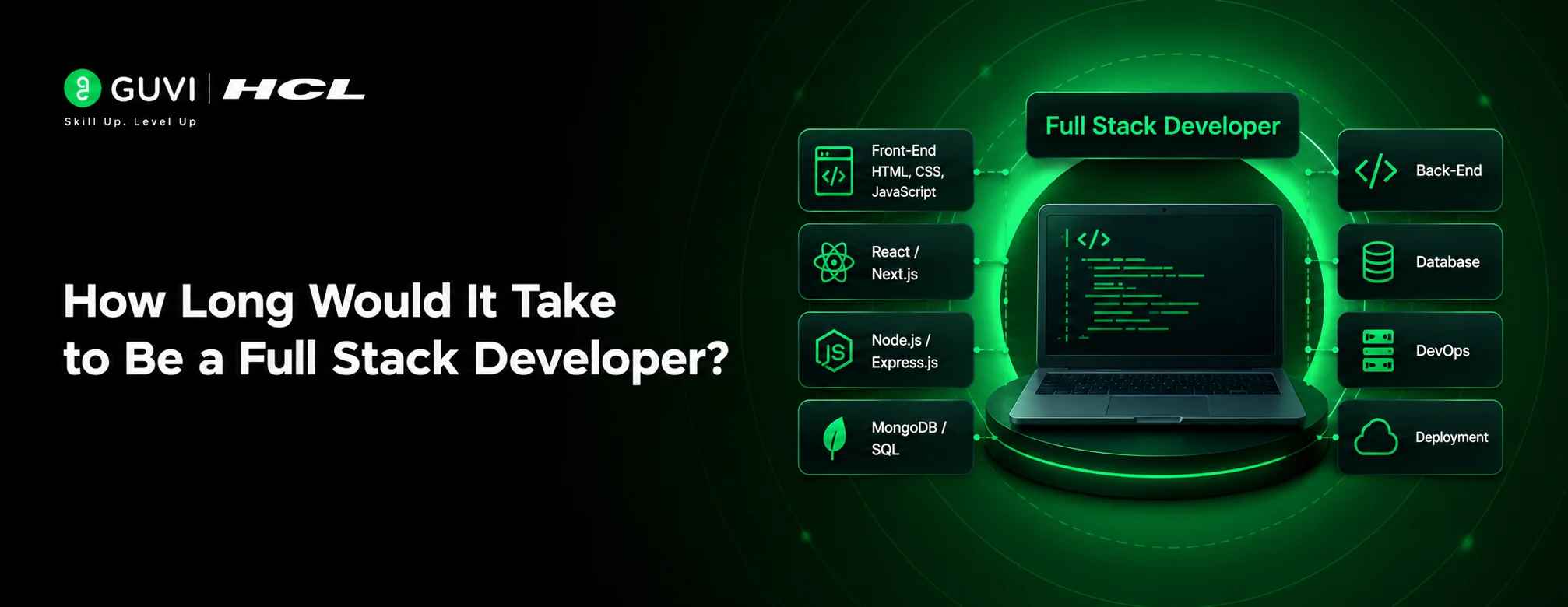
How Long Would It Take to Be a Full Stack Developer?
Jul 17, 2026 4 Min Read 62996 Views
(Last Updated)
How long it takes to become a full stack developer depends more on your weekly hours than on how naturally good you are at coding. Full stack development means learning both frontend and backend skills, and juggling both is exactly what makes the timeline unpredictable for most beginners.
This article walks you through a realistic, month-by-month roadmap, compares different learning paths, and flags the mistakes that quietly stretch your timeline out. By the end, you will have a plan built around the hours you can actually commit, not a generic promise.
Table of contents
- TL;DR Summary
- Full Stack Developer Timeline at a Glance
- Full Stack Learning Roadmap by Month: Month 1, 2, 3, 4 Plan
- Month 1: Frontend Foundations
- Month 2: Backend and Databases
- Month 3: Frameworks and Integration
- Month 4: Projects, Deployment, and Job Prep
- Full Stack Timeline: Self-Taught vs Bootcamp vs Course Comparison
- Common Mistakes That Triple Learning Time
- Signs You Are Job-Ready as a Full Stack Developer
- Get a Fixed Timeline Instead of Guesswork
- Conclusion
- FAQs
- How long does it take to become a full stack developer?
- Can I become a full stack developer in 3 months?
- Do I need a computer science degree to become a full stack developer?
- Is self-taught or a bootcamp faster for becoming job-ready?
- What should I learn first, frontend or backend?
- Is full stack development still in demand in 2026?
- Can working professionals learn full stack development part-time?
- How many projects do I need before applying for jobs?
TL;DR Summary
- How long it takes to become a full stack developer depends far more on your daily hours than on natural talent
- Most beginners with no coding background need 6 to 9 months of consistent practice
- Learners who can dedicate 5 to 6 hours a day to a structured course often reach job-ready in 3 to 4 months
- Self-taught learners tend to take longer, closer to 9 to 18 months, mainly because there’s no fixed curriculum forcing progress
- This guide breaks the process into a month-by-month roadmap, compares self-taught, bootcamp, and course paths, and lists the mistakes that quietly triple your timeline
Full Stack Developer Timeline at a Glance
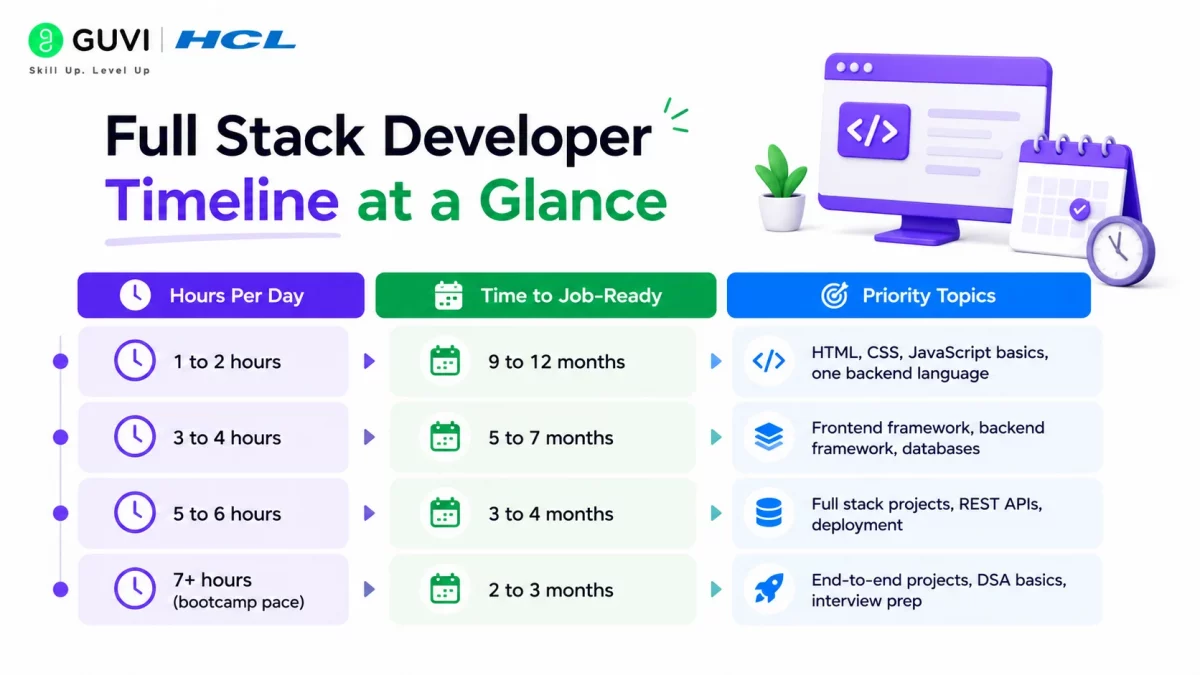
Your daily study hours are the single biggest factor in how fast you get job-ready. Here’s how that plays out in practice.
| Hours Per Day | Time to Job-Ready | Priority Topics |
|---|---|---|
| 1 to 2 hours | 9 to 12 months | HTML, CSS, JavaScript basics, one backend language |
| 3 to 4 hours | 5 to 7 months | Frontend framework, backend framework, databases |
| 5 to 6 hours | 3 to 4 months | Full stack projects, REST APIs, deployment |
| 7+ hours (bootcamp pace) | 2 to 3 months | End-to-end projects, DSA basics, interview prep |
Use this table to set expectations before you start. If your daily hours don’t match your target timeline, it’s better to adjust the timeline than to burn out chasing a deadline that isn’t realistic.
Full Stack Learning Roadmap by Month: Month 1, 2, 3, 4 Plan
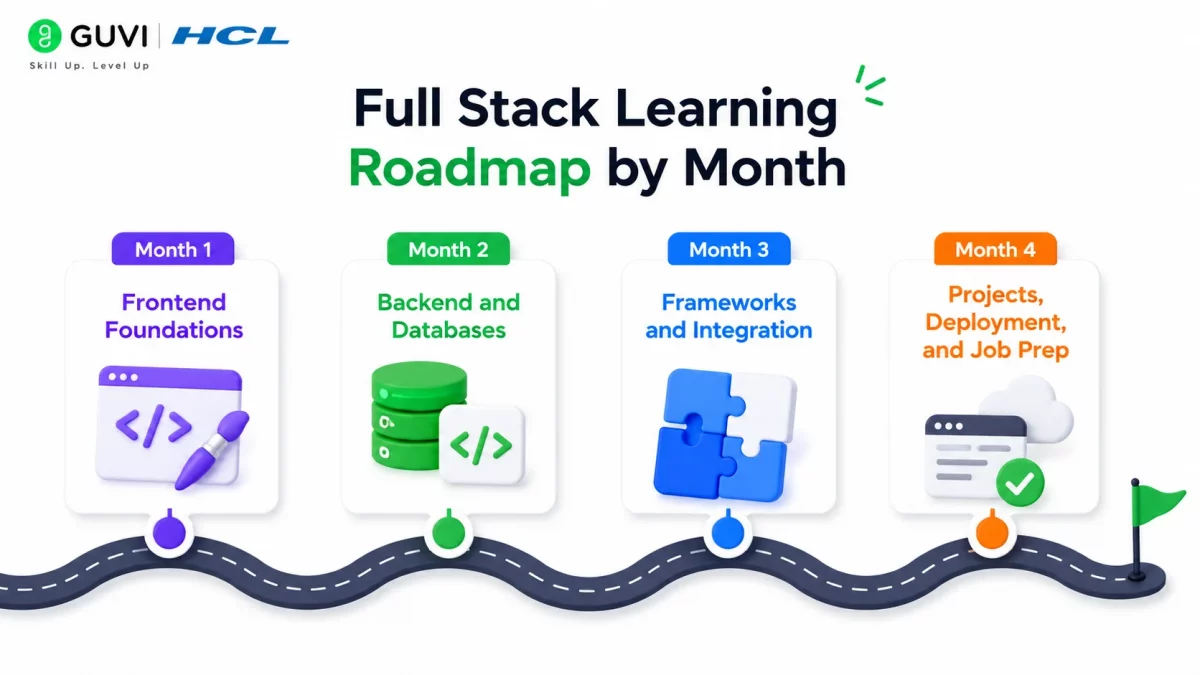
This is a fast-track path built for learners who can commit 5 to 6 focused hours a day. If you have fewer hours, stretch each month proportionally using the table above.
Month 1: Frontend Foundations
- Learn HTML and CSS to structure and style web pages
- Get comfortable with core JavaScript: variables, functions, loops, DOM manipulation
- Set up Git and GitHub for version control
- Build 2 to 3 small static pages to lock in the basics
Month 2: Backend and Databases
- Pick one backend language: Node.js, Python, or Java
- Learn how REST APIs work and build a few simple endpoints
- Get hands-on with a database, either SQL (MySQL, PostgreSQL) or MongoDB
- Build a basic CRUD application connecting your backend to a database
Month 3: Frameworks and Integration
- Learn a frontend framework such as React or Angular
- Pair it with a backend framework like Express.js, Django, or Spring Boot
- Practice connecting your frontend and backend into one working application
- Start using tools like Postman to test your APIs
Month 4: Projects, Deployment, and Job Prep
- Build 2 to 3 full stack projects that solve a real problem, not tutorial clones
- Deploy your projects using platforms like Render, Vercel, or AWS basics
- Put together a developer portfolio showcasing your work
- Start applying and practicing interview questions alongside your job search
Job postings for full-stack development roles rose by 42% in a single year, and nearly 8 out of 10 companies now say they prefer hiring one full-stack developer over separate frontend and backend specialists. That’s exactly why the combined skill set is worth the extra months of learning.
Full Stack Timeline: Self-Taught vs Bootcamp vs Course Comparison
Not every path takes you to job-ready at the same speed. Here’s how the three common routes actually compare.
| Path | Typical Timeline | Structure | Best For |
|---|---|---|---|
| Self-taught (free resources) | 9 to 18 months | Low, entirely self-paced | Highly disciplined learners with flexible time |
| Structured course or bootcamp | 3 to 6 months | High, fixed curriculum with mentorship | Career switchers who want speed and accountability |
| University degree (CS) | 3 to 4 years | Very high, broad theoretical foundation | Learners building long-term, formal credentials |
Self-taught learners often take longer not because they’re less capable, but because there’s no one flagging gaps or forcing them to move on from a topic. A structured course closes that gap by deciding, in advance, what you learn and when.
Common Mistakes That Triple Learning Time
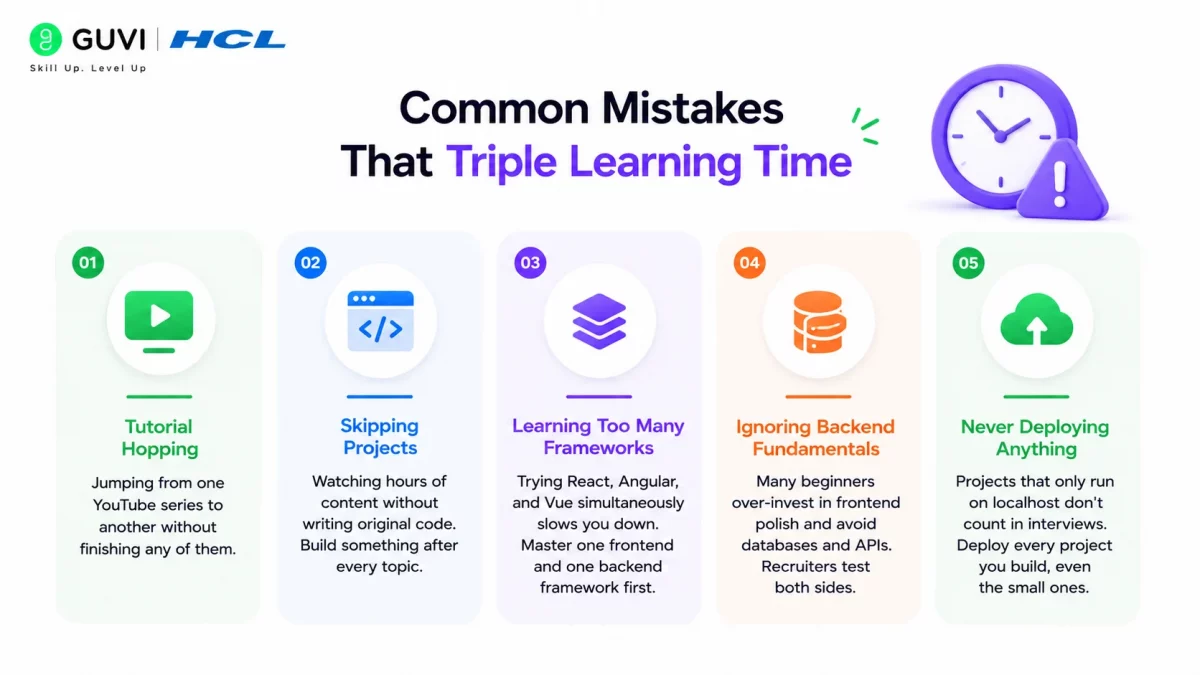
Most delays aren’t about difficulty. They come from a handful of avoidable habits.
- Tutorial hopping: Jumping from one YouTube series to another without finishing any of them. Pick one resource per topic and complete it before switching.
- Skipping projects: Watching hours of content without writing original code. Build something after every topic, even if it’s small.
- Learning too many frameworks at once: Trying React, Angular, and Vue simultaneously slows you down. Master one frontend and one backend framework first.
- Ignoring backend fundamentals: Many beginners over-invest in frontend polish and avoid databases and APIs. Recruiters test both sides.
- Never deploying anything: Projects that only run on localhost don’t count in interviews. Deploy every project you build, even the small ones.

Signs You Are Job-Ready as a Full Stack Developer
Before you start applying, check yourself against these markers instead of a fixed number of months.
- You can build a full stack CRUD app from scratch without following a tutorial step by step
- You understand how your frontend and backend communicate through APIs
- You’re comfortable with a Git and GitHub workflow, including branches and pull requests
- You have 2 to 3 deployed full stack projects in your portfolio, not just code on your laptop
- You can explain the choices behind your code in an interview, not just that it works
Get a Fixed Timeline Instead of Guesswork
If you’d rather follow a set schedule than figure this out alone, GUVI’s Full Stack Development Career Program gives you a structured, month-by-month path through the MERN stack, real projects, and placement assistance, so you always know exactly what to learn next and by when.
Conclusion
There’s no single answer to how long it takes to become a full stack developer, but there is a predictable pattern: more focused hours and more structure both shrink your timeline. A dedicated learner following a fixed course can be job-ready in 3 to 4 months, while a self-taught path often takes 9 months or longer.
What matters most isn’t the calendar, it’s whether you’re building real projects, covering both frontend and backend, and avoiding the habits that stall progress. Use the roadmap and checklist above to set a timeline that fits your hours, then stay consistent until you hit it.
FAQs
How long does it take to become a full stack developer?
Most beginners take 6 to 9 months with consistent daily practice. With a structured course and 5 to 6 hours a day, this can drop to 3 to 4 months.
Can I become a full stack developer in 3 months?
Yes, but only with an intensive schedule of 6 or more hours a day and a structured curriculum. Self-taught learners rarely hit this timeline.
Do I need a computer science degree to become a full stack developer?
No. Many full stack developers are self-taught or come from bootcamps and online courses. Projects and practical skills matter more to recruiters than a degree.
Is self-taught or a bootcamp faster for becoming job-ready?
A bootcamp or structured course is almost always faster, typically 3 to 6 months, because the curriculum and deadlines are fixed for you.
What should I learn first, frontend or backend?
Start with frontend basics like HTML, CSS, and JavaScript. They’re easier to visualize and give you quick wins before you move into backend logic.
Is full stack development still in demand in 2026?
Yes. Demand for full stack developers continues to grow in India, especially for MERN and Java full stack roles, as companies prefer hires who can work across the entire application.
Can working professionals learn full stack development part-time?
Yes, with 1 to 2 hours a day, though it usually takes 9 to 12 months. Weekend-heavy study can shorten this if paired with a structured course.
How many projects do I need before applying for jobs?
Aim for 2 to 3 solid, deployed projects that solve a real problem. Quality and depth matter more than the number of projects on your resume.
Success Stories

About the Author
Lukesh S
A professional content writer who has experience in freelancing and now working as a Technical Content Writer at HCL GUVI having sound knowledge in Blog Writing and Creative Writing!
View all posts by Lukesh S
Connect with me @

Did you enjoy this article?
Comments


Learn with HCL GUVI





















Schedule 1:1 free counselling
Similar Articles




After research and deciding I wanted to be a full stack developer, learned that I need good credit or a lot of money. One of the reasons I decided to go back to school was because of struggling with bills. Also make life more full filling. But I can't.
Good
VERY HELPFULL IDEA ESPECIALY TIME BREAK DOWN
I am motivated to learn and make a career change! I am 71 years of age, and according to "German law" I am considered to be no longer employable, which has resulted in my not being able to get an "education voucher" (Bildungsgutschein) from the German government, through the "labor office" (Bundesagentur für Arbeit)! The "social office" (Sozialamt) would rather pay me to sit at home, while they pay my rent, health insurance, etc, rather than help me by sponsoring my participation in a course! This article and my insane experiences with the German governmental offices, has only served to make me stronger and more determined to become a full-stack developer this year!