


Data Science Articles
BPO Experience for Data Analyst Jobs Does It Count When Applying? - Best Guide
What's Career Growth After 5 Years in BPO? Are You Missing Out on a Data Analyst Career?
Can a BPO Team Leader Become a Data Analyst?
BPO vs Data Analyst Salary in India: What Changes After the Switch?


Get In Touch For Details! Request More Information
Will Moving From Team Lead to Data Analyst Reduce Salary or Seniority?
Oct 07, 2026 5 Min Read 81 Views
(Last Updated)
Moving from a Team Lead to Data Analyst salary path can feel like a step backward, especially if you already have experience managing people and responsibilities. However, changing career tracks does not automatically mean losing your professional value or accepting a significantly lower salary.
Your compensation after the transition depends on factors such as your current salary, years of experience, analytical skills, industry, location, company, and whether the new role is considered entry-level or experienced-hire. Your leadership experience can also remain valuable if you can connect it with data-driven decision-making.
For professionals moving from BPO, operations, customer support, or other non-IT backgrounds into data analytics, the transition requires a slightly different approach. This article explains how the move can affect salary and seniority, what employers may consider, and how to make the transition strategically.
Table of contents
- TL;DR Summary
- Will Moving From Team Lead to Data Analyst Reduce Your Salary?
- Does Changing Roles Mean Losing Seniority?
- What Happens to Your Team Lead Experience?
- Can BPO Experience Help You Become a Data Analyst?
- What Skills Do You Need for the Transition?
- Excel
- SQL
- Power BI
- Statistics
- How Can You Protect Your Salary During the Transition?
- Don't Apply Only for Fresher Roles
- Build a Portfolio
- Use Your Existing Domain Knowledge
- Compare Total Compensation
- What If You Are Moving From Non-IT to Data?
- Should You Accept a Lower Salary to Enter Data Analytics?
- Career Growth After the Transition
- How Long Does the Transition Take?
- How Should You Position Yourself on Your Resume?
- Start Your Learning Journey with HCL GUVI.
- Conclusion
- FAQs
- Will I lose my seniority if I move from Team Lead to Data Analyst?
- Will my salary decrease when moving from Team Lead to Data Analyst?
- Can a BPO Team Lead become a Data Analyst?
- Is Data Analyst a good career transition for non-IT professionals?
- Should I accept a lower salary to become a Data Analyst?
- Can I become a Data Analyst without a technical degree?
TL;DR Summary
- Moving from Team Lead to Data Analyst does not automatically mean losing your seniority or taking a major salary cut.
- Your team lead to data analyst salary depends on your existing compensation, analytical skills, experience, location, and the level of the new role.
- You may initially enter at a lower title if your professional experience does not directly match the requirements of an analyst role.
- Leadership, process management, reporting, stakeholder communication, and business knowledge can transfer well into data analytics.
- Professionals moving from BPO or operations can use their existing domain experience to target business-focused analyst roles.
- Building skills in SQL, Excel, Power BI, statistics, and data visualization can improve your chances of negotiating better offers.
- A carefully planned transition can create long-term opportunities in data analytics without permanently resetting your career.
Will Moving From Team Lead to Data Analyst Reduce Your Salary?
It can, but it does not have to.
The biggest factor is whether the employer sees you as an experienced professional changing specialization or as a complete beginner entering the workforce.
For example, someone with several years of team leadership experience who has developed strong reporting, Excel, SQL, and dashboard skills may be considered differently from someone with no professional experience who has only completed a data analytics course.
A salary reduction is more likely when:
- The analyst position is explicitly entry-level.
- Your previous experience is unrelated to the company’s analytical requirements.
- You have limited practical analytics experience.
- Your current Team Lead compensation is significantly above the company’s analyst salary range.
- You are changing both industry and career function at the same time.
However, you may be able to maintain a similar salary when your previous experience provides relevant business knowledge and transferable skills.
Build practical data analytics skills with HCL GUVI’s Data Science Course. Learn data analysis, Python, statistics, and machine learning through hands-on projects and industry-focused training.
Does Changing Roles Mean Losing Seniority?
Not necessarily.
Seniority is not based only on your job title. Companies may evaluate your years of experience, responsibilities, technical capabilities, industry knowledge, and ability to work independently.
However, your job level may change.
For example, someone moving from Team Lead to Data Analyst might move from:
Team Lead → Data Analyst → Senior Data Analyst → Analytics Leadrather than directly becoming an Analytics Lead.
That does not mean the previous leadership experience disappears. It means the professional is building credibility in a new technical function.
The important question is whether you are moving backward temporarily to build a stronger long-term career.
What Happens to Your Team Lead Experience?
Your previous experience can become a significant advantage if you position it correctly.
Team Leads often work with:
- Performance reports
- Productivity metrics
- Quality metrics
- Team dashboards
- Workforce data
- Process improvement
- Business reporting
- Stakeholder communication
- Root-cause analysis
These responsibilities overlap with many business analytics activities.
Instead of describing your experience only as “managed a team of 15 employees,” you can highlight the analytical side of your work.
For example:
“Analyzed team performance metrics to identify productivity gaps and supported process improvements.”
This communicates analytical experience rather than focusing only on people management.
Professionals transitioning into analytics do not always need to discard their previous domain experience. Knowledge of operations, customer service, finance, healthcare, or other industries can help analysts understand the business context behind the data.
Can BPO Experience Help You Become a Data Analyst?
Yes.
A BPO background can provide useful experience with operational metrics, customer data, quality monitoring, workforce management, and performance reporting.
For someone making a BPO to data analyst transition, the goal should be to connect previous responsibilities with analytical work.
For example:
| Previous Experience | Analytics Connection |
|---|---|
| Team performance tracking | KPI analysis |
| Quality monitoring | Quality analytics |
| Customer data | Customer analytics |
| Workforce scheduling | Workforce analytics |
| Daily reports | Reporting and dashboards |
| Process improvement | Data-driven process optimization |
| SLA monitoring | Operational analytics |
This positioning can make your career transition more credible.
What Skills Do You Need for the Transition?
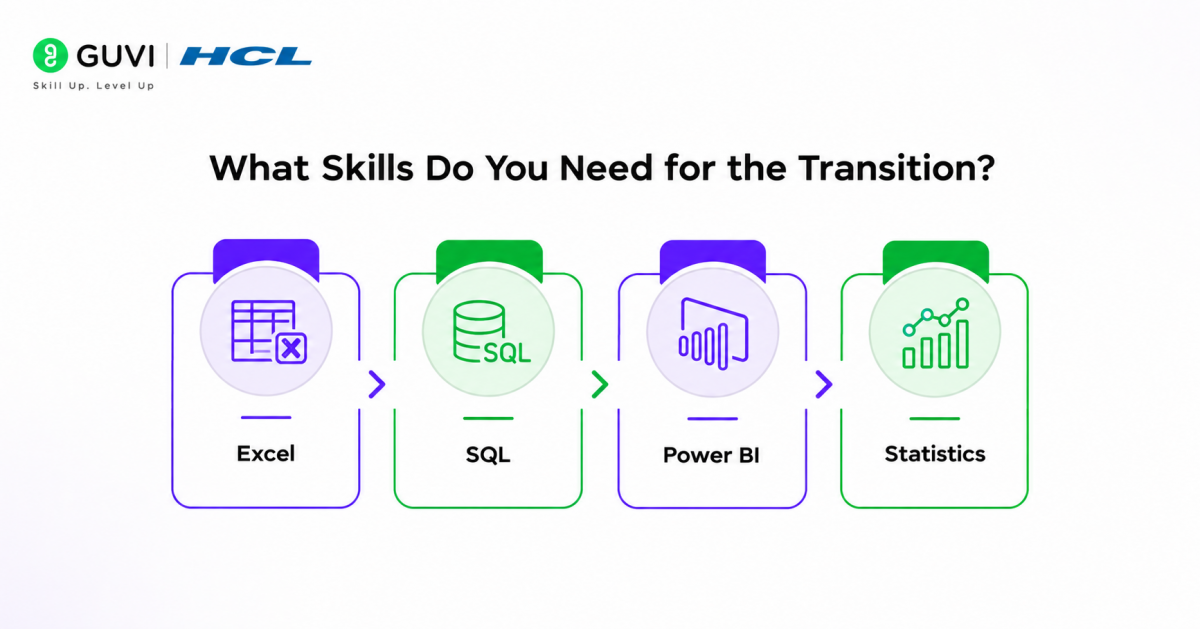
You do not need to become a software engineer to become a Data Analyst.
Focus first on the skills commonly used in analytics roles.
1. Excel
Learn:
- Pivot tables
- XLOOKUP
- Conditional formulas
- Data cleaning
- Charts
- Basic dashboards
2. SQL
SQL is one of the most important skills to develop.
Focus on:
- SELECT
- WHERE
- GROUP BY
- JOIN
- CASE statements
- Subqueries
- Common table expressions
- Window functions
3. Power BI
Learn how to:
- Import data
- Clean data
- Create relationships
- Build dashboards
- Create calculated measures
- Use filters and slicers
- Present business insights
4. Statistics
You should understand basic concepts such as:
- Mean, median, and mode
- Percentages
- Distributions
- Correlation
- Variance
- Sampling
- Basic hypothesis testing
The goal is not to become a statistician. You should be able to interpret data correctly and avoid misleading conclusions.
How Can You Protect Your Salary During the Transition?
A strategic approach can reduce the risk of taking a large pay cut.
1. Don’t Apply Only for Fresher Roles
If you already have several years of professional experience, search for roles such as:
- Data Analyst
- Business Analyst
- Operations Analyst
- Reporting Analyst
- MIS Analyst
- Workforce Analyst
- Business Intelligence Analyst
Some of these positions may value your previous operational experience.
2. Build a Portfolio
Create projects that demonstrate practical analytical ability.
For example:
- BPO performance dashboard
- Customer satisfaction analysis
- Employee productivity dashboard
- Sales performance analysis
- Workforce analytics project
A project connected to your previous industry can be particularly effective because it demonstrates both domain knowledge and analytical ability.
3. Use Your Existing Domain Knowledge
Suppose you worked in customer operations.
Instead of competing with every beginner for a generic Data Analyst position, target companies hiring analysts for customer operations, support analytics, workforce management, or business operations.
Your previous experience can then become a differentiator.
4. Compare Total Compensation
Do not compare only the job title.
Consider:
- Base salary
- Bonuses
- Benefits
- Variable pay
- Work location
- Growth opportunities
- Learning opportunities
- Promotion timeline
A slightly lower starting salary may be worthwhile if the role provides a strong path into analytics and substantially better long-term opportunities.

What If You Are Moving From Non-IT to Data?
A non-IT to data transition is possible, but you need to demonstrate practical skills.
Employers may ask:
“Why are you moving into data analytics?”
A strong answer should connect your previous experience with your new direction.
For example:
“In my previous role, I regularly worked with performance metrics and operational reports. I became interested in understanding the data behind those numbers, so I developed my skills in SQL, Excel, Power BI, and data analysis. I now want to apply both my business experience and analytical skills in a dedicated data role.”
This is stronger than simply saying that you want to enter IT because data analytics has good career opportunities.
Should You Accept a Lower Salary to Enter Data Analytics?
Sometimes, but only strategically.
A moderate reduction can make sense if the new role gives you genuine analytical responsibilities and a realistic path to progression.
However, you should be cautious about accepting a large salary cut simply because a company labels a position as “Data Analyst.”
Before accepting an offer, ask:
- What percentage of the role involves actual analysis?
- Which tools will I use?
- Will I work with SQL and BI tools?
- Who will I report to?
- What level is the position?
- What does progression look like?
- Will I own analytical projects?
- Is the role primarily reporting or data entry?
Warning: Some jobs use the title “Data Analyst” while primarily involving repetitive reporting, spreadsheet updates, or manual data entry. Always evaluate the actual responsibilities before accepting an offer.
Career Growth After the Transition
A career transition into analytics can lead to several paths.
One possible progression is:
Data Analyst → Senior Data Analyst → Analytics Lead → Analytics ManagerYou can also move into specialized areas such as:
- Business Intelligence
- Product Analytics
- Marketing Analytics
- Operations Analytics
- Data Science
- Analytics Engineering
- Business Analysis
Your previous leadership experience can become increasingly valuable as you progress.
Someone who combines analytical expertise with people management and business knowledge may eventually be well positioned for analytics leadership roles.
How Long Does the Transition Take?
There is no fixed timeline.
Someone who already works with reports and business metrics may need less time to become job-ready than someone starting completely from scratch.
A practical learning sequence could be:
Excel → SQL → Statistics → Power BI → Projects → Resume → InterviewsRather than spending months learning every possible data tool, focus on the skills required by the roles you are actually applying for.
Pro Tip: Study job descriptions from 20–30 Data Analyst openings and identify the skills that appear repeatedly. Use that list to guide your learning and portfolio projects.
How Should You Position Yourself on Your Resume?
Do not hide your previous experience.
Instead, connect it to analytics.
For example, instead of:
- Team Lead
- Managed a team.
- Conducted daily meetings.
- Monitored employee performance.
You could emphasize:
2. Team Lead
- Analyzed productivity and quality metrics to identify performance trends.
- Prepared operational reports and monitored KPIs.
- Used performance data to identify process gaps and recommend improvements.
- Communicated data-driven insights to stakeholders.
Only include responsibilities you actually performed. Do not add SQL, Power BI, or other technical skills to your experience section unless you genuinely used them.
Start Your Learning Journey with HCL GUVI.
Build practical data analytics skills with HCL GUVI’s Data Science Course. Learn data analysis, Python, statistics, and machine learning through hands-on projects and industry-focused training.
Conclusion
Moving from a Team Lead position to a Data Analyst role does not automatically mean starting your career from zero. Your team lead to data analyst salary may change depending on how closely your previous experience aligns with the new role, but your leadership, business, reporting, and problem-solving experience can still provide significant value.
For professionals coming from BPO, operations, or other non-IT backgrounds, the strongest strategy is to combine existing domain knowledge with practical analytics skills. Learn SQL, Excel, Power BI, and statistics, build relevant projects, and target analyst roles where your previous experience is an advantage.
The transition may require some adjustment in title or compensation at first, but the right role can create a strong foundation for long-term growth in analytics and eventually analytics leadership.
FAQs
1. Will I lose my seniority if I move from Team Lead to Data Analyst?
You may move to a different job level because you are changing career functions, but your previous professional experience does not disappear. Your leadership and business experience can continue to support your career progression.
2. Will my salary decrease when moving from Team Lead to Data Analyst?
It can, particularly if you enter an entry-level analyst position. However, relevant experience, technical skills, industry knowledge, and negotiation can help you target roles where the salary difference is smaller.
3. Can a BPO Team Lead become a Data Analyst?
Yes. BPO Team Leads often have experience with KPIs, productivity reports, quality metrics, customer data, and process improvement. These experiences can be positioned as relevant business and analytical skills.
4. Is Data Analyst a good career transition for non-IT professionals?
Yes. Data analytics can be accessible to professionals from different backgrounds because business knowledge and analytical thinking are valuable alongside technical skills. Building practical skills in Excel, SQL, Power BI, and statistics can improve your opportunities.
5. Should I accept a lower salary to become a Data Analyst?
A moderate salary reduction may make sense if the role provides genuine analytical experience and strong career growth. Before accepting, evaluate the responsibilities, tools, learning opportunities, and progression path.
6. Can I become a Data Analyst without a technical degree?
Yes. Many analytics roles focus on practical skills such as SQL, Excel, visualization, statistics, and business understanding. A relevant portfolio can help demonstrate your ability even if your previous education or career was outside IT.
Success Stories

About the Author
HCL GUVI
This article was selected and published as part of the HCL GUVI AI Blogathon 2026, an initiative designed to encourage students, AI enthusiasts, and aspiring tech writers to simplify complex AI concepts through impactful technical content. The contest recognized high-quality, original, and insightful AI-focused blogs, with selected authors receiving publication opportunities on the HCL GUVI blog platform along with official author credits and recognition.
View all posts by HCL GUVI
Connect with me @










Did you enjoy this article?