


Forward Deployed Engineer Articles
How to Ace the FDE "Decomposition" Case Study Round
Prompt Engineering Skills for Forward Deployed AI Engineers
RAG and Vector Databases: A Forward Deployed Engineer's Primer


Get In Touch For Details! Request More Information

Anthropic Applied AI Engineer Interview: What’s Different
Sep 19, 2026 4 Min Read 26 Views
(Last Updated)
Preparing for an Anthropic applied AI engineer interview requires more than strong coding or machine learning knowledge. The role combines software engineering with practical AI development, so candidates need to show how they can turn AI capabilities into reliable, useful applications.
Unlike a traditional software engineering interview, an Applied AI Engineer interview may place greater emphasis on working with AI models, evaluating outputs, designing AI-powered systems, and making practical engineering trade-offs. You may also need to demonstrate your understanding of areas such as LLMs, APIs, retrieval, evaluation, and production reliability.
If you’re preparing for an Anthropic interview, understanding what makes the process different can help you focus your preparation. This guide covers the technical skills, AI engineering concepts, system design, project experience, and problem-solving abilities you should be ready to demonstrate.
Table of contents
- TL;DR Summary
- What Is an Applied AI Engineer at Anthropic?
- What Makes the Anthropic Applied AI Engineer Interview Different?
- What Technical Skills Should You Prepare?
- Programming
- Backend Development
- Cloud and Infrastructure
- AI Engineering
- What AI Engineering Questions Can You Expect?
- How would you build an application using an LLM?
- What is retrieval-augmented generation?
- Why can LLM applications produce incorrect answers?
- How would you reduce unreliable AI responses?
- How would you evaluate an AI application?
- When would you use RAG instead of fine-tuning?
- How Important Is Coding?
- How Should You Prepare for the Interview?
- Step 1: Strengthen Software Engineering
- Step 2: Learn AI Application Fundamentals
- Step 3: Build a Complete AI Application
- Step 4: Practice System Design
- Step 5: Practice Explaining Your Decisions
- Start Your Learning Journey with GUVI
- Conclusion
- FAQs
- What is an Applied AI Engineer interview at Anthropic like?
- What technical skills should I prepare for an Anthropic Applied AI Engineer interview?
- Do I need machine learning research experience?
- How important is coding in an Applied AI Engineer interview?
- What AI projects can help me prepare?
- How can I stand out in an Anthropic Applied AI Engineer interview?
TL;DR Summary
- The Anthropic applied AI engineer interview can test software engineering, AI application development, system design, and practical problem-solving.
- Candidates should understand how to build reliable applications using large language models and modern AI systems.
- Expect technical discussions around coding, APIs, data, AI workflows, evaluation, debugging, and system architecture.
- Strong candidates can explain technical trade-offs instead of simply naming AI tools or frameworks.
- Experience building practical AI applications can help demonstrate your engineering ability.
- Preparation should focus on both software engineering fundamentals and the challenges of deploying AI systems in real-world environments.
What Is an Applied AI Engineer at Anthropic?
An Applied AI Engineer focuses on turning AI capabilities into useful applications and solutions for real-world users and problems.
At an AI company such as Anthropic, this can involve working with large language models, application infrastructure, APIs, evaluation systems, and user-facing or customer-facing products.
The role can sit between traditional software engineering and AI development.
Depending on the position, your work may involve:
- Building AI-powered applications
- Integrating language models into products
- Designing reliable AI workflows
- Developing APIs and backend services
- Evaluating model outputs
- Improving application performance
- Working with product and engineering teams
- Solving real-world user problems
This means the interview is unlikely to focus exclusively on machine learning theory.
You need to demonstrate that you can build useful software around AI systems and reason about their limitations.
Prepare for emerging AI engineering opportunities with HCL GUVI’s Artificial Intelligence & Machine Learning Course. Build practical skills in AI, machine learning, and real-world application development through hands-on projects.
What Makes the Anthropic Applied AI Engineer Interview Different?
The Anthropic applied AI engineer interview can be different from a conventional software engineering interview because it combines software engineering with practical AI application development.
A traditional software engineering interview may focus heavily on algorithms, data structures, system design, and coding.
An Applied AI interview can still test those skills, but you may also need to think about questions such as:
- How should an AI application use a language model?
- How do you evaluate an AI system?
- What happens when the model produces an incorrect response?
- How do you reduce unreliable outputs?
- How should an AI workflow handle edge cases?
- How do you balance quality, latency, and cost?
The important point is that using an LLM API is not the same as engineering a reliable AI application.
You need to understand the entire system around the model.
AI application engineering often requires developers to evaluate system behavior rather than assuming that a model will produce the correct output every time. This makes testing and evaluation especially important.
What Technical Skills Should You Prepare?
Start with strong software engineering fundamentals before focusing on advanced AI concepts.
1. Programming
You should be comfortable writing production-quality code in at least one programming language.
Python is particularly useful for AI application development, but the exact language requirements depend on the role.
Review:
- Data structures
- Algorithms
- Object-oriented programming
- Functions and modular design
- Error handling
- Testing
- Debugging
- Git
2. Backend Development
Understand how applications communicate and process information.
Focus on:
- REST APIs
- Authentication
- Databases
- Background jobs
- Caching
- Logging
- Monitoring
3. Cloud and Infrastructure
You should understand how applications move from development to production.
Relevant topics include:
- Containers
- Cloud services
- CI/CD
- Networking
- Environment configuration
- Observability
- Scalability
4. AI Engineering
Then build knowledge around:
- Large language models
- Prompt design
- Structured outputs
- Retrieval-augmented generation
- Embeddings
- Vector search
- Tool use
- AI agents
- Model evaluation
The goal isn’t to memorize terminology.
You should understand when and why each technique is useful.
What AI Engineering Questions Can You Expect?
AI engineering questions may test whether you understand how to build reliable applications around language models.
Here are examples worth practicing.
1. How would you build an application using an LLM?
Answer: Start by understanding the use case and requirements. Then design the application around the model, including input processing, model calls, data retrieval if required, output validation, error handling, monitoring, and evaluation.
2. What is retrieval-augmented generation?
Answer: Retrieval-augmented generation, or RAG, combines information retrieval with language generation. Relevant external information is retrieved and provided to the model so it can generate responses using that context.
3. Why can LLM applications produce incorrect answers?
Answer: Language models generate responses based on learned patterns and available context rather than guaranteeing factual correctness. Poor prompts, missing context, ambiguous inputs, or limitations in the underlying model can contribute to incorrect outputs.
4. How would you reduce unreliable AI responses?
Answer: Improve the available context, use retrieval where appropriate, constrain outputs, validate responses, create evaluation datasets, monitor production behavior, and iterate based on observed failures.

5. How would you evaluate an AI application?
Answer: Define success criteria first, create representative test cases, evaluate outputs using appropriate metrics or human review, analyze failure patterns, and continuously test changes against the evaluation set.
6. When would you use RAG instead of fine-tuning?
Answer: RAG can be useful when the application needs access to changing or external information. Fine-tuning may be more appropriate for adapting model behavior or output patterns to a specific task. The choice depends on the actual requirements.
How Important Is Coding?
Coding can be an important part of the interview because Applied AI Engineers still need strong software engineering skills.
Don’t assume that knowing how to call an AI API is enough.
You should be able to:
- Write clean code
- Debug problems
- Work with APIs
- Handle errors
- Design functions and modules
- Write tests
- Work with databases
- Reason about performance
You may also be asked to modify existing code rather than writing everything from scratch.
For example, you might receive an AI application that occasionally returns invalid results and be asked to identify and fix the problem.
A strong approach would be:
Reproduce → Investigate → Identify the failure → Implement a fix → Test → EvaluateBest Practice: When solving a coding problem, explain your assumptions and trade-offs. Clear reasoning can demonstrate engineering maturity even when the final implementation is not perfect.
A small AI project with thoughtful evaluation, error handling, and clear technical reasoning can demonstrate more engineering ability than a large project that only showcases a model API call.
How Should You Prepare for the Interview?
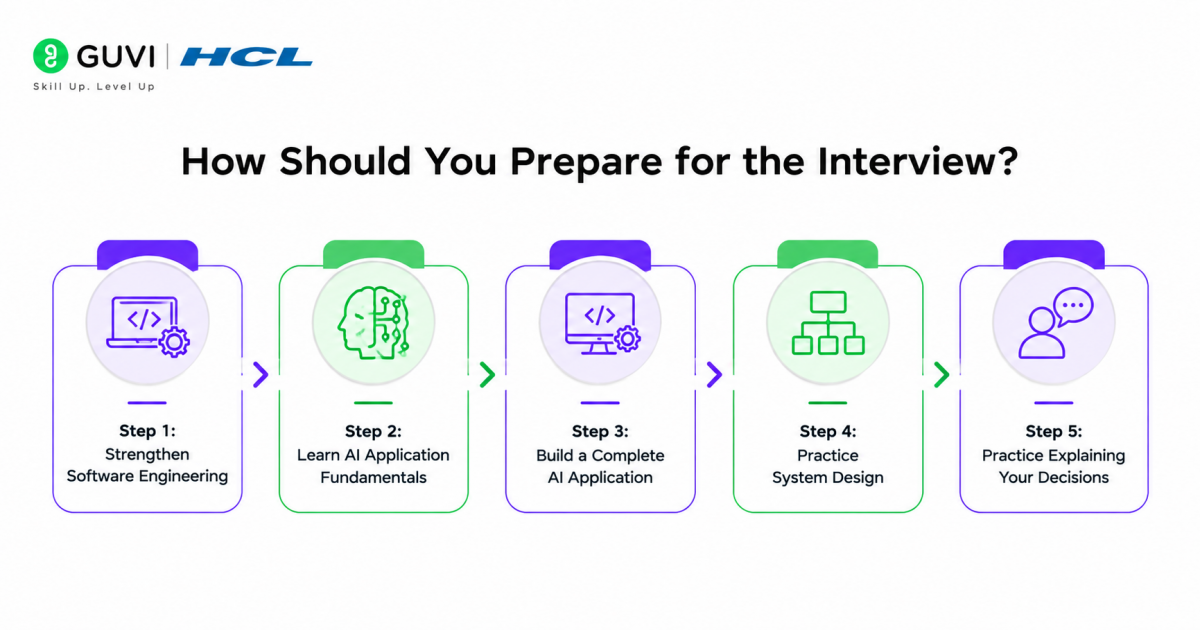
Prepare in layers instead of trying to learn every AI topic at once.
Step 1: Strengthen Software Engineering
Review:
- Python or another relevant language
- Data structures
- Algorithms
- APIs
- SQL
- Git
- Testing
- Debugging
Step 2: Learn AI Application Fundamentals
Understand:
- LLMs
- Prompting
- Embeddings
- RAG
- Tool calling
- Structured outputs
- Model limitations
Step 3: Build a Complete AI Application
Build one project that includes:
Frontend → Backend → AI Model → Data → Evaluation → DeploymentThis gives you something concrete to discuss during interviews.
Step 4: Practice System Design
Take AI use cases and design them from requirements through deployment.
Step 5: Practice Explaining Your Decisions
Don’t just say:
“I used RAG.”
Explain:
“I used retrieval because the application needed access to external information that could change over time.”
That distinction shows engineering judgment.
Start Your Learning Journey with GUVI
Prepare for emerging AI engineering opportunities with HCL GUVI’s Artificial Intelligence & Machine Learning Course. Build practical skills in AI, machine learning, and real-world application development through hands-on projects.
Conclusion
The Anthropic applied AI engineer interview requires a combination of strong software engineering fundamentals and practical AI knowledge. You need to show that you can build applications, work with APIs and data, design reliable systems, and reason about the limitations of AI models.
The biggest difference from a traditional software engineering interview is the additional layer of uncertainty that AI introduces. Model outputs need to be evaluated, failures need to be handled, and system behavior needs to be tested against realistic use cases.
The best way to prepare is to build something yourself and understand every part of it. Be ready to explain why you selected a particular architecture, how you evaluated the system, what went wrong, and how you improved it. That combination of engineering depth and AI-focused problem-solving can make your interview preparation much stronger.
FAQs
What is an Applied AI Engineer interview at Anthropic like?
The interview can evaluate software engineering, AI application development, system design, problem-solving, and communication. The exact process and technical focus can vary by role and team.
What technical skills should I prepare for an Anthropic Applied AI Engineer interview?
Focus on programming, data structures, APIs, databases, system design, testing, debugging, cloud fundamentals, and AI application concepts such as LLMs, RAG, and evaluation.
Do I need machine learning research experience?
Not necessarily for every Applied AI Engineer role. Requirements depend on the position, but practical software engineering and AI application development can be important for applied roles.
How important is coding in an Applied AI Engineer interview?
Coding can be important because Applied AI Engineers still build and maintain software. You should be comfortable solving programming problems and writing clear, reliable code.
What AI projects can help me prepare?
Build practical applications such as document assistants, AI customer support systems, data analysis assistants, or other AI applications that demonstrate APIs, retrieval, evaluation, error handling, and deployment.
How can I stand out in an Anthropic Applied AI Engineer interview?
Demonstrate strong engineering judgment. Explain your technical decisions, understand AI limitations, discuss evaluation and failure cases, and show that you can turn AI capabilities into reliable real-world applications.
Success Stories

About the Author
HCL GUVI
This article was selected and published as part of the HCL GUVI AI Blogathon 2026, an initiative designed to encourage students, AI enthusiasts, and aspiring tech writers to simplify complex AI concepts through impactful technical content. The contest recognized high-quality, original, and insightful AI-focused blogs, with selected authors receiving publication opportunities on the HCL GUVI blog platform along with official author credits and recognition.
View all posts by HCL GUVI
Connect with me @













Did you enjoy this article?