


Forward Deployed Engineer Articles
Scale AI Forward Deployed Data Scientist Interview Prep
ElevenLabs Forward Deployed Engineer Interview Guide
Forward Deployed Engineer Resume: A Template That Gets Interviews
Working With Legacy Systems: A Forward Deployed Engineer's Survival Guide


Get In Touch For Details! Request More Information
Data Integration Techniques Every FDE Should Master
Sep 18, 2026 4 Min Read 18 Views
(Last Updated)
Data integration for forward deployed engineers is essential for connecting different applications, databases, APIs, and data sources in real-world customer environments. FDEs often work with systems that were built at different times and use different technologies, making reliable data integration a critical part of their work.
From connecting REST APIs and databases to building ETL pipelines and handling real-time data, FDEs need to understand how information moves between systems. They must also handle challenges such as data transformation, validation, authentication, errors, and monitoring.
This article explores the key data integration techniques every FDE should master, including APIs, ETL and ELT, databases, webhooks, data transformation, batch processing, real-time integration, and error handling.
Table of contents
- TL;DR Summary
- What Is Data Integration for a Forward Deployed Engineer?
- Why Do FDEs Need Data Integration Skills?
- Which Data Integration Techniques Should FDEs Master?
- API Integration
- ETL and ELT
- Database Integration
- Webhooks and Event-Driven Integration
- Data Transformation and Mapping
- Batch and Real-Time Processing
- Data Validation and Error Handling
- Logging and Monitoring
- How Should an FDE Approach a Data Integration Project?
- Step 1: Understand the Customer's Systems
- Step 2: Define the Data Flow
- Step 3: Choose the Integration Method
- Step 4: Build a Small Prototype
- Step 5: Add Validation and Error Handling
- Step 6: Test With Realistic Data
- Step 7: Deploy and Monitor
- What Challenges Do FDEs Face During Integration?
- How Can You Improve Your Data Integration Skills?
- Start Your Learning Journey with HCL GUVI
- Conclusion
- FAQs
- What is data integration for a forward deployed engineer?
- Which data integration techniques should FDEs learn?
- Why are APIs important for FDEs?
- Should an FDE learn ETL?
- How do FDEs troubleshoot failed data integrations?
- How can I practice data integration for an FDE career?
TL;DR Summary
- Data integration for a forward deployed engineer involves connecting data from different systems into reliable workflows.
- FDEs should understand APIs, ETL and ELT, database integration, webhooks, batch processing, and real-time pipelines.
- Data mapping and transformation help standardize information across different customer systems.
- Reliable integrations require validation, error handling, logging, monitoring, and security.
- Strong FDEs choose integration techniques based on customer requirements, data volume, latency, and system constraints.
What Is Data Integration for a Forward Deployed Engineer?
Data integration for a forward deployed engineer means connecting different applications, databases, APIs, and data sources so information can move reliably between systems. FDEs often work directly with customers, making integration a core part of turning technical requirements into working solutions.
For example, a customer may want an AI application to retrieve information from its CRM, internal database, and cloud storage. The FDE needs to understand how these systems expose data and determine the best way to connect them.
Unlike a purely internal engineering role, FDEs must often work with unfamiliar systems and adapt their approach to each customer’s environment.
Build the technical skills needed for modern AI engineering roles with HCL GUVI’s Artificial Intelligence & Machine Learning Course. Learn AI, machine learning, and practical application development through hands-on projects.
Why Do FDEs Need Data Integration Skills?
FDEs frequently operate between a company’s product and the customer’s existing technology stack. Even a strong product may not deliver value if it cannot access or exchange information with the systems the customer already uses.
Data integration skills help FDEs:
- Connect third-party applications and internal systems.
- Move customer data between different platforms.
- Transform incompatible data formats.
- Build automated data workflows.
- Troubleshoot failed integrations.
- Protect sensitive information during data transfer.
For example, an FDE deploying an AI solution might connect an organization’s CRM with a knowledge base and an internal analytics platform. Understanding how those systems exchange information makes deployment faster and more reliable.
A manufacturing environment can contain both highly automated machinery and decades-old software systems. This makes integration and deployment skills particularly valuable for engineers working on industrial AI.
Which Data Integration Techniques Should FDEs Master?
1. API Integration
APIs are among the most important integration methods for FDEs. REST APIs, GraphQL APIs, and other interfaces allow applications to exchange data programmatically.
An FDE should understand:
- Authentication and authorization
- HTTP methods
- Request and response formats
- JSON and XML
- Pagination
- Rate limits
- Error handling
For example, an FDE could use a customer’s CRM API to retrieve account information and pass relevant data into an application.
2. ETL and ELT
ETL stands for Extract, Transform, Load. Data is extracted from a source, transformed into the required format, and loaded into a target system.
ELT follows a slightly different approach by loading data before performing transformations.
These techniques are useful when customers need to move large amounts of data between databases, warehouses, or analytics systems.
An FDE should understand when batch-based ETL is more appropriate than real-time integration.
3. Database Integration
Many customer environments contain multiple databases. An FDE may need to connect applications to PostgreSQL, MySQL, SQL Server, MongoDB, or cloud databases.
Important concepts include:
- SQL queries
- Schemas
- Relationships
- Indexing
- Data types
- Transactions
- Connection management
Understanding databases helps FDEs identify where data lives and how it can be accessed safely.
4. Webhooks and Event-Driven Integration
Webhooks allow one system to notify another when an event occurs.
For example, when a customer creates a new support ticket, the support platform can send an event to another application automatically.
This approach is useful when customers need near-real-time updates without repeatedly polling an API.
5. Data Transformation and Mapping
Different systems rarely represent information in exactly the same way.
One system might use customer_id, while another uses account_number. Similarly, dates, currencies, names, and status values may use different formats.
FDEs need to map and transform these fields so systems can communicate correctly.
Best Practice: Create a clear data mapping document before implementing a complex integration. Identify the source field, target field, data type, transformation rule, and validation requirement.
6. Batch and Real-Time Processing
FDEs should understand the difference between batch and real-time integration.
Batch processing moves data at scheduled intervals, such as every hour or once per day. Real-time processing moves or processes data as events occur.
The right choice depends on the customer’s requirements.
A financial dashboard may need frequent updates, while a historical reporting system may work perfectly with daily batch processing.
7. Data Validation and Error Handling
An integration should not assume that every incoming record is correct.
FDEs should consider:
- Missing fields
- Invalid data types
- Duplicate records
- Authentication failures
- API timeouts
- Rate-limit errors
- Partial failures
Validation and retry mechanisms help prevent bad data from spreading across connected systems.

8. Logging and Monitoring
A successful integration needs visibility after deployment.
Logs can help an FDE determine whether a request succeeded, failed authentication, returned invalid data, or exceeded a timeout.
Monitoring can also identify unusual error rates or delays.
This is particularly important in customer environments where the FDE may need to diagnose issues remotely or support production deployments.
How Should an FDE Approach a Data Integration Project?
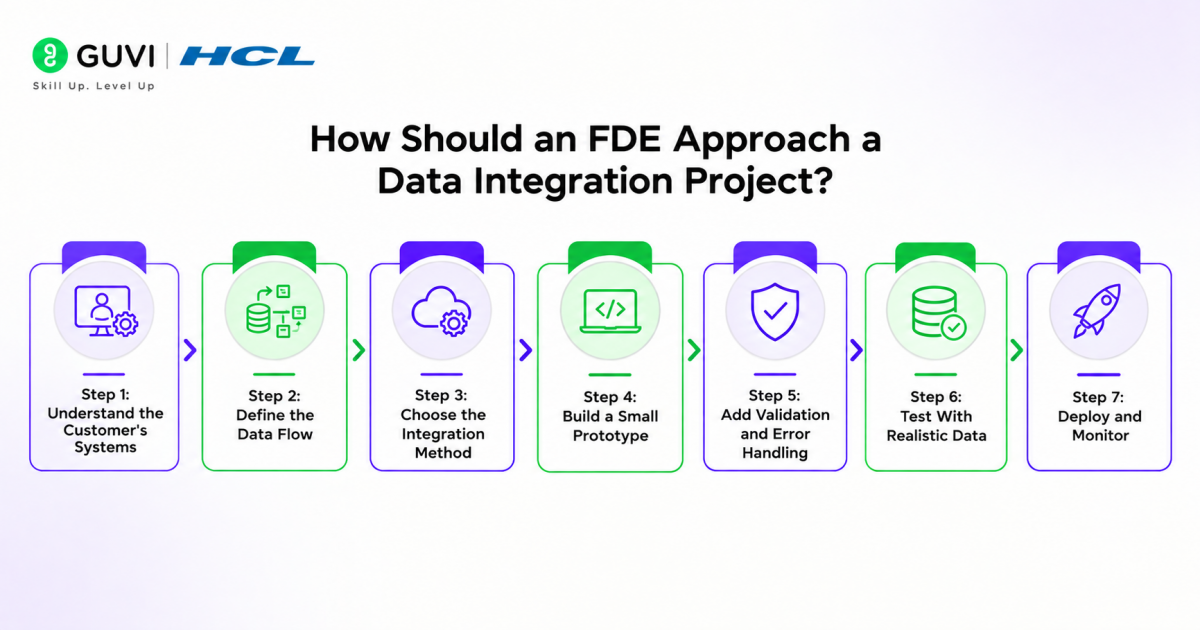
A structured approach makes integration work easier to manage.
Step 1: Understand the Customer’s Systems
Identify the data sources, applications, databases, APIs, authentication methods, and existing workflows.
Step 2: Define the Data Flow
Determine where data starts, where it needs to go, and what transformations are required.
Step 3: Choose the Integration Method
Select APIs, webhooks, ETL, database connections, batch processing, or event-driven architecture based on the requirements.
Step 4: Build a Small Prototype
Test the most important data flow before building the complete integration.
Step 5: Add Validation and Error Handling
Handle missing data, failures, retries, authentication issues, and unexpected responses.
Step 6: Test With Realistic Data
Use representative customer data to identify edge cases that may not appear in basic testing.
Step 7: Deploy and Monitor
After deployment, monitor logs, performance, failures, and data quality.
Pro Tip: Start with the smallest useful integration rather than attempting to connect every customer system at once. A working prototype can reveal technical constraints early.
What Challenges Do FDEs Face During Integration?
Data integration is rarely straightforward in real customer environments.
Common challenges include:
- Legacy systems: Older applications may have limited APIs or outdated data formats.
- Inconsistent data: The same information may be represented differently across systems.
- Authentication issues: APIs may require OAuth, API keys, service accounts, or custom authentication.
- Poor documentation: Customer systems may have incomplete or outdated technical documentation.
- Data quality problems: Missing, duplicated, or incorrect records can affect downstream applications.
- Scalability: An integration that works with 1,000 records may behave differently with millions.
- Security requirements: Sensitive customer data may require encryption, access controls, and auditing.
An FDE needs both technical knowledge and communication skills to work through these constraints with customers.
How Can You Improve Your Data Integration Skills?
The best way to improve is through practical projects that simulate customer environments.
Build projects that involve:
- Connecting two REST APIs.
- Moving data between a database and an application.
- Creating an ETL pipeline.
- Implementing a webhook workflow.
- Transforming JSON data between different schemas.
- Adding logging and retry mechanisms.
- Building a small real-time data pipeline.
When working on these projects, do not focus only on making the integration work. Document why you selected a particular approach and how you would handle failures in production.
Start Your Learning Journey with HCL GUVI
Build the technical skills needed for modern AI engineering roles with HCL GUVI’s Artificial Intelligence & Machine Learning Course. Learn AI, machine learning, and practical application development through hands-on projects.
Conclusion
Mastering data integration can make you a stronger forward deployed engineer because many customer problems involve connecting systems that were never designed to work together. Understanding APIs, databases, ETL, webhooks, transformations, and real-time processing gives you the technical foundation to solve these problems effectively.
However, successful integration is not only about moving data. You also need to understand customer requirements, choose practical architectures, handle failures, and communicate technical decisions clearly. Combining these skills can help you build reliable solutions and become more effective in customer-facing engineering roles.
FAQs
What is data integration for a forward deployed engineer?
Data integration for a forward deployed engineer involves connecting different customer systems, applications, databases, and APIs so data can move reliably between them.
Which data integration techniques should FDEs learn?
FDEs should understand API integration, ETL and ELT, database integration, webhooks, data transformation, batch processing, and real-time event-driven systems.
Why are APIs important for FDEs?
APIs allow FDEs to connect applications and access customer data programmatically. They are commonly used to integrate SaaS platforms, internal applications, and other systems.
Should an FDE learn ETL?
Yes. ETL and ELT are useful when customers need to move and transform large amounts of data between databases, warehouses, and analytics systems.
How do FDEs troubleshoot failed data integrations?
FDEs can examine logs, API responses, authentication settings, data formats, network connectivity, rate limits, and retry behavior to identify integration problems.
How can I practice data integration for an FDE career?
Build projects that connect APIs, databases, and webhooks. Add data transformation, validation, logging, and error handling to make the projects closer to real customer integration scenarios.
Success Stories

About the Author
HCL GUVI
This article was selected and published as part of the HCL GUVI AI Blogathon 2026, an initiative designed to encourage students, AI enthusiasts, and aspiring tech writers to simplify complex AI concepts through impactful technical content. The contest recognized high-quality, original, and insightful AI-focused blogs, with selected authors receiving publication opportunities on the HCL GUVI blog platform along with official author credits and recognition.
View all posts by HCL GUVI
Connect with me @








Did you enjoy this article?