


Forward Deployed Engineer Articles
Anthropic Applied AI Engineer Interview: What's Different
How to Ace the FDE "Decomposition" Case Study Round


Get In Touch For Details! Request More Information
RAG and Vector Databases: A Forward Deployed Engineer’s Primer
Sep 19, 2026 4 Min Read 26 Views
(Last Updated)
RAG and vector databases for forward deployed engineers are important technologies for building AI applications that can work with customer-specific information. Retrieval-Augmented Generation (RAG) allows an AI system to retrieve relevant information from external sources before generating a response, while vector databases help store and search the numerical representations of that information.
For FDEs, these technologies are particularly useful when deploying AI solutions that need to work with private documents, internal knowledge bases, product information, or business data. Engineers may need to connect data sources, generate embeddings, build retrieval pipelines, evaluate responses, and integrate the system into an existing customer workflow.
This article explains how RAG and vector databases work, why they matter for FDEs, the components involved, common use cases, and the practical skills engineers need to build reliable customer-facing AI solutions.
Table of contents
- TL;DR Summary
- What Are RAG and Vector Databases?
- How Does RAG Work?
- Indexing
- Retrieval and Generation
- Why Do FDEs Need RAG and Vector Databases?
- How Do Vector Databases Support RAG?
- What Does a RAG Workflow Look Like?
- What Skills Should FDEs Learn?
- Programming and APIs
- Embeddings and Retrieval
- Databases
- AI and LLMs
- Deployment and Monitoring
- What Challenges Do FDEs Face With RAG?
- Start Your Learning Journey with HCL GUVI
- Conclusion
- FAQs
- What is RAG for Forward Deployed Engineers?
- Why are vector databases used in RAG?
- Do FDEs need to know vector databases?
- Is Python useful for building RAG applications?
- What are common RAG problems?
- How can I learn RAG as a Forward Deployed Engineer?
TL;DR Summary
- RAG and vector databases for forward deployed engineers enable AI applications to retrieve customer-specific information before generating responses.
- RAG combines information retrieval with generative AI to provide context to language models.
- Vector databases store embeddings and enable semantic similarity searches.
- FDEs may build pipelines covering document ingestion, chunking, embedding, retrieval, generation, and evaluation.
- Common use cases include enterprise search, AI assistants, support tools, and document question answering.
- FDEs should understand embeddings, metadata, retrieval, APIs, data pipelines, evaluation, and deployment.
What Are RAG and Vector Databases?
RAG is an AI architecture that retrieves relevant information from an external knowledge source and provides it to a language model as context. This allows the model to generate responses using information that may not have been included in its original training data.
A vector database stores embeddings, which are numerical representations of text or other data. These embeddings allow systems to search for information based on semantic similarity rather than relying only on exact keyword matches.
Together, RAG and vector databases can help create AI applications that understand and retrieve relevant customer information.
Explore modern AI technologies with HCL GUVI’s Artificial Intelligence & Machine Learning Course. Learn AI, machine learning, and practical application development through hands-on projects and industry-focused training.
How Does RAG Work?
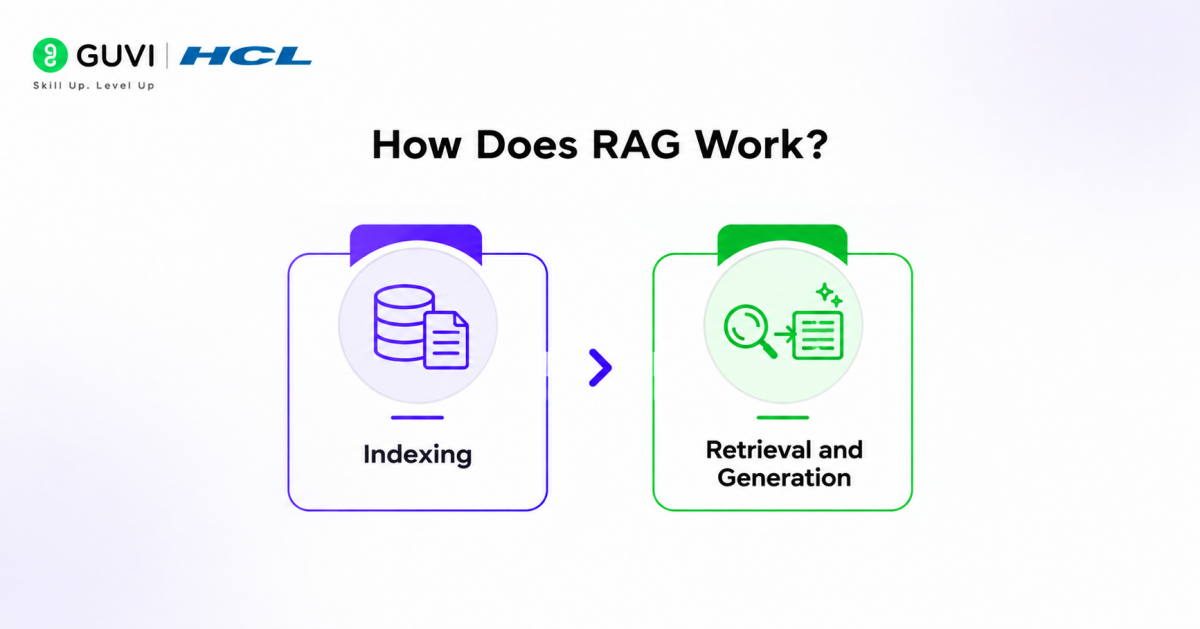
A typical RAG system has two main stages: indexing and retrieval.
1. Indexing
Customer information is first prepared for searching.
The process usually involves:
- Collecting documents or data.
- Splitting content into smaller chunks.
- Generating embeddings for each chunk.
- Storing embeddings and metadata in a vector database.
2. Retrieval and Generation
When a user asks a question:
- The question is converted into an embedding.
- The system searches for similar content.
- Relevant chunks are retrieved.
- The retrieved information is added to the model’s context.
- The language model generates an answer using that context.
This approach allows an AI application to work with changing or private information without requiring the underlying language model to be retrained for every update.
RAG can reduce the need to put an organization’s entire knowledge base directly into a model prompt. Instead, the system retrieves only information relevant to the current query.
Why Do FDEs Need RAG and Vector Databases?
FDEs often build AI solutions around customer-specific data. Generic AI models may not have access to a customer’s internal documentation, policies, product information, or operational knowledge.
RAG can help solve this problem by connecting the model to the customer’s existing information sources.
For example, an FDE working with a company could build an internal AI assistant that answers questions about:
- Company policies
- Product documentation
- Technical manuals
- Support knowledge bases
- Internal procedures
- Customer records
The engineer must do more than connect a language model. They need to understand where the data comes from, how it should be indexed, who can access it, and how the system should behave when information is missing.
How Do Vector Databases Support RAG?
Vector databases provide the search layer of many RAG systems.
Traditional databases are excellent for structured queries such as finding a customer by ID. Vector search is useful when the system needs to find content that is conceptually similar to a query.
A vector database can store:
- Embeddings
- Original text or references
- Metadata
- Document identifiers
- Access information
Metadata can help filter results based on attributes such as department, document type, date, or user permissions.
Popular vector database technologies include purpose-built vector databases as well as traditional databases that support vector search.
The important skill for an FDE is understanding the underlying concepts rather than memorizing one particular product.
What Does a RAG Workflow Look Like?
A practical customer deployment might follow this workflow:
Customer Data → Ingestion → Chunking → Embeddings → Vector Storage → Retrieval → LLM → ResponseConsider a customer with thousands of technical documents.

An FDE could create a pipeline that:
- Collects documents from existing systems.
- Extracts and cleans their content.
- Splits documents into useful chunks.
- Generates embeddings.
- Stores them with metadata.
- Retrieves relevant content for each question.
- Sends the retrieved context to an LLM.
- Returns an answer to the user.
The engineer would then evaluate retrieval quality and response accuracy before deploying the application.
What Skills Should FDEs Learn?
FDEs working with RAG systems should develop skills across several areas.
1. Programming and APIs
Python is particularly useful for building ingestion pipelines, retrieval services, and integrations. Knowledge of REST APIs helps connect the RAG application to customer systems.
2. Embeddings and Retrieval
Understand:
- What embeddings represent
- How similarity search works
- Chunking strategies
- Metadata filtering
- Retrieval ranking
3. Databases
Basic SQL and database concepts remain valuable even when using vector search because customer data often exists across multiple storage systems.
4. AI and LLMs
Learn how language models use context, prompts, tokens, and retrieved information. FDEs should also understand the limitations of LLM-generated responses.
5. Deployment and Monitoring
Customer-facing RAG applications need reliable deployment, logging, monitoring, access control, and error handling.
Pro Tip: Build a small document-question-answering project using Python, embeddings, a vector database, and an LLM. Then add metadata filtering and evaluation to make the project more representative of an enterprise deployment.
What Challenges Do FDEs Face With RAG?
RAG systems can produce poor results even when the language model itself is capable.
Common challenges include:
- Poor-quality source documents
- Incorrect chunk sizes
- Weak retrieval results
- Outdated information
- Duplicate content
- Missing metadata
- Access-control problems
- High latency
- Incorrect model responses
Warning: Adding a vector database does not automatically make an AI application accurate. Retrieval quality, source data, permissions, evaluation, and prompt design all affect the final result.
FDEs should test the system using realistic customer questions and continuously improve the retrieval pipeline based on observed failures.
Start Your Learning Journey with HCL GUVI
Explore modern AI technologies with HCL GUVI’s Artificial Intelligence & Machine Learning Course. Learn AI, machine learning, and practical application development through hands-on projects and industry-focused training.
Conclusion
Understanding RAG and vector databases for forward deployed engineers can help FDEs build practical AI solutions that work with real customer data. RAG provides the architecture for retrieving relevant information, while vector databases provide an efficient way to search that information using embeddings.
For FDEs, the most important skill is not simply knowing how to connect an LLM to a vector database. It is understanding the complete workflow from customer data ingestion to retrieval, generation, evaluation, security, and deployment. Building practical RAG projects is a strong way to develop these skills and prepare for customer-focused AI engineering roles.
FAQs
What is RAG for Forward Deployed Engineers?
RAG is an architecture that allows an AI application to retrieve relevant external information before generating a response. FDEs can use it to build AI solutions around customer-specific knowledge.
Why are vector databases used in RAG?
Vector databases store embeddings and enable semantic similarity searches. This helps a RAG system retrieve information that is conceptually relevant to a user’s question.
Do FDEs need to know vector databases?
AI-focused FDEs can benefit significantly from understanding vector databases, embeddings, indexing, similarity search, and metadata filtering.
Is Python useful for building RAG applications?
Yes. Python is commonly useful for building data ingestion pipelines, API integrations, retrieval workflows, and AI applications.
What are common RAG problems?
Common issues include poor source data, ineffective chunking, weak retrieval, outdated information, access-control issues, latency, and inaccurate generated responses.
How can I learn RAG as a Forward Deployed Engineer?
Start by learning embeddings and retrieval concepts, then build a small document-question-answering application. Add APIs, metadata filtering, evaluation, logging, and deployment to make the project closer to a real customer solution.
Success Stories

About the Author
HCL GUVI
This article was selected and published as part of the HCL GUVI AI Blogathon 2026, an initiative designed to encourage students, AI enthusiasts, and aspiring tech writers to simplify complex AI concepts through impactful technical content. The contest recognized high-quality, original, and insightful AI-focused blogs, with selected authors receiving publication opportunities on the HCL GUVI blog platform along with official author credits and recognition.
View all posts by HCL GUVI
Connect with me @







Did you enjoy this article?