


Forward Deployed Engineer Articles
Scale AI Forward Deployed Data Scientist Interview Prep
ElevenLabs Forward Deployed Engineer Interview Guide
Forward Deployed Engineer Resume: A Template That Gets Interviews
Working With Legacy Systems: A Forward Deployed Engineer's Survival Guide


Get In Touch For Details! Request More Information

How Long Does It Take to Become a Forward Deployed Engineer?
Sep 18, 2026 4 Min Read 24 Views
(Last Updated)
There is no fixed timeline to become a Forward Deployed Engineer, because the time required depends on your current technical skills, experience, and learning pace. Someone with a software engineering background may need only a few months to prepare, while a beginner may need a year or more to build the necessary foundation.
FDE roles combine programming, system design, APIs, cloud deployment, debugging, and customer problem-solving. That means becoming job-ready requires more than completing a course or learning a programming language.
The most effective approach is to focus on practical skills and build projects that demonstrate your ability to solve real problems. In this guide, you’ll learn what affects the timeline, which skills to prioritize, what projects to build, and how to create a focused learning path toward an FDE career.
Table of contents
- TL;DR Summary
- How Long Does It Take to Become a Forward Deployed Engineer?
- What Determines How Quickly You Can Become an FDE?
- Your Current Technical Knowledge
- Your Learning Time
- Your Project Experience
- Your Communication Skills
- What Should You Learn First?
- Programming
- Git and Software Development
- APIs and Databases
- Cloud and Deployment
- AI and Automation
- Can You Become an FDE in Six Months?
- How Can You Speed Up Your FDE Preparation?
- Use a Project-Based Approach
- Study Real Job Descriptions
- Get Feedback
- Start Your Learning Journey with HCL GUVI
- Conclusion
- FAQs
- How long does it take to become a Forward Deployed Engineer?
- Can I become a Forward Deployed Engineer in six months?
- What skills should I learn to become an FDE?
- Do I need professional experience to become an FDE?
- What projects should I build before applying for FDE jobs?
- Is Forward Deployed Engineering difficult to learn?
TL;DR Summary
- It can take around 6–18 months to become a Forward Deployed Engineer, depending on your existing technical background.
- Beginners may need more time to build programming, APIs, cloud, databases, and deployment skills.
- Software engineers can potentially transition faster because they already have strong engineering fundamentals.
- Building real-world projects is one of the best ways to demonstrate FDE-ready skills.
- Communication, customer problem-solving, and adaptability are important alongside technical ability.
- The fastest approach is to follow a focused learning plan instead of trying to master every technology.
How Long Does It Take to Become a Forward Deployed Engineer?
For someone with a technical background, it can take roughly 6–12 months to prepare for an FDE role. Beginners may need 12–18 months or longer to develop the necessary engineering skills.
A software engineer who already knows programming, APIs, databases, and deployment may only need to develop customer-facing and solution-building skills.
Someone starting from scratch will need to build those technical foundations first.
The important question isn’t simply, “How many months will it take?”
It’s “Can I demonstrate that I can solve real technical problems?”
Build your AI and machine learning skills with HCL GUVI’s Artificial Intelligence & Machine Learning Course. Gain practical experience through hands-on projects and develop skills that can help you prepare for emerging AI engineering opportunities.
What Determines How Quickly You Can Become an FDE?
Your starting skill level is the biggest factor affecting how quickly you can become an FDE.
1. Your Current Technical Knowledge
If you already know Python, Git, SQL, APIs, cloud platforms, and Docker, you have a significant head start.
If you’re new to programming, expect to spend more time building fundamentals.
2. Your Learning Time
Someone studying for two hours every day will naturally progress faster than someone learning for a few hours each weekend.
Consistency matters more than occasional long study sessions.
3. Your Project Experience
Watching tutorials can teach concepts, but building projects shows whether you can actually apply them.
FDE roles often involve messy, real-world problems. Practical experience helps you become comfortable with that uncertainty.
4. Your Communication Skills
FDEs often work directly with customers.
If you already have experience explaining technical concepts, gathering requirements, or working with stakeholders, you may progress faster in the customer-facing side of the role.
The “forward deployed” part of FDE refers to working closely with customers and their real environments. That means an FDE often needs to understand both the technology and the business problem behind it.
What Should You Learn First?
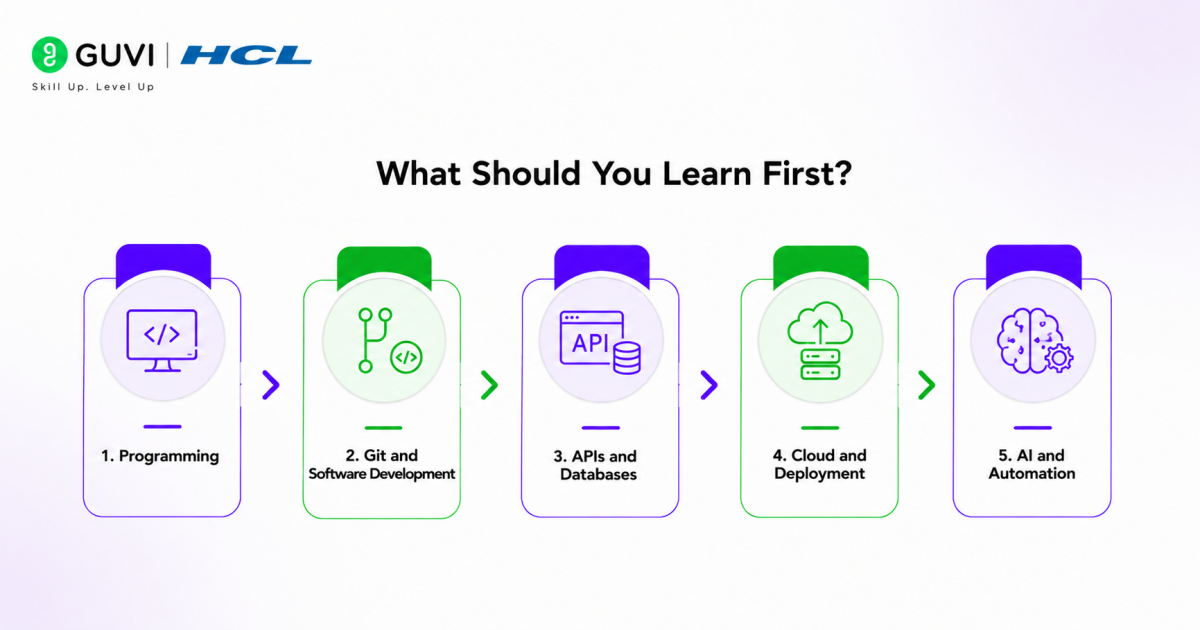
Start with software engineering fundamentals before moving into advanced cloud or AI technologies.
A practical learning sequence looks like this:
1. Programming
Learn one language well enough to build applications.
Python is a practical choice for many FDE paths, especially those involving automation, backend systems, data, and AI.
2. Git and Software Development
Learn how to:
- Use Git and GitHub
- Structure projects
- Debug code
- Write tests
- Handle errors
- Work with documentation
3. APIs and Databases
Understand how applications communicate and store information.
Focus on:
- REST APIs
- JSON
- Authentication
- Webhooks
- SQL
- Database design
4. Cloud and Deployment
Learn how to move an application from your laptop to a real environment.
Start with:
- AWS, Azure, or Google Cloud
- Linux
- Docker
- CI/CD
- Networking basics
- Monitoring
5. AI and Automation
For AI-focused FDE roles, add:
- LLM APIs
- RAG
- Embeddings
- Vector databases
- AI agents
- Model evaluation
You don’t need to learn everything at once.
Best Practice: Choose technologies based on the FDE roles you want. If most of your target jobs mention Python, APIs, AWS, and AI, prioritize those instead of spending months learning unrelated tools.

Can You Become an FDE in Six Months?
Yes, six months can be enough for someone who already has a strong technical foundation, but it is an aggressive timeline for a complete beginner.
For an experienced developer, the six months could focus on:
Months 1–2: Customer problem-solving and system design
Months 3–4: Integration and deployment projects
Months 5–6: Portfolio development, interviews, and applications
For a beginner, the same six months may primarily be spent learning programming and software development fundamentals.
Don’t rush simply to meet a deadline.
Being able to build and explain a working application is more valuable than completing a six-month checklist without understanding the material.
How Can You Speed Up Your FDE Preparation?
Focus on learning by building rather than studying technologies separately for months.
1. Use a Project-Based Approach
Instead of learning Docker for three weeks and then forgetting it, use Docker while deploying your application.
Instead of studying APIs only theoretically, build an application that consumes and exposes APIs.
This creates stronger connections between concepts.
2. Study Real Job Descriptions
Review FDE openings and identify common requirements.
Create a simple skill matrix:
| Skill | Current Level | Target Level |
| Python | Beginner | Intermediate |
| APIs | Beginner | Intermediate |
| SQL | Intermediate | Intermediate |
| Cloud | Beginner | Intermediate |
| Docker | Beginner | Intermediate |
| System Design | Beginner | Intermediate |
| Communication | Strong | Strong |
This helps you spend your time where it matters.
3. Get Feedback
Ask developers, mentors, or peers to review your projects.
A fresh perspective can reveal problems you might not notice yourself.
Pro Tip: Don’t wait until your portfolio feels “perfect” before applying. Once you meet the core requirements, start applying and use interview feedback to identify gaps.
Start Your Learning Journey with HCL GUVI
Build your AI and machine learning skills with HCL GUVI’s Artificial Intelligence & Machine Learning Course. Gain practical experience through hands-on projects and develop skills that can help you prepare for emerging AI engineering opportunities.
Conclusion
The time it takes to become a forward deployed engineer isn’t determined by a fixed number of months. Your existing technical skills, learning consistency, project experience, and target FDE specialization all affect the timeline.
For a technical candidate, six to twelve months of focused preparation can be enough to become competitive for some roles. Beginners may need longer to build the fundamentals.
The smartest approach is to learn by building. Strengthen your programming, APIs, databases, cloud, and deployment skills, then create projects that solve realistic problems. Combine those technical abilities with strong communication and customer-focused thinking, and you’ll be much better prepared for an FDE career.
FAQs
How long does it take to become a Forward Deployed Engineer?
It can take around 6–12 months for candidates with a technical background and 12–18 months or longer for beginners, depending on their learning pace and existing skills.
Can I become a Forward Deployed Engineer in six months?
Yes, particularly if you already have software engineering experience. Beginners may need more time to develop the required technical foundation.
What skills should I learn to become an FDE?
Focus on programming, APIs, databases, Git, cloud computing, Docker, deployment, system design, debugging, and customer communication.
Do I need professional experience to become an FDE?
Not always. Strong projects, internships, open-source contributions, and other practical experience can demonstrate relevant skills, although requirements vary by employer.
What projects should I build before applying for FDE jobs?
Build two or three end-to-end projects involving realistic problems, APIs, databases, cloud deployment, automation, or AI integrations.
Is Forward Deployed Engineering difficult to learn?
It can be challenging because the role combines engineering with customer problem-solving. However, a structured learning plan and consistent project practice can make the transition manageable.
Success Stories

About the Author
HCL GUVI
This article was selected and published as part of the HCL GUVI AI Blogathon 2026, an initiative designed to encourage students, AI enthusiasts, and aspiring tech writers to simplify complex AI concepts through impactful technical content. The contest recognized high-quality, original, and insightful AI-focused blogs, with selected authors receiving publication opportunities on the HCL GUVI blog platform along with official author credits and recognition.
View all posts by HCL GUVI
Connect with me @








Did you enjoy this article?