


Forward Deployed Engineer Articles
Scale AI Forward Deployed Data Scientist Interview Prep
ElevenLabs Forward Deployed Engineer Interview Guide
Forward Deployed Engineer Resume: A Template That Gets Interviews
Working With Legacy Systems: A Forward Deployed Engineer's Survival Guide


Get In Touch For Details! Request More Information
How to Get Your First Forward Deployed Engineer Job With No Experience
Sep 10, 2026 4 Min Read 102 Views
(Last Updated)
Getting a forward deployed engineer job with no experience can feel difficult because many FDE roles ask for software engineering or customer-facing experience. But you don’t necessarily need previous FDE experience to get started. What you need is proof that you can solve technical problems, build practical solutions, and work with people to understand their needs.
Forward Deployed Engineers sit between engineering and real-world implementation. They build solutions, integrate systems, troubleshoot problems, and often work directly with customers. That makes practical skills especially valuable when you’re applying for your first role.
If you’re starting out, this guide will show you which technical skills to develop, what projects can strengthen your portfolio, how to gain relevant experience, and how to position yourself for entry-level opportunities.
Table of contents
- TL;DR Summary
- Can You Get an FDE Job With No Experience?
- What Skills Do Entry-Level FDE Candidates Need?
- What Projects Should You Build?
- Project 1: AI Knowledge Assistant
- Project 2: Business Automation Tool
- Project 3: Customer Analytics Platform
- How Can You Build Experience Before Your First FDE Job?
- How Should You Create Your FDE Portfolio?
- Start Your Learning Journey with HCL GUVI
- Conclusion
- FAQs
- Can I get a Forward Deployed Engineer job with no experience?
- What skills do I need for an entry-level FDE job?
- What projects should I build for an FDE job?
- Do I need a CS degree to get an FDE job?
- How can I gain FDE experience before getting hired?
- How can I stand out when applying for my first FDE role?
TL;DR Summary
- Getting a forward deployed engineer job with no experience is possible if you can demonstrate strong technical and problem-solving skills.
- Focus on programming, APIs, databases, cloud, deployment, debugging, and system design.
- Build two to four practical projects that solve realistic business problems.
- Use internships, hackathons, open-source contributions, and personal projects as evidence of your abilities.
- Strong communication matters because FDEs often work directly with customers and stakeholders.
- Don’t wait for your first job to gain experience. Create practical experience through projects and real-world technical work.
Can You Get an FDE Job With No Experience?
Yes, you can get a Forward Deployed Engineer job without previous FDE experience, but you still need evidence that you can perform the work.
FDE roles are usually built around solving customer problems through technology. That means employers may look beyond your previous job title and evaluate your technical skills, projects, communication, and ability to learn quickly.
If you have never worked as an FDE, you can demonstrate relevant experience through:
- Personal projects
- Internships
- Hackathons
- Open-source contributions
- Freelance work
- Technical competitions
- Academic projects
The goal is to replace “professional FDE experience” with credible evidence of FDE-related skills.
Ready to start your AI engineering career? HCL GUVI’s Artificial Intelligence & Machine Learning Course helps you build practical AI and machine learning skills through hands-on projects and industry-focused learning.
What Skills Do Entry-Level FDE Candidates Need?
You need a combination of engineering fundamentals and customer-focused problem-solving skills.
- Programming
Start with one programming language and become comfortable building real applications.
Python is a practical choice for many FDE paths because it is widely used in backend development, automation, data, and AI.
Learn:
- Programming fundamentals
- Object-oriented programming
- Data structures
- Error handling
- Testing
- Debugging
- Git
- APIs and Integrations
FDEs frequently connect different systems.
You should understand:
- REST APIs
- JSON
- Authentication
- Webhooks
- API testing
- Third-party integrations
- Databases
Learn SQL and understand how applications store and retrieve information.
You should know basic concepts such as:
- Tables and relationships
- Queries
- Indexes
- Transactions
- Database design
- Cloud and Deployment
Knowing how to run an application outside your laptop is valuable.
Start with:
- AWS, Azure, or Google Cloud
- Linux
- Docker
- CI/CD
- Networking basics
- Monitoring
- Communication
Here’s something beginners often underestimate.
FDEs may need to explain technical solutions to customers who don’t have an engineering background.
You should be able to ask questions, understand requirements, explain trade-offs, and communicate technical problems clearly.
FDE work often involves ambiguity. A customer may describe a business problem without knowing exactly what technical solution they need, so asking the right questions can be as important as writing the code.
What Projects Should You Build?
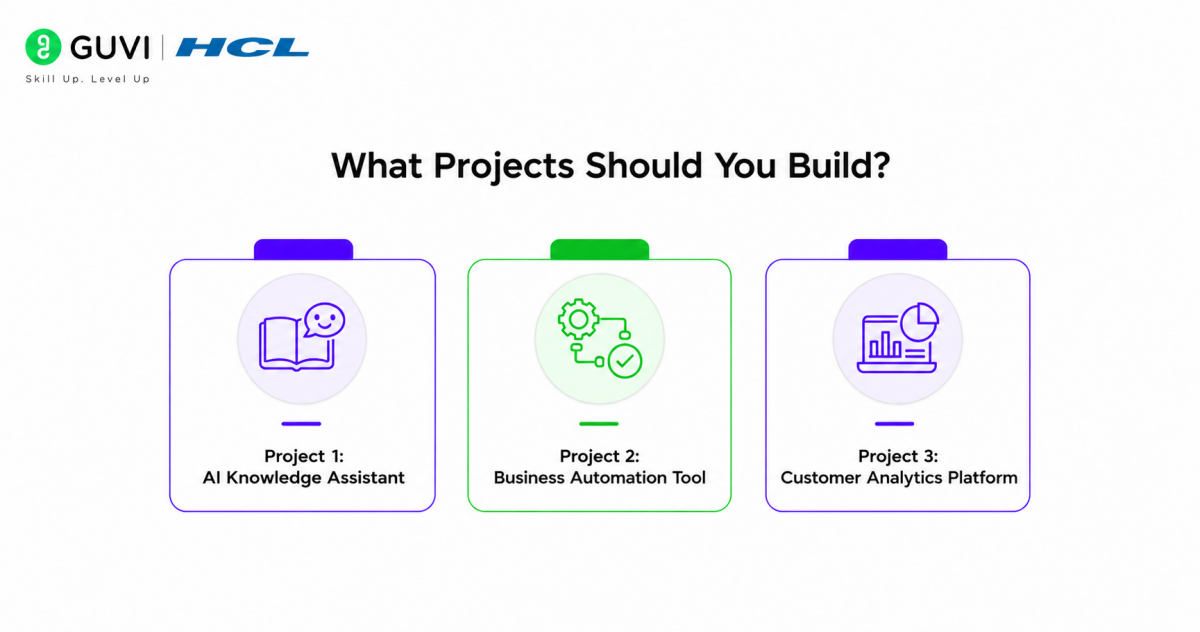
Build projects that show you can take a problem from idea to working deployment.
Avoid building only simple tutorials.
Instead, choose realistic problems that require multiple technical components.
Project 1: AI Knowledge Assistant
Build an application that allows users to ask questions about company documents.
You could include:
Documents → Processing → Embeddings → Retrieval → LLM → API → User InterfaceThis demonstrates AI integration, backend development, APIs, databases, and problem-solving.
Project 2: Business Automation Tool
Choose a repetitive business process and automate it.
For example:
Form → API → Data Processing → Database → NotificationThis demonstrates your ability to connect different systems into one workflow.
Project 3: Customer Analytics Platform
Build an application that processes customer data and provides useful insights.
Include:
- Data ingestion
- SQL database
- Python processing
- Dashboard
- API
- Cloud deployment
The project doesn’t need to be huge.
What matters is whether you can explain the problem, your solution, technical decisions, challenges, and outcome.
Best Practice: Choose projects where you can explain why every major technical decision was made. Interviewers may care more about your reasoning than the project’s complexity.

How Can You Build Experience Before Your First FDE Job?
Create opportunities to practice real engineering instead of waiting for an employer to give you experience.
- Contribute to Open Source
Start with manageable contributions such as:
- Documentation improvements
- Bug fixes
- Tests
- Small features
- Issue investigation
This gives you experience working with an existing codebase.
- Join Hackathons
Hackathons are useful because they force you to:
- Understand a problem quickly
- Build under time constraints
- Work with others
- Present your solution
- Make technical trade-offs
These are all relevant to FDE work.
- Build for Real Users
This is even better.
Instead of building an application only for your portfolio, find a small business, student organization, community, or project that has a genuine problem.
Then build a solution for it.
Even a small real-world deployment can give you a valuable story to discuss in interviews.
Pro Tip: When describing a project, don’t just say “I built an application.” Explain who needed it, what problem they had, what you changed, and how you measured whether the solution worked.
How Should You Create Your FDE Portfolio?
Your portfolio should make it easy for a recruiter to see evidence of engineering and problem-solving ability.
For each project, include:
- Problem statement
- Solution
- Architecture
- Technologies
- Key implementation details
- Challenges
- Results
- GitHub repository
- Live demo, if available
A good README can make a major difference.
For example:
Problem: Customer support teams spend significant time searching internal documentation.
Solution: Built an AI-powered document assistant using retrieval and an LLM.
Implementation: Python, FastAPI, PostgreSQL, vector search, Docker.
Result: Created a working prototype that allows users to retrieve relevant information through natural-language questions.
This tells a much stronger story than a technology list.
Start Your Learning Journey with HCL GUVI
Ready to start your AI engineering career? HCL GUVI’s Artificial Intelligence & Machine Learning Course helps you build practical AI and machine learning skills through hands-on projects and industry-focused learning.
Conclusion
Getting a forward deployed engineer job with no experience is challenging, but it is not impossible. Your biggest task is proving that you can do the work even if you haven’t held the FDE title before.
Start by building strong engineering fundamentals. Then create practical projects that involve APIs, databases, cloud deployment, automation, or AI. Look for opportunities to work with real users, contribute to open source, or participate in hackathons.
Most importantly, don’t treat your lack of experience as a dead end. Treat it as a reason to create evidence. A strong project portfolio, clear communication, and a solid understanding of the problems FDEs solve can help you compete for the right entry-level opportunities.
FAQs
Can I get a Forward Deployed Engineer job with no experience?
Yes. You can demonstrate FDE-relevant skills through personal projects, internships, hackathons, open-source contributions, and other practical work.
What skills do I need for an entry-level FDE job?
Focus on programming, APIs, SQL, databases, cloud fundamentals, Git, Docker, deployment, debugging, system design, and communication.
What projects should I build for an FDE job?
Build practical applications that solve realistic problems. AI assistants, business automation tools, API-based applications, and customer analytics platforms are useful examples.
Do I need a CS degree to get an FDE job?
Not necessarily. Requirements vary by company, but strong technical skills and practical experience can be valuable alternatives when a degree isn’t explicitly required.
How can I gain FDE experience before getting hired?
Build projects for real users, contribute to open source, participate in hackathons, complete internships, or work on freelance and community projects that involve technical problem-solving.
How can I stand out when applying for my first FDE role?
Show evidence rather than making claims. A focused portfolio, deployed projects, strong GitHub repositories, clear communication, and the ability to explain your technical decisions can strengthen your application.
Success Stories

About the Author
HCL GUVI
This article was selected and published as part of the HCL GUVI AI Blogathon 2026, an initiative designed to encourage students, AI enthusiasts, and aspiring tech writers to simplify complex AI concepts through impactful technical content. The contest recognized high-quality, original, and insightful AI-focused blogs, with selected authors receiving publication opportunities on the HCL GUVI blog platform along with official author credits and recognition.
View all posts by HCL GUVI
Connect with me @








Did you enjoy this article?