


Forward Deployed Engineer Articles
Scale AI Forward Deployed Data Scientist Interview Prep
Forward Deployed Engineer Resume: A Template That Gets Interviews
Working With Legacy Systems: A Forward Deployed Engineer's Survival Guide


Get In Touch For Details! Request More Information
ElevenLabs Forward Deployed Engineer Interview Guide
Sep 18, 2026 4 Min Read 17 Views
(Last Updated)
Preparing for an ElevenLabs forward deployed engineer interview requires a combination of software engineering, AI knowledge, problem-solving, and customer-facing skills. The role goes beyond writing code because Forward Deployed Engineers often need to understand real-world requirements and turn them into practical technical solutions.
Because ElevenLabs works with voice and AI technologies, candidates may need to understand APIs, integrations, real-time systems, AI applications, and production challenges. The interview may also explore how you approach ambiguous customer problems, communicate technical decisions, and build solutions that work reliably in real-world environments.
If you’re targeting an FDE role at ElevenLabs, knowing what areas to prepare can make your preparation more focused. This guide explains the technical skills, AI concepts, coding, system design, customer problem-solving, and project experience you should be ready to discuss.
Table of contents
- TL;DR Summary
- What Does a Forward Deployed Engineer Do at ElevenLabs?
- What Technical Skills Should You Prepare?
- Programming
- APIs
- Backend Development
- Cloud and Deployment
- What AI and Voice Technology Topics Should You Know?
- Text-to-Speech
- Speech-to-Text
- Conversational AI
- What Coding Questions Can You Expect?
- How would you process a large stream of data?
- How would you handle an API that returns errors?
- How would you optimize slow code?
- How would you write testable code?
- How would you design a reusable API client?
- How Are Customer Problem-Solving Skills Tested?
- What Is the Goal?
- How Should You Prepare for the Interview?
- Step 1: Strengthen Coding Fundamentals
- Step 2: Learn AI Application Development
- Step 3: Build an AI Application
- Step 4: Practice System Design
- Step 5: Practice Customer Scenarios
- Step 6: Research the Role
- Start Your Learning Journey with HCL GUVI
- Conclusion
- FAQs
- What is an ElevenLabs Forward Deployed Engineer?
- What should I study for an ElevenLabs FDE interview?
- Is coding required for an ElevenLabs FDE role?
- What AI concepts should I know for an ElevenLabs interview?
- What projects can help me prepare for an ElevenLabs FDE interview?
- How can I stand out in an ElevenLabs FDE interview?
- Meta Title: ElevenLabs Forward Deployed Engineer Interview Guide
TL;DR Summary
- The ElevenLabs forward deployed engineer interview can test software engineering, AI application development, system design, and customer-focused problem-solving.
- Prepare for coding, APIs, backend systems, cloud infrastructure, debugging, and technical architecture.
- Because ElevenLabs builds AI-powered voice and audio technology, understanding AI application workflows can be particularly useful.
- Expect practical questions about integrating AI capabilities into real products and customer environments.
- Be ready to discuss your projects, technical decisions, trade-offs, and approach to ambiguous requirements.
- Strong preparation combines software engineering fundamentals with AI, communication, and real-world implementation skills.
What Does a Forward Deployed Engineer Do at ElevenLabs?
A Forward Deployed Engineer at ElevenLabs would typically need to combine software engineering with practical AI implementation and customer problem-solving.
ElevenLabs is known for AI-powered voice technology, including text-to-speech, speech-to-text, voice generation, and conversational AI applications.
For an FDE, the work can involve turning these capabilities into solutions that address specific customer or business requirements.
Depending on the role, responsibilities may include:
- Building AI-powered applications
- Integrating APIs
- Developing backend services
- Connecting customer systems
- Prototyping solutions
- Deploying applications
- Debugging production issues
- Working with customers and internal teams
This means you should prepare for more than traditional coding questions.
The interview may evaluate whether you can understand a problem, identify the right technical approach, build a solution, and communicate it effectively.
Looking to strengthen your AI engineering skills? HCL GUVI’s Artificial Intelligence & Machine Learning Course helps you learn AI, machine learning, and practical application development through hands-on, industry-focused projects.
What Technical Skills Should You Prepare?
Strong software engineering fundamentals should form the foundation of your interview preparation.
1. Programming
Be comfortable with at least one programming language.
For AI application development, Python is particularly useful, although the required language depends on the specific position.
Review:
- Data structures
- Algorithms
- Functions
- Object-oriented programming
- Error handling
- Testing
- Debugging
2. APIs
API knowledge is especially relevant for integration-focused engineering work.
Understand:
- REST APIs
- HTTP methods
- Authentication
- JSON
- Webhooks
- Rate limits
- Error handling
3. Backend Development
Review:
- Databases
- API architecture
- Authentication
- Background processing
- Caching
- Logging
- Monitoring
4. Cloud and Deployment
Be familiar with:
- Docker
- Cloud platforms
- CI/CD
- Networking basics
- Environment variables
- Observability
- Application scaling
The goal isn’t to memorize every cloud service.
You should understand how to take an application from development to production.
What AI and Voice Technology Topics Should You Know?
You should understand the basic architecture and engineering challenges behind modern AI and voice applications.
You don’t necessarily need to be a machine learning researcher.
However, you should understand concepts such as:
- Large language models
- Text-to-speech
- Speech-to-text
- Voice cloning
- Conversational AI
- AI agents
- Prompting
- Streaming
- API-based AI integration
- Model evaluation
Text-to-Speech
Text-to-speech systems convert written text into spoken audio.
In an application, the workflow could look like:
Text → AI Voice Model → Audio → UserYou should think about:
- Latency
- Audio quality
- Voice selection
- Streaming
- Error handling
Speech-to-Text
Speech-to-text converts spoken audio into text.
A conversational system could therefore use:
Speech → Transcription → LLM → Response → SpeechUnderstanding this pipeline helps you reason about voice-based applications.
Conversational AI
For conversational systems, consider:
- Conversation history
- Context management
- Response latency
- Interruptions
- Tool use
- Authentication
- Evaluation
Best Practice: Don’t prepare by memorizing definitions of AI concepts. Practice explaining how you would use each technology to solve a specific product or customer problem.
What Coding Questions Can You Expect?
Coding questions may evaluate your ability to write clean, reliable code and reason through practical problems.
1. How would you process a large stream of data?
Answer: Consider whether the data can be processed incrementally rather than loaded entirely into memory. Choose an appropriate streaming or batch-processing approach based on latency and scale requirements.
2. How would you handle an API that returns errors?
Answer: Identify the type of failure, use appropriate timeouts and retries, handle expected error responses, log useful information, and implement fallback behavior where necessary.
3. How would you optimize slow code?
Answer: Measure the application’s performance first, identify the bottleneck, and optimize the relevant component. Avoid making changes based only on assumptions.
4. How would you write testable code?
Answer: Break functionality into small, well-defined components, minimize unnecessary dependencies, define clear inputs and outputs, and use unit and integration tests.
5. How would you design a reusable API client?
Answer: Separate authentication, request handling, error processing, configuration, and business logic. Provide clear interfaces and handle timeouts, retries, and rate limits appropriately.

During coding questions, explain your reasoning rather than silently writing code.
Voice AI applications have additional engineering considerations compared with text-only applications. Latency, audio quality, interruptions, pronunciation, and conversational flow can all affect the user experience.
How Are Customer Problem-Solving Skills Tested?
FDE interviews can test whether you can translate a business problem into a practical technical solution.
Imagine a customer says:
“We want to add an AI voice assistant to our website.”
Don’t immediately start designing the system.
Ask:
- Who will use the assistant?
- What questions will users ask?
- What systems does it need to access?
- Does it need to perform actions?
- How quickly should it respond?
- What happens when it cannot answer?
- How will success be measured?
Only then should you recommend an architecture.
What Is the Goal?
The interviewer wants to see whether you can:
- Understand the actual problem
- Identify requirements
- Ask useful questions
- Prioritize features
- Consider technical constraints
- Explain trade-offs
- Build a practical solution
This is a core part of forward deployed engineering.
How Should You Prepare for the Interview?
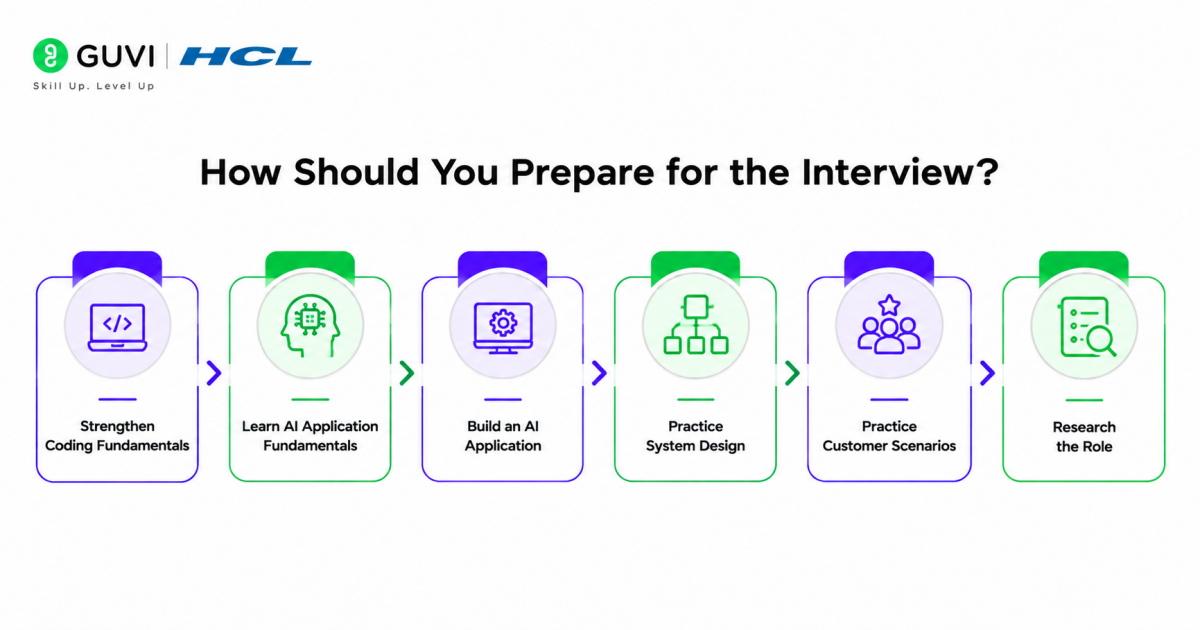
Prepare across software engineering, AI, system design, and customer problem-solving.
Step 1: Strengthen Coding Fundamentals
Review:
- Python
- Data structures
- Algorithms
- SQL
- APIs
- Git
- Testing
- Debugging
Step 2: Learn AI Application Development
Understand:
- LLMs
- Speech-to-text
- Text-to-speech
- Prompting
- AI agents
- Retrieval
- Tool calling
- Evaluation
Step 3: Build an AI Application
Create a project that combines multiple components.
For example:
Frontend → Backend → AI API → Database → DeploymentA voice-focused project can be particularly useful for understanding audio workflows.
Step 4: Practice System Design
Design systems such as:
- AI customer support
- Voice assistants
- Document assistants
- AI search systems
- Automated workflows
Step 5: Practice Customer Scenarios
Take vague requirements and practice asking questions before designing solutions.
Step 6: Research the Role
Read the specific job description carefully.
Different FDE positions can have different expectations.
Some may emphasize customer deployment, while others may focus more heavily on software development, AI applications, or integrations.
Start Your Learning Journey with HCL GUVI
Looking to strengthen your AI engineering skills? HCL GUVI’s Artificial Intelligence & Machine Learning Course helps you learn AI, machine learning, and practical application development through hands-on, industry-focused projects.
Conclusion
Preparing for an ElevenLabs forward deployed engineer interview requires a combination of engineering fundamentals and practical AI knowledge. You need to demonstrate that you can write reliable software, integrate APIs, design systems, and troubleshoot technical problems.
For an AI voice-focused company, it is also useful to understand how voice applications work and what makes them challenging. Think about latency, audio quality, streaming, conversation state, model limitations, and reliability.
Most importantly, prepare to think like an FDE. Start with the customer’s problem, ask the right questions, understand the constraints, and then design the simplest solution that can deliver the desired outcome. If you can combine technical depth with practical problem-solving and clear communication, you’ll be better prepared for the interview.
FAQs
What is an ElevenLabs Forward Deployed Engineer?
A Forward Deployed Engineer works on applying technical and AI capabilities to real-world customer or business problems. The role can involve software development, integrations, deployment, troubleshooting, and customer collaboration.
What should I study for an ElevenLabs FDE interview?
Prepare programming, APIs, databases, cloud fundamentals, system design, debugging, AI application development, and customer problem-solving. Voice AI concepts can also be relevant depending on the position.
Is coding required for an ElevenLabs FDE role?
For engineering-focused FDE positions, coding is generally an important skill. The exact level depends on the specific job and its responsibilities.
What AI concepts should I know for an ElevenLabs interview?
Understand concepts relevant to AI applications and voice systems, including LLMs, text-to-speech, speech-to-text, prompting, tool use, streaming, conversational AI, and evaluation.
What projects can help me prepare for an ElevenLabs FDE interview?
Build practical AI applications such as voice assistants, customer support systems, AI agents, document assistants, or API-driven automation tools. Focus on complete workflows rather than simple demos.
How can I stand out in an ElevenLabs FDE interview?
Demonstrate strong engineering fundamentals, practical AI knowledge, customer empathy, and clear communication. Explain your technical decisions, ask thoughtful questions, and connect your solutions to measurable user or business outcomes.
Meta Title: ElevenLabs Forward Deployed Engineer Interview Guide
Meta Description: Prepare for an ElevenLabs Forward Deployed Engineer interview with key technical, AI, system design, and customer problem-solving topics.
Success Stories

About the Author
HCL GUVI
This article was selected and published as part of the HCL GUVI AI Blogathon 2026, an initiative designed to encourage students, AI enthusiasts, and aspiring tech writers to simplify complex AI concepts through impactful technical content. The contest recognized high-quality, original, and insightful AI-focused blogs, with selected authors receiving publication opportunities on the HCL GUVI blog platform along with official author credits and recognition.
View all posts by HCL GUVI
Connect with me @










Did you enjoy this article?