


Forward Deployed Engineer Articles
Anthropic Applied AI Engineer Interview: What's Different
How to Ace the FDE "Decomposition" Case Study Round
RAG and Vector Databases: A Forward Deployed Engineer's Primer


Get In Touch For Details! Request More Information
Prompt Engineering Skills for Forward Deployed AI Engineers
Sep 19, 2026 4 Min Read 23 Views
(Last Updated)
Prompt engineering for forward deployed engineers is about designing instructions that help AI models produce useful, reliable, and task-specific outputs. For FDEs, prompt engineering becomes especially important when adapting AI systems to customer workflows, business requirements, and domain-specific information.
An FDE may need to create prompts for customer support assistants, document processing systems, AI agents, data analysis tools, or internal knowledge applications. The challenge is not simply writing a good prompt. Engineers also need to provide the right context, define expected outputs, handle edge cases, and evaluate whether the model performs consistently.
This article explores the prompt engineering skills FDEs should develop, practical prompting techniques, common challenges, and how to test prompts before deploying AI solutions in real customer environments.
Table of contents
- TL;DR Summary
- Why Is Prompt Engineering Important for FDEs?
- Which Prompt Engineering Skills Should FDEs Learn?
- Writing Clear Instructions
- Providing Context
- Defining Output Formats
- Using Examples
- Handling Edge Cases
- What Prompting Techniques Are Useful?
- Zero-Shot Prompting
- Few-Shot Prompting
- Role-Based Instructions
- Chain-of-Thought Considerations
- Prompt Templates
- How Do FDEs Test and Evaluate Prompts?
- How Does Prompt Engineering Work With RAG and AI Agents?
- RAG
- AI Agents
- What Prompt Engineering Mistakes Should FDEs Avoid?
- Start Your Learning Journey with HCL GUVI
- Conclusion
- FAQs
- What is prompt engineering for Forward Deployed Engineers?
- Why is prompt engineering important for FDEs?
- What prompt engineering techniques should FDEs learn?
- How should FDEs test prompts?
- Is prompt engineering enough to build reliable AI applications?
- Do FDEs need prompt engineering skills for AI agent development?
TL;DR Summary
- Prompt engineering for forward deployed engineers focuses on creating reliable instructions for customer-specific AI applications.
- FDEs should understand clear instructions, context, examples, output formats, constraints, and role-based prompting.
- Prompts should be tested with realistic inputs and edge cases before deployment.
- Structured outputs can make LLM responses easier for applications to process.
- Prompt engineering often works alongside RAG, APIs, tools, and AI agents.
- FDEs should treat prompts as part of an engineering workflow rather than one-time text instructions.
Why Is Prompt Engineering Important for FDEs?
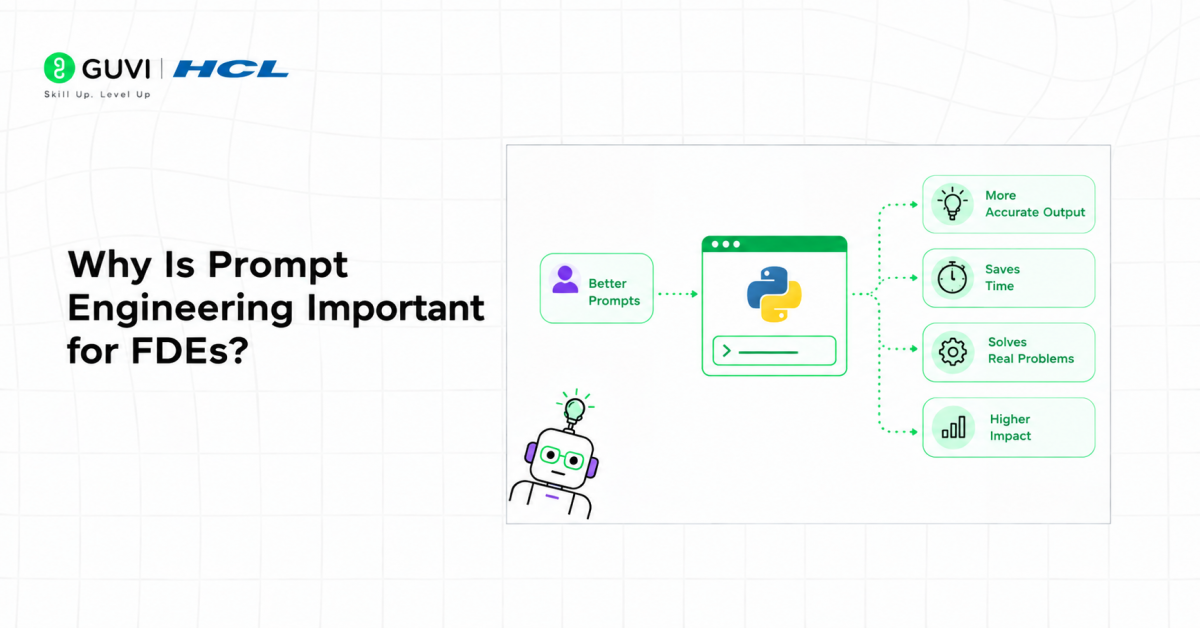
FDEs often customize AI systems for specific customers. A general-purpose prompt may not understand the customer’s terminology, workflow, output requirements, or business rules.
Effective prompt engineering helps engineers guide models toward the desired behavior.
For example, an FDE building a customer support assistant might need the model to:
- Answer using approved documentation.
- Avoid inventing information.
- Escalate uncertain questions.
- Return responses in a specific format.
- Follow company terminology.
- Protect sensitive information.
The prompt becomes one component of the overall technical solution.
Build the skills needed for AI engineering roles with HCL GUVI’s Artificial Intelligence & Machine Learning Course. Learn AI, machine learning, and practical development techniques through hands-on projects.
Which Prompt Engineering Skills Should FDEs Learn?
1. Writing Clear Instructions
The model should receive precise instructions about what it needs to accomplish.
Instead of a vague request such as “Summarize this document,” define the task, audience, length, and expected structure.
Clear instructions reduce ambiguity and make outputs easier to evaluate.
2. Providing Context
Models perform better when they receive relevant context.
FDEs may provide:
- Customer documentation
- Product information
- Business rules
- User information
- Retrieved knowledge
- Previous conversation context
However, adding unnecessary information can make prompts less efficient. FDEs should focus on providing relevant context.
3. Defining Output Formats
Customer applications often need predictable responses.
For example, an application may require:
{

  "category": "...",

  "priority": "...",

  "summary": "..."

}
Structured outputs make it easier for downstream applications to process model responses.
4. Using Examples
Providing examples can demonstrate the expected behavior.
This is particularly useful when the task involves classification, formatting, tone, or domain-specific rules.
For example, an FDE can provide sample customer questions and the expected classifications before asking the model to classify new inputs.
5. Handling Edge Cases
Real customer environments rarely contain perfect inputs.
Prompts should account for:
- Missing information
- Ambiguous requests
- Invalid inputs
- Conflicting information
- Unsupported questions
Defining what the model should do in these situations can improve reliability.
What Prompting Techniques Are Useful?
1. Zero-Shot Prompting
The model receives instructions without examples. This approach works well for straightforward tasks.
2. Few-Shot Prompting
The prompt includes several examples to demonstrate the desired behavior. This can help when the expected output is more specific.
3. Role-Based Instructions
The model can be given a role or operating context, such as acting as a technical support assistant following specific company guidelines.
4. Chain-of-Thought Considerations
FDEs may structure tasks into logical steps, but they should focus on the required output rather than unnecessarily requesting private reasoning. For complex workflows, breaking a task into smaller operations can make the overall system easier to test.
5. Prompt Templates
Instead of manually creating every prompt, FDEs can build reusable templates with variables.
For example:

Customer issue: {issue}

Relevant documentation:

{context}
Provide the recommended solution using the approved format.
Templates make customer-specific customization easier to maintain.
Prompt engineering is often iterative. A prompt that works well on one example may fail on a different customer input, which is why systematic testing is important.

How Do FDEs Test and Evaluate Prompts?
A prompt should not be considered production-ready simply because it works once.
FDEs should create a collection of realistic test cases and evaluate the results.
A basic evaluation process can include:
- Define the desired behavior.
- Create representative inputs.
- Run the prompt against those inputs.
- Compare outputs with expected results.
- Identify failure patterns.
- Modify the prompt.
- Test again.
Evaluation can consider factors such as:
- Accuracy
- Relevance
- Consistency
- Formatting
- Safety
- Latency
- Cost
For customer deployments, testing should include both normal scenarios and difficult edge cases.
Pro Tip: Keep a versioned record of important prompts and evaluation results. This makes it easier to identify whether a prompt change actually improved the system.
How Does Prompt Engineering Work With RAG and AI Agents?
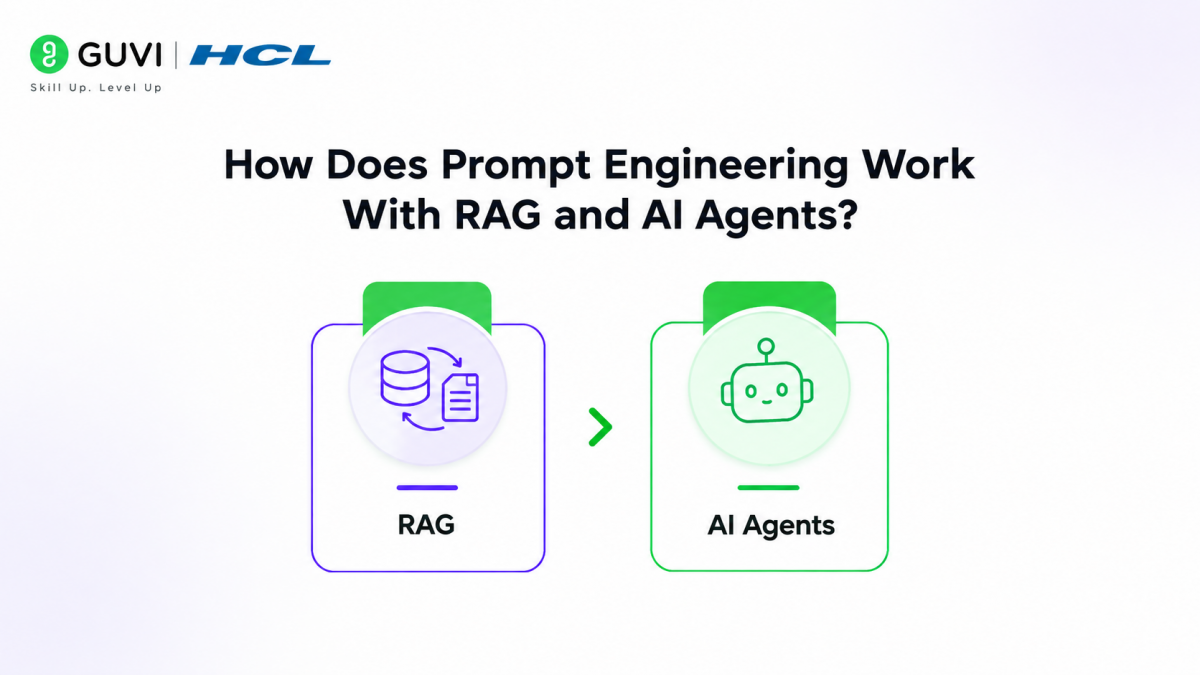
Prompt engineering rarely operates alone in modern AI applications.
1. RAG
In a RAG system, retrieved documents are placed into the model’s context. The prompt can instruct the model to use that information and avoid relying on unsupported claims.
2. AI Agents
AI agents may use prompts to determine how they should interact with tools, APIs, databases, or other systems.
An FDE might define:
- Which tools are available
- When a tool should be used
- What information should be collected
- How errors should be handled
- When the agent should escalate
This makes prompt engineering part of a larger application architecture.
What Prompt Engineering Mistakes Should FDEs Avoid?
Common mistakes include:
- Writing vague instructions
- Providing too much irrelevant context
- Ignoring edge cases
- Assuming one prompt works for every customer
- Failing to test outputs
- Hardcoding sensitive information
- Changing prompts without tracking versions
- Relying entirely on prompts to solve system-level problems
Warning: Prompt engineering cannot compensate for poor source data, weak application architecture, missing access controls, or an unsuitable AI model. FDEs should identify whether a problem actually requires a prompt change.
Start Your Learning Journey with HCL GUVI
Build the skills needed for AI engineering roles with HCL GUVI’s Artificial Intelligence & Machine Learning Course. Learn AI, machine learning, and practical development techniques through hands-on projects.
Conclusion
Prompt engineering for forward deployed engineers is a practical engineering skill that helps adapt AI models to real customer requirements. FDEs need to understand how instructions, context, examples, output formats, and constraints influence model behavior.
The strongest approach is to treat prompts as components of a larger technical system. Combine prompt design with reliable data, RAG, APIs, evaluation, security, and monitoring. By testing prompts against realistic customer scenarios and continuously improving them, FDEs can build AI solutions that are more consistent, useful, and easier to maintain.
FAQs
What is prompt engineering for Forward Deployed Engineers?
PrompWhat prompt engineering techniques should FDEs learn?t engineering involves designing instructions and context that guide AI models to produce useful outputs for specific customer workflows. FDEs use it when building customized AI applications and integrations.
Why is prompt engineering important for FDEs?
FDEs often need to adapt AI systems to different customers, industries, data sources, and business requirements. Effective prompts help control model behavior and make AI applications more useful for these environments.
What prompt engineering techniques should FDEs learn?
FDEs should understand clear instructions, zero-shot and few-shot prompting, context management, structured outputs, prompt templates, role-based instructions, and edge-case handling.
How should FDEs test prompts?
They should create realistic test cases, evaluate outputs against expected behavior, identify failure patterns, modify the prompt, and repeat the process. Testing should include both common scenarios and edge cases.
Is prompt engineering enough to build reliable AI applications?
No. Reliable AI applications also require good data, appropriate models, retrieval systems, application architecture, security, testing, and monitoring.
Do FDEs need prompt engineering skills for AI agent development?
Yes. AI agents often rely on instructions that define how they should use tools, interact with data, follow workflows, and handle errors. Prompt engineering can therefore be an important part of agent development.
Success Stories

About the Author
HCL GUVI
This article was selected and published as part of the HCL GUVI AI Blogathon 2026, an initiative designed to encourage students, AI enthusiasts, and aspiring tech writers to simplify complex AI concepts through impactful technical content. The contest recognized high-quality, original, and insightful AI-focused blogs, with selected authors receiving publication opportunities on the HCL GUVI blog platform along with official author credits and recognition.
View all posts by HCL GUVI
Connect with me @













Did you enjoy this article?