


Artificial Intelligence and Machine Learning Articles
AI/ML Skills Gap 2026: Why Companies Can't Find Job-Ready Talent
20 AI/ML Interview Questions Recruiters Can Use Without a Tech Background - Best Guide
How Industry-Backed AI/ML Bootcamps Are Changing the AI/ML Hiring Pipeline - Best Guide 2026
From IT Support to AI Engineer: A Realistic Career Switch Guide 2026


Get In Touch For Details! Request More Information
Applied AI: A Guide to Real-World Innovation
Jul 14, 2026 7 Min Read 527 Views
(Last Updated)
Imagine having technology that can diagnose diseases faster than experienced doctors, predict equipment failures before they happen, and personalize customer experiences for millions of users simultaneously. This is not science fiction. This is applied AI working right now in hospitals, factories, banks, and businesses around the world.
Applied AI is where theoretical algorithms meet practical problems. It is the difference between a research paper describing a neural network and a system that actually approves loans, routes delivery trucks, or detects fraud in real time. While academic AI focuses on pushing the boundaries of what is possible, applied AI focuses on deploying solutions that work reliably in messy, real-world conditions.
The gap between AI that works in a lab and AI that works in production is enormous.
This guide explains how to bridge that gap and build AI systems that actually solve real problems.
Table of contents
- Quick TL;DR Summary
- Why Applied AI Is Different From AI Research
- How Applied AI Works: The End-to-End Process
- Step 1: Identify a problem worth solving with AI
- Step 2: Validate that sufficient quality data exists
- Step 3: Frame the problem as a specific ML task
- Step 4: Build a simple baseline before complex models
- Step 5: Develop and iterate on model architecture
- Step 6: Design the production system architecture
- Step 7: Deploy with monitoring and safeguards
- Critical Success Factors for Applied AI Projects
- How to Implement Applied AI: Step-by-Step Process
- Step 1: Assess Business Value and Feasibility
- Step 2: Secure Stakeholder Alignment and Resources
- Step 3: Collect and Prepare Training Data
- Step 4: Build and Validate Initial Models
- Step 5: Design Production Integration Architecture
- Step 6: Implement Monitoring and Observability
- Step 7: Deploy Incrementally with Risk Mitigation
- Step 8: Maintain and Improve Over Time
- Real-World Applications of Applied AI Across Industries
- Conclusion
- FAQs
- What skills do I need to work in applied AI?
- How is applied AI different from data science?
- When should I use AI versus traditional software?
- How do I measure ROI for applied AI projects?
- What percentage of AI projects fail in production?
Quick TL;DR Summary
- This guide explains what applied AI is and how it differs from theoretical AI research by focusing on practical implementation and real-world deployment.
- You will learn the complete process of taking AI from concept to production, including problem selection, data preparation, model development, and deployment strategies.
- The guide covers real-world AI applications across healthcare, finance, retail, manufacturing, and other industries with specific use cases and implementation patterns.
- Step-by-step instructions show you how to assess whether AI is the right solution for your problem, select appropriate techniques, and measure business impact.
- You will understand the challenges unique to applied AI including data quality issues, integration with existing systems, regulatory compliance, and maintaining models in production.
What Is Applied AI?
Applied AI is the practical use of artificial intelligence technologies to solve specific real-world problems and deliver measurable business or operational value. Rather than focusing on theoretical research, applied AI emphasizes building, deploying, and maintaining AI systems that work reliably at scale in production environments. It is used across industries for applications such as recommendation systems, fraud detection, predictive analytics, customer support, healthcare diagnostics, and process automation.
Why Applied AI Is Different From AI Research
- Research optimizes for accuracy, applied AI optimizes for value
Academic AI research measures success by benchmark performance on standardized datasets. Applied AI measures success by business impact, user satisfaction, and return on investment. A model that achieves 95% accuracy is worthless if it costs more to run than the value it creates or if users do not trust its outputs enough to act on them.
- Research uses clean data, applied AI works with messy reality
Research datasets are carefully curated, labeled, and balanced. Real-world data is incomplete, inconsistent, biased, and constantly changing. Applied AI systems must handle missing values, data entry errors, format variations, and evolving patterns while still producing reliable outputs. Most of the work in applied AI is data engineering, not algorithm design.
- Research builds one model, applied AI maintains systems
Publishing a paper requires training a model once and reporting its performance. Production AI systems need continuous monitoring, retraining as data distributions shift, updating as business requirements change, and maintaining as surrounding systems evolve. Applied AI is software engineering combined with machine learning, not just modeling.
- Research assumes infinite compute, applied AI has resource constraints
Academic work often uses whatever computational resources are needed to achieve the best results. Production systems have strict latency requirements, memory limits, and cost budgets. A model that takes 10 seconds to make a prediction is useless for real-time applications. Applied AI requires balancing model complexity against operational constraints.
- Research publishes novel techniques, applied AI uses what works
Cutting-edge research explores new architectures and training methods. Applied AI practitioners reach for proven, reliable techniques first and only innovate when necessary. Using a three-year-old algorithm that is well-understood and debugged is often better than deploying the latest research breakthrough that no one knows how to fix when it breaks.
Read More: Top AI Tools for Software Development: Revolutionize Coding
How Applied AI Works: The End-to-End Process
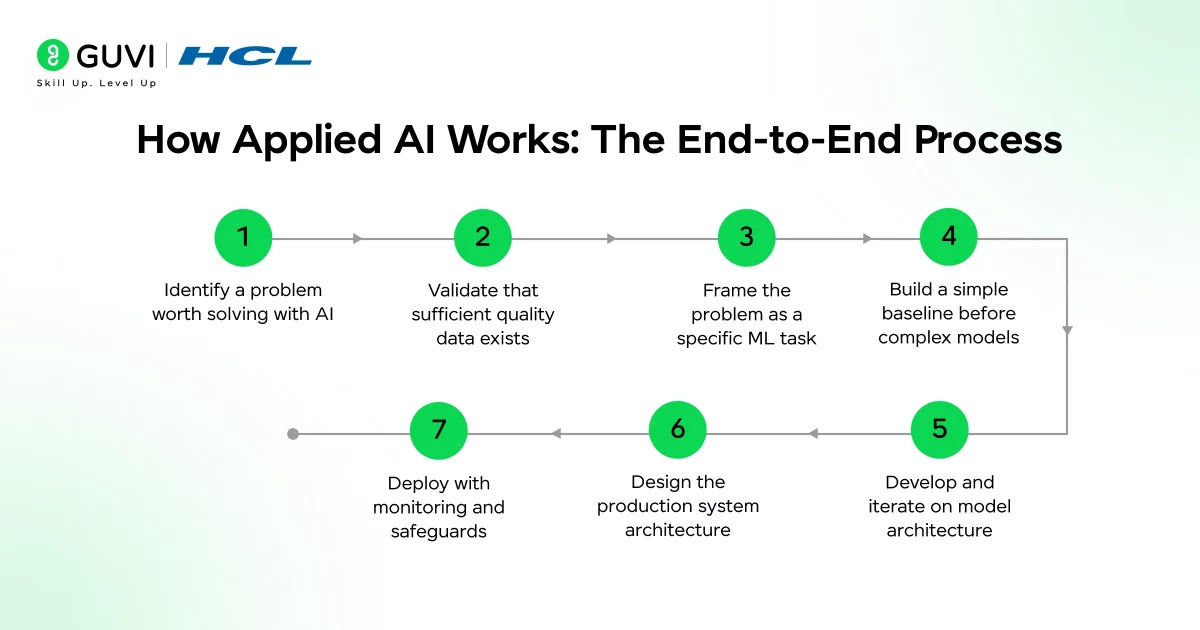
Step 1: Identify a problem worth solving with AI
Not every problem needs AI. Applied AI starts by finding problems where machine learning provides meaningful advantages over traditional solutions. Good candidates involve pattern recognition in large datasets, decisions that need to scale beyond human capacity, or tasks where optimal rules are too complex to code manually. Bad candidates include problems with insufficient data, requirements for perfect accuracy, or situations where simple rule-based systems work fine.
Step 2: Validate that sufficient quality data exists
Before building anything, confirm you can access the data needed to train and evaluate models. Check the data volume, label quality, feature coverage, and whether the data actually contains signal related to what you are trying to predict. Many applied AI projects fail not because of bad models but because the necessary data does not exist or is too expensive to collect.
Step 3: Frame the problem as a specific ML task
Translate the business problem into a technical machine learning formulation. Is this classification, regression, clustering, ranking, or generation? What exactly are you predicting? What are the input features and target outputs? Clear problem framing determines which techniques are applicable and how you will measure success.
Step 4: Build a simple baseline before complex models
Start with the simplest possible approach that could work. For classification, try logistic regression. For time series, try moving averages. This baseline establishes a performance floor and helps you understand the data. If a simple model performs well, you might not need anything more complex. If it performs terribly, you learn what signal is missing.
Step 5: Develop and iterate on model architecture
Now experiment with more sophisticated techniques appropriate to your problem. Try gradient boosting, neural networks, or ensemble methods. Focus on the models that match your data type and problem structure. For tabular data, tree-based models often win. For images, use convolutional networks. For sequences, use transformers. Match the technique to the task.
Step 6: Design the production system architecture
Determine how the model fits into your broader system. Will it run in batch mode processing data overnight, or does it need to serve real-time predictions? How will it integrate with existing databases and services? What happens if the model fails? Applied AI requires thinking about the entire system, not just the model in isolation.
Step 7: Deploy with monitoring and safeguards
Launch the system with comprehensive monitoring of model performance, data quality, system health, and business metrics. Implement safeguards like confidence thresholds, human review for low-confidence predictions, and automatic alerts when behavior deviates from expectations. Plan for graceful degradation if the AI component fails.
One of the earliest AI programs, Logic Theorist, was developed by Allen Newell, Herbert Simon, and Cliff Shaw in the mid-1950s and was showcased around the time of the historic Dartmouth Conference in 1956, the event often considered the birth of artificial intelligence as a field. Logic Theorist could prove mathematical theorems and demonstrated that machines could perform tasks previously associated with human reasoning. Despite these early breakthroughs, widespread business adoption of AI did not occur until the 2010s, when advances in big data, cloud computing, powerful GPUs, and deep learning made AI systems practical and scalable for real-world applications.
Critical Success Factors for Applied AI Projects
- Data quality determines everything
The quality of your training data sets an upper bound on model performance. No algorithm can overcome fundamentally bad data. Garbage in, garbage out is absolutely true in applied AI. Invest heavily in data collection, cleaning, and validation. If your data has systematic biases, your model will learn and amplify those biases. If your labels are wrong, your model will learn the wrong patterns.
- Clear success metrics aligned with business goals
Define exactly how you will measure whether the AI system is working. These metrics must connect to actual business outcomes, not just ML performance statistics. A fraud detection system might optimize for catching fraudulent transactions while minimizing false positives that annoy legitimate customers. Both matter for business success even if only the first is a traditional ML metric.
- Domain expertise integrated throughout development
The best applied AI systems are built by teams that combine ML expertise with deep domain knowledge. Data scientists need to work closely with domain experts who understand the problem, the data sources, the edge cases, and the context where predictions will be used. Models built in isolation from domain knowledge often optimize for the wrong things.
- Realistic expectations about what AI can and cannot do
Applied AI works best for tasks with inherent uncertainty where good-enough predictions at scale create value. It does not work for problems requiring perfect accuracy, full explainability of every decision, or handling of extremely rare edge cases. Set realistic expectations about performance, limitations, and ongoing maintenance requirements before committing resources.
- Infrastructure for continuous model maintenance
Production AI models degrade over time as the world changes. Applied AI requires infrastructure for monitoring model performance, detecting data drift, retraining models with fresh data, and safely deploying updated versions. This is not a one-time project but an ongoing operational commitment. Budget for long-term maintenance from the start.
- User trust and adoption strategies
The best AI system is useless if people do not use it or trust it. Applied AI requires thinking about user experience, explaining predictions when necessary, and designing interfaces that help users make better decisions with AI assistance. Consider how you will build user confidence and handle the inevitable cases where the model is wrong.

Want to understand applied AI in Generative AI systems? Download HCL GUVI’s free Generative AI ebook to master core concepts, practical safeguards, and real-world implementation strategies.
How to Implement Applied AI: Step-by-Step Process
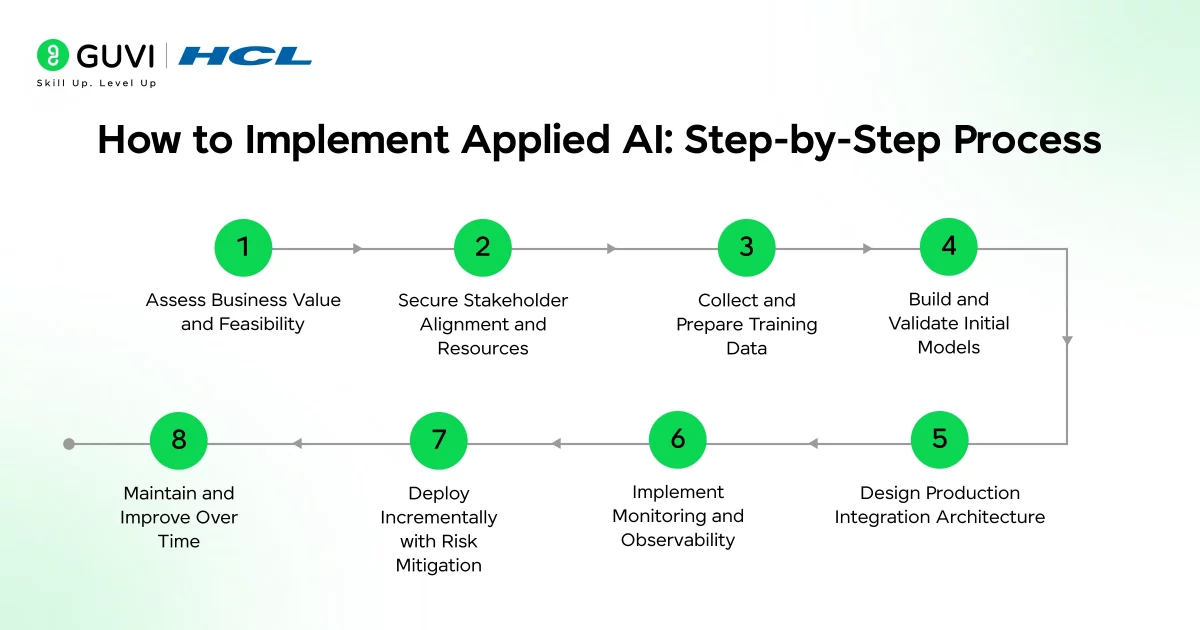
Here is exactly how to take an AI project from initial concept to production deployment.
Step 1: Assess Business Value and Feasibility
Determine if AI is the right solution before investing resources
Start by estimating the potential business impact if the AI system works as hoped. What processes will it improve? How much time or money will it save? What new capabilities will it enable? Then assess technical feasibility by checking data availability, problem difficulty, and resource requirements. Many problems that seem perfect for AI turn out to lack sufficient data or have simple rule-based solutions that work better.
Step 2: Secure Stakeholder Alignment and Resources
Get organizational buy-in before technical work begins
Applied AI projects fail more often from organizational issues than technical problems. Ensure stakeholders understand what AI can realistically deliver, the timeline for seeing results, and the resources required. Get commitment for data access, engineering support, and ongoing maintenance. Clarify who will use the system and how success will be measured.
Step 3: Collect and Prepare Training Data
Data preparation takes 80% of the time in applied AI projects
Gather all relevant data sources and assess quality. Clean the data by handling missing values, removing duplicates, and fixing formatting inconsistencies. Create training labels either from historical outcomes or through manual annotation. Split data into training, validation, and test sets that reflect how the model will be used in production. Document all data transformations and assumptions.
Step 4: Build and Validate Initial Models
Start simple and add complexity only when justified
Implement baseline models first to establish performance floors. Then experiment with more sophisticated approaches, systematically testing which techniques work best for your specific problem and data. Use proper cross-validation to estimate real-world performance. Focus on metrics that align with business goals, not just standard ML metrics. Investigate failure cases to understand model limitations.
Step 5: Design Production Integration Architecture
Plan how AI fits into existing systems and workflows
Determine the deployment architecture based on latency requirements, scale, and integration points. Will the model run as a microservice, be embedded in an application, or process data in batch jobs? Design APIs or interfaces for other systems to consume predictions. Plan for model versioning, A/B testing, and rollback capabilities. Consider security, privacy, and compliance requirements.
Step 6: Implement Monitoring and Observability
Production AI requires comprehensive monitoring of multiple layers
Instrument the system to track model performance metrics, data quality indicators, prediction distributions, and business outcomes. Set up alerts for anomalies like sudden accuracy drops, data distribution shifts, or system errors. Log predictions with enough context to debug issues. Build dashboards that make model behavior visible to both technical teams and business stakeholders.
Step 7: Deploy Incrementally with Risk Mitigation
Reduce deployment risk through gradual rollout strategies
Start with a limited deployment to a small user segment or low-risk use case. Monitor closely and validate that the system performs as expected in real-world conditions. Use shadow mode where the AI makes predictions but humans make final decisions initially. Gradually increase the system’s scope and autonomy as confidence builds. Have a rollback plan ready if problems emerge.
Step 8: Maintain and Improve Over Time
Production AI is never finished, it requires ongoing attention
Schedule regular model retraining as new data becomes available. Monitor for data drift and model degradation. Collect feedback from users and investigate prediction errors. Update models as business requirements evolve or new techniques become available. Budget time for ongoing maintenance, not just initial development. Applied AI is an operational commitment, not a one-time project.
Industry studies have consistently found that only a minority of AI projects successfully transition from prototype to full-scale production. Surprisingly, the biggest obstacles are often not the machine learning algorithms themselves but organizational challenges such as poor problem selection, low-quality data, lack of stakeholder support, unclear business objectives, and insufficient planning for deployment, monitoring, and maintenance. This highlights an important lesson in applied AI: building the model is often only a small part of the overall effort, while integration, governance, and operational execution determine whether an AI initiative ultimately delivers real business value.
Real-World Applications of Applied AI Across Industries
- Healthcare: Diagnostic assistance and treatment optimization
AI systems analyze medical images to detect tumors, fractures, and abnormalities with accuracy comparable to radiologists. Predictive models identify patients at high risk for readmission or complications, enabling preventive interventions. Drug discovery platforms use AI to screen millions of compounds and predict which are most likely to become effective treatments. These applications save lives and reduce healthcare costs.
- Finance: Fraud detection and risk assessment
Banks deploy real-time fraud detection systems that analyze transaction patterns to flag suspicious activity within milliseconds. Credit scoring models assess default risk using alternative data sources beyond traditional credit history. Algorithmic trading systems execute trades based on market pattern recognition. Applied AI in finance processes billions of transactions while adapting to evolving fraud tactics.
- Retail: Personalization and inventory optimization
Recommendation engines personalize product suggestions for millions of customers simultaneously, driving significant revenue increases. Demand forecasting systems predict future sales to optimize inventory levels and reduce waste. Dynamic pricing algorithms adjust prices in real time based on demand, competition, and inventory. Computer vision systems enable cashierless stores where customers simply take items and walk out.
To learn more about applied AI and how to implement machine learning solutions in real-world contexts, do not miss the chance to enroll in this HCL GUVI’s AI and Machine Learning course covering AI fundamentals, practical implementation, deployment strategies, and production best practices through hands-on projects and expert guidance with certification.
Conclusion
Applied AI is about making artificial intelligence work in the real world where data is Applied AI is about making artificial intelligence work in the real world where data is messy and business value matters more than academic benchmarks. It requires combining machine learning expertise with software engineering, domain knowledge, and practical problem-solving.
The most successful projects start with clear business problems, validate data early, and plan for long-term maintenance. Applied AI is not about using the most advanced algorithms but using the right techniques to solve real problems reliably at scale. A simple model in production delivering business value beats a sophisticated model that never leaves development.
Focus first on fundamentals like data quality, clear problem framing, and operational infrastructure. ML modeling is often the easiest part. Everything around it determines success or failure.
FAQs
1. What skills do I need to work in applied AI?
You need machine learning fundamentals combined with software engineering skills. Data engineering experience is essential for handling real-world data. Understanding system design, APIs, and cloud infrastructure matters significantly. Applied AI is about building reliable production systems, not advancing research.
2. How is applied AI different from data science?
Applied AI focuses on deploying ML models in production. Data science is broader, including analysis and reporting. Applied AI emphasizes engineering and maintenance. Data scientists build prototypes, applied AI engineers scale them in production.
3. When should I use AI versus traditional software?
Use AI for pattern recognition in large datasets or tasks where rules are too complex to code. Use traditional software for problems with clear rules, perfect accuracy needs, or when explainability is critical.
4. How do I measure ROI for applied AI projects?
Identify specific business metrics like reduced costs or increased revenue. Measure baseline performance before deployment. Track metrics after and compare value created against full costs including development and maintenance.
5. What percentage of AI projects fail in production?
Studies suggest 80% fail to reach production or deliver expected value. Common reasons include poor problem selection, insufficient data quality, and inadequate deployment planning. Success requires addressing organizational challenges, not just technical ones.
Success Stories

About the Author
Vishalini Devarajan
An Aerospace Engineer turned content writer, I focus on making complex concepts easy to understand through well-structured, reader-friendly blogs. Whether it’s a technical topic or a non-technical one, I love creating content that is clear, engaging, and impactful.
View all posts by Vishalini Devarajan
Connect with me @







Did you enjoy this article?