


Artificial Intelligence and Machine Learning Articles
Finance Manager to Data Analytics: Career Growth, Salary and Seniority
How to Evaluate LLM Outputs in Production Deployments
AI/ML Skills Gap 2026: Why Companies Can't Find Job-Ready Talent
20 AI/ML Interview Questions Recruiters Can Use Without a Tech Background - Best Guide


Get In Touch For Details! Request More Information
How Much ML is Needed for Data Analysis?
Oct 31, 2025 6 Min Read 1293 Views
(Last Updated)
How much of today’s decision-making truly depends on human judgment alone? Every industry now runs on data that grows faster than it can be manually analyzed. Patterns once visible through charts or summaries now hide within millions of rows and thousands of variables. This challenge has turned machine learning into the foundation of modern data analysis.
To understand how ML shapes analysis and where it delivers the greatest impact, read the complete blog!
- 45% of a data scientist’s time goes into preparing and cleaning data before modeling begins.
- 8% of organizations using ML report higher decision accuracy and stronger operational efficiency.
- 42% of large enterprises have exceeded profit expectations after adopting machine learning systems.
Table of contents
- Why Machine Learning Is Important for Data Analysis?
- Determining How Much Machine Learning Is Needed in Data Analysis
- Assess the Analytical Objective Before Applying ML
- Match ML Depth to Data Availability
- Determine ML Investment Based on Decision Frequency
- Align ML Use with Infrastructure and Skill Capacity
- Establish a Scalable Threshold for ML Expansion
- Top Tools for Applying Machine Learning in Data Analysis
- Python Ecosystem
- R Environment
- Cloud-Based ML Platforms
- Visualization and Monitoring Tools
- Automated Machine Learning Frameworks
- Best Strategies for Applying Machine Learning to Data Analysis
- Maintain Data Quality
- Prevent Data Leakage
- Balance Model Accuracy and Transparency
- Evaluate with Suitable Metrics
- Monitor Bias and Fairness
- Control Overfitting
- Document and Reproduce Work
- Top Applications of Machine Learning in Data Analysis
- Fraud Detection in Financial Transactions
- Diagnostic Support in Healthcare Data Analysis
- Demand Forecasting in Retail and Supply Chains
- Cybersecurity Threat Analysis
- Future Trends in Machine Learning for Data Analysis
- Integration of Explainable AI
- Edge-Based Machine Learning
- Emphasis on Ethical and Responsible ML
- Fusion of ML with Domain-Specific Systems
- Conclusion
- FAQs
- How Do Businesses Decide When to Adopt Machine Learning for Data Analysis?
- Can Small Organizations Benefit from Machine Learning in Data Analysis?
- How Does Machine Learning Support Continuous Improvement in Data Analysis?
Why Machine Learning Is Important for Data Analysis?
Machine learning strengthens data analysis by introducing adaptive methods that identify relationships too complex for manual interpretation. It operates as a branch of artificial intelligence that enables systems to learn patterns directly from data without relying on fixed instructions.
The traditional approach to analysis often struggles with growing data volume and inconsistent formats. Machine learning deals with them by automating pattern recognition and refining prediction accuracy with each data update.
Determining How Much Machine Learning Is Needed in Data Analysis
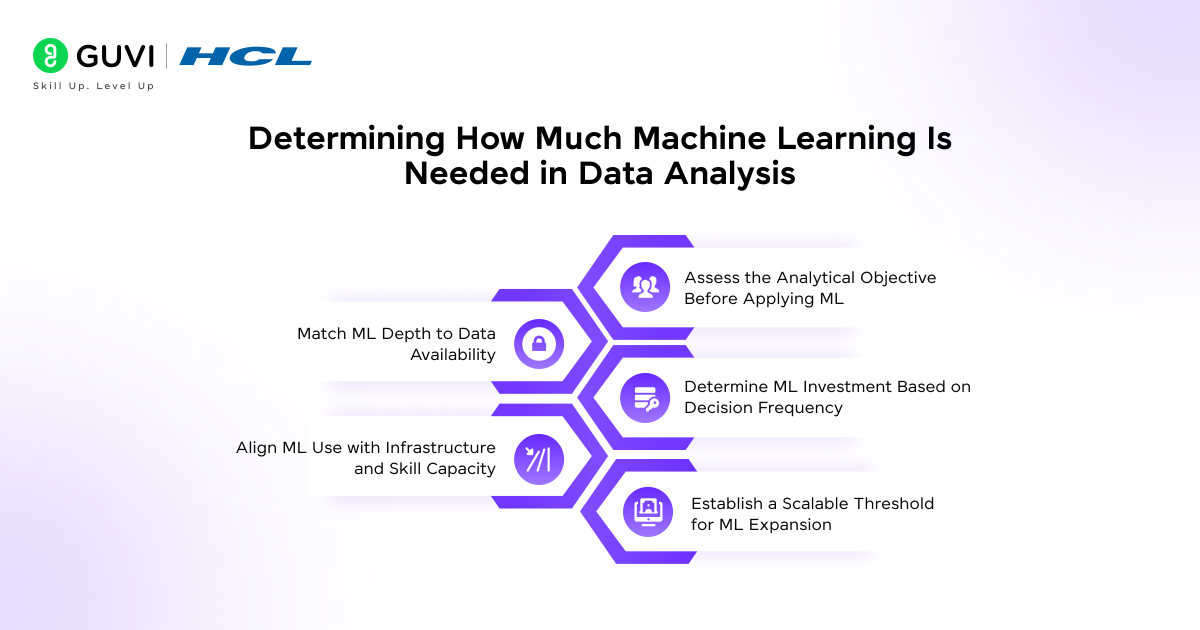
Machine learning supports complex analysis, yet its involvement must match the depth and direction of the project. Too little learning restricts insight, while excessive automation creates opacity and inefficiency. Here is how you can determine the appropriate level of machine learning needed for data analysis:
1. Assess the Analytical Objective Before Applying ML
The first step is identifying whether the problem requires predictive modeling or whether descriptive and diagnostic techniques already meet the need. Machine learning contributes value when relationships between variables remain uncertain or when datasets grow beyond manual interpretation:
- Define the Decision Horizon: Analyses focused on short-term operations, such as tracking monthly demand, often perform well with statistical summaries. Strategic forecasting that depends on evolving data patterns benefits from learning-based models that refine accuracy through exposure to new inputs.
- Evaluate the Value of Prediction: When predictive accuracy directly affects measurable results, ML becomes essential. Analyses meant to describe historical performance rather than forecast future trends often achieve better transparency through classical techniques.
2. Match ML Depth to Data Availability
The degree of learning must align with the foundation the data provides:
- Structured Data Scenarios: Organized datasets with clear variable definitions often yield accurate outcomes through interpretable models. Logistic regression or decision trees deliver balanced results without heavy tuning. Applying deep models in these settings may increase complexity without improving predictive strength.
- Unstructured or High-Dimensional Data: Text, image, or sensor data require greater modeling depth. In these cases, ML translates unorganized signals into measurable features. Advanced architectures process this variety more effectively than linear approaches.
3. Determine ML Investment Based on Decision Frequency
Analytical systems differ in how often they inform decisions. This frequency shapes how much automation is worthwhile and how models must adapt to ongoing changes:
- Static and Periodic Environments: In stable conditions where inputs change slowly, manual updates remain practical. Model retraining may occur at set intervals to maintain alignment with new data. Frequent updates in such cases waste computational resources and complicate validation.
- Continuous and Real-Time Systems: Domains that rely on uninterrupted data flow, such as logistics routing or online risk detection, depend on adaptive ML systems. The value comes from the model’s ability to refresh as patterns evolve. In these scenarios, continuous learning becomes integral rather than optional.
4. Align ML Use with Infrastructure and Skill Capacity
Decisions about how much to automate must consider both computing power and the competence of the analytical team:
- Computational Boundaries: Training large language models on limited servers produces slow iterations and unstable results. Assessing processing capability before selecting architectures prevents wasted effort. Several smaller, specialized models often perform better than one oversized model that exceeds resource limits.
- Team Competence and Maintenance Readiness: Analysts must understand how models learn, adapt, and degrade. When teams have limited expertise, relying on interpretable algorithms maintains accuracy and oversight. The appropriate level of ML is determined by what the organization can maintain without external dependence.
5. Establish a Scalable Threshold for ML Expansion
Scaling ML in measured stages creates stability and traceable improvement over time:
- Incremental Implementation: Begin with focused applications where ML clearly provides stronger outcomes than manual analysis. Once verified, extend similar techniques to additional areas.
- Performance Benchmarking: After each expansion phase, compare the model’s results to established analytical baselines. When accuracy improvements decline despite added complexity, ML has reached its effective limit. Further layers of modeling would consume resources without increasing value.
Top Tools for Applying Machine Learning in Data Analysis
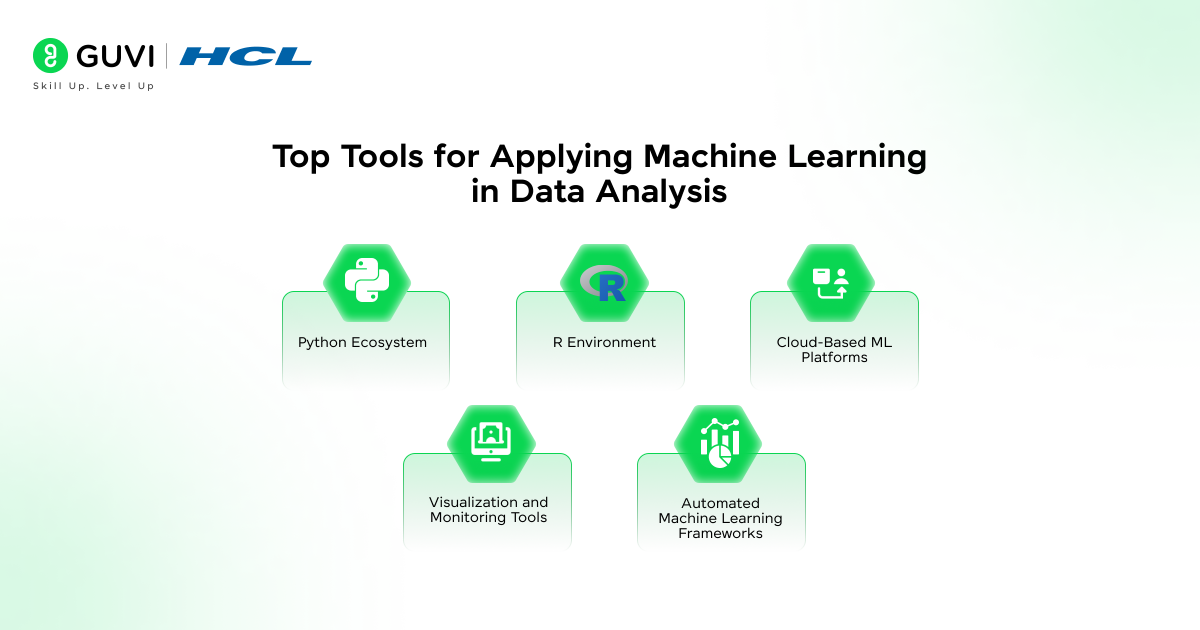
1. Python Ecosystem
Python remains the most widely adopted language for data analysis and ML. Its libraries combine statistical functions, visualization options, and deep learning frameworks within one environment.
- Scikit-learn: Best suited for supervised and unsupervised learning tasks. It supports classification, regression, clustering, and model evaluation with simple integration. Analysts use it for feature scaling, cross-validation, and model comparison.
- TensorFlow: Developed for scalable deep learning applications. It handles numerical computation through efficient dataflow graphs. TensorFlow supports neural network design across CPU and GPU setups, making it suitable for image, text, and time-series data.
- PyTorch: Known for flexibility and strong community support. It provides dynamic computation graphs that allow real-time debugging during model training.
2. R Environment
R excels in statistical modeling and exploratory analysis. It integrates graphical visualization and data manipulation with ML algorithms:
- Caret: A unifying framework that simplifies model training and tuning. It provides consistent syntax for multiple algorithms, allowing analysts to compare model outcomes under the same conditions.
- MLR3: Designed for modular and extensible workflows. It supports pipeline construction, task definition, and benchmark testing. R users employ MLR3 for research-oriented experimentation and reproducible performance tracking.
3. Cloud-Based ML Platforms
Modern organizations rely on cloud tools for scalability and integration with enterprise systems. These platforms handle resource allocation, deployment, and data security within managed environments:
- Google Cloud Vertex AI: Provides automated model training, hyperparameter tuning, and deployment pipelines. It integrates easily with BigQuery for analytical storage and real-time prediction delivery.
- Azure Machine Learning: Offers model lifecycle management from data preparation to deployment. Its visual interface allows drag-and-drop experimentation alongside code-based workflows.
- Amazon SageMaker: Facilitates large-scale training, optimization, and hosting of ML models. It supports automatic scaling for resource-heavy processes and connects directly to cloud-based data warehouses.
4. Visualization and Monitoring Tools
Interpreting and maintaining ML outputs require visualization and monitoring solutions that translate complex model behavior into measurable insights:
- Tableau with Python Integration: Connects visual dashboards with live model outputs. It allows analysts to observe prediction trends while retaining statistical context within the same interface.
- Weights and Biases: Tracks experiments, hyperparameters, and performance metrics. It creates a transparent history of model iterations that helps teams analyze where improvements or errors originated.
5. Automated Machine Learning Frameworks
Automation tools and frameworks reduce manual effort in model selection and parameter adjustment. They serve teams that require consistent accuracy but lack time for extensive tuning:
- H2O.ai: Delivers automated feature engineering and model comparison. It identifies optimal algorithms through structured testing while maintaining reproducibility.
- DataRobot: Focuses on end-to-end automation, from data ingestion to deployment. It suits business teams that need reliable predictions without managing low-level code.
Wondering how much machine learning is just right for impactful data analysis? Turn that curiosity into skill with our Artificial Intelligence & Machine Learning Course with Intel Certification. Learn to build predictive models, automate analytics, and draw powerful insights from data using Python, TensorFlow, and Scikit-learn, all under expert mentorship. Earn your globally recognized Intel-backed certification and transform from a data analyst into an AI-powered decision-maker. Start your learning journey today!

Best Strategies for Applying Machine Learning to Data Analysis
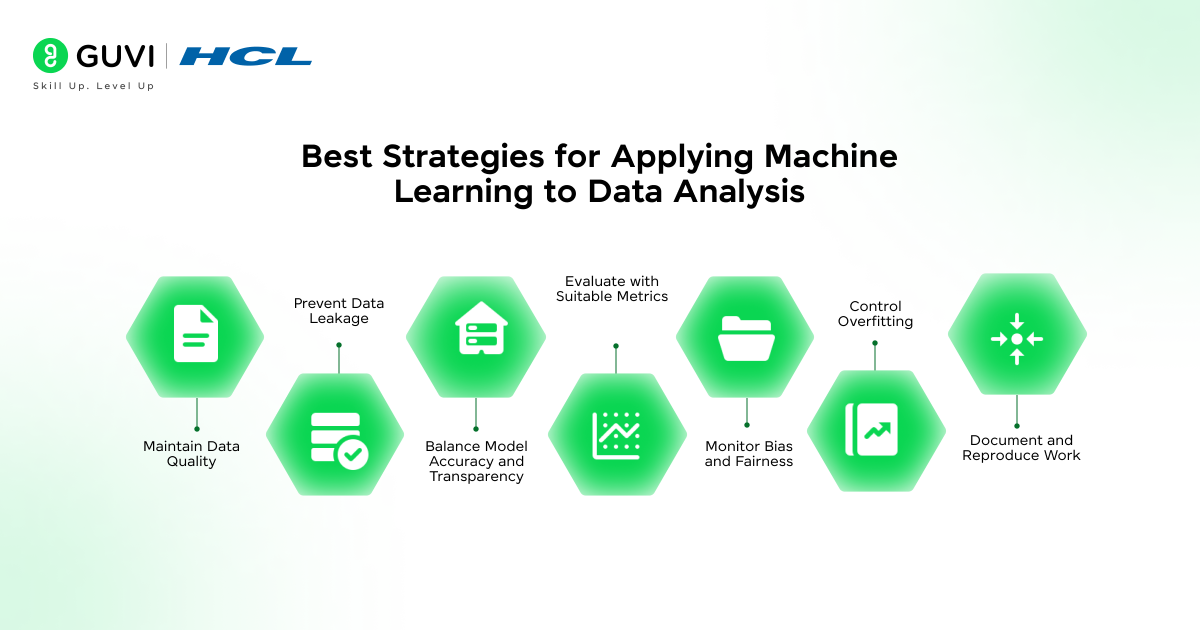
1. Maintain Data Quality
Collected data often contains duplicates and missing values. They are also filled with uncertain and inconsistent formats that weaken model accuracy. Each dataset should pass through structured cleaning and validation before any modeling begins. Statistical checks for outliers and correlation strength reveal early flaws that manual review might miss. Encoding categories and verifying completeness convert raw data into a dependable foundation for learning.
2. Prevent Data Leakage
Data leakage silently breaks validity by exposing future or external information during training. It can occur through improperly joined tables or reused transformation steps. Once leakage enters, accuracy appears high but fails in real use. Creating isolated training, validation, and test partitions at the start avoids this trap. Each preprocessing step must operate only within its assigned partition to maintain independence throughout evaluation.
3. Balance Model Accuracy and Transparency
A highly complex model may reach strong numerical accuracy but obscure the reasoning behind predictions. Simpler models can support faster reviews and clearer communication with decision-makers. The balance between interpretability and precision depends on the problem context. Comparing multiple models under the same data conditions helps reveal where added complexity no longer provides value.
4. Evaluate with Suitable Metrics
Each machine learning task requires metrics aligned with its goal. Classification demands attention to precision and recall, while regression relies on mean absolute error or root mean square error. Overreliance on a single score hides weaknesses that become visible only when comparing results from different perspectives. Evaluation must also include variance checks across multiple runs to confirm consistency.
5. Monitor Bias and Fairness
Bias develops from unbalanced or incomplete datasets. When certain groups appear less often or contain noisier data, predictions skew toward dominant patterns. Detecting this early through fairness reports helps maintain ethical standards and regulatory compliance. Adjusting class weights or collecting more balanced samples corrects structural bias. Regular re-evaluation prevents gradual drift as data updates over time.
6. Control Overfitting
A model that memorizes training data cannot generalize to new information. This occurs when it learns noise instead of a signal. Cross-validation and dropout layers help confirm whether performance remains stable across samples. Monitoring validation curves during training shows the point where additional epochs reduce external accuracy. Periodic retraining with recent data improves adaptability without rebuilding the entire model.
7. Document and Reproduce Work
Comprehensive documentation provides continuity for future analysts and reviewers. It records dataset sources, transformation logic, and model parameters. When issues surface later, well-kept records make replication possible. Documentation also improves accountability across distributed teams.
Top Applications of Machine Learning in Data Analysis
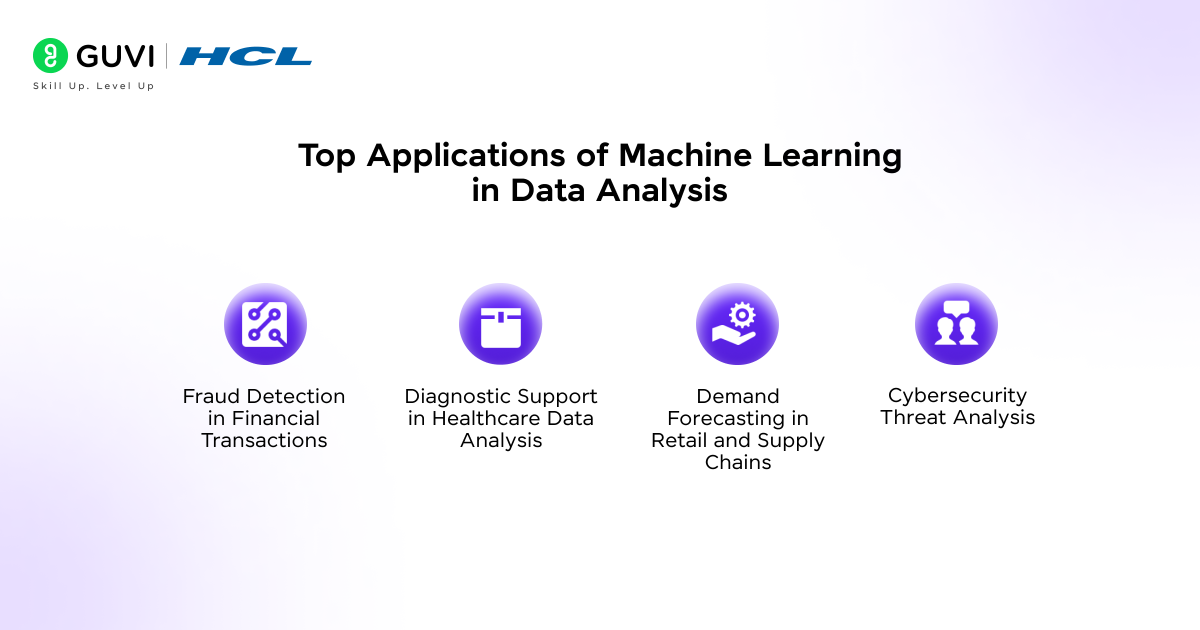
1. Fraud Detection in Financial Transactions
Financial institutions rely on ML models to identify suspicious activities across millions of transactions. Algorithms evaluate features such as transaction frequency, amount distribution, and device location patterns. Models adapt to new fraud behaviors faster than rule-based systems. They also maintain accuracy as transaction data grows, allowing real-time risk assessment that strengthens security without manual review of every case.
2. Diagnostic Support in Healthcare Data Analysis
Healthcare organizations apply ML to analyze medical images and patient histories. Algorithms trained on verified cases identify patterns associated with disease progression or early symptoms. These systems support clinicians by providing probability estimates that guide further investigation. Their strength lies in processing high-dimensional medical data while retaining accuracy under strict validation.
3. Demand Forecasting in Retail and Supply Chains
Retailers and logistics providers depend on ML for inventory planning and distribution management. Models study sales data, seasonal changes, and regional factors to forecast product demand. They also detect anomalies caused by external influences such as market trends or climate variation. Accurate forecasting helps reduce overstocking and shortages.
4. Cybersecurity Threat Analysis
Security systems use ML to detect abnormal network behavior that signals intrusion attempts. Models analyze packet flows and endpoint activity to establish a baseline of safe operation. When deviations occur, alerts trigger rapid investigation before damage spreads. Continuous learning enables adaptation to new attack strategies and provides protection that grows with threat complexity.
Future Trends in Machine Learning for Data Analysis
1. Integration of Explainable AI
Transparency in model reasoning will remain a central requirement. Explainable AI tools present structured insight into how variables influence predictions. Analysts and decision-makers use these explanations to confirm that model logic aligns with domain knowledge. This approach strengthens accountability and improves acceptance of ML-driven conclusions in regulated environments.
2. Edge-Based Machine Learning
Processing data closer to its source will become more common. Edge ML enables local inference without constant dependence on cloud infrastructure. This reduces latency and strengthens data privacy. Industries that handle continuous sensor input, such as manufacturing and transportation, benefit from faster decision cycles supported by on-device models.
3. Emphasis on Ethical and Responsible ML
Ethical data handling will shape every stage of model development. Bias detection, fairness scoring, and traceable model lineage will become standard components of analytical governance. Teams will evaluate datasets for representational balance before training begins. Responsible ML practice will move from regulatory compliance to operational necessity.
4. Fusion of ML with Domain-Specific Systems
Future ML applications will blend analytical intelligence with industry workflows. Healthcare models will integrate with electronic records for early diagnosis. Finance systems will combine ML scoring with compliance validation. In each case, learning models will adapt to the operational environment rather than functioning as external analytical tools.
Conclusion
Machine learning has become an essential extension of data analysis rather than an optional enhancement. Although the real value lies in applying the right amount of learning to each analytical need, supported by quality data and responsible implementation. The integration of ML will define how efficiently they interpret complex information and convert it into practical action as organizations continue to expand their analytical capabilities.
FAQs
1. How Do Businesses Decide When to Adopt Machine Learning for Data Analysis?
Businesses adopt machine learning when data volume and complexity exceed what traditional analysis can manage. Before adoption, organizations evaluate data readiness, infrastructure strength, and team capability to confirm that machine learning will improve both speed and accuracy without creating operational strain.
2. Can Small Organizations Benefit from Machine Learning in Data Analysis?
Small organizations benefit when ML is applied with focus rather than scale. Using open-source frameworks and cloud-based platforms reduces cost barriers while providing access to powerful modeling tools. Starting small with targeted objectives builds internal understanding and sets a foundation for gradual and controlled expansion.
3. How Does Machine Learning Support Continuous Improvement in Data Analysis?
Machine learning supports improvement by learning from new data over time. Each update upgrades pattern recognition and corrects earlier inaccuracies. Continuous retraining aligns models with current conditions, providing that predictions remain reliable even as input behavior shifts.
Success Stories

About the Author
Vaishali
I'm a seasoned writer with four years of experience across technical, non-technical, and just about every genre or niche you can imagine. Adaptable and curious, I enjoy exploring new topics and making information engaging and easy to understand. Fueled by a steady stream of tea, I approach each project with creativity, reliability, and genuine enthusiasm for storytelling.
View all posts by Vaishali
Connect with me @


















Did you enjoy this article?