


Artificial Intelligence and Machine Learning Articles
CI/CD Pipelines for Machine Learning Projects
A/B Testing for Machine Learning Models
Canary Deployment Strategies for ML Models
What is Model Drift Detection: Keeping Models Accurate in Production


Get In Touch For Details! Request More Information
Learning Rate in Machine Learning: The Core of AI Training
Jun 17, 2026 4 Min Read 691 Views
(Last Updated)
Every machine learning model learns through trial and error. The model makes predictions, checks mistakes, and updates itself repeatedly during training.
The learning rate controls how big those updates should be. A small change in this setting can decide whether a model learns smoothly or struggles completely.
In this article, we will learn what a learning rate is, why it matters in machine learning, how it works with gradient descent, and how modern AI systems use it for efficient training.
Table of contents
- TL;DR
- Why Learning Rate Matters in AI Training
- A Simple Real World Analogy
- How Learning Rate Works with Gradient Descent
- What Happens When the Learning Rate is Too High?
- What Happens When the Learning Rate is Too Low?
- Learning Rate and Convergence
- Why Learning Rate Becomes More Important in Deep Learning
- Adaptive Learning Rate Optimizers
- Adam Optimizer
- RMSProp
- AdaGrad
- Learning Rate Scheduling
- Practical Python Example
- How AI Engineers Tune Learning Rates
- Monitoring Loss Curves
- Using Learning Rate Schedulers
- Testing Multiple Values
- Learning Rate and Overfitting
- Real World Applications of Learning Rate Optimization
- Common Beginner Mistakes
- Using Extremely High Learning Rates
- Ignoring Validation Metrics
- Copying Hyperparameters Blindly
- Conclusion
- FAQs
- What is the learning rate in machine learning?
- Why is the learning rate important?
- What happens if the learning rate is too high?
- What happens if the learning rate is too low?
- What are adaptive learning rate optimizers?
- Is learning rate tuning necessary in deep learning?
TL;DR
- Learning rate controls how much a machine learning model updates itself during training.
- A high learning rate can make training unstable, while a low one can slow learning dramatically.
- Learning rate works closely with gradient descent, backpropagation, and neural network optimization.
- Modern AI systems use adaptive optimizers like Adam and RMSProp for smarter learning rate control.
- Proper learning rate tuning improves convergence, model accuracy, and training efficiency.
- From ChatGPT to recommendation systems, almost every advanced AI model depends on effective learning rate strategies.
What is the Learning Rate in Machine Learning?
The learning rate in machine learning is a hyperparameter that determines how much a model updates its weights after each training step. It controls the speed and stability of the learning process during optimization. A well-tuned learning rate helps models train efficiently, converge smoothly toward the optimal solution, and achieve better accuracy without becoming unstable or overshooting the target.
Why Learning Rate Matters in AI Training
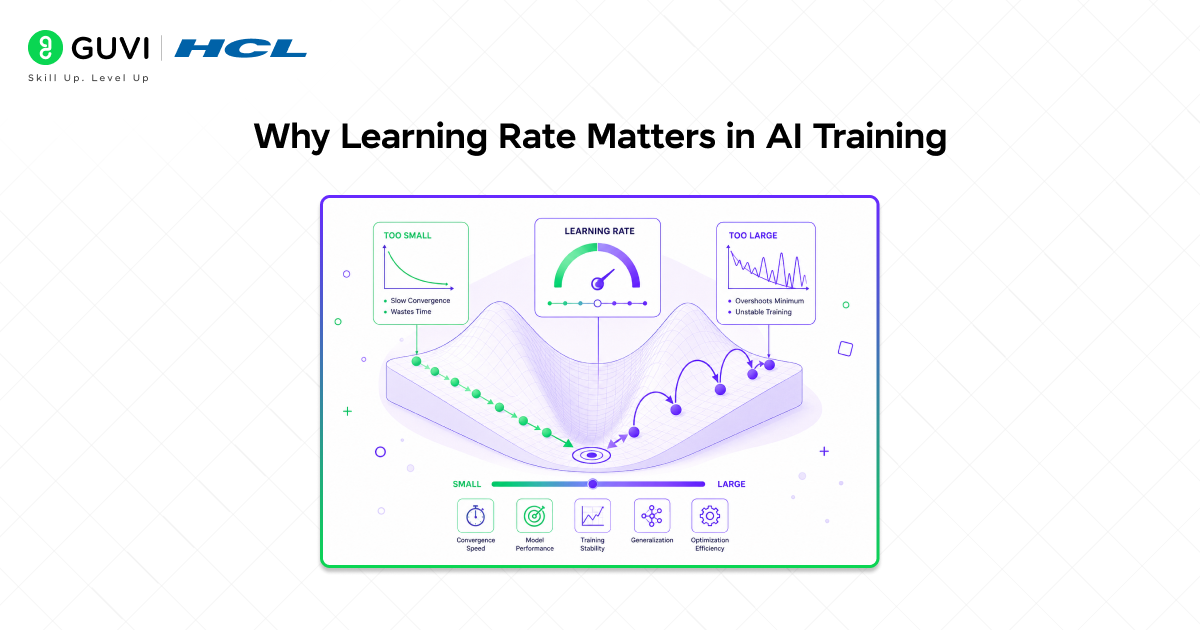
During training, machine learning models continuously update their internal weights to reduce prediction error.
The update process follows this equation:
W(new) = W(old) − η ∇L
Here:
- W represents model weights.
- η (eta) represents the learning rate.
- ∇L represents the gradient of the loss function.
The learning rate decides how aggressively the model moves toward the optimal solution.
If the updates are too large, training becomes unstable. If they are too small, the model learns extremely slowly.
This is why the learning rate directly affects:
- Training speed.
- Convergence quality.
- Optimization stability.
- GPU training cost.
- Final model accuracy.
A Simple Real World Analogy
Imagine trying to reach the bottom of a hill in thick fog.
- Huge steps may cause you to miss the safe path completely.
- Tiny steps may take forever to reach the bottom.
- Balanced steps help you move steadily and safely.
Learning rate works exactly like this in machine learning.
The model continuously searches for the point with the lowest error, while the learning rate controls the size of each step.
How Learning Rate Works with Gradient Descent
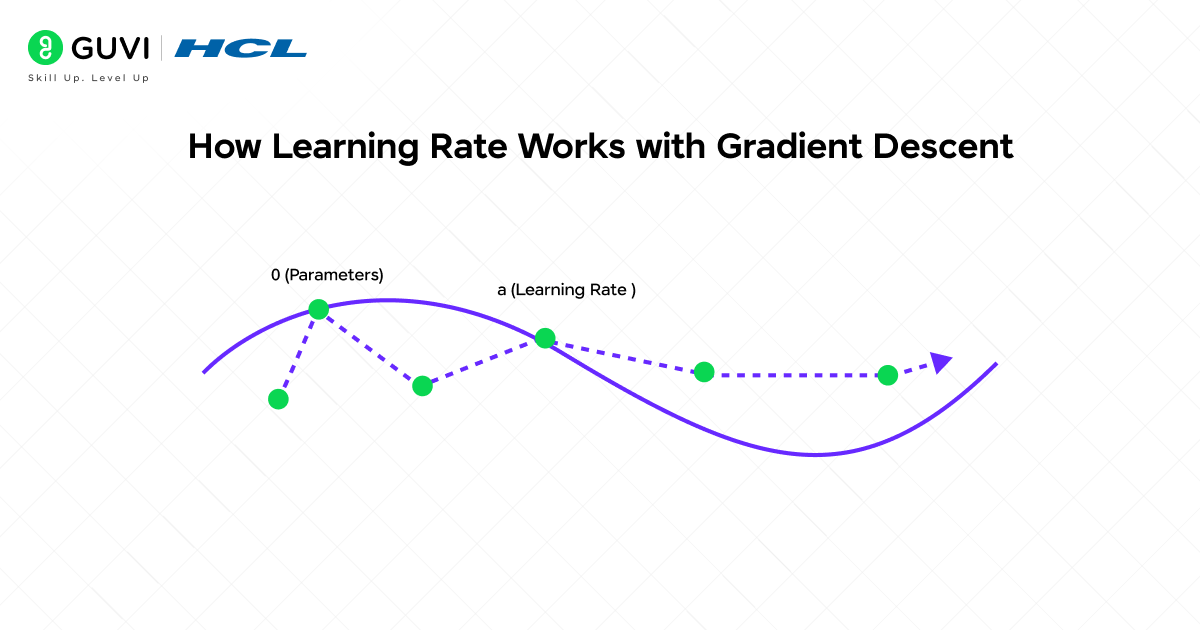
Gradient descent is one of the core optimization algorithms in machine learning and deep learning.
The process usually works like this:
- The model receives input data.
- It generates predictions.
- The loss function measures prediction error.
- Backpropagation calculates gradients.
- Gradient descent updates weights using the learning rate.
- The cycle repeats until convergence.
Without a learning rate, gradient descent would not know how much to adjust the model during training.
To understand how models reduce prediction errors step by step, you can also explore Gradient Descent in Machine Learning.
What Happens When the Learning Rate is Too High?
A high learning rate may initially look fast and efficient. However, it often creates unstable optimization behavior.
Instead of moving smoothly toward the minimum error point, the model keeps jumping around it.
This usually causes:
- Oscillating loss values.
- Failed convergence.
- Sudden spikes during training.
- Poor final accuracy.
Example
Imagine training a neural network for handwritten digit recognition.
If the learning rate is set too high, the accuracy may improve briefly and then suddenly collapse because the model overshoots the optimal solution repeatedly.
What Happens When the Learning Rate is Too Low?
Very small learning rates create the opposite problem.
The model learns extremely slowly because every update becomes tiny.
This can lead to:
- Long training times.
- Wasted computational resources.
- Slow convergence.
- Minimal learning progress.
Example
Suppose a deep learning model normally trains in 2 hours using a balanced learning rate.
With an excessively low learning rate, the same model might take 15 hours while producing nearly identical results.
Training advanced AI models can cost companies millions of dollars in compute resources, yet something as simple as a poorly chosen learning rate can destabilize the entire process within hours by causing the training loss to explode uncontrollably. Because modern neural networks are extremely sensitive to optimization dynamics, research into optimizers, learning rate schedules, and stable training methods has become one of the most important areas in large-scale artificial intelligence development.
Learning Rate and Convergence
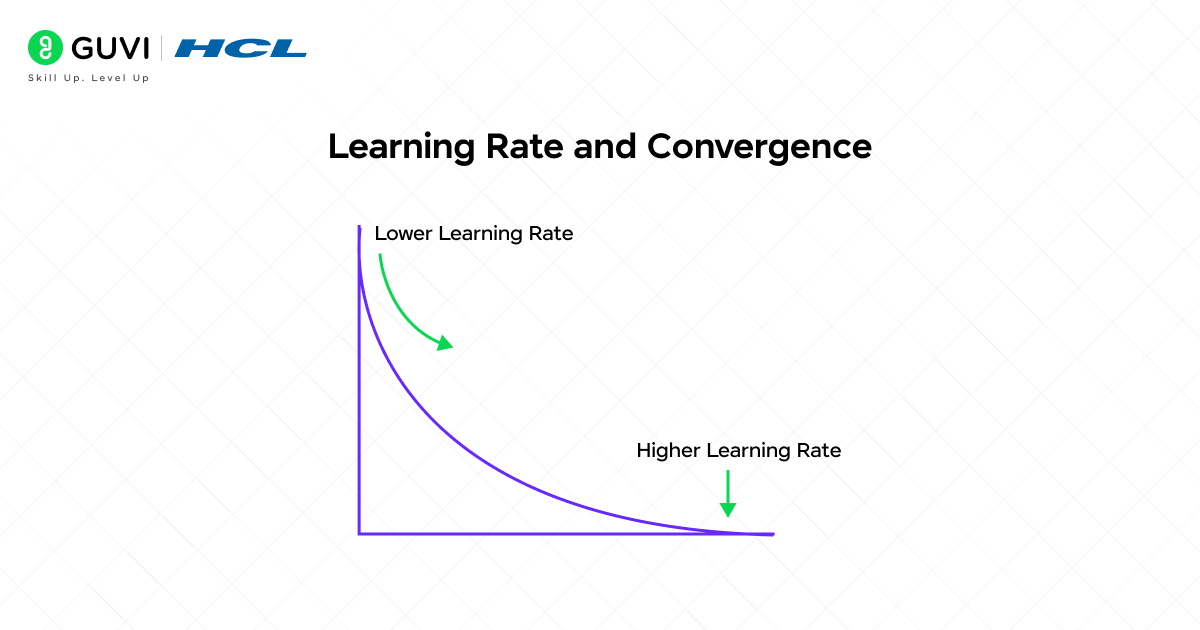
Convergence happens when the model reaches a point where additional training produces very little improvement.
A good learning rate helps the model reach this point smoothly.
When learning rate tuning is correct:
- Loss decreases steadily.
- Accuracy improves consistently.
- Training remains stable.
- Validation performance improves.
Bad learning rates usually create unstable or inefficient convergence patterns.
Why Learning Rate Becomes More Important in Deep Learning
Deep learning models contain millions or even billions of trainable parameters.
During backpropagation, gradients travel through multiple hidden layers while updating weights continuously.
In these massive neural networks, the learning rate becomes extremely sensitive.
A poor learning rate can cause:
- Exploding gradients.
- Unstable optimization.
- Slow training progress.
- Failed model convergence.
This is why deep learning frameworks like TensorFlow and PyTorch include built-in optimization tools.
To understand how AI models learn through hidden layers, you can also explore Deep Learning and Neural Networks in detail.

Adaptive Learning Rate Optimizers
Modern AI systems rarely rely only on fixed learning rates.
Instead, they use adaptive optimizers that automatically adjust learning behavior during training.
Adam Optimizer
Adam is one of the most popular optimizers in deep learning.
It combines momentum and adaptive learning rate techniques to improve training efficiency.
Benefits of Adam include:
- Faster convergence.
- Stable optimization.
- Better deep learning performance.
- Strong results across many AI tasks.
RMSProp
RMSProp dynamically adjusts learning rates using recent gradient information.
It works especially well in sequential learning tasks and recurrent neural networks.
AdaGrad
AdaGrad assigns different learning rates to different parameters.
It performs particularly well in sparse datasets and natural language processing systems.
Learning Rate Scheduling
Using one fixed learning rate throughout training is not always effective.
Modern AI systems often reduce learning rates gradually during optimization. This process is called learning rate scheduling.
Popular scheduling methods include:
- Step decay.
- Exponential decay.
- Cosine annealing.
- Warmup scheduling.
These strategies help models stabilize during later training stages.
Practical Python Example
Here is a simple example of setting a learning rate using TensorFlow.
import tensorflow as tf
optimizer = tf.keras.optimizers.Adam(
learning_rate=0.001
)
In this example:
- Adam handles optimization.
- The learning rate is set to 0.001.
- The optimizer updates neural network weights during training.
Beginners interested in practical AI model training can also explore how to build a neural network using TensorFlow to understand how learning rates work in real deep learning workflows.
How AI Engineers Tune Learning Rates
Learning rate tuning is rarely based on guesswork alone.
Engineers usually monitor training carefully while adjusting optimization settings.
Monitoring Loss Curves
Loss curves reveal whether training is stable or unstable.
Common warning signs include:
- Sudden spikes in loss.
- Oscillating accuracy.
- Extremely slow improvement.
- Validation instability.
Using Learning Rate Schedulers
Dynamic scheduling often performs better than fixed learning rates because optimization needs change throughout training.
Testing Multiple Values
AI engineers frequently experiment with different learning rates before selecting the most stable option.
If you want a deeper understanding of optimization, neural network training, and backpropagation, reading a practical deep learning optimization ebook can help you understand how real AI systems train efficiently at scale.
Learning Rate and Overfitting
Learning rate can also influence generalization quality.
Unstable optimization sometimes causes models to memorize noisy training patterns instead of learning meaningful relationships.
This can contribute to overfitting.
On the other hand, extremely slow optimization may prevent sufficient learning, leading to underfitting.
This is why learning rate tuning often works alongside:
- Dropout.
- Batch normalization.
- Early stopping.
- Weight regularization.
Real World Applications of Learning Rate Optimization
Learning rate optimization plays a major role in modern AI applications, such as:
- Recommendation systems.
- Self-driving vehicles.
- Fraud detection systems.
- Medical AI models.
- Speech recognition.
- Large language models.
Advanced AI systems like ChatGPT rely heavily on sophisticated optimization strategies during training.
Common Beginner Mistakes
Using Extremely High Learning Rates
Many beginners increase learning rates aggressively, hoping for faster results. This often destabilizes training completely.
Ignoring Validation Metrics
Only checking training accuracy can hide optimization problems. Validation performance matters equally.
Copying Hyperparameters Blindly
A learning rate that works perfectly for one model may completely fail for another.
If you want practical experience with neural networks, hyperparameter tuning, deep learning optimization, and AI projects, HCL GUVI’s AI & Machine Learning Course provide structured hands-on learning aligned with real industry workflows.
Conclusion
Learning rate may look like a tiny hyperparameter, but it has an enormous influence over machine learning performance.
It controls how models learn, optimize, and converge during training. Even advanced neural networks can fail because of poor learning rate selection.
Modern AI systems depend heavily on adaptive optimizers, learning rate scheduling, and careful hyperparameter tuning to maintain stable training behavior.
As artificial intelligence models continue becoming larger and more complex, understanding learning rate optimization will remain one of the most valuable skills in machine learning engineering.
FAQs
1. What is the learning rate in machine learning?
Learning rate is a hyperparameter that controls how much a model updates its weights during training.
2. Why is the learning rate important?
It affects training speed, convergence stability, optimization quality, and final model accuracy.
3. What happens if the learning rate is too high?
The model may overshoot the optimal point, oscillate, or fail to converge properly.
4. What happens if the learning rate is too low?
Training becomes extremely slow, and the model may take much longer to learn.
5. What are adaptive learning rate optimizers?
Optimizers like Adam, RMSProp, and AdaGrad automatically adjust learning behavior during training.
6. Is learning rate tuning necessary in deep learning?
Yes. Proper learning rate tuning is one of the most important parts of successful neural network training.
Success Stories

About the Author
Vishalini Devarajan
An Aerospace Engineer turned content writer, I focus on making complex concepts easy to understand through well-structured, reader-friendly blogs. Whether it’s a technical topic or a non-technical one, I love creating content that is clear, engaging, and impactful.
View all posts by Vishalini Devarajan
Connect with me @









Did you enjoy this article?