


Full Stack Development Articles
Best Full Stack Development Training Programs for Career Switchers
Best Full Stack Developer Courses for Working Professionals in India
From Manual Operations to Fullstack Development : A Career Transition Guide
How Can a Software Maintenance Engineer Move into Modern Application Development?


Get In Touch For Details! Request More Information

Full-Stack Development in 2026: Is It Still Worth Learning in a Saturated Market?
Nov 19, 2026 5 Min Read 3962 Views
(Last Updated)
Scroll through any developer forum and you will find the same worried question: is full-stack dead? With AI tools writing code and thousands of new learners entering the market every year, the fear makes sense.
Here is the short answer. Full-stack development is not dead in 2026, but the definition of a job-ready full-stack developer has changed. Knowing one frontend framework, one backend framework and basic database operations is no longer enough to stand out.
In this blog, we will look at why the market feels saturated, bust 6 common myths, check what AI is really changing, review India salaries, and share a 90-day plan to stay relevant.
Table of contents
- TL;DR Summary
- What Does "Is Full-Stack Dead" Really Mean?
- Why Full-Stack Feels Saturated Today
- Is Full-Stack Dead? Job Market Data vs Reality
- Is Full-Stack Dead or Just Evolving?
- What Companies Now Expect
- The Shift to T-Shaped Developers
- Are Specialists Replacing Full-Stack Developers?
- Will AI Replace Full-Stack Developers?
- Is Full-Stack Dead in India?
- Full-Stack Developer Salaries in India
- Full-Stack vs Other Developer Roles
- Skills to Learn in 2026
- Is the MERN Stack Enough?
- 90-Day Plan to Stay Relevant
- Common Mistakes to Avoid
- Conclusion
- FAQs
- Is full-stack development dead in 2026?
- Is full-stack development a good career in India in 2026?
- Will AI replace full-stack developers?
- What skills should a full-stack developer learn in 2026?
- Is MERN stack enough to get a full-stack developer job?
- Should full-stack developers specialize in one technology?
TL;DR Summary
- What it is: This blog answers “is full-stack dead in 2026?” Short answer: no. Basic full-stack skills are less competitive, but developers with production skills are still in demand.
- What changed: Companies now expect testing, cloud deployment, security and system thinking, not just CRUD apps.
- AI impact: AI speeds up routine coding, but developers still review, debug and own the code.
- Who still wins: T-shaped developers with broad stack knowledge plus one deep specialty.
- Next step: Fill your production skill gaps with the 90-day plan below.
What Does “Is Full-Stack Dead” Really Mean?
Full-stack development means building both the frontend users see and the backend that handles servers, APIs and databases.
When people ask “is full-stack dead,” they mean three things: are there jobs, will AI replace the role, and is it worth learning?
If you want to learn full-stack the way companies now expect, with production projects and AI integration, HCL GUVI’s IITM Pravartak certified Full Stack Development Zen Class covers it end to end.
Why Full-Stack Feels Saturated Today
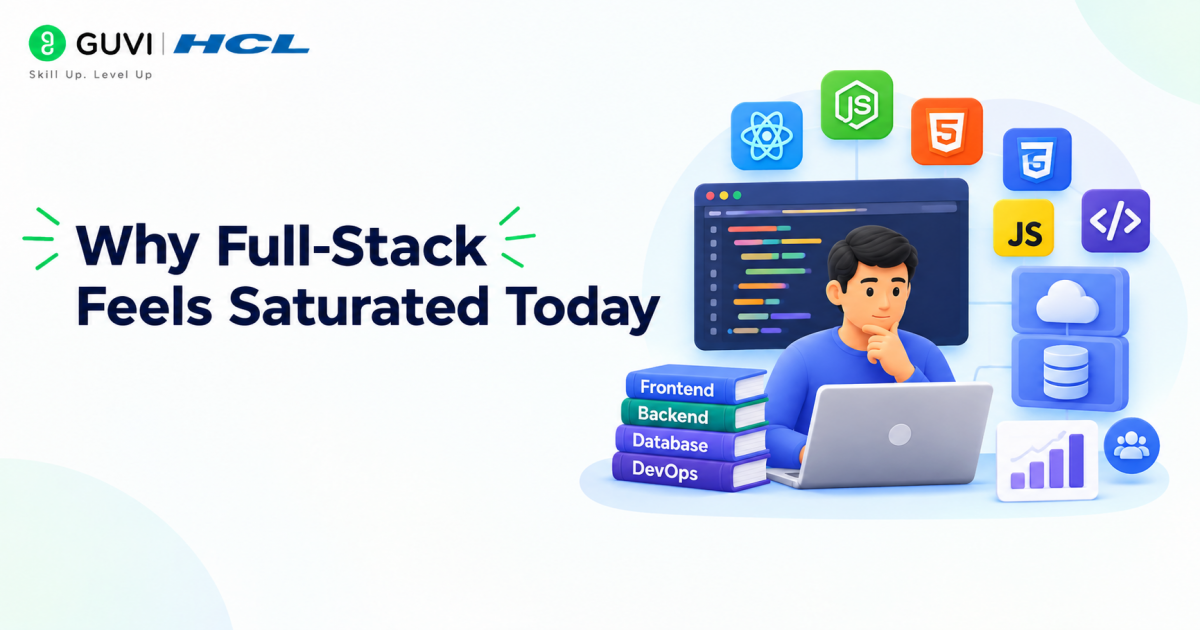
Most of the “is full-stack dead” worry comes from the entry level. Thousands of candidates learn the same React, Node.js, MongoDB and SQL workflows, so recruiters see very similar resumes.
- Rapid growth of entry-level developers: More candidates share the same foundations, increasing competition for junior roles.
- Repetitive portfolio projects: Task managers and e-commerce clones show syntax, but not scalability, security or architecture.
- Low barrier to claiming full-stack skills: Connecting a frontend to an API is often called full-stack, even without testing, deployment or monitoring.
- Lack of production exposure: Many candidates have never handled real authentication, CI/CD pipelines or production incidents.
Tip: Build fewer but stronger full-stack projects that include authentication, tests, deployment and one clear performance challenge.
Is Full-Stack Dead? Job Market Data vs Reality
The “is full-stack dead” debate gets loud online, but the reality is more layered. Here is how 6 common claims hold up:
| Common Claim | What Actually Happens | What It Means for You |
|---|---|---|
| “Full-stack roles are disappearing” | Startups, SaaS firms and Global Capability Centres still hire full-stack developers | Roles exist; competition is real |
| “Companies prefer specialists now” | Large enterprises add specialists, while startups and lean teams favour full-stack developers | Your fit depends on company size |
| “The market is too crowded” | The entry level is crowded; developers with one strong area stand out | Go deep in one skill |
| “Full-stack pays less due to oversupply” | Pay rises clearly with experience (see the salary table below) | Growth comes from skills, not titles |
| “AI is replacing full-stack developers” | Most developers use AI tools, but many distrust the output | Learn to review AI code |
| “The role itself is outdated” | Titles are branching into Full-Stack Software Engineer and AI-integrated roles | The job is evolving, not dying |
Is Full-Stack Dead or Just Evolving?
So, is full-stack dead or just changing? What is losing value is the older definition: someone who knows basic React, Node.js and databases without understanding how systems behave in production. The modern full-stack developer is expected to deliver a complete production feature.
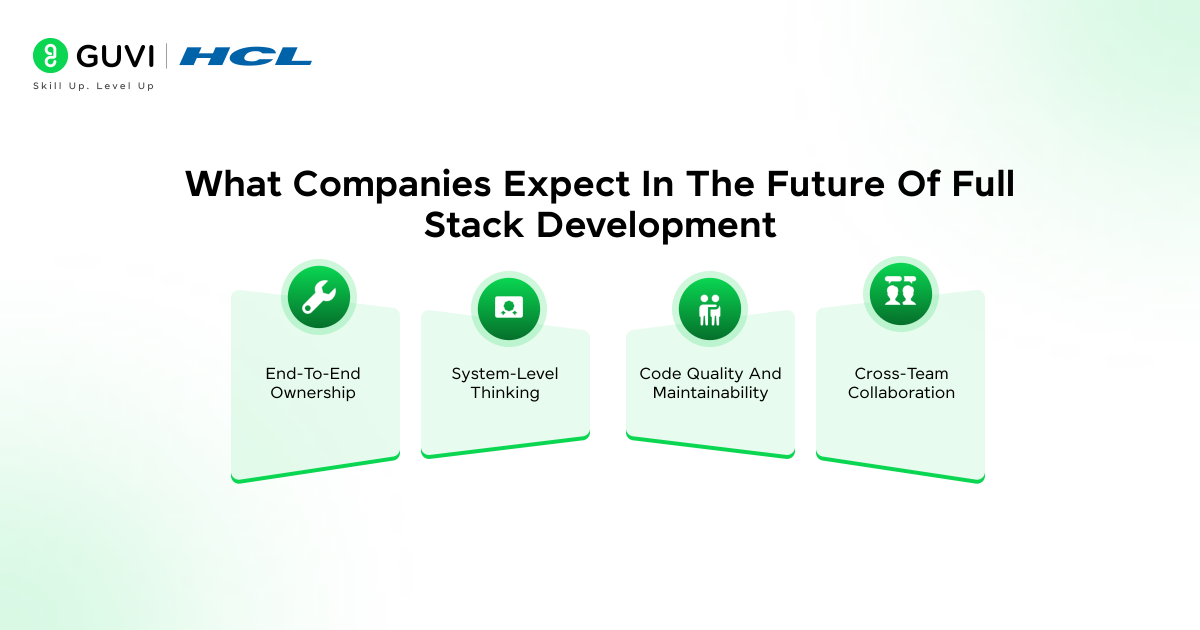
1. What Companies Now Expect
Hiring trends answer the “is full-stack dead” question clearly:
- End-to-end ownership: Design the UI flow, build APIs, model data, test, deploy and support the feature.
- System-level thinking: Understand how frontend choices affect API load and how queries affect latency.
- Production reliability: Work with logging, monitoring, CI/CD and DevOps practices.
2. The Shift to T-Shaped Developers
When people ask whether full-stack is dead, they often confuse the decline of shallow generalists with the decline of the role. The T-shaped model fixes this:
- Horizontal layer: Frontend, backend, databases, APIs, testing, deployment and cloud basics.
- Vertical layer: Deep expertise in one area, such as backend scalability, frontend performance, database optimization or security.
3. Are Specialists Replacing Full-Stack Developers?
Specialist roles are growing, but not everywhere. A platform with millions of users needs dedicated frontend, backend, security and SRE engineers. A smaller SaaS startup prefers one developer who can build, deploy and troubleshoot across layers. Many product teams mix both.
💡 Did You Know?
- Searches for “is full stack dead” increase during hiring slowdowns rather than permanent market shifts.
- The future of full stack development increasingly overlaps with system design and DevOps.
- Developers with production debugging experience are shortlisted faster.
Will AI Replace Full-Stack Developers?
This is the biggest reason people search “is full-stack dead.” The data says AI is changing the workflow, not removing the role.
In the Stack Overflow 2025 Developer Survey, 84% of respondents were using or planning to use AI tools, and 51% of professional developers used them daily. Yet 46% said they don’t trust the accuracy of AI output.
For anyone asking “is full-stack dead” because of AI, here is the split:
| AI Does Well | Developers Still Own |
|---|---|
| Boilerplate and repetitive code | Architecture and system design |
| Test and documentation drafts | Verifying correct and secure code |
| Code explanations | Debugging failures across layers |
| Quick prototypes | Security, performance and production operations |
Learning the right AI tools for developers makes you faster, but your value comes from reviewing and operating software, not just generating it.
Is Full-Stack Dead in India?
Asking “is full-stack dead in India?” usually reflects worries about entry-level competition and AI coding tools. In reality, Indian companies still hire full-stack developers across these areas:

- Startups: Need developers who build UI, APIs, databases and deployments with small teams.
- SaaS companies: Look for skills in multi-tenant apps, authentication and cloud infrastructure.
- Global Capability Centres: Hire for product development, cloud modernization and platform engineering.
So, is full-stack dead in India? No. The market is just more selective.
Full-Stack Developer Salaries in India
| Experience | Salary Range (Annual) |
|---|---|
| Fresher | ₹1 L to ₹12 L |
| 1 year | ₹1.2 L to ₹10 L |
| 2 years | ₹2.2 L to ₹12.9 L |
| 3 years | ₹3 L to ₹16.3 L |
| 4 years | ₹3.5 L to ₹20 L |
Overall, full-stack developers in India earn about ₹1.8 L to ₹15.4 L per year, with top reported salaries much higher. See the full full stack developer salary in India breakdown for city and company data.
Note: Salary figures may change over time as users update their reported data. Please refer to the linked source for the latest salary ranges.
Full-Stack vs Other Developer Roles
Asking “is full-stack dead” before choosing a path? Here’s how it compares:
| Role | Scope | Best For |
|---|---|---|
| Full-stack developer | Frontend, backend, database, deployment | Startups, product teams, feature ownership |
| Frontend developer | UI, performance, accessibility | Design-focused learners |
| Backend developer | APIs, databases, scalability | Logic and systems lovers |
| AI engineer | Models, LLM APIs, data pipelines | Learners strong in maths and Python |
Skills to Learn in 2026
If you are asking “is full-stack dead,” the better question is what to learn. Go deep in one stack, plus the skills that take code to production.
| Area | What to Learn |
|---|---|
| Frontend | JavaScript, TypeScript, React, Next.js |
| Backend | Node.js, Java with Spring Boot, or Python with FastAPI |
| Databases | PostgreSQL or MySQL, plus Redis (SQL vs NoSQL) |
| APIs | REST APIs, auth, webhooks, GraphQL where needed |
| Testing | Unit, integration and end-to-end tests |
| Cloud and DevOps | Docker, AWS or Azure basics, CI/CD |
| AI integration | LLM APIs, embeddings, AI-assisted workflows |
Is the MERN Stack Enough?
MERN is a great base, but on its own it may not be enough for production roles. Add TypeScript, SQL, authentication, testing, Docker, cloud deployment and caching. The MERN stack developer roadmap shows how to layer these in.
90-Day Plan to Stay Relevant
Instead of asking “is full-stack dead,” use these 90 days to close your skill gaps.
| Days | Focus | Output |
|---|---|---|
| 1 to 30 | TypeScript, SQL, authentication, testing | Old project refactored with tests and login |
| 31 to 60 | Docker, cloud deployment, CI/CD, logging | Live deployment with pipeline and monitoring |
| 61 to 90 | One deep specialty plus interview prep | Solve one performance challenge; practise interview questions |
New to the field? Start with the complete full stack developer roadmap first. Want mentors and real projects along the way? The Full Stack Development Zen Class follows this production-first approach.
Common Mistakes to Avoid
Many people who ask “is full-stack dead” after months of job hunting make these mistakes:
- Building only CRUD apps: They show syntax, not engineering depth.
- Stopping at localhost: Undeployed projects carry little weight in interviews.
- Skipping SQL and testing: Most production apps rely on both.
- Copy-pasting AI code: If you can’t explain it, you can’t debug it.
- Staying shallow everywhere: Pick one area to go deep in.
Conclusion
So, is full-stack dead? No. What is fading is the tutorial-level full-stack developer. The perception comes from tougher competition and higher expectations, not from a lack of demand.
Developers who understand systems, own features end to end and use AI wisely will stay relevant, whatever the “is full-stack dead” headlines say. If you want a guided path to that level, the HCL GUVI Full Stack Development Zen Class is a strong place to start.
FAQs
1. Is full-stack development dead in 2026?
No. Full-stack development is evolving rather than disappearing. Companies still need developers who can work across frontend, backend, databases, APIs, and deployment, but they increasingly expect production-level skills, system thinking, and deeper expertise in at least one area.
2. Is full-stack development a good career in India in 2026?
Yes. Full-stack development remains relevant across Indian startups, SaaS companies, product businesses, and Global Capability Centres. Candidates with cloud, AI integration, system design, DevOps, or advanced backend skills can differentiate themselves in a competitive market.
3. Will AI replace full-stack developers?
AI is more likely to change full-stack workflows than completely replace developers. AI coding tools can accelerate code generation, testing, debugging, and documentation, but developers are still needed for architecture, security, performance, production debugging, and technical decision-making.
4. What skills should a full-stack developer learn in 2026?
A full-stack developer should understand frontend development, backend frameworks, APIs, SQL and NoSQL databases, authentication, testing, Git, Docker, cloud platforms, CI/CD, security, monitoring, and system design. AI API integration and AI-assisted development are also becoming increasingly useful.
5. Is MERN stack enough to get a full-stack developer job?
MERN provides a strong foundation, but MERN alone may not be enough for production-focused roles. Developers should also learn TypeScript, SQL, testing, authentication, Docker, cloud deployment, CI/CD, caching, monitoring, and basic system design.
6. Should full-stack developers specialize in one technology?
Yes. The modern full-stack developer is increasingly T-shaped, with broad knowledge across the application stack and deeper expertise in one area such as backend engineering, frontend performance, cloud infrastructure, databases, security, or AI integration.
Success Stories

About the Author
Jebasta
I translate the language of data into stories that anyone can understand. As a writer with a data science background, I simplify analytics, AI, and decision-making so beginners and enthusiasts can confidently explore the world of data.
View all posts by Jebasta
Connect with me @






























Did you enjoy this article?